

... aka: Pahan silmät (Evil Eyes)
... aka: Two Evil Eyes
Directed by:
Dario Argento
George A. Romero
Originally conceived as an four-part anthology of Edgar Allan Poe adaptations with short segments to be directed by Argento, Romero, John Carpenter and Wes Craven (Stephen King was also considered), this instead ended up as a two-parter with segments from just Romero, who directed and co-wrote the first story, "The Facts in the Case of Mr. Valdemar", and Argento, who directed and co-wrote (with frequent collaborator Franco Ferrini) the second story, "The Black Cat." While it would have been interesting to see what Carpenter and Craven's contributions would have looked like (neither had done a Poe film before), it's also cool that whittling this down to just two segments that run nearly an hour apiece gives us essentially two features for the price of one. Not that the results here are flawless by any means, or anywhere near either director's best work, but there's still plenty of interest here for fans of both.
Revisiting this for the first time since my teen years, back when I much preferred Argento's segment, I've had a change of opinion now that I've looked at this again through adult eyes. Unsurprisingly, Argento's segment is much more bizarre, exploitative, flashy, attention-grabbing and visually creative and thus obviously would have appealed more to the instant gratification seeking teenager I used to be. However, it needs to be said that Romero is trying for something completely different with his take, something much more measured, moody and with reverence to both the tone and style of the source material. The brevity of most of Poe's classic stories didn't allow for much plot complication and most were structured as a steady atmospheric build toward a final shocking moment. That's similar to how Romero has approached this job, with respect for Poe's writing style, as opposed to Argento, who opted to stick to his signature directorial style. Both offer up imperfect visions with rewarding moments done in two completely different ways so it's impossible for me to say one is "better" than the other.


"The Facts in the Case..." opens with Jessica Valdemar (Adrienne Barbeau) paying a visit to family lawyer Steven Pike (E.G. Marshall) to liquidate a large portion of her dying husband's stocks. It would appear that the elderly husband, Ernest (Bingo O'Malley), who has just three to six weeks left to live, wants to make sure his much-younger wife is well taken care of in his absence. As for her feelings, she rather bluntly points out, "I was a flight attendant that Ernie brought home off the Red Eye to the shock and dismay of you and everyone else in this town. I married a rich old man. I let him use me for pleasure and for show. Now I'm going to let him pay me for my services." Jessica wants her payment for services rendered in the form of large sums of cash and doesn't want to wait the eighteen months to two years it would take to settle the estate. She not only has the signed paperwork to prove her husband's intent but she even puts her husband on the phone to have him personally ensure it's what he wants. Though suspicious, Pike prepares the paperwork as instructed.
Naturally, all is not what it appears to be. While Ernest is indeed on his deathbed, he's being kept in a state of hypnosis by Dr. Robert Hoffman (Ramy Zada). Using a pyramid-shaped electronic metronome and voice commands, he's able to control what his subject says and what he does, including making him sign important documents he'd otherwise not be signing. When out of the trance, Ernest is in such excruciating pain that all he can do is curse, scream and denigrate his wife, though apparently he wasn't a kind and decent man even in good health. Hoffman turns out to be Jessica's former lover who now wants to rekindle things. Though the two are conspiring to gain complete control over Ernest's estate, Jessica's still not completely sold on getting back together with Robert on a permanent basis. Both have their doubts about how trustworthy their partner in crime may, or may not, be.


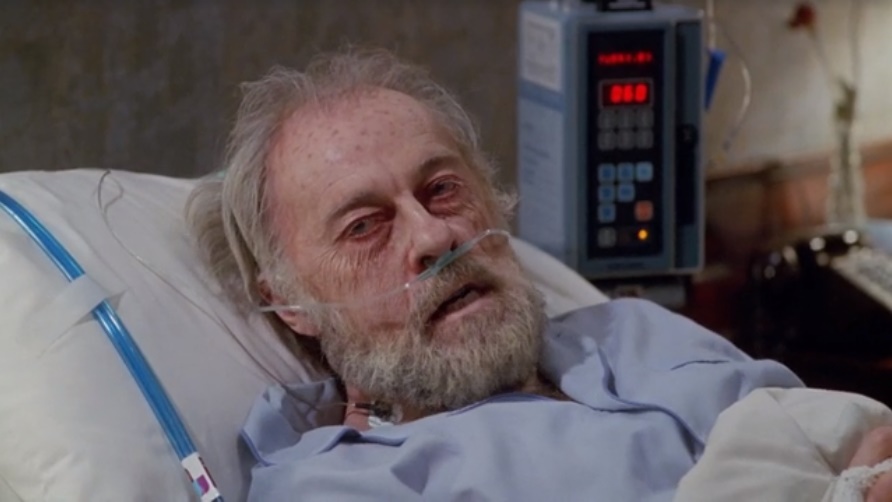


A wrench is thrown into the scheming duo's master plan when Ernest dies before they're able to get his signature to receive the bulk of his money. Instead of reporting his death, Robert hatches a plan to hide his corpse in a freezer in the basement and pretend like he's still alive long enough to have Jessica forge the remaining documents herself. However, because Ernest was in a hypnotic state when he passed, he's become trapped in a limbo between our world and the next. While his corpse lies frozen solid, he's still able to continue communicating and, wherever he's now speaking from, it's dark, cold and "there are others..."
Albeit visually unimpressive and routine / predictable at points, this certainly isn't bad from a technical standpoint. Romero both works in some of his trademark social commentary ("Sick stuff always turns out to be rich people") and does a fair job of extending the short story by adding the conspiring-against-the-corpse angle to the works. Most of the highlights are quite subtle, so I'm not surprised many critics and viewers have completely overlooked them. Take the character Barbeau plays for instance. What probably would have been a one dimensional gold-digger role in another filmmaker's hands is more fleshed out than is the norm here thanks to both the script and Barbeau's performance. We're given enough information (working class background, abusive husband, upper class "polite society" never accepting someone with her background into their ranks...) to make both her motivations and her cold, hard exterior (used to mask her insecurities) all make sense.
Romero had originally wanted to update "The Masque of the Red Death" to comment upon the AIDS crisis and growing wealth disparity in Reagan-era America, which honestly sounds much more interesting than what we get here, but his concept was reportedly rejected by Argento (the executive producer of both segments) so he settled for this instead. Minor roles are played by Tom Atkins, who shows up near the end as a police inspector, Romero's then-wife Christine Forrest as a nurse and Antone Di Leo Jr. (Day of the Dead) as a taxi driver. The same story had previously been filmed, actually a fair sight better if I'm to be honest, by Roger Corman for his anthology TALES OF TERROR (1963), which starred Vincent Price and Basil Rathbone.


As we swing into Argento's take on "The Black Cat," we're immediately greeted with gore (body parts strewn about), full frontal nudity (a bisected nude female body), Poe references (the victim was killed with a razor-sharp pendulum), Argento's usual weird camera shots (from the POV of a swinging pendulum) and dreary narration talking about depravity and perversity. The near 180 degree change in approach from Romero's slow-moving, steady-handed, routinely filmed and comparatively classy segment to this is quite jarring! We open at a bloody crime scene where Detective Legrand (John Amos) and his men examine the carnage and photographer Rod Usher (Harvey Keitel) is busy snapping away at the grisly findings, completely unfazed by what surrounds him. Usher, who does not work for the police, actually makes his living publishing photographs of mangled and dismembered corpses taken at murder scenes. Is that even legal?
Usher's latest book, "Metropolitan Horrors," stirs up a lot of controversy, but his relationship with a pouty, much-younger violin teacher named Annabel (Madeleine Potter) is crumbling because of his alcoholism and cruel and controlling ways. When Annabel brings home a black cat that she refuses to divulge the name of, the animal is immediately and rightfully leery of Usher and hisses at his mere presence. Rod responds to that by murdering the cat and taking photos of him torturing and killing it, putting said photos into another of his morbid books.
This all makes for quite an interesting contrast to how the central evildoer was handled in Romero's segment. While Jessica has reservations and moral qualms to work through, and a backstory to work off of, we know absolutely nothing about Rod aside from the fact he's an unpleasant degenerate with sociopathic tendencies. That doesn't enable Keitel to modulate his performance nor provide much nuance and, despite him garnering rave reviews from some fans, he seems completely lost here to me. What he does get to do is suck down about a quart of tequila shot-by-shot over the course of the film, scream and curse a lot and provide the occasional stilted and / or unintentionally funny line read. It's a memorable performance in a strange way, just how he's overwrought one minute and flat the next, but I wouldn't necessarily call it a good one.


Annabel strongly suspects Rod has killed her beloved pet, but he denies it ("It's a fuckin' cat! Meow! Meow! A cat!") and slaps her for accusing him. He then has a weird dream where he's swept back to Medieval times and gets executed (dropped on a sharpened spear that goes through his crotch and out his mouth to be precise!) for killing the feline. He runs into a black cat with the same exact distinct markings while at a bar, which the extremely strange-acting barmaid, Eleonora (Sally Kirkland), lets him take home. He attempts to kill it again, but Annabel interrupts and the two gets into a fight, which ends with him chopping her up with a cleaver. Instead of trying to dispose of the body elsewhere, he puts it in an upstairs closet, builds a wall in front of it and puts a bookshelf in front of that.
Paranoia soon sets in as the phone keeps ringing and Annabel's favorite student Christian (Holter Ford Graham), his elderly neighbors (Martin Balsam and Kim Hunter) and others show up looking for her. Not everyone is willing to buy his excuse that she went on a long concert tour either. As for the black cat that's already been killed a time or two, it shows up yet again in the home, only this time clawing its way through the wall from inside the hidden room housing Annabel's corpse. Though it's chopped in half with a saw, the cat leaves a secret behind that leads to Rod's undoing.


While Romero's segment has a more linear and coherent script, better characterizations and better performances, Argento's certainly has more visual flair, fluid camerawork and panache. Instead of going for a gloomy Poe-esque mood, he's content generally following the primary events of the covered short story and then scattering references to numerous other Poe works throughout the rest. There are not only nods to Cat, Pit and Usher but also The Premature Burial, Berenice, Annabel Lee and more. The best moment here is a protracted suspense scene near the end when Amos' detective and his partner (James MacDonald) show up at Rod's home and, through a series of minor incidents that prolong their visit, are around long enough to hear strange noises coming from upstairs.

Usually listed as a U.S. / Italian co-production, this was filmed entirely in and around Pittsburgh by a mostly American crew and features mostly American actors, though the two production companies who bankrolled it and all of the credited producers (including Claudio Argento) are Italian. Tom Savini was in charge of the typically solid make-up fx and appears in a brief cameo in Argento's segment. Pino Donaggio provided the scores for both segments, which are so different you'd never even guess that the same guy did both!


I can't say for sure how well Eyes did during its theatrical run in Italy, but it was a box office flop here in America when it was dumped into 150 theaters in 1991 and didn't even gross half a million dollars. However, the film likely made up for that with a strong global push on the home video market. I've found releases from nearly every corner of the globe.
After numerous DVD releases from Anchor Bay and other companies, Blue Underground finally gave it the Blu-ray treatment in 2009. Their 2 disc set comes with the 30-minute documentary Two Masters' Eyes (2003) which features interviews with Romero, Savini and a troika of Argento's; Dario, Claudio and Asia (who dubbed some of the characters in the Italian-language version). There are additional featurettes with Savini, as well as a brief separate interview with Barbeau that was originally intended for Roy Frumkes' 1989 Romero documentary Document of the Dead, which also touches on this production.
★★1/2


