.
.
.
Showing posts with label anthology. Show all posts

Sunday, April 2, 2023

Meiji · Taishô · Shôwa: Ryôki onna hanzai-shi (1969)

... aka: 明治・大正・昭和 猟奇女犯罪史
... aka: Criminal History of Bizarre Women
... aka: History of Bizarre Crimes by Women in the Meiji, Taisho and Showa Eras
... aka: Love and Crime
... aka: Meiji, Taisho, and Showa Eras: Grotesque Cases of Cruelty by Woman

Directed by:
Teruo Ishii

True crime and "poison woman" films featuring treacherous and usually murderous femme fatales were very popular in Japan at the time so why not combine both? That's precisely what we have here with this particular production, which was actually a rather ingenuous concoction for its time. What better way to get asses into theater seats than the promise of gory, titillating and lurid reenactments of famous crimes? Interesting too is that this is an anthology film featuring four separate tales along with a framing story, which makes it one of the earliest omnibus-style films to tackle multiple true crime stories. A similar concept was later employed by Hong Kong's Shaw Brothers for their five part Criminals series in the late 70s and, of course, these can be seen as precursors to any true crime TV show featuring reenactments. Also making this unique is that the director sought out, and actually got an interview with, one of the reclusive subjects, who gets to tell her side of her own story as a dramatization of it plays out.

At the Tokyo Forensic Institute, police forensics examiner Dr. Murase (Teruo Yoshida) gets the surprise of his life when the latest corpse to show up on his slab is Yukiko - his wife! After performing the gory autopsy over the opening credits, Murase discovers Yukiko had sex prior to committing suicide... and it clearly wasn't with him. Hoping to gain some insight into what may have happened, he gathers together old criminal case files involving female murderers, and these are what comprise the bulk of the running time. The film sporadically returns to Murase and he also narrates portions of the stories.


First up is "Toyokaku Inn Case," which is based on a 1961 incident that led to the first woman being sentenced to death in Japan after the war. Chiyu Saito (Mitsuko Aoi) owns a hotel with her husband, Kosuke (Kenjirô Ishiyama), whom she suspects is having an affair since he disappears so frequently. She's correct in her assumption. Hubby has grown sick of, in his own words, his "old hag of a wife" and has been sleeping with a beautiful younger woman instead. Chiyu has been voicing her suspicions about his adultery to her assistant, Kinue Munakata (Rika Fujie), all this time, as well as relaying her future plans for the hotel; namely her plans on selling it and opening up a brothel instead.

Unbeknownst to Chiyu, her friend and confidant Kinue is her husband's secret mistress and she's been using some of the things Chiyu has told her to further drive a wedge between the couple. While Kosuke is planning on leaving his wife and kicking her out, Kinue suggests they murder her instead. In fact, she promises to help him. With help from gigolo Shibuya (Takashi Fujiki), Kinue does the deed and then the two reveal to Kosuke that they are lovers. Blackmailing the new widower, they're able to get their hands on some money to build an expansion onto the hotel. As the business increases in value, the cold-blooded Kinue decides she wants it all to herself, leading to several more murders.

Though a full length expansion on this case would no doubt be a lot more interesting (same can be said for all of the other featured stories), there's plenty to keep one's interest here, including lots of nudity, sex, sex right next to a decomposing body, a topless cat fight, a poisoning, a bloody axe murder and a maggoty corpse plastered up behind a wall. There's quite a lot packed into just 20 minutes!


In 1936, Sada Abe, a former prostitute then employed as a restaurant apprentice, strangled her married boss / lover to death in bed during an erotic asphyxiation session. She then carved her name on his arm, removed his genitals and carried them around with her for days until she was tracked down and arrested by the police. A nationwide media circus and trial followed, and she was eventually convicted of murder and mutilation of a corpse and sentenced to ten years in prison. After serving six, she was released and capitalized on the public's interest by penning an autobiography and appearing in a one woman stage show. She then was able to blend back into society using an alias and lived out the remainder of her days mostly in anonymity, becoming the subject of many best-selling books and popular movies along the way.

"Sada Abe Incident" features a multiple flashback structure and very scrambled time frame, cutting between a courtroom scene where a pitiable Sada (Yukie Kagawa) recounts her bizarre tale and a series of flashbacks showing her at various stages in her life. She became an out-of-control teen after being raped, was sent to a geisha house to work as a servant at age 16 by her father, where she was raped yet again by a sweaty old pervert (who was nice enough to at least get his wife's permission first), and then became a sex worker being used and discarded by various men while she herself used and discarded various men. Hey, it's a dog eat dog world out there.

We also get reenactments of her intense relationship with restaurant owner Kichizo Ishisa (Eiji Wakasugi), the man she'd later murder, as well as the murder itself ("No one will touch him anymore!"), which isn't as grisly as it could have been all things considered. In its brief time, this segment does both a good job relaying the main facts in the case as well as capturing the insane passion shared by the couple prior to the murder, which began with nonstop sex marathons lasting days before descending into kinkier stuff. That's followed by several vignettes of other disgruntled women, perhaps "inspired" by Abe, who remove their lover's junk with scissors.

This segment is especially noteworthy in that the director managed to track Abe herself down and has the Dr. Murase character conduct a brief interview with her (shot on a bridge from across a busy road), which is edited in with the other footage. In her interview, Abe claims her lover wanted to die, asked her to kill him and died happy, insists she did nothing wrong, doesn't understand the public's fascination with her and says that we only fall in love - truly fall in love - with a single person in our entire life and Kichizo was that person to her. Abe disappeared shortly after filming this interview and her whereabouts remained unknown, though it's reported that she passed away sometime in the early to mid 70s.

While I believe this is the first film to tackle Abe's story, it's also one of the least watched. The Nikkatsu production A Woman Called Sada Abe (1975) and the infamous In the Realm of the Senses (1976) are both much better known and more popular. The latter, directed by Nagisa Ôshima, became a notorious, oft-banned film due to its inclusion of explicit sex, and was an art house hit around much of the world upon release. There were numerous later Abe films as well, including ones produced in 1998, 1999 and 2011, as well as a French-produced documentary about her in 2017.


Next, in an ill-conceived break from the female-centered murderers, we take a look at a male one: little-known Japanese serial killer Yoshio Kodaira. After having served in the Japanese military, where he reportedly engaged in various war crimes (including raping and murdering Chinese civilians), Kodaira returned to Japan, where he raped and murdered at least seven women between 1946 and 1947, and also engaged in necrophilia with some of the corpses. The victims were mostly impoverished young women who were lured into the woods with promises of jobs / food. After his apprehension and trial, Kodaira was sentenced to death and was hanged in 1949.

As this segment opens, a sweaty and grotesque Kodaira (Asao Koike) has already been apprehended and is recounting his crimes to police during his interrogation. His first murder occurs at a military factory in Kanto, where he uses a bombing as an opportunity to get a young woman alone, then rips off her clothes and strangles her to death. Next up is a starving woman he lures into the country and yanks into the woods. To try to avoid being killed, she offers herself up to him willingly, but he strangles her until she passes out and has sex with her unconscious body. When she wakes up and wants to leave, he kills her and goes in for round two. A third victim is also shown being killed during a rainstorm.

After a steady stream of brief murders, the next is shown in greater detail as Kodaira befriends and grooms a poor, fatherless teen named Ryuko (Yumiko Katayama). He gives her food, promises her work and even goes home with her to meet her mother but, despite developing a relationship with her over the course of a few months, she's eventually lured into the woods and beaten, raped and killed just like any other random victim. This murder was to be his ultimate undoing, as Ryuko's mother knew his identity and was able to report him to the police.

Stylistically, this is perfectly fine. Ishii shot it in grainy black-and-white; an apt choice to make this resemble b/w newsreel footage indicative of the WWII era, some of which is also edited into the segment. This also sticks fairly close to the real case, though it's too short to cover all of the crimes and a few other details, namely Kodaira's first victim actually being his father-in-law over a decade earlier, have been altered. With that said, thematically this feels sorely out of place. Despite the narrator's silly attempt to find a connection between it and the other stories ("Do women's bodies turn men into madmen?"), this doesn't really have any business being in a film about murderous women.


Finally, we return to the killer female theme in a segment set during the mid-19th century that covers murderess Takahashi Oden, who was the last woman in Japan to be executed by beheading. Against her wishes, Oden (Teruko Yumi) is set up in an arranged marriage to Naminosuke (Shin'ichirô Hayashi), whom she doesn't love. To make matters worse, her new husband is struck down with leprosy and becomes hideously deformed. Despite that, he can't keep his hands off of his beautiful bride and keeps forcing himself on her. She eventually takes on another lover, a criminal named Tomekichi, who murders Naminosuke after he catches the two of them together.

The lovers then flee to the city where Tomekicki continues on in his criminal ways and sells Oden to a brothel. There, she meets another man and plots to run off with him. A series of murders and betrayals follow until Oden is finally captured and beheaded. There are some very gruesome moments in this one plus a generous helping of nudity from the lead but it tries to cover too much ground in too little time (just 10 minutes!) so we never can get a handle on any of the characters. A feature length version of this same story had been filmed back in 1958 as Dokufu Takahashi Oden (titled Wicked Woman in English) by Nobuo Nakagawa, and would be retold yet again in the 1983 softcore film Koyamu / Crimson Night Dream.


While this certainly has its problems with pacing and the script, as 99% of all anthologies do, good production values, competent acting, some clever directorial and aesthetic choices, nearly nonstop sex and violence and plentiful eye candy provided by at least a dozen gorgeous Japanese actresses keep things highly entertaining throughout. If you're wanting more in-depth versions of any of the true stories, you can always check out one of the other film versions or, better yet, read up on them. However, if you can accept this on its own terms, as being the exploitation film it clearly is intended to be, it delivers in spades for its target audience.


Unlike with many of the director's other films, I couldn't find evidence this was ever officially released outside of its home country. Toei gave it at least one VHS and one DVD release in Japan, which are the only releases that I'm aware of.

Saturday, March 11, 2023

Due occhi diabolici (1990)

... aka: Oczy szatana (Satan's Eyes)
... aka: Pahan silmät (Evil Eyes)
... aka: Two Evil Eyes

Directed by:
Dario Argento
George A. Romero

Originally conceived as an four-part anthology of Edgar Allan Poe adaptations with short segments to be directed by Argento, Romero, John Carpenter and Wes Craven (Stephen King was also considered), this instead ended up as a two-parter with segments from just Romero, who directed and co-wrote the first story, "The Facts in the Case of Mr. Valdemar", and Argento, who directed and co-wrote (with frequent collaborator Franco Ferrini) the second story, "The Black Cat." While it would have been interesting to see what Carpenter and Craven's contributions would have looked like (neither had done a Poe film before), it's also cool that whittling this down to just two segments that run nearly an hour apiece gives us essentially two features for the price of one. Not that the results here are flawless by any means, or anywhere near either director's best work, but there's still plenty of interest here for fans of both.

Revisiting this for the first time since my teen years, back when I much preferred Argento's segment, I've had a change of opinion now that I've looked at this again through adult eyes. Unsurprisingly, Argento's segment is much more bizarre, exploitative, flashy, attention-grabbing and visually creative and thus obviously would have appealed more to the instant gratification seeking teenager I used to be. However, it needs to be said that Romero is trying for something completely different with his take, something much more measured, moody and with reverence to both the tone and style of the source material. The brevity of most of Poe's classic stories didn't allow for much plot complication and most were structured as a steady atmospheric build toward a final shocking moment. That's similar to how Romero has approached this job, with respect for Poe's writing style, as opposed to Argento, who opted to stick to his signature directorial style. Both offer up imperfect visions with rewarding moments done in two completely different ways so it's impossible for me to say one is "better" than the other.


"The Facts in the Case..." opens with Jessica Valdemar (Adrienne Barbeau) paying a visit to family lawyer Steven Pike (E.G. Marshall) to liquidate a large portion of her dying husband's stocks. It would appear that the elderly husband, Ernest (Bingo O'Malley), who has just three to six weeks left to live, wants to make sure his much-younger wife is well taken care of in his absence. As for her feelings, she rather bluntly points out, "I was a flight attendant that Ernie brought home off the Red Eye to the shock and dismay of you and everyone else in this town. I married a rich old man. I let him use me for pleasure and for show. Now I'm going to let him pay me for my services." Jessica wants her payment for services rendered in the form of large sums of cash and doesn't want to wait the eighteen months to two years it would take to settle the estate. She not only has the signed paperwork to prove her husband's intent but she even puts her husband on the phone to have him personally ensure it's what he wants. Though suspicious, Pike prepares the paperwork as instructed.

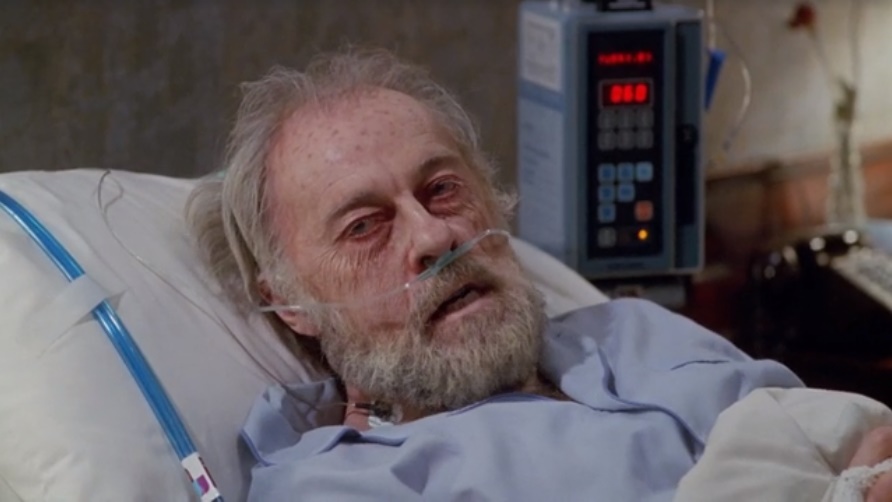
Naturally, all is not what it appears to be. While Ernest is indeed on his deathbed, he's being kept in a state of hypnosis by Dr. Robert Hoffman (Ramy Zada). Using a pyramid-shaped electronic metronome and voice commands, he's able to control what his subject says and what he does, including making him sign important documents he'd otherwise not be signing. When out of the trance, Ernest is in such excruciating pain that all he can do is curse, scream and denigrate his wife, though apparently he wasn't a kind and decent man even in good health. Hoffman turns out to be Jessica's former lover who now wants to rekindle things. Though the two are conspiring to gain complete control over Ernest's estate, Jessica's still not completely sold on getting back together with Robert on a permanent basis. Both have their doubts about how trustworthy their partner in crime may, or may not, be.


A wrench is thrown into the scheming duo's master plan when Ernest dies before they're able to get his signature to receive the bulk of his money. Instead of reporting his death, Robert hatches a plan to hide his corpse in a freezer in the basement and pretend like he's still alive long enough to have Jessica forge the remaining documents herself. However, because Ernest was in a hypnotic state when he passed, he's become trapped in a limbo between our world and the next. While his corpse lies frozen solid, he's still able to continue communicating and, wherever he's now speaking from, it's dark, cold and "there are others..."

Albeit visually unimpressive and routine / predictable at points, this certainly isn't bad from a technical standpoint. Romero both works in some of his trademark social commentary ("Sick stuff always turns out to be rich people") and does a fair job of extending the short story by adding the conspiring-against-the-corpse angle to the works. Most of the highlights are quite subtle, so I'm not surprised many critics and viewers have completely overlooked them. Take the character Barbeau plays for instance. What probably would have been a one dimensional gold-digger role in another filmmaker's hands is more fleshed out than is the norm here thanks to both the script and Barbeau's performance. We're given enough information (working class background, abusive husband, upper class "polite society" never accepting someone with her background into their ranks...) to make both her motivations and her cold, hard exterior (used to mask her insecurities) all make sense.

Romero had originally wanted to update "The Masque of the Red Death" to comment upon the AIDS crisis and growing wealth disparity in Reagan-era America, which honestly sounds much more interesting than what we get here, but his concept was reportedly rejected by Argento (the executive producer of both segments) so he settled for this instead. Minor roles are played by Tom Atkins, who shows up near the end as a police inspector, Romero's then-wife Christine Forrest as a nurse and Antone Di Leo Jr. (Day of the Dead) as a taxi driver. The same story had previously been filmed, actually a fair sight better if I'm to be honest, by Roger Corman for his anthology TALES OF TERROR (1963), which starred Vincent Price and Basil Rathbone.


As we swing into Argento's take on "The Black Cat," we're immediately greeted with gore (body parts strewn about), full frontal nudity (a bisected nude female body), Poe references (the victim was killed with a razor-sharp pendulum), Argento's usual weird camera shots (from the POV of a swinging pendulum) and dreary narration talking about depravity and perversity. The near 180 degree change in approach from Romero's slow-moving, steady-handed, routinely filmed and comparatively classy segment to this is quite jarring! We open at a bloody crime scene where Detective Legrand (John Amos) and his men examine the carnage and photographer Rod Usher (Harvey Keitel) is busy snapping away at the grisly findings, completely unfazed by what surrounds him. Usher, who does not work for the police, actually makes his living publishing photographs of mangled and dismembered corpses taken at murder scenes. Is that even legal?

Usher's latest book, "Metropolitan Horrors," stirs up a lot of controversy, but his relationship with a pouty, much-younger violin teacher named Annabel (Madeleine Potter) is crumbling because of his alcoholism and cruel and controlling ways. When Annabel brings home a black cat that she refuses to divulge the name of, the animal is immediately and rightfully leery of Usher and hisses at his mere presence. Rod responds to that by murdering the cat and taking photos of him torturing and killing it, putting said photos into another of his morbid books. 

This all makes for quite an interesting contrast to how the central evildoer was handled in Romero's segment. While Jessica has reservations and moral qualms to work through, and a backstory to work off of, we know absolutely nothing about Rod aside from the fact he's an unpleasant degenerate with sociopathic tendencies. That doesn't enable Keitel to modulate his performance nor provide much nuance and, despite him garnering rave reviews from some fans, he seems completely lost here to me. What he does get to do is suck down about a quart of tequila shot-by-shot over the course of the film, scream and curse a lot and provide the occasional stilted and / or unintentionally funny line read. It's a memorable performance in a strange way, just how he's overwrought one minute and flat the next, but I wouldn't necessarily call it a good one.


Annabel strongly suspects Rod has killed her beloved pet, but he denies it ("It's a fuckin' cat! Meow! Meow! A cat!") and slaps her for accusing him. He then has a weird dream where he's swept back to Medieval times and gets executed (dropped on a sharpened spear that goes through his crotch and out his mouth to be precise!) for killing the feline. He runs into a black cat with the same exact distinct markings while at a bar, which the extremely strange-acting barmaid, Eleonora (Sally Kirkland), lets him take home. He attempts to kill it again, but Annabel interrupts and the two gets into a fight, which ends with him chopping her up with a cleaver. Instead of trying to dispose of the body elsewhere, he puts it in an upstairs closet, builds a wall in front of it and puts a bookshelf in front of that.

Paranoia soon sets in as the phone keeps ringing and Annabel's favorite student Christian (Holter Ford Graham), his elderly neighbors (Martin Balsam and Kim Hunter) and others show up looking for her. Not everyone is willing to buy his excuse that she went on a long concert tour either. As for the black cat that's already been killed a time or two, it shows up yet again in the home, only this time clawing its way through the wall from inside the hidden room housing Annabel's corpse. Though it's chopped in half with a saw, the cat leaves a secret behind that leads to Rod's undoing.


While Romero's segment has a more linear and coherent script, better characterizations and better performances, Argento's certainly has more visual flair, fluid camerawork and panache. Instead of going for a gloomy Poe-esque mood, he's content generally following the primary events of the covered short story and then scattering references to numerous other Poe works throughout the rest. There are not only nods to Cat, Pit and Usher but also The Premature Burial, Berenice, Annabel Lee and more. The best moment here is a protracted suspense scene near the end when Amos' detective and his partner (James MacDonald) show up at Rod's home and, through a series of minor incidents that prolong their visit, are around long enough to hear strange noises coming from upstairs.


Usually listed as a U.S. / Italian co-production, this was filmed entirely in and around Pittsburgh by a mostly American crew and features mostly American actors, though the two production companies who bankrolled it and all of the credited producers (including Claudio Argento) are Italian. Tom Savini was in charge of the typically solid make-up fx and appears in a brief cameo in Argento's segment. Pino Donaggio provided the scores for both segments, which are so different you'd never even guess that the same guy did both!


I can't say for sure how well Eyes did during its theatrical run in Italy, but it was a box office flop here in America when it was dumped into 150 theaters in 1991 and didn't even gross half a million dollars. However, the film likely made up for that with a strong global push on the home video market. I've found releases from nearly every corner of the globe.

After numerous DVD releases from Anchor Bay and other companies, Blue Underground finally gave it the Blu-ray treatment in 2009. Their 2 disc set comes with the 30-minute documentary Two Masters' Eyes (2003) which features interviews with Romero, Savini and a troika of Argento's; Dario, Claudio and Asia (who dubbed some of the characters in the Italian-language version). There are additional featurettes with Savini, as well as a brief separate interview with Barbeau that was originally intended for Roy Frumkes' 1989 Romero documentary Document of the Dead, which also touches on this production.

1/2
Related Posts Plugin for WordPress, Blogger...