

... aka: Halloween: Die Nacht des Grauens (Halloween: The Night of Horrors)
... aka: John Carpenter's Halloween
... aka: La noche de Halloween (Halloween Night)
... aka: Maskernes nat (Night of the Masks)
Directed by:
John Carpenter
I frequently get emails playfully chastising me for slacking in my coverage of some of the most famous genre films of all time here. How in the hell can you not have a review for Jaws up? Why haven't you done a real review for Invasion of the Body Snatchers or An American Werewolf in London or The Evil Dead or Psycho yet? And while I agree with everyone who's ever called me out on this, I do have an explanation: I've never been in a big hurry to cover famous genre films from this time period simply because they've been so well-covered everywhere else. I instead opted to concentrate mostly on obscure movies; namely those with little (sometime no) online representation. Now that doesn't mean there will never be reviews for the classics and better-known films here. My plans were always to occasionally fall back and cover them, just not make that the primary focus. After all, there's no dearth of literature out there on, say, Hitchcock's The Birds. There's also no shortage of write-ups and reviews for Halloween; one of the most famous, most discussed, most analyzed and most beloved genre movies of all time. I just didn't want to let another All Hallow's Eve pass by without giving this one its due, especially since it's probably one of the five most cross-referenced films around here. I suppose there's no better place to start than with the basics...

Halloween is entirely deserving of its place as an iconic film and pop culture phenomenon, as well as its place in history as one of the great classic horror movies. It's that rare, modestly-budgeted film that gets to share a table with the original NIGHT OF THE LIVING DEAD (1968) and The Texas Chainsaw Massacre (1974); films that are so effective and well-crafted, and proved to be so influential over the years, that they managed to reshape and redefine the entire genre for years to come. Fans have never allowed Halloween to simply fade away and its popularity has endured throughout the decades. It was a huge theatrical hit upon release with its domestic gross of 47 million on a 300,000 budget, making it one of the most profitable independent productions of all time. It then became a top-selling VHS release, video rental favorite and seasonal TV staple in the 80s and 90s. And it now is one of the top streamed genre films, especially at this time of year. As of this writing, it's currently one of the Top 5 most searched horror films on IMDb... out of nearly 170,000 titles. Not bad for a movie that's now over 40 years old!
Just what is the key to the film's success and longevity, and its timelessness that seems to know no generational bounds? Well, that's impossible to really pin down to just one thing. The plot (escaped lunatic who murdered his sister as a child returns to his hometown fifteen years later, gets a mask and begins a new killing spree) barely even merits mention, but a film that's executed as well as this one doesn't need an intricate plot. In fact, that would have merely gotten in the way, as we'd see later with a spate of far-less-successful sequels attempting to expound upon the Michael Myers character.




The first plaudit surely needs to go to Carpenter's brilliantly simple piano / synth score, which was composed in just three days with assist from Dan Wyman and has become one of the film's most notable attributes. I was just at a horror-themed night at an amusement park last weekend and heard Carpenter's music countless times while I was there. Just like with the Jaws theme, everyone - regardless of age - knows this score. Just as you can't go to the beach or hop in the ocean without someone jokingly humming the Jaws theme, you won't attend many Halloween functions where the Halloween theme isn't played. Just as notable here is the smooth, gliding Steadicam work from Dean Cundey, eerily prowling around suburbia as the killer stalks his next victim, which is just as crucial to establishing the mood.
Another aspect that helps this withstand the weathering of time is its downright perfect evocation of the Autumnal / Halloween season. Despite being a suspenseful, scary film, there's still a pleasing, nostalgic feel to the whole thing... Cold wind blowing the leaves down vacant streets, laughing trick-or-treaters shuffling from door to door, Jack-O-Lanterns lining porches, THE THING FROM ANOTHER WORLD playing on TV... It not only brings to mind everything that's great about this time or year, but also everything that's great about horror film atmosphere when it's done correctly.


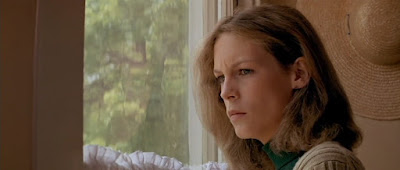


Really excellent use is made of widescreen Panavision, especially the foreground and background in the shot compositions. Some of the spookiest images here are the quietest ones, with the blank-faced killer standing solemnly and silently off in the distance watching. And waiting. We never know what makes him tick or even what drives him to kill. Keeping the character's psychology and history shrouded in mystery turns out to be another big plus, as is the decision to keep the potential supernatural elements surrounding the killer muted. Carpenter and his co-writer Debra Hill (also a producer) wisely opted to present Myers as an abstract, enigmatic boogeyman; a pure distillation of evil.

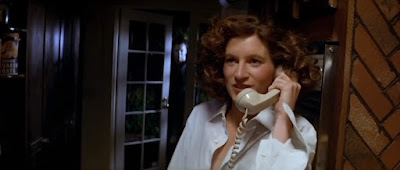


We also have a star making turn for 19-year-old Jamie Lee Curtis in her film debut as heroine Laurie Strode. What struck me as interesting in this re-watch is that Laurie isn't exactly the impossibly chaste final girl trope she's often made out to be. While she is more studious, mature and responsible than her peers (and likely still a virgin), she also smokes weed and shows an interest in boys and sex. Her comparably virtuous nature isn't by choice, but due to the fact she's awkward, shy and, as she puts it, "too smart." There's a nice little hidden gem moment tucked away in here where Laurie and her more outgoing and brash friend Annie (Nancy Loomis) are cruising around town headed toward their babysitting jobs right as the sun is setting that gives us a little insight into Laurie's lack of self-esteem and vulnerability which instantly gets us in her corner for the remainder of the film.
Curtis would, of course, use this film as a springboard to launch a successful career. After this, the 1981 sequel and four other genre films in rapid succession, she grew tired of the typecasting and mostly sought out projects in other genres for the remainder of the decade and throughout most of the 90s. However, she has wisely kept Halloween in her back pocket and continued to use her association with this series to sustain any career lulls she's come across. In the late 90s, after the success of Scream, she returned for Halloween H20 (1998), which was also a big box office hit. Twenty years later, she was back again for Halloween (2018), a direct follow-up to the original which was also a huge money-maker and broke a number of box office records, including having the highest opening weekend for a film with a female lead over 55. The latest franchise installment, Halloween Kills, which is in theaters as we speak and seems headed to a 100 million domestic gross. Just like the boogeyman, this is a property that simply refuses to die. Unfortunately, none of the sequels, nor the endless imitators that followed, were quite able to recapture the deceptively simple magic found here.


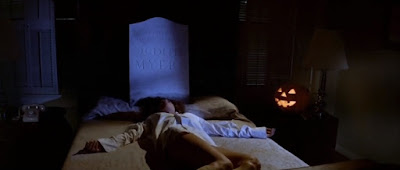

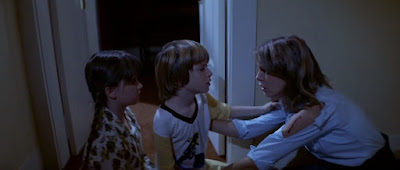


Donald Pleasence also memorably contributes as intense psychiatrist Dr. Sam Loomis, who has "spent eight years trying to reach him, and then another seven trying to keep him locked up." The film became an unlikely signature role for the veteran British character actor... and a role he almost didn't even get as both Peter Cushing and Christopher Lee previously passed on it. The cast also includes Charles Cyphers as the Sheriff Leigh Brackett, P. J. Soles as vapid ("Totally!") cheerleader friend Lynda, future Real Housewives reality TV star Kyle Richards as babysitting charge Lindsay, Nancy Stephens as a nurse and Playboy Playmate Sandy Johnson as Michael's sister in the memorable opening scene. Most of these actors would subsequently appear in later Halloween films.
Myers is played by a number of different actors, though predominately by future director Nick Castle. In his unmasked form, he's briefly played by Tony Moran, brother of Happy Days star Erin. Another notable future director, Tommy Lee Wallace (who went on to make the unrelated third Halloween film), served as an editor and production designer. In 2018, Robert Englund revealed that he also spent a single day on the set helping to make Southern California in the Spring look like the fictional Midwestern town of Haddonfield, Illinois in the Fall by helping to throw dead leaves around!


In 1981, Carpenter returned to direct brand new scenes for a TV-friendly version. This footage, roughly 11 minutes worth of dialogue, was used to replace some of the more violent content in the original. Pleasence, Curtis, Loomis and Soles all returned to reprise their roles and a few new actors (including Jennifer Rhodes) were brought in for smaller parts. In addition to spawning a ton of sequels, a remake, a sequel to the remake and a whole slew of unofficial fan films, there was a novelization, a comic book adaptation, a 1983 Atari video game and seemingly endless documentaries dedicated either solely to this original film or the entire series. Halloween has received many accolades over the years, culminating with it being inducted into the National Film Registry in 2006.
★★★★


