.
.
.

Saturday, February 25, 2012

Horror of Frankenstein, The (1970)

Directed by:
Jimmy Sangster


After a decade-and-a-half run of successful costume horrors usually featuring more mature protagonists, Hammer decided to start specifically catering some of their output toward a younger audience with stories centered around more youthful protagonists. So no, Peter Cushing (who headlined all of Hammer's previous Frankenstein films) wasn't invited to this particular party. Instead we get Ralph Bates in the central mad doctor role. Bates had just made an impression playing the dashing, aristocratic black magic practitioner who helped to resurrect the Count in TASTE THE BLOOD OF DRACULA (1969) and, while no spring chicken here at 30 years old, adequately fills the role of an evil, unfeeling medical school student. His Victor is a brilliant, smarmy sociopath with a truly pompous attitude who always seems to be pissing someone off. He kills indiscriminately: If you get in his way, you're toast and that's that. When Victor's rich father, who's carrying on an affair with the underage housemaid, Alys (Kate O'Mara), refuses to spring for him to go to a more prestigious university, Victor simply rigs his hunting rifle to explode and kill him.


Now with the title of Baron, a huge castle and a considerable amount of money all at his disposal, Victor decides to go to Vienna to further his studies. During his time there, he manages to knock up the dean's daughter, but tells him not to worry: Now that he has medical training, he'll just give her an abortion. The dean refuses and says he'll arrange for the two to be married. Victor decides to flee for the summer instead, with no real intentions of going back, and invites his classmate Wilhelm (Graham James) to come along with him to aid in his experiments. Away from town six years, Victor is promptly reunited with several former classmates. One of them, the sweet Elizabeth Heiss (Veronica Carlson, a real stunner), is still in love with Victor after all these years and has denied many potential suitors awaiting his return. Too bad for her, but he could care less and never has really liked her, anyway. He much prefers his no-strings-attached arrangement with Alys, who's still working as housekeeper in the castle and promptly becomes his lover.


After successfully reviving a dead turtle, Victor arranges for a sleazy grave robber (Dennis Price) and his wife to provide him with fresh body parts so that he can construct a human. The grave robber is able to acquire six whole bodies after an avalanche and when Wilhelm questions the ethics of all this and threatens to report Victor to the authorities, he's promptly electrocuted to provide even more parts. Now needing a brain, Victor poisons Elizabeth's professor father (Bernard Archard). Because of his debt, Elizabeth loses her home and is forced to come stay in Castle Frankenstein, where Victor plans to make her the new maid and decides to rid himself of Alys when she attempts to blackmail him. After stitching it all together, Victor's human creation (muscleman David Prowse) is revived by thunder. It immediately escapes and chops a villager up with an axe. Victor feeds it raw meat, attempts to teach it basic skills like sitting down and obeying his orders and is eventually able to make it kill for him. The obligatory police detective (Jon Finch), another of Victor's childhood friends, is on to him, though. Much use is made of an acid pit - convenient for eliminating evidence - in the meantime.


Director Sangster, who's better known as a script writer (and co-wrote this one as well), fails to inject much life into this entry, visually or otherwise. Perhaps strangest of all is his inability to really make good use of the lavish costumes, props and sets which were clearly at the studio's disposal. Some of the more talented of Hammer's production people seemed to be on hiatus when this was made, as the photography and music score - while competent - are also a bit lackluster. As scripted, the young mad scientist in this outing seems a bit one-dimensional, as well. The main problem however lies in the pacing. Because over an hour is spent leading up to the monster's creation, the concluding scenes seem rushed, leading up to a truly pathetic and anti-climactic final scene.


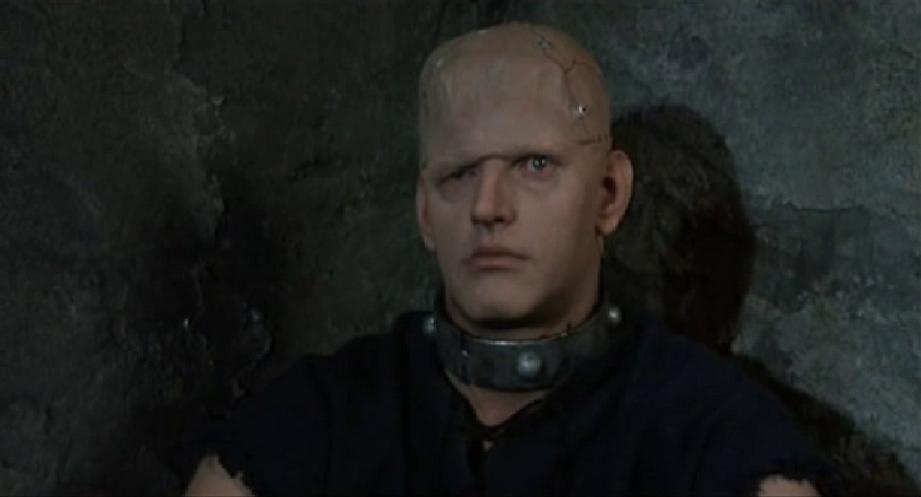

On the plus side, O'Mara manages to bring some real verve to her supporting role (which is very much appreciated, especially considering how bland most of the rest of the cast is) and veteran actor Price seems to be having a ball in his small role and has the film's most amusing scene sitting in a cemetery eating sausage and crackers while making his pregnant wife dig up a grave for him! The film provides some effective black comedy here and there (as well as some rather juvenile moments), and the monster design is pretty good. Mr. Prowse would also play the creature in FRANKENSTEIN AND THE MONSTER FROM HELL (1974); Hammer's last Frankenstein film.

Like many of the studio's other titles, this has been well-serviced over the years, enjoying frequently television airings that continue to this day, as well as wide distribution on VHS and DVD (Warner in the UK; Anchor Bay in the U.S.).

★★

Sexy Cat (1972)

Directed by:
Julio Pérez Tabernero


A dispute over ownership of a popular comic strip character fuels the murder spree in this bloody mystery. Martin Graham, who claims to be the author of Sexy Cat, a comic involving a masked murderess beloved by millions (sort of like a gory version of Catwoman), hires low-rent private eye Mike Cash (Germán Cobos) to get information that can help him win back the copyright of the character he claims to have created. Right after their meeting, someone sneaks into Graham's apartment and slashes his throat. Police Lieutenant Cole (Mariano Vidal Molina) is now on the case, but Cash decides to continue investigating on his own. He goes to a TV studio and meets the cast and crew of the upcoming Sexy Cat series, which is set to begin taping the following day. Greedy, sniveling producer Paul Karfas (Marques de Toro) promptly tries to pay him 10 thousand dollars so he'll go away but Cash refuses. Studio actress Marta Florence (Dyanik Zurakowska), who's set to co-star in the show, takes the detective's side and ends up getting killed when someone sneaks a poisonous snake into her apartment. Each of the murders matches one of the original comics ("Sexy Cat in The Venetian Dagger," "Sexy Cat in The Coral Snake" etc.) and the killer dresses in the Sexy Cat outfit (black leather cat suit with boots and gloves, a blonde wig and a mask) to do their dirty work.


The killer next visits Karfas' former secretary Carla, promptly karate chops her unconscious, ties her up and then asphyxiates her with a plastic bag. Whoever's doing the killing always seems one step ahead of poor Mike, and he ends up at the scene of the murders right after they occur. The list of suspects is ridiculously lengthy. Sugar Lane, who's sleeping with Paul and has secured the Sexy Cat role in the series, and Gail Crystal, another of Paul's former lovers ("a mixture of races without scruples") who's bitter about being tossed aside for the other actress and not above trying to pay the detective to implicate Paul in the killings are just two. There's also Mrs. Sheen, Paul's wealthy ex-wife, whose other husband had been mysteriously killed years earlier, leaving her to raise her wheelchair-bound son Malcolm with help from family friend Dr. Joe Kramer. Sexy adulteress Lacy St. James (Lone Fleming) might also fit the bill and the same goes for Velda Lynn, the original model for the Sexy Cat character, who might be angry that she didn't get to play the character in the TV version. Whoever it is looks good in a cat suit. During one sequence, the killer pops out of a closet brandishing razor sharp cat claws and makes a bloody mess out of a victim and the finale takes place in a junkyard where someone gets crushed by a piece of heavy machinery.


As much as I hate knocking something with a title as cool as Sexy Cat, some things just can't be avoided. There's the seed of a good film in here somewhere, but this isn't the way to go about it. The film is far too convoluted and the presence of so many suspects (many of whom get no development whatsoever and just one brief scene) really does the movie in. It probably doesn't help that I watched a heavily damaged print with horrible audio (taken from an ancient Greek VHS release), but that's sadly all that's available at this time. It was English-dubbed, runs just 75 minutes and appears to be cut. Shower scenes and such end abruptly; likely to remove any trace of nudity, though the gore seems to be intact. I guess Americans aren't the only ones who bask in the glory of violence and bloodshed but turn their noses up at bare breasts.


It's pretty colorful (something severely muted in the version I watched), the macabre comic drawings are fun and there's quite a bit of humor (including an extremely lame bit where a queeny dress designer comes to the station to report spotting the killer), but none of that changes the fact that it's poorly written and structured. Perhaps I'll give this one another shot if a better print (hopefully one that's uncut with the original audio) surfaces.

Director Tabernero also made VAMPIRES OF VOGEL (1974), which again starred Cobos and is just as rare as this one. Some sources also claim he made the Eurociné bomb CANNIBAL TERROR (1981) - probably the single worst jungle/cannibal movie - though the film is credited solely to Allan W. Steeve, an alias for Alain Deruelle.

★★

Friday, February 24, 2012

Farewell Lina Romay (1954-2011)

Just taking this opportunity to send a little love out to Lina Romay, who passed away on the 15th of this month from cancer. She was just 57 years old. Born June 25th, 1954 in Barcelona, Spain as Rosa María Almirall Martínez, she'd take her stage name from a 40s-era actress and jazz singer and became a cult legend thanks to her forty-year collaboration with extremely prolific Spanish director Jesus Franco, whom she was involved with off-screen as well. Romay would become Franco's muse soon after the tragic death of Soledad Miranda in a car accident in 1970 and went on to appear in the majority of Franco's films from 1972 onward. Some say the two worked on over 200 film projects together, though many of these were either never finished or never released. Showing versatility in a wide variety of roles in a wide variety of different genres, the lovely Romay also accumulated numerous production credits along the way.

Lina began her acting career for Franco playing a gypsy in the THE EROTIC RITES OF FRANKENSTEIN (1972) and from there on out the two were an inseparable pair. In 1973 alone she appeared in more than half a dozen exploitation features, including THE GOBBLERS, THE LUSTFUL AMAZONS, the unreleased MYSTERY OF THE RED CASTLE and (in a small part) THE SINISTER EYES OF DR. ORLOFF. She'd also play perhaps her best-known role; mute, caped, often-nude vampiress Irina Karlstein, in FEMALE VAMPIRE (or one of at least fifteen [!] other titles it was known by). In THE PERVERSE COUNTESS (1973 also), Romay played a woman hunted down by a cannibal couple (Alice Arno and Howard Vernon) in this erotic spin on The Most Dangerous Game. In the gruesome WIP feature BARBED WIRE DOLLS (1975), Romay played a vicious murderess who killed her philandering lover and ends up getting an electro-shock to her most private of areas. In ILSA, THE WICKED WARDEN (1976), she was a nasty female prisoner who had pins driven into her breasts by the iconic Dyanne Thorne, in JACK THE RIPPER (1976) she played a cabaret singer who has the misfortune of crossing paths with a serial killer played by Klaus Kinski ("A gentleman," recalled Lina) and in WOMEN WITHOUT INNOCENCE (1977) she's one of many mentally disturbed women locked away in a asylum who may be killing off the others. The sexually-explicit DORIANA GRAY (1976) found her playing twin sisters; one moody, depressed and sullen because she can't achieve orgasm and the other a nymphomaniac driven mad with desire. The above titles are just the tip of the iceberg in her extensive 70s filmography.

The 80s saw lots of erotica, zombie and cannibal flicks, de Sade and Poe adaptations, action movies and much more. She assisted Franco on the popular slasher BLOODY MOON (1981) and starred, served as assistant director on and helped to edit MACUMBA SEXUAL (1983). During the late 90s, Franco began working with the company One Shot Productions and Romay got to co-star with several notable U.S. Scream Queens. She especially enjoyed working with LUST FOR FRANKENSTEIN co-star Michelle Bauer, whom she referred to as "The closest thing to John Wayne, skirt or not, I've ever seen." William Berger, Howard Vernon and Antonio Mayans were amongst Romay's other favorite actors to work with.

The dynamic between Franco and Romay was the dynamic between voyeur and exhibitionist, as the completely uninhibited Romay would often appear in hardcore films for her husband, well into the 2000s. When asked about her participation in these films, Romay simply stated "I do not regret anything," adding "When you do what you like, it's ALWAYS worth it." Romay even got to direct at least a dozen hardcore films herself, usually under the names Candy Coster or Lulu Laverne, and penned the screenplays for KILLER BARBYS VS. DRACULA (2002), SNAKEWOMAN (2005) and others.

Romay was a fan of the films of John Ford, Robert Altman and Luis Buñuel and listed Dreyer's VAMPYR and Murnau's NOSFERATU on a list of her favorite movies. Of her own film work, she was especially fond of her roles in THE PERVERSE COUNTESS (1973) and LORNA THE EXORCIST (1974).

Lina - like her Jess - absolutely lived for the cinema, so I find it only fitting to conclude with a few photo memories.


Doriana Grey (1976)


Night of the Skulls (aka Night of the Assassin) (1976)


Ilsa, the Wicked Warden (aka Wanda the Wicked Warden) (1977)


Cannibals (aka White Cannibal Queen) (1980)


Thursday, February 23, 2012

Marquis de Sade's "Justine" (1968)

... aka: Deadly Sanctuary
... aka: Justine
... aka: Justine and Juliette
... aka: Marquis de Sade: Justine

Directed by:
Jesus Franco


Just as its nubile protagonist deals with her own 'misfortunes of virtue,' director Franco also met similar misfortunes on the set of this Marquis de Sade adaptation; his first of many attempts at bringing the controversial author's work to life. For starters, Franco's preferred choice to play Justine (Rosemary Dexter) was overturned by the producers. Instead, he had inexperienced 17-year-old Romina Power, the daughter of ill-fated Hollywood star Tyrone Power, imposed upon him at the last minute while Dexter was relegated to a minor supporting role. While Powers' wooden performance (the director would later compare her to a piece of furniture in interviews) certainly doesn't help matters as she's unable to either elicit much sympathy for Justine nor bring any real dimensions to the role, in this context she doesn't actually do that much damage. The character is supposed to be clueless and extremely naive, and there's a certain earnestness to Power's amateurism that is actually far less offensive than several of the big name, scenery-chewing guest stars who later show up in the film. However, Franco would blame the casting change for the backers' insistence that he tone down the material, though that might actually have more to do with censors snooping around on the set and shutting down the production several times before it was completed than Powers being added to the cast.


Despite all of the above issues, and despite the fact that this is far from his best work, the film would go on to become one of Franco's best-known and most-viewed efforts, likely because of the cast and the production values. Franco had a much higher budget here than in any of his other films, and this is evident in the cinematography, costumes, art direction and location work (all about on par with any big budget studio film of the time), as well as the large amount of extras during some scenes.

Set in France in the 18th Century, things begin with a delirious flurry of images as de Sade himself (Klaus Kinski) is carted off to prison where, in an imaginatively presented series of fades, blurs, zooms and jerky camera movements, he begins to write the story we are about to see.


Because their parents have fled the country, virtuous and virginal Justine and her wicked sister Juliette (Maria Rohm), polar opposites in both look and demeanor as the narrator informs us, are given a small pension and are kicked out of their convent home. Juliette immediately heads to a brothel and tells Justine that if she doesn't like it, she'll have to go elsewhere. Justine wanders off, encounters a priest who steals her money and then ends up at the home of miserly weirdo Mr. Du Harpin (Akim Tamiroff), who spies on her changing clothes, sells her dress and has her working as his maid dressed in rags. Du Harpin's neighbor Desroches (Gustavo Re) unsuccessfully comes on to our heroine and after his advances are rebuked he frames Justine for stealing a broche and has her arrested. She's given the death sentence, is taken to prison and ends up meeting teeth-grinding murderess Madame Dusbois (Mercedes McCambridge) who decides to enlist Justine's aid in escaping. The two ladies manage to get out of there with help from four of Dusbois' henchmen, but like in most of Justine's other nihilistic misadventures, things end in another attempted rape.


Justine flees from them and ends up at the home of kind artist Raymond (Harald Leipnitz). Because of how she's been treated by everyone she'd encountered thus far in her travels, Justine is wary of Raymond and what his intentions may be despite his compassion. Before the relationship can develop any further, the authorities show up looking for her and she's forced to run off yet again. She then encounters the decadent Marquis de Bressac (Horst Frank), who is having a rendezvous with a male lover in the woods when she first bumps into him. He agrees to hire her as a maid in exchange for something he's not quite ready to reveal. That something turns out to be poisoning his wife (Sylva Koscina), who's grown close to Justine the few months she's been employed there. Justine warns her about the husband's intentions, but he finds out about it, kills her instead, frames Justine for the murder and then brands an "M" on her chest before sending her on her merry way. Justine then ends up at a monastery of 'pleasure-in-pain' freaks headed over by a grotesquely overacting Jack Palance, whom Franco claimed was drunk the entire shoot. (Not surprising when you get to see his bizarre performance!) Barely making it out of there alive, a weak and injured Justine ends up back in the city, where she's re-captured by Madame Dusbois and her gang, who force her to exhibit herself naked in front of a leering crowd.


Every once in awhile, the film cuts away from Justine back to the brooding de Sade writing away or to her sister Juliette, who's busy indulging in a sinful - though even emptier - life. Juliette and her lover, fellow prostitute Claudine (this is the role Baxter ended up with), murder the whorehouse madam and one of her tricks, raid her safe and take off on a thieving / murder spree, for which the two become wealthy. After Juliette murders her partner in crime, she ends up settling down with a wealthy nobleman (Gérard Tichy) and finally crosses paths with her sister again during the last few minutes.


Because of the highly variable acting and writing (producer Harry Alan Towers also scripted as "Peter Welbeck"), the film is dramatically uneven throughout, with some ill-fitting attempts at broad comedy along the way, but it has its moments. Despite a run time in excess of two hours (the original U.S. video release titled Deadly Sanctuary was trimmed of about 30 minutes), the film stays so busy there's no real time to be bored. The material is colorfully presented by cinematographer Manuel Merino and it also boasts a truly beautiful score from Bruno Nicolai. As per the director's usual, he's filled the film with many beautiful, naked women, including Rosalba Neri (who'd also appear in Franco's women-in-prison opus 99 WOMEN). Howard Vernon (as one of the monks) also appears briefly.


Still, I'd be amiss not to point out that several of Franco's other de Sade adaptations; EUGENIE... THE STORY OF HER JOURNEY INTO PERVERSION (1969) and EUGENIE DE SADE (1970; released 1974) - though much lower-budgeted - pack more of a wallop. They're also much more in tune with the dark tone of de Sade's writings than this one. However, this film does drive home the real point of de Sade's source novel: How can a just higher power allow someone good and virtuous to suffer while simultaneously allowing the wicked to prosper?

★★1/2

Related Posts Plugin for WordPress, Blogger...