.
.
.
Showing posts with label Herbert L. Strock. Show all posts

Tuesday, December 27, 2022

Magnetic Monster, The (1953)

... aka: A-Men
... aka: El monstruo magnético
... aka: Gizli Kuvvet (Secret Force)
... aka: Il mostro magnetico
... aka: Implosion

Directed by:
Curt Siodmak
Herbert L. Strock (uncredited)

Though he started out in Hollywood writing musicals, comedies and romantic dramas, Hungarian-born producer / writer Iván Törzs (Ivan Tors) was actually mostly interested in three other topics: animals, science fiction and all things aquatic. After starting his own namesake production company, he scratched his sci-fi itch first with The Magnetic Monster, following by Riders to the Stars and the 3D release Gog (both 1954 releases) and then the TV series Science Fiction Theater. Entering into the 60s, he began working on most of what he'd become most famous for today. 

After his ocean-centered adventure TV shows The Aquanauts and Sea Hunt concluded, he had his most noteworthy hit merging his animal and ocean interests with Flipper, which started out as two movies and then became a beloved TV series lasting from 1964 to 1967. Afterward, he produced Gentle Giant (1967), an adaptation of a popular children's book about a family friendly bear that doesn't want to rip your face off, which became the basis for the series Gentle Ben, which lasted two seasons.


Tapped to direct this first Tors sci-fi production was... Well, I'm not entirely sure. Listed in the credits only as editing supervisor, Herbert L. Strock also reputedly directed part, if not MOST, of the film sans credit. The sole directorial credit however was given to Curt Siodmak, who co-wrote the script with Tors. This seemed to be an unfortunate recurring theme throughout Strock's career. He also supposedly directed or co-directed the same team's aforementioned Riders to the Stars, Donovan's Brain (1953), the troubled Monstroid (which began production in 1971 but wasn't released until nearly a decade later) and other films without receiving credit. Strock's Los Angeles Times obit claims Magnetic Monster was his feature directorial debut and also claims he was one of the producers, though he's not credited for that either.


Science is a double-edged sword. On one hand, it can make all of our lives easier. On the other, it can destroy us all. Our opening narrator warns of recently-discovered "deadly isotopes of unknown elements," sound frequencies that can penetrate the human brain and kill and chemicals that can burn and sear human flesh. Quite the pessimist he is. Thankfully, there's a team of scientists who are doing everything in their power to make sure we don't annihilate ourselves. They're the OSI, or the Office of Scientific Investigations. Operatives at the OSI are referred to as A-Men ("Sounds like the final word of a prayer. It is not."), who are described as being essentially detectives. With science degrees.

After receiving a call about strange occurrences from a concerned city engineer, OSI agent Dr. Jeff Stewart (Richard Carlson) and his assistant Dr. Dan Forbes (King Donovan) are on the case. Hardware store owner Mr. Simon (Byron Foulger) is at a loss as to why all of his clocks have mysteriously stopped at 12 past 12, his merchandise is sticking together and dryer doors and mowers are moving on their own. It appears to be a case of extremely strong magnetization. Geiger counters pick up strong traces of radioactivity, and they appear to be emanating from upstairs. Exploring the office immediately above, the two find a corpse, as well as a container that appears to be the primary source of all the radioactivity. It's now empty.


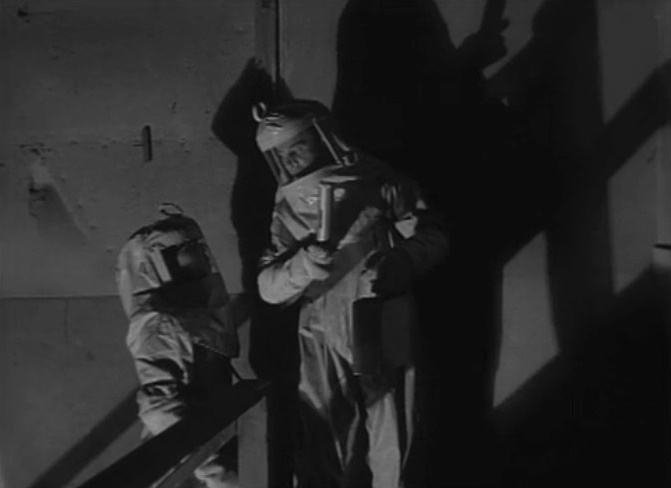


Numerous tests are run and all information is fed into a "giant brain machine" called M.A.N.I.A.C. (Mathematical Analyzer Numerical Integrator and Computer) but M.A.N.I.A.C. is basically like I have no clue what this stuff is. The men suspect they may be dealing with a brand knew element, which shares some similar properties to uranium but is much denser and much stronger. Radio broadcasts are then arranged to let the public know to report any strange occurrences with their TVs, radios, watches, cars or other metal-based belongings. OSI is soon swamped with reports, with the townsfolk treating them as little better than repairmen. However, one call comes through that they definitely need to check out...

A cabbie picked up a nervous gentleman who was carrying a heavy briefcase that he wouldn't let the driver touch. After dropping the man off at the airport, the cabbie's vehicle has picked up magnetic properties. Traces of radiation are then found on an air trip insurance machine (was that really a thing back in 1953?), indicating the man had purchased a policy prior to boarding one of the planes. Cracking open the machine, they're able to find out the identity of the insurance purchaser: Dr. Howard Denker (Leonard Mudie), a well-known research physicist at Southwest University.


Jeff and Dan are able to order the plane to turn around and come back, and have a brief conversation with the sickly scientist before he dies of radiation poisoning. According to him, he and his assistant (i.e. the dead guy in the office) bombarded an element called "serenium" (any relation to selenium?) with alpha particles for hundreds of hours. Now whatever substance they've created is "hungry" and must be fed a constant stream of electricity or else it will "reach out with its magnetic arms" and grab anything in its reach. The deadly, constantly-growing element is then given a new home in a cyclotron at a state university, but that doesn't last long after it implodes and blows up the building. The scientists then learn some horrifying, and potentially apocalyptic, things about it.


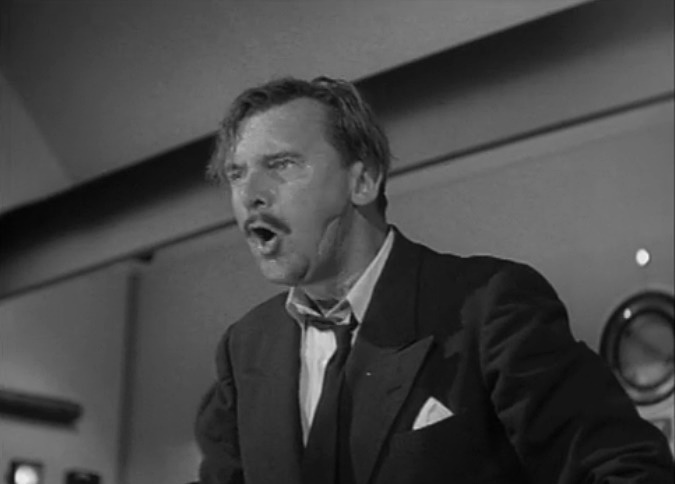
I'd venture a guess and say the easiest way to make a monster movie is to have that "monster" be something that's invisible to the human eye. I'd also venture a guess and say that it's even easier to make an invisible monster movie when your entire exciting climax consists of stolen footage from an old sci-fi movie. And that's pretty much what we have here with this throwaway cheapie. Mind you, this isn't unwatchable. It's competent, with some interesting ideas here and there and a good central performance from Carlson, but it's also almost entirely devoid of action and exceedingly talky, with gaps filled in by endless narration and expository science blabber.

All of the airplane, military and explosion scenes are stock footage and everything centered around the "Deltatron" machine at the finale has been swiped from the German film Gold (1934), which looks like it's probably worth checking out in its original form. The cast is filled with overworked character actors from the day, with the likes of Roy Engle, Frank Gerstle and Billy Benedict filling small roles. Also on hand here are pretty Jean Byron in a thankless role as Carlson's pregnant wife, Harry Ellerbe (from Corman's House of Usher), a young Strother Martin as a pilot and Kathleen Freeman as a secretary.




A fairly well-circulated title over the years, this was released theatrically in 1953, reissued in 1956 and then debuted on TV that same year. There were numerous VHS and DVD releases from MGM, Sinister Cinema, Monterey, etc., plus a blu-ray edition from Kino Lorber released a 2016. It's also currently on the streaming service Tubi, though not an especially good print of it.

Friday, October 29, 2021

I Was a Teenage Frankenstein (1957)

... aka: Des filles pour Frankenstein (Girls for Frankenstein)
... aka: El hijo de Frankenstein (The Son of Frankenstein)
... aka: La strage di Frankenstein (The Massacre of Frankenstein)
... aka: Teenage Frankenstein

Directed by:
Herbert L. Strock

Producer Herman Cohen had a big hit on his hands with I WAS A TEENAGE WEREWOLF (1957) in the summer of 1957, which reputedly made 2 million on a budget of just 82,000 dollars. He retained much of the same team and then immediately went into production on this follow-up, which he also co-wrote with frequent collaborator Aben Kandel. So just how rushed was the production? Well, it began shooting in October 1957 and was in theaters just in time for Thanksgiving, a mere five months after Werewolf debuted. If that wasn't impressive enough, the same folks decided to tackle vampires while they were at it and made Blood of Dracula around the same time, which focused on a teenage female bloodsucker. The three films then got mixed and matched as double features over the next few years. It was all about catering directly to the until-then-ignored teen demographic, who were flocking in droves to newly-established drive-in theaters.

Whit Bissell, the same man responsible for transforming Michael Landon into a wolf man, returns in an almost identical role as yet another untrustworthy adult / unscrupulous mad scientist preying on yet another naïve teen. Bissell's character this time out is Professor Frankenstein, an English academic (curiously lacking any kind of British accent) whose lofty career ambitions far outweigh any moral or ethical crises of conscience. Temporarily living in the U. S. and working the college circuit as a guest lecturer, the professor's ranting and raving about finding a way to graft whole human limbs from the dead onto the bodies of the living brings skepticism from his peers. He concludes: "I'll hold to my beliefs and some day, very soon possibly, I'll prove them so conclusively that even cynics like you all over the world will be convinced!" And that he does! As a descendant of the notorious Baron Frankenstein, who'd expect anything less?


Frankenstein manages to coerce / blackmail his supportive colleague and friend, physicist Dr. Karlton (Robert Burton), into helping him to construct an entire human using the body parts stolen from cadavers. But not just any body will do. After all, he's well aware of what happened to his ancestor because he wasn't too particular about where he got his spare limbs from. Nope. This Frankenstein believes in a theory called "selective breeding." After all, "If you breed morons, you beget morons." He only wants the finest of body parts from strong, able-bodied young men or, as he calls them, "the ingredients of youth." A "worm out body inhabited by an overtaxed brain" simply won't suffice. Right as Frankenstein is laying out his master plan, the sound of car brakes and a loud bang are heard coming from outside. There's been a terrible car accident. And the drivers were teenagers. And one of those bodies was thrown from the vehicle. And the body that was thrown from the vehicle happens to belong to a strapping, muscular young man. Whatta coincidence!


Despite a large crowd gathering at the scene, the professor and Karlton somehow manage to scoop the boy's corpse up and carry it back home undetected. Thankfully, Frankenstein's already prepared for such an incident. Down in his basement, he has what he calls his "personal morgue;" a laboratory complete with cold lockers to store bodies, a temperature control that he keeps the place at near-freezing temperatures to help preserve corpses and an alligator pit (!!) to dispose of discarded body parts. But Frankenstein will need plenty of time. After all, the car crash victim has had his head crushed in, his face mangled beyond recognition and both of his hands plus a leg injured beyond repair. Soon after, another "Whatta coincidence!" moment - a plane crash killing star athletes - makes the necessary body parts available. Well, available if one is willing to do a little grave digging and corpse thievery, which our determined doctor Is more than willing to do! A couple of arms from a champion wrestler and a leg from a star football player later and the human jigsaw is complete.

In order to get the peace and quiet needed, the professor has asked a former assistant, lovely university hospital nurse Margaret (Phyllis Coates), to come to stay at his home and act as his secretary while he's working. She's to handle all of his business and personal affairs, keep any people / distractions away and not ask any questions about what he's doing. And when he's through, he plans on taking her back to England with him after his visa expires and marrying her. However, the relationship rapidly deteriorates whenever Margaret, ya know, starts expecting things. He tries to pacify her by taking her to Lovers Lane but she then begins snooping around his off-limits lab, which puts her in danger.


After the "monster" (Gary Conway) is revived, he also starts to cause the professor problems. Though he's obedient at first and patient through his exercise regiments, speech therapy ("Speak! You've got a civil tongue in your head! I know you have because I sewed it back myself!"), vitamin shots and "electrical treatments," he soon tires of being locked away in the basement and desires companionship. There's still one major problem with him: Though he may have the body of an Adonis, he has the face of Joseph Merrick. Frankenstein uses that to his advantage and informs his creation that he'll only fix his face if he remains obedient to him. Still, the monster can't resist venturing out of the lab. He sneaks into town late one night and strangles a screaming blonde bombshell to death after busting through her window.

Showing that he's willing to go to great lengths, including murder at his master's behest, the creature is finally allowed his new face. The professor is even nice enough to take him to Lovers Lane and let him pick out the one he wants. The two stumble upon handsome teenager Bob (Conway again) and his date necking in a car. The creature knocks out the girl and then they kill and decapitate Bob; bringing his head back to the lab for a quickie full-face transplant that works out surprisingly well. His experiment now complete, Professor Frankenstein then plots to return to the UK with his creature... only he plans on first disassembling him for easier transport! As that's going on, a pair of coppers (George Lynn, John Cliff) investigate the murders. The last couple of minutes are in color.


Unimaginatively shot, lifelessly directed and very talky, this mildly lurid, pseudo-camp effort has to default back to its cast to provide most of the entertainment value. Good thing then that at least a few of the stars deliver. Prolific character actor Bissell is given a rare (his only?) top billed lead role and offers up a cold, calculating, arrogant and completely unfeeling / sociopathic Frankenstein. Upon seeing his newly-revived creation cry, instead of offering an sympathetic ear, his first instinct is to exclaim "Even his tear ducts work!" and how he sets up one character's demise is extremely mean-spirited and more than just a little sadistic! While Bissell is given some hokey dialogue, his dry and dead-serious delivery helps make it all work. His version of Frankenstein is also notable as being entirely detestable... There is NOTHING even remotely likable about this asshole!


Conway, in either his first or second film (he was also in Corman's Viking Women and the Sea Serpent the same year), offers up an earnest performance as the creature. Prior to acting, he got by working as a near-nude model in "physique" magazines, which probably functioned mostly as gay porn back then. A year after appearing in this, he married Miss America 1957, Marian McKnight, and the two are still together to this day... over 60 years later. Now there's a love story for ya. Conway would sort-of reprise his role in the same company's HOW TO MAKE A MONSTER (1958) in the same Phillip Scheer make-up.


This played theatrically on an AIP double bill with Blood of Dracula (re-titled Blood is My Heritage in the UK). Strangely, and unlike most other American genre films from this time, this one's never been given a legitimate DVD release and I'm not entirely sure why that is. There's a rumor that the current owner, former actress Susan Hart (widow of AIP co-founder James H. Nicholson), is holding out for more money, but it's hard to tell. The only official U.S. home video release I'm aware of is a 1991 VHS from RCA / Columbia.

Related Posts Plugin for WordPress, Blogger...