

... aka: El monstruo magnético
... aka: Gizli Kuvvet (Secret Force)
... aka: Il mostro magnetico
... aka: Implosion
Directed by:
Curt Siodmak
Herbert L. Strock (uncredited)
Though he started out in Hollywood writing musicals, comedies and romantic dramas, Hungarian-born producer / writer Iván Törzs (Ivan Tors) was actually mostly interested in three other topics: animals, science fiction and all things aquatic. After starting his own namesake production company, he scratched his sci-fi itch first with The Magnetic Monster, following by Riders to the Stars and the 3D release Gog (both 1954 releases) and then the TV series Science Fiction Theater. Entering into the 60s, he began working on most of what he'd become most famous for today.
After his ocean-centered adventure TV shows The Aquanauts and Sea Hunt concluded, he had his most noteworthy hit merging his animal and ocean interests with Flipper, which started out as two movies and then became a beloved TV series lasting from 1964 to 1967. Afterward, he produced Gentle Giant (1967), an adaptation of a popular children's book about a family friendly bear that doesn't want to rip your face off, which became the basis for the series Gentle Ben, which lasted two seasons.


Tapped to direct this first Tors sci-fi production was... Well, I'm not entirely sure. Listed in the credits only as editing supervisor, Herbert L. Strock also reputedly directed part, if not MOST, of the film sans credit. The sole directorial credit however was given to Curt Siodmak, who co-wrote the script with Tors. This seemed to be an unfortunate recurring theme throughout Strock's career. He also supposedly directed or co-directed the same team's aforementioned Riders to the Stars, Donovan's Brain (1953), the troubled Monstroid (which began production in 1971 but wasn't released until nearly a decade later) and other films without receiving credit. Strock's Los Angeles Times obit claims Magnetic Monster was his feature directorial debut and also claims he was one of the producers, though he's not credited for that either.


Science is a double-edged sword. On one hand, it can make all of our lives easier. On the other, it can destroy us all. Our opening narrator warns of recently-discovered "deadly isotopes of unknown elements," sound frequencies that can penetrate the human brain and kill and chemicals that can burn and sear human flesh. Quite the pessimist he is. Thankfully, there's a team of scientists who are doing everything in their power to make sure we don't annihilate ourselves. They're the OSI, or the Office of Scientific Investigations. Operatives at the OSI are referred to as A-Men ("Sounds like the final word of a prayer. It is not."), who are described as being essentially detectives. With science degrees.
After receiving a call about strange occurrences from a concerned city engineer, OSI agent Dr. Jeff Stewart (Richard Carlson) and his assistant Dr. Dan Forbes (King Donovan) are on the case. Hardware store owner Mr. Simon (Byron Foulger) is at a loss as to why all of his clocks have mysteriously stopped at 12 past 12, his merchandise is sticking together and dryer doors and mowers are moving on their own. It appears to be a case of extremely strong magnetization. Geiger counters pick up strong traces of radioactivity, and they appear to be emanating from upstairs. Exploring the office immediately above, the two find a corpse, as well as a container that appears to be the primary source of all the radioactivity. It's now empty.



Numerous tests are run and all information is fed into a "giant brain machine" called M.A.N.I.A.C. (Mathematical Analyzer Numerical Integrator and Computer) but M.A.N.I.A.C. is basically like I have no clue what this stuff is. The men suspect they may be dealing with a brand knew element, which shares some similar properties to uranium but is much denser and much stronger. Radio broadcasts are then arranged to let the public know to report any strange occurrences with their TVs, radios, watches, cars or other metal-based belongings. OSI is soon swamped with reports, with the townsfolk treating them as little better than repairmen. However, one call comes through that they definitely need to check out...
A cabbie picked up a nervous gentleman who was carrying a heavy briefcase that he wouldn't let the driver touch. After dropping the man off at the airport, the cabbie's vehicle has picked up magnetic properties. Traces of radiation are then found on an air trip insurance machine (was that really a thing back in 1953?), indicating the man had purchased a policy prior to boarding one of the planes. Cracking open the machine, they're able to find out the identity of the insurance purchaser: Dr. Howard Denker (Leonard Mudie), a well-known research physicist at Southwest University.


Jeff and Dan are able to order the plane to turn around and come back, and have a brief conversation with the sickly scientist before he dies of radiation poisoning. According to him, he and his assistant (i.e. the dead guy in the office) bombarded an element called "serenium" (any relation to selenium?) with alpha particles for hundreds of hours. Now whatever substance they've created is "hungry" and must be fed a constant stream of electricity or else it will "reach out with its magnetic arms" and grab anything in its reach. The deadly, constantly-growing element is then given a new home in a cyclotron at a state university, but that doesn't last long after it implodes and blows up the building. The scientists then learn some horrifying, and potentially apocalyptic, things about it.


I'd venture a guess and say the easiest way to make a monster movie is to have that "monster" be something that's invisible to the human eye. I'd also venture a guess and say that it's even easier to make an invisible monster movie when your entire exciting climax consists of stolen footage from an old sci-fi movie. And that's pretty much what we have here with this throwaway cheapie. Mind you, this isn't unwatchable. It's competent, with some interesting ideas here and there and a good central performance from Carlson, but it's also almost entirely devoid of action and exceedingly talky, with gaps filled in by endless narration and expository science blabber.
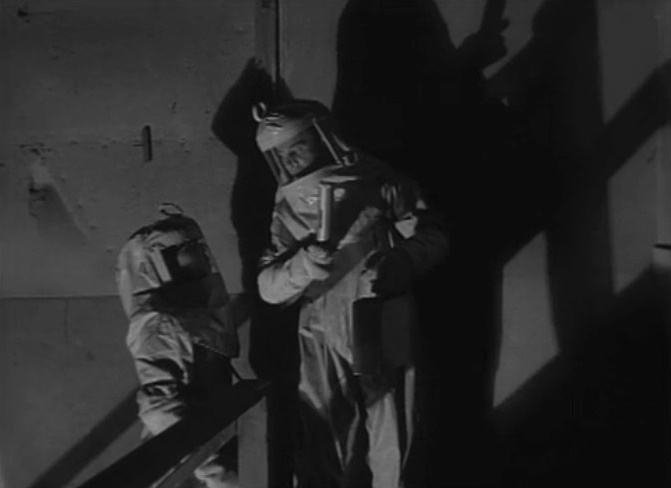
All of the airplane, military and explosion scenes are stock footage and everything centered around the "Deltatron" machine at the finale has been swiped from the German film Gold (1934), which looks like it's probably worth checking out in its original form. The cast is filled with overworked character actors from the day, with the likes of Roy Engle, Frank Gerstle and Billy Benedict filling small roles. Also on hand here are pretty Jean Byron in a thankless role as Carlson's pregnant wife, Harry Ellerbe (from Corman's House of Usher), a young Strother Martin as a pilot and Kathleen Freeman as a secretary.




A fairly well-circulated title over the years, this was released theatrically in 1953, reissued in 1956 and then debuted on TV that same year. There were numerous VHS and DVD releases from MGM, Sinister Cinema, Monterey, etc., plus a blu-ray edition from Kino Lorber released a 2016. It's also currently on the streaming service Tubi, though not an especially good print of it.
★★


