.
.
.
Showing posts with label Finland. Show all posts

Friday, September 18, 2020

Films by country: Finland


FINNISH HORROR [1950 - 1990]

A Wiki page dedicated to Finnish horror has an index containing six titles, only two of which were made before 1990. IMDb does a little better job, turning up six pre-1990 feature films and two TV movies. Poking around I was able to turn up a few more for a grand total of ten films made between 1950 and 1990. 

Tracing back Finnish horror to its roots, we first have to go all the way back to 1927 with the silent Noidan kirot (“Curses of the Witch”) from pioneering director Teuvo Puro. Puro had previously made 1907's Salaviinanpolttajat / "The Moonshiners"; a 20-minute comedy short that was also Finland's very first feature film, as well as Sylvi (1913), which was Finland's first full-length feature film. While his lone genre effort is widely considered the first Finnish horror by historians, a previous 1923 fantasy film, Rautakylän vanha parooni (“The Old Iron Baron of the Village”), is sometimes also considered. These were also the only genre films out of Finland for awhile. There wouldn't be another until the ghost film Linnaisten vihreä kamari ("The Green Chamber of Linnais") two decades later.


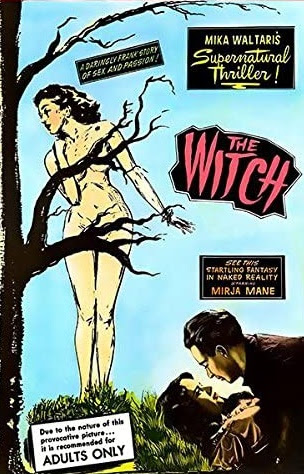
Moving on to 1952 we have a pair of horror films. First and foremost is the brilliantly-shot and wonderfully Nordic The White Reindeer, which is filled with dark imagery that practically leaps off the screen since it's set against a snowy white backdrop and became an unlikely cross-over success that won the Best Foreign Language Film Golden Globe and a major award at Cannes. And then there was Noita palaa elämään (aka The Witch, or Return of the Witch) which may have been less artistically accomplished but was still adequately atmospheric. It was also a hot export due to its sexually frank nature and the fact it contained numerous nude scenes from its female star, which eventually got this booked in U.S. theaters as an "adults only" skin flick (center image below) with the tagline "See this startling fantasy in naked reality!" I'm forever grateful that this pair of films exist because 1952 is, globally, pretty slim on horror films otherwise. Two years later there was a ghost comedy (Kummitus kievari / “Ghost Tavern”) and then... barely anything... for decades. In fact, the countries entire film industry hit a slump for awhile. Many blame the rising popularity of TV for this dry spell.

It wouldn't be until the mid-80s that a few other genre features emerged. The Finnish commercial TV network Mainostelevisio made the ghost tale Yöjuttu: Merkitty (1984) and the four-part miniseries Painajainen / "Nightmare" (1988), which involves an amnesiac uncovering horrifying secrets about his life. The same year as the latter came the theatrical release The Moonlight Sonata from Olli Soinio, which is highly derivative of American slasher movies (most notably The Texas Chainsaw Massacre) and unfortunately filled with forced camp comedy. Soinio had previously made the 23-minute short Transvestijan tarinoita ("Tales of Transvestia"), a monster movie parody, which is thus far the only Finnish horror from the 1970s I've been able to unearth. 

There were around a half dozen 90s releases, including Soinio's Sonata sequel Kuutamosonaatti 2: Kadunlakaisijat (1991), which was called Army of Zombies in the U.S. and Germany. More recently, well-received genre films like Sauna (2008), Rare Exports: A Christmas Tale (2010) and Euthanizer (2017) make the occasional ripple, though The White Reindeer remains the major highlight here.

__________________________________________________


1950s


White Reindeer, The (Valkoinen peura) (1952; Erik Blomberg) ▲
- Witch, The (Noita palaa elämään) (1952; Roland af Hällström)

- Ghost Tavern (Kummitus kievari) (1954; Lasse Pöysti)


1960s

- Galgmannen (Gallows; Hirsipuumies) (1961; Carl Mesterton) [TV]


1970s

- Tales of Transvestia (Transvestijan tarinoita) (1975; Olli Soinio) [short]


1980s

- MP - I'm Afraid (MP - Minä pelkään) (1982; Pekka Hyytiäinen)

- Marked (Merkitty; Yöjuttu: Merkitty) (1984; Ismo Sajakorpi) [TV]

- Folk Artist (Kansantaiteilija) (1986; Risto Rumpunen [short]

- Moonlight Sonata, The (Kuutamosonaatti) (1988; Olli Soinio) ▼
- Nightmare (Painajainen) (1988; Ismo Sajakorpi) [4 part TV miniseries]


TOTAL FILMS:
10

NOTES:
- Galgmannen is based on a(n apparently popular) play by Finnish writer Runar Schildt. There were two other adaptations made in Sweden; a theatrical release in 1945 and a TV movie in 1969, as well as a Norwegian TV version in 1983.
Seitsemän hirtetyn tarina / "The Seven Who Were Hanged" (1982) - Possible psychological horror. Made for Finnish television. Directed by Jarmo Nieminen.

__________________________________________________


Got any more for the list? Let me know below.

Thursday, September 17, 2020

Nordic Horror


NORDIC HORROR [1950-1990]

Instead of calling this category "Scandinavian countries," which to some would simply include Sweden, Denmark and Norway, I'm using the more generic term "Nordic" here, which will also include Finland, Iceland, Åland Islands, Faroe Islands, Svalbard and Jan Mayen and, because it's sometimes though not always included, Greenland (which is sometimes grouped with North America). That's my best option considering most other countries under the Nordic umbrella had next to no film industry, at least not until here recently, and don't really merit their own page. 

To my knowledge, no pre-1990 horror films were produced in four out of the nine countries in this grouping. Greenland's first horror film didn't come until 2011 with Malik Kleist's Qaqqat alanngui, while the first (and thus far only) feature-length horror film from the Faroe Islands appears to be the "dark psychological drama" Ludo (2014) directed by Katrin Ottarsdóttir. Åland Islands, which has a population of just 28,000, Svalbard, with just 2,500 residents, and Jan Mayen, with no permanent residents as its a volcanic island, all show no horror films on a search. Hell, the former shows no films period while the latter two are made up almost exclusively of documentaries made there by outside crews within the last 10 years. That leaves us with just the original Scandinavian trio plus Finland and Iceland, each of which will get their own write-up on their own page. None of these countries were uber prolific in the genre during the 40 year block of time we cover here though most are worth discussing for several benchmark films.


NORDIC COUNTRIES
Click on one of the flags below to learn more...


If I dig up other information about any of the countries without a page, I'll make sure to post it.

Monday, November 7, 2016

Kuutamosonaatti (1988)

... aka: Moonlight Sonata, The

Directed by:
Olli Soinio

I want to start this out by talking about classic Finnish horror cinema. OK, so now that that's done let's move on to... Hey, I'm only kidding. Sort of. There's honestly not a whole lot to talk about here. A wiki page dedicated to Finnish horror has an index containing 6 titles, only two of which were made before 1990. IMDb does a little better job, turning up six pre-1990 feature films and two TV movies. Poking around I was able to find a few more for a grand total of around 10 films. We first have to go all the way back to 1927 with the silent Noidan kirot (“Curses of the Witch”) from director Teuvo Puroo, which is widely considered the first Finnish horror film, though a previous 1923 fantasy film, Rautakylän vanha parooni (“The Old Iron Baron of the Village”), is sometimes considered. While either of those may have been the first, they were also the only genre offering(s) out of them until the ghost film Linnaisten vihreä kamari ("The Green Chamber of Linnais") two decades later. Moving on to 1952 we have a pair; the excellent THE WHITE REINDEER (a cross-over success that won the Best Foreign Language Film Golden Globe and a major award at Cannes) and the OK but less successful THE WITCH. I'm forever grateful that pair exists because 1952 is pretty slim on horror titles otherwise. Two years after those came a ghost comedy (Kummitus kievari / “Ghost Tavern”). And then there was long silence...

The 80s finally rolled around and the Finnish commercial TV network Mainostelevisio offered up the ghost tale Yöjuttu: Merkitty (1984) and the four-part miniseries Painajainen / “Nightmare” (1988), which involves an amnesiac uncovering horrifying secrets about his life. The same year as the latter came this theatrical release from Soinio, who'd previously made the 23-minute monster movie parody Transvestijan tarinoita (“Tales of Transvestia”) back in 1975. There were also a few 90s releases and, in recent years, a couple of fairly well-received genre offerings like Sauna (2008) and Rare Exports: A Christmas Tale (2010). And there you have it folks, a brief overview of Finnish horror to this day. As nice as it is to be able to sum up the horror output of an entire country in just two brief paragraphs, I'm glad all other countries aren't Finland. Otherwise I would have closed up shop here about five years ago.


International fashion model Anni Stark (Tiina Björkman) flies back home to Finland and is hounded by the press as soon as she steps off the plane. See, Anni is not a nice or sweet or even halfway decent young woman. In fact, she's hot headed, foul-mouthed, has a bad temper and is about to get canned by her agency. That's why she's in Finland in the wintertime; to avoid bad press over one of her latest explosions and lay low for a few days. In four days' time she's off to Milan to fulfill another contract. Her agent Carli (Ville-Veikko Salminen) has arranged the trip and has even found an out-of-the-way hotel where no one can find her. When they show up, they find the hotel is remodeling, so the owner sends them off an an even further out-of-the-way skiing cabin located down a long and winding road. Carli then leaves her there and promises he will back in a few days time to personally drive her to the airport for her job in Italy.


Left all alone in the cabin except for her dog (who gets about twice as many adoring close-ups as the human actors), Anni is kept up late her first night by strange, loud noises coming from outside. Little does she realize, but someone's been watching her the entire time. As for her missing panties, the same peeper crept inside while she was in the bathtub and snatched those, too. Thankfully, Anni's kid brother Johannes is supposed to come in and stay with her in another day. She walks to the bus stop the following morning hoping he's there and instead has a strange encounter with a stern old woman (Soli Labbart) and her creepy, pervy adult son Arvo (Kari Sorvali), who also happens to be the panty thief. Arvo warns her to be careful because “the roads are slippery... slippery like a wet pussy,” before pushing his ailing old mum away in her ski-chair. Anni then walks down the road looking for a phone and instead stumbles onto the unkempt farmhouse Arvo shares with his mum and another family member we'll get to here in a bit. Arvo's been following the newspapers and knows exactly who Anni is and about all of the controversies in her life. He tries to take her picture and then grabs her tits and she runs off. He makes a return visit to her cabin later on and she's forced to defend herself with a knife.


Johannes (Kim Gunell), an electronics wiz (which factors into a few later scenes), finally shows up and he and Anni face one horror after another dealing with Arvo and his disturbed family, which not only includes the mother (who likes to beat on her kids) but also a hulking, whack job of a brother with a half-burnt face. He - Sulo (Mikko Kivinen) – speaks in a comically slowed-down ultra-deep voice, fancies himself a wolf and is typically kept locked up in a shack but frequently escapes. Sulo steals Anni's dog and takes him to a snowy cliff where the two of them howl at the moon together. He also chops a TV license inspector on the head with a scythe. Not only are the family bad news, but it seems the entire rest of the town is related to them and refuse to help, including the bus driver who passes through once a day.


Unlike the earlier Finnish horror films I'd seen, which are steeped in the countries folklore and old traditions, this is straightforward, very commercial and completely modern. After starting out on a completely serious note and going on that way for nearly the entire first half, this sadly deteriorates into another blatant retread of The Texas Chainsaw Massacre. The entire warped family dynamic; disturbed authority figure (a woman this time) with one son who's a talkative weirdo and the other a big, groaning brute, is copied, as well as other scenes like our heroine stumbling into a general store where the owner is roasting some bloody meat and is in cahoots with the family to the mini junkyard of cars (from previous victims) at the whack family's farmhouse. Unwisely carried over is the camp attitude of the second TCM, including 80s-style cornball one-liners like the killer shouting “Time to burn some rubber!” before trying to run our heroes down with a tractor.


Lack of originality and the tonal shifts seriously harm what is otherwise a fairly well-made and nicely shot movie with a few fun ideas, nice scenery and some visual style. The most amusing bit is that Anni's dog takes to the wolf-brother, views him as being the leader of the pack and starts following him around everywhere. However, little is done with that concept aside from it making for one good sight gag. There's much less violence, blood and gore here than in most other films of this type and the cast is pretty mediocre aside from the underused Labbart and Sorvali, who makes really great evil faces. Either way, aside from the location, there's not much to differentiate this from dozens of other backwoods / hillbilly horrors flick out there.

This was successful enough in its homeland to be followed by a sequel from the same director and featuring the same crazy family: Kadunlakaisijat / Kuutamosonaatti 2 (1991), which has been given the English language title Army of Zombies. In Germany, these films were released as Muttertag 2 - Die Söhne sind zurück (“Mother 2: The Sons Are Back”) and Muttertag 3 to be sequels to Troma's Mother's Day (1980), which was released as Muttertag 1 and is yet another movie this has a lot in common with.

★★

Saturday, July 19, 2014

Noita palaa elämään (1952)

... aka: Resurrection of the Witch
... aka: Witch, The
... aka: Witch Returns to Life, The

Directed by:
Roland af Hällström

Archaeologist Hannu (Toivo Mäkelä) and his wife / assistant Greta (Hillevi Lagerstam) have received a government grant to do some excavating near a small Finnish village. While digging in the swamp lands they come across a skeleton with a large aspen stake driven through its chest. Because of the cold conditions, the find has been well-preserved through the centuries. The skeleton still has long black hair, there are enough clothing fragments to later reconstruct an entire dress and a small leather pouch around the neck still contains herbs and a talisman. Ignoring the "old wive's tales" from superstitious villagers, who've already warned that the plot of land is cursed and the skeleton is likely that of a woman executed three-hundred years earlier for practicing witchcraft, they remove the stake and take the skeleton back to the mansion where they're staying with wealthy Baron Hallberg (Aku Korhonen); a sleazy tyrant who doesn't quite have the best reputation in town himself. Due to the some uproar in the village, Hannu returns to the grave site later that night and finds a young, beautiful, naked woman lying in the grave. He picks her up and carries her back to the castle. The woman - who announces herself as Birgit (Mirja Mane) - is hungry, confused and disoriented... but that doesn't last for too long.


The bewitching beauty soon starts showing her true colors and easily manages to seduce all of the men staying in the castle; nearly driving everyone in the village insane in the process. Painter Kauko (Helge Herala) doesn't keep quiet about the crush he has on Greta (even in front of her husband), but his attentions soon begin to drift toward the pretty new visitor. The Baron's son Viekko (Sakari Jurkka) has been unable to find a girl in the area that his father has not gotten to first. You see, the village women have dubbed the old man a "perverted pig" because he has "spread his seeds all over" and forced himself upon nearly all of the women in the area. Now poor Viekko is afraid to court because he doesn't even know who may or may not be his sister! As a result, Viekko falls hardest of all for Birgit, figuring "Well if she's a bit out of her head, maybe she'll even like me." Birgit also sinks her claws into the married Hannu, driving his wife into the arms of the painter in the process. Ironically enough, the horny old Baron is the only one really able to resist her charms, simply because he's paranoid she's faking being a witch in order to get her hands on his money. He doesn't even care what she is really because to him "All women are witches."


Birgit laughs gleefully as she causes all kinds of problems for our protagonists. She bites Greta when she tries to touch her and bites Viekko's lip when he tries to kiss her. She disappears and reappears at will. She causes one farmer to chop another's leg up with a hoe. She makes a snake appear. She breaks a horse's leg simply by looking at it, makes another horse disappear and, when she tries to milk a cow, blood comes out. A bird lands even on her finger just like in some Disney cartoon. Every single time Birgit leaves the castle to frolic in the fields, a mob of angry townspeople are there to greet her armed with scythes, axes, hoes, spears and pitchforks and chase her around. Eventually, the resurrected witch feeds Viekko seeds of life and death from her pouch and attempts to make him burn down the mansion as a dedication of his love to her.


Plot-wise, this is rather ordinary, predictable fantasy-oriented material. It's extremely dialogue-heavy, the music is often laughably overbearing and overly-dramatic and the film attempts to throw us off at times by introducing the idea that Birgit may be a crazy village girl and not actually a witch, but that idea doesn't work at all since we've already seen and heard too much to believe otherwise. There's also a moral that's beaten over our heads in the least subtle way imaginable by having one character keep repeating: "We all have a beast inside us." And in case you somehow happened to miss it, the archaeologist character actually turns to face the camera and explains it to us once again at the very end. What actually sets this apart, aside from picturesque Finnish locations seldom seen in this genre, is how surprisingly frank and free this is when it comes to matters of sex. Compared to movies from nearly any other country made around the same time, this is startling in its bluntness, with character casually discussing and joking about sex and numerous sexual one-liners and double entendres. In fact, all of the characters seem quite obsessed with their various desires and relationships. When one character brings up artificial insemination, the Baron says "The traditional way is much more fun," but a village woman warns him "What you pork in the past will come oinking in the future." (Ha, I'm gonna have to remember that line.)


The Witch isn't just limited to sexual dialogue either. Lead actress Mane isn't one bit shy showing off what God gave her in numerous sequences seducing men, dancing with a sheer shawl or cavorting around outside completely naked, which certainly wasn't something commonly filmed in most other countries in the early 50s. These scenes made the film somewhat scandalous in its day. It also comes at no surprise that when this made it stateside, it was an "adult's only" release only shown in sleaze pits on the exploitation circuit. Dan Sonney's company Sonney Amusements - who also released such films as Striptease Girl and A Virgin in Hollywood - were the first to bite, giving this a U.S. theatrical release in 1954. Joseph Brenner Associates (The Bellboy and the Playgirls) gave it a whirl in 1957, too. One American ad promised audiences "Starling fantasy in naked reality!" Back in Finland, however, this was a film taken rather seriously and it won several major awards there. The locations, art direction, photography, acting, dialogue and atmosphere (lots of wind and fog) are all vastly superior to most of the no-budget amateur soft-core trash passing for erotica in American at the same time.


Along with Linnaisten vihreä kamari (1945) and THE WHITE REINDEER (1952), it was one of the first sound horror films produced in Finland and was based upon a 1947 play of the same name by Mika Waltari. Larry Buchanan's THE NAKED WITCH (1961) more or less copied this film's plot, as well as its poster art (having the nude witch shielded behind strategically-placed tree branches). On home video, there were VHS and DVD releases in Finland, but nowhere else to my knowledge.

★★1/2
Related Posts Plugin for WordPress, Blogger...