.
.
.
Showing posts with label Iceland. Show all posts

Wednesday, September 13, 2023

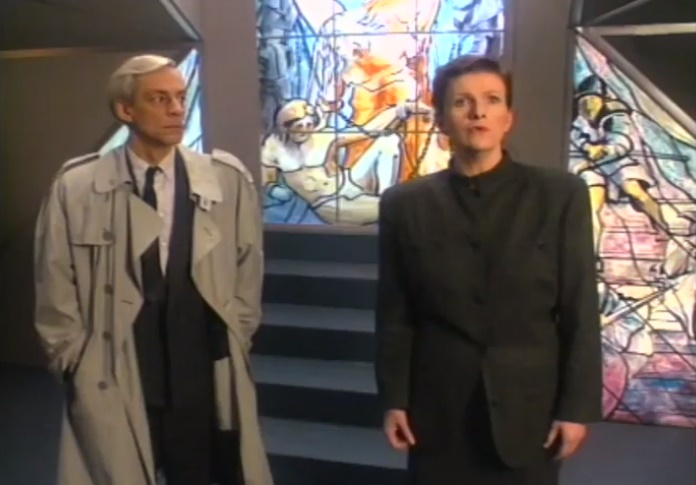
Tilbury (1987) (TV)

Directed by:
Viðar Víkingsson

Iceland wanted no part in WWII and declared neutrality, refusing to side with either the Nazis or the Allies. That's when the UK took it upon themselves to launch an invasion of the country, sending their Royal Navy and Marines there in 1940 against the Icelandic government's wishes. While this wasn't a bloody, violent takeover by any means, or really a takeover at all, the Brits certainly weren't wanted there at the time either. This was viewed as a major violation of the countries desire for independence. Looking through a retrospective lens, one can now say that the imposed British presence helped ward off a potential German takeover. It also was an important strategic decision, especially after Canadian and American forces joined the war efforts and tens of thousands of troops ended up stationed on the isolated, sparsely-populated North Atlantic island. However, this caused a lot of local turmoil, but perhaps not in the most expected of ways... 

Though the occupation brought money, jobs and improved infrastructure to the poor country, Icelandic menfolk became infuriated when many of "their" women began romantic relationships with the foreign soldiers. These women were branded traitors and prostitutes, and many of them were shunned by their friends and family. The government of Iceland even formed a special committee to try to crack down on these taboo relationships. It was unsuccessful, but the "problem" eventually solved itself as the war wound down and the troops started to leave.

While I know nobody's here for a history lesson (at least one not related to film), it's an important topic to discuss in regards to this particular film, which is deliberately commenting upon it. Tilbury is set in 1940, right after the British invasion, and stretches into 1941, when U.S. troops started arriving, and cleverly weaves its mythology (apparently based on local folklore) into this real life historical event.


Audun Thorarinsson (Kristján Franklín Magnús), a young, sheltered lad from the country with aspirations of becoming a professional swimmer, is sent to Reykjavík to help out the British troops and take advantage of their better pool facilities. While he's there, he hopes to reconnect with his childhood crush, a parson's daughter named Gudrún Innness (Helga Bernhard). Audun moves in with a widow and her rebellious teenage daughter, Sigrún (Erla Skúladóttir), who's basically the embodiment of what 40s era Icelandic men feared from their women. She smokes, drinks, asserts her independence and is unimpressed with uncultured local men ("ordinary yokels!"), instead opting to sneak out late at night to "entertain" soldiers.

Audun eventually runs across Gudrún, only to discover she has also hooked up with a Brit: Major Tilbury (Karl Ágúst Úlfsson). The catch? He's old, short, bald, obnoxious and hideously unattractive, with bushy eyebrows, a terrible complexion, a protruding chin and a huge nose. He also may already be married and has a bad habit of randomly projectile vomiting huge amounts of green something or other. What could she possibly see in such a grotesque character? Well, aside from the fact he's a high ranking member of the military supposedly descended from British royalty. And a snazzy dancer.


The few minutes of narration that opens the film has already clued us in to what's going on. According to legend, women facing hunger or hardship are able to bring a tiny imp called a "tilberi" to life by wrapping a human rib in wool, nestling it in their bosom and then activating it with communion wine. The tilberi will then go out and drink milk from livestock and produce a substance called "tilberi butter." The butter, which has a strange consistency and greenish color, can entirely sustain the woman, but in return she has to feed the tilberi her own blood. Thankfully, once the process has started, the woman will miraculously sprout a nipple on her inner thigh for the imp to feed from! The existence of the tilberi also has to remain hidden or else it will retaliate against its "mommy" and suckle her to death!

While the folklore here is certainly unique, this strange and ultimately awkward cocktail of history, horror, humor and mythology possesses an uncertain tone that will delight some but be a hard pillberi to swallow for others. The addition of highly questionable subtext and a bland roster of unlikable / underdeveloped characters only add fuel to the polarizing fire. There's absurdist and often juvenile comedy, surreal elements, childhood flashbacks, hallucinations and crude, gross out moments with Troma-style puking, and they even throw in a long choreographed dance number for some reason. Perhaps they should have set some time aside to make us actually care about these people instead.

Though he certainly shows more sympathy toward his fellow countrymen, at times the director seems to be satirizing both the unwelcome military invaders and the resulting homegrown hysteria. The Icelandic women here are all but lining up to get with the soldiers, while the men are flummoxed and frustrated. Gudrún is caught sneaking off to a graveyard to feed her tilberi (disguised as her British military lover "Major Tilbury," of course!) and has been using its butter to make Cadbury (a British company) chocolate products. A Scottish general refers to local hired help as "the lowest form of life" while soldiers mockingly wave used condoms around to signal their conquests. When U.S. forces finally show up ("We Americans will make sure you get all the guns you need!"), their leader refers to the locals as "backwater peasants" as he eats a Hershey's bar.

Several other aspects of the plot manage to be even more perplexing. Now I want to be careful here and point out that depicting characters with certain prejudices is not the same thing as endorsing said prejudices. That said, what we're left with here is a film that's so heavy on anti-Jewish sentiment and dog whistles, and so heavy on criticizing the Allied forces, that it actually appears to be sympathizing with the Nazis! I'm not sure if this comes off that way because it's so muddled or if it comes off that way because the leveled criticism is extremely imbalanced.


Firing a starting pistol during a swim meet is used as an excuse for the military to arrest Coach Kemp (Aðalsteinn Bergdal), who turns out to be a Nazi sympathizer and bemoans the "Jewish mentality" now corrupting his country. This teary-eyed character, arrested and held captive under false pretenses, is also the only character in the entire movie willing to tell Audun the truth, thus steering our protagonist in the right direction. As far as the evil, culture-destroying tilberi is concerned, it's designed with a pretty infamous anti-Semitic trope: The large hooked nose. One of the many Nazi propaganda campaigns used against Jews involved spreading lies that they were poisoning food, and thus it's no coincidence this features a scene of its evil, short, big-schnozed demon throwing out contaminated candy bars to children!

The film not only depicts the anti-Nazi forces as complete scumbags who aggressively threaten the Icelandic way of life, but also depicts the local women as vacuous, promiscuous, backstabbing social climbers. Everything leans toward painting Icelandic men as the ultimate victims in this scenario simply for having romantic competition from outsiders, but it's hard to forget it's saying this while there's a global genocide of millions occurring simultaneously. Ah, the perils of isolationism and bubble life. Your world-shattering problem that's unique to you or your culture may be the ultimate IDGAF to the rest of the world in the grand scheme of things. The naïve male lead is left scarred and alone a year later, but there's no real catharsis for him either. He's still shackled to his lost love (who never appears to have fancied him anyway) and ends up getting sucked into a haystack by unseen forces (?) for all his troubles! I'd like to think the director and writer had other, more nobler intentions with this film, but whatever those were, they get hopelessly scrambled here.


Not many people had even heard of this before it turned up on Severin's All the Haunts Be Ours: A Compendium of Folk Horror box set in 2021. That collection, spread out over 14 discs, contains nineteen features, tons of shorts, essays and interviews, Keir-La Janisse's 3+-hour-long documentary Woodlands Dark and Days Bewitched: A History of Folk Horror (2021), a book, and tons of special features. It's well worth getting if you have the money to throw down on it. If not, many of the titles from this set can currently be viewed for free on Tubi. Some can also be found on Youtube, though the quality obviously isn't going to be as good.

This 2021 release marks the very first time this film has been officially released here in America as well as the first time it's been available with proper English subtitles. Notable extras include commentary from the director and writer Þórarinn Eldjárn, interviews with the director and stars Magnúss and Úlfsson and a 33-minute short from the director called Tache blanche sur la nuque / "A White Spot in the Back of the Head" (1979), which he made while studying in France. It's based on a ghost story called Djákninn á Myrká ("The Deacon of Myrka"), which is also its Icelandic release title, and is yet another new-to-me movie I need to add to my ever-growing index.

Like Vikingsson's previous genre film GHOST STORY (1985), this is short (just 56 minutes) and was made for the Icelandic TV network Ríkisútvarpið-Sjónvarp (RÚV).

Friday, September 18, 2020

Films by country: Iceland


ICELANDIC HORROR [1950 - 1990]

As you can probably imagine from the most sparsely populated country in Europe (just 3.5 people per square kilometer), the Nordic island of Iceland has a rather small film industry; so small that they didn't even have their own film awards (the Edda Awards) until 1999. And if we're talking internationally-known chief entertainment exports, those would include pop singer Björk and Gunnar "Leatherface" Hansen, who was born in Iceland but immigrated to the U.S. at age 5 with his family, rather than the scant horror films produced in the country. To my knowledge, none of the films below were ever released in the U.S. except for The Juniper Tree, which was filmed in 1987 but not released until 1990 when it played film festivals in Los Angeles and elsewhere. It was also the first acting role for - here's that name again - Björk. Björk also had the female lead in the bizarre Glerbrot / Broken Glass (1988) a year later, which means with just two credits she starred in over 20% of the countries early horror films and even those are only partially horror. Since 1990, Iceland has produced or co-produced quite a few horror films though, with Óskar Thór Axelsson's I Remember You (2017) being a standout. Still, the pickins are very slim in the early years.

Iceland's very first horror film was Hrafn Gunnlaugsson's Blóðrautt sólarlag ▼ (given the English titles “Blood Red Sunset” or "The Crimson Sunset"), which all but disappeared after being shown on TV in 1977. It, like six of the eight films listed below, was made for the public TV network Ríkisútvarpið-Sjónvarp (RÚV). According to the English-language Icelandic paper The Reykjavík Grapevine, the film was met with some controversy upon release, with some viewers irate that taxpayer money funded a horror film while others were thrilled to finally see an entirely homegrown genre film, especially one incorporating elements of Icelandic folklore. Still, this and most of the other titles listed below have never received a legitimate home video release. Gunnlaugsson himself used to sell Blóðrautt on his website but it appears to have been pulled from circulation. He's also uploaded his Vandarhögg / "Whiplash" (1980) onto Youtube, though there are no English subtitles.


Egill Eðvarðsson's Húsið: Trúnaðarmál ("The House") appears to have been the first Icelandic genre film made for theaters... and that wasn't until 1983. Like many others, it was made with funding from the government-supported Icelandic Film Center. Viðar Víkingsson's Draugasaga ("Ghost Story") was a co-production between Icelandic (RÚV again) and Norwegian TV networks and reputedly was so hated by Norwegian critics that they attempted to dissuade any further collaborations! Still, it's been resurrected in recent years as a minor cult film and was shown on the big screen at the Frostbiter: Icelandic Horror Film Festival.

__________________________________________________


1950s

None.


1960s

None.


1970s

- Blood Red Sunset (Blóðrautt sólarlag; The Crimson Sunset) (1977; Hrafn Gunnlaugsson) [TV]


1980s

- Whiplash (Vandarhögg) (1980; Hrafn Gunnlaugsson) [TV]

- House, The (Húsið: Trúnaðarmál) (1983; Egill Eðvarðsson)
- Oxsmá Planet, The (Oxsmá-plánetan) (1983; ?) [short]

- Ghost Story (Draugasaga) (1985; Viðar Víkingsson) [TV] [co-Norway]

- Tilbury (1987; Viðar Víkingsson) [TV]

- Broken Glass (Glerbrot) (1988; Kristín Jóhannesdóttir) [TV]
- Deacon of Dark River, The (Djákninn) (1988; Egill Eðvarðsson) [TV]

- Juniper Tree, The (Einitréð) (1990; Nietzchka Keene) ▼


TOTAL FILMS:
9


NOTES:
- I've seen The Juniper Tree classified as a "eerie witchcraft drama" but I'm holding off judgment as to whether it's "horror enough" for this website until I get a chance to actually watch it.
- Blóðrautt sólarlag is available on DVD-R with English subtitles from some bootleg outlets using the title The Crimson Sunset. Don't want to promote these outfits by name as I can't vouch for the quality of their release; just putting it out there that an English version is available.
- Not had much of a chance to comb through the Icelandic films classed as "thrillers" so there's a possibility a few others may qualify for this list.
- A 1950 film called Síðasti bærinn í dalnum (“The Last Farm in the Valley”) is set on a remote farm and includes a big-nosed troll menacing a family plus heroic elves. It is classified as drama / family / fantasy on most websites so I'm leaving it off of here.
- Also need to keep an eye on 1982's Sóley (aka The Hidden People of the Shadowy Rocks), which looks to be a bizarre surreal film with ghost / horror elements. I only had a 2 minute trailer to go by. It has English subs which clearly means a full version with English subs is out there somewhere.

__________________________________________________


Any comments, corrections or additions (I'm always looking for these) are always more than welcome so please drop a message down below if you've got anything to say or anything to add to the list.

Thursday, September 17, 2020

Nordic Horror


NORDIC HORROR [1950-1990]

Instead of calling this category "Scandinavian countries," which to some would simply include Sweden, Denmark and Norway, I'm using the more generic term "Nordic" here, which will also include Finland, Iceland, Åland Islands, Faroe Islands, Svalbard and Jan Mayen and, because it's sometimes though not always included, Greenland (which is sometimes grouped with North America). That's my best option considering most other countries under the Nordic umbrella had next to no film industry, at least not until here recently, and don't really merit their own page. 

To my knowledge, no pre-1990 horror films were produced in four out of the nine countries in this grouping. Greenland's first horror film didn't come until 2011 with Malik Kleist's Qaqqat alanngui, while the first (and thus far only) feature-length horror film from the Faroe Islands appears to be the "dark psychological drama" Ludo (2014) directed by Katrin Ottarsdóttir. Åland Islands, which has a population of just 28,000, Svalbard, with just 2,500 residents, and Jan Mayen, with no permanent residents as its a volcanic island, all show no horror films on a search. Hell, the former shows no films period while the latter two are made up almost exclusively of documentaries made there by outside crews within the last 10 years. That leaves us with just the original Scandinavian trio plus Finland and Iceland, each of which will get their own write-up on their own page. None of these countries were uber prolific in the genre during the 40 year block of time we cover here though most are worth discussing for several benchmark films.


NORDIC COUNTRIES
Click on one of the flags below to learn more...


If I dig up other information about any of the countries without a page, I'll make sure to post it.

Sunday, September 13, 2020

Glerbrot (1988) [TV]

... aka: Broken Glass

Directed by:
Kristín Jóhannesdóttir

Glerbrot checks a number of boxes that interest me right out of the gate. First, it's Icelandic and, as per my last count, one of just eight genre films produced there prior to 1990. Second, it was made by a female director. Though having a female filmmaker at the helm of a horror film is not an uncommon occurrence nowadays, it was back when this was made. Jóhannesdóttir even went one step further by also co-scripting, editing and shooting this. Third, this features alternative pop star Björk (credited under her full name Björk Guðmundsdóttir) in the lead role back when she was still with her band The Sugarcubes and years before her 1993 solo breakout album, Debut. Prior to this, Bjork had acted in the black-and-white art film The Juniper Tree (filmed in 1987 but not released until 1990), which was witchcraft-themed and also made by a female director, the late Nietzchka Keene.

Unlike Glerbrot, which runs just 50 minutes and was an Icelandic TV movie made for RÚV (basically Iceland's equivalent to PBS), Juniper played in theaters around the world and took home a few festival awards. Still, it was and still remains a film of limited interest due to its art-house-ish-ness and seldom been viewed despite getting a DVD release in 2002 from Rhino and a Blu-ray release in 2019 from Arbelos Films. Glerbot, on the other hand, doesn't even have that luxury. I couldn't find a single VHS or DVD release for this title. The best that's currently available is a copy ripped from TV.

And, finally, this is just plain weird. I couldn't quite figure out what it was attempting to say or why it was even made. It's sort of a mix of women-in-prison film, nunsploitation film (minus nuns if that makes any sense!) and sane (maybe) person locked up in a corrupt asylum film with flashes of horror, torture, surrealism and religious iconography.


An unkempt old man (Helgi Skúlason) with the biblical name of Theofilus is washing clothes in what appears to be a laundromat located inside a cave but just turns out to be a cavernous laundry room (?!) inside their home with TEN stacked washing machines and dryers. The man's bitchy, miserable daughter-in-law, Liney (Margrét Ákadóttir), walks in and starts arguing with him about how much she hates both him and his son. He tells her she has no room to talk because, back in her younger years, she partied a lot and was far from a pristine virgin. When her drunk husband Jon (Pétur Einarsson) comes stumbling home, the two get into an even worse fight with her chastising him for being a drunk and him chastising her for being a whore. It gets a little physical and has to be broken up by Theofilus.

The married couple both want to send Maria (Björk), his crazy-haired teenage daughter from an earlier marriage, away because she's got a foul mouth, emotional issues and is staying out all night doing God knows what. What she's actually been doing, unless it is all being imagined (certainly a possibility given the the rest of the film) is shooting some kind of music video on a massive sound stage with a crashed airplane and lots of swirling fog.


After yet another screaming match, the parents get their way and two stern older women (Kristbjörg Kjeld and Margrét Guðmundsdóttir); a doctor and the director of the asylum (which they call a "boarding school") show up, get the parent's permission to "be rough with her, if needed," and then drag a screaming Maria off. They drive out into the country to the seaside asylum, walk down a corridor and then throw Maria into a cell with just a bed and crosses on the walls. When she starts acting up, they threaten to drug her. They then make her strip naked and one of the women gropes her while asking her to pray to God for forgiveness. In other words, a typical religious establishment.

Maria is haunted by frequent nightmares of a cross being thrust in her face and the doctors coming at her with scissors (probably trying to give her a butch haircut). The staff is entirely female and also entirely lesbian. The lez asylum director tries to grope Maria again; justifying that by informing her that the devil lives inside men and that messing around with them will make her suffer in hell for all eternity. Yet doing it with her is apparently OK. The sin, according to the director, is entirely masculine and she's so dead set in her beliefs that the asylum cat also has to be female. Some of the other inmates start indulging in PG-rated girl lovin', even out in the open, and the staff slip sleeping pills into the milk at night to make sure they don't cause any problems. After her idiot parents stop by for a visit and prove they're still utterly useless, Maria plots to break out with help from her sort-of boyfriend, Vinur (Björn Baldvinsson).


So what is this all about? Well, uh... Fairly early on, Maria is shown overdosing on drugs she buys from some guys on the set. That leads me to believe she's either in the process of dying and this is kind of a delirious jumble of her final beliefs / thoughts / memories or that it's all some kind of drug-induced delusion. Religious imagery is all over the place, and the final scene of her going off into the blindingly bright snow and then lying down to sleep is obviously a death / afterlife metaphor. Making all of the asylum staff predatory, evil lesbians whose chief objective is to turn their young charges against men, and her savior finally coming in the form of a man, is a story point that has me even more befuddled. I doubt they intended this to be offensive, but if anyone decries this homophobic I can certainly see why!


As for Björk, she gets to wear weird clothes, have weird hair, make weird faces, do a little bit of singing and shriek, curse, cry and scream in hysterics most of the time, so nothing out of the ordinary for her. She appears topless during a scene, but that isn't much of a surprise since she'd go on to pose nude plenty of other times. This almost seems like a precursor to when Lars von Trier put her through the emotional ringer playing a death row inmate in Dancer in the Dark (2000).

Related Posts Plugin for WordPress, Blogger...