.
.
.

Monday, February 24, 2020

Incredible Petrified World, The (1959)

... aka: El mundo increíble (The Amazing World)
... aka: Le monde pétrifié (The Petrified World)

Directed by:
Jerry Warren

Like any other low budget 50s horror / sci-fi flick worth its grain in schlock, this opens with five minutes of narrated stock footage. We see the roaring ocean, an octopus and shark fighting and then a bunch of regular ole fish doing their thing. "We are now prepared to invade this black wilderness," says the monotone voice-over. Well, I was actually already prepared five minutes ago but thanks for your concern. After a few men at a private screening discuss the money and time sunk into ocean exploration, we're whisked off to somewhere in the Caribbean where Professor Millard Wyman (John Carradine) is preparing to test out his new diving bell, which should instead be renamed a "diving ball" because of its completely circular shape. Because both his peers and investors alike had no faith in what he was trying to accomplish, Wyman was forced to finance this project all on his own. Meaning, his reputation and pocketbook are both about to take a big hit.

Wyman's aluminum beach ball is slated to go "deeper than any man has ever gone before" so that a small group of explorers can see what exists "thousands of feet" below the surface. Since Wyman is already up there in age, he enlists four others to take the plunge in his place. There's ambitious, catty and cone-bra'd "lady reporter" Dale Marshall (Phyllis Coats), who's just received a Dear Joan letter from her estranged husband, oceanographers Paul Whitmore (Allen Windsor) and Lauri Talbott (Sheila Noonan), both former students of Wyman's, and scientist Craig Randall (Robert Clarke), the newest addition to their research team. Everyone is high in spirit and enthusiasm as the flimsy tin death trap is lowered into the water, but those good times won't be lasting much longer for our four-person crew.


Once they are 1700 feet below the surface, there's a glitch in the electricity, radio contact is lost and the cable lowering the contraption snaps, dropping the bell deep into the recesses of the unknown. Professor Wyman tries to stave off the obligatory bad press while fellow scientist J.R. Matheny (George Skaff), who's planning his own rival diving bell expedition with a different model designed by Professor Wyman's brother, Jim (Joe Maierhauser), keep tabs on what's going on and put their own planned underwater expedition on indefinite hiatus. Meanwhile, the crew, who passed out during the fall, finally awaken on what they first assume is the ocean floor. After a hysterical Dale has to be slapped back into reality, the group soon realize they're actually somewhere else entirely. They can see light through their porthole, which wouldn't be the case had they floated all the way down. And, well, they're still alive when they should be dead from the pressure increase.


The team throw on their diving gear and air tanks and head out to see where the light is coming from. They end up in an elaborate cave system, filled with countless tunnels illuminated by phosphorous. Pools of potable water are around and there's plenty of access to fresh seafood so at least their basic needs are met while they wait for help. Back on the main ship, Carradine and company have resigned themselves to the fate of their friends and are only hanging around nearby to potentially retrieve their corpses from the water. Radio operator Wilson (Lloyd Nelson) picks up what he believes to be the missing party on his sonar but his observations are all but ignored. Instead, Wyman discovers why his diving bell didn't work properly and goes to Matheny about possibly making adjustments to his diving bell so he can make a second attempt at underwater exploration.


By now, the four lost explorers have given up hope they'll be rescued. They use up most of their oxygen tanks making trips back to the diving bell to retrieve whatever may be useful for their long life living in the caves. They stumble across a big lizard, a human skeleton and, finally, a delirious, bug-eyed old man (Maurice Bernard) in a terrible wig and fake beard who claims to have been trapped down there for fourteen long years. As for why there's breathable air and clean water all the way down there, it's because they're situated somewhere underneath a movie volcano that only decides to become active when it's convenient for the plot. None of the new information raises morale or hope they'll ever make it back to the surface. With miles and miles of caves that are incredibly easy to get lost in, how will they ever be able to navigate themselves out of there?


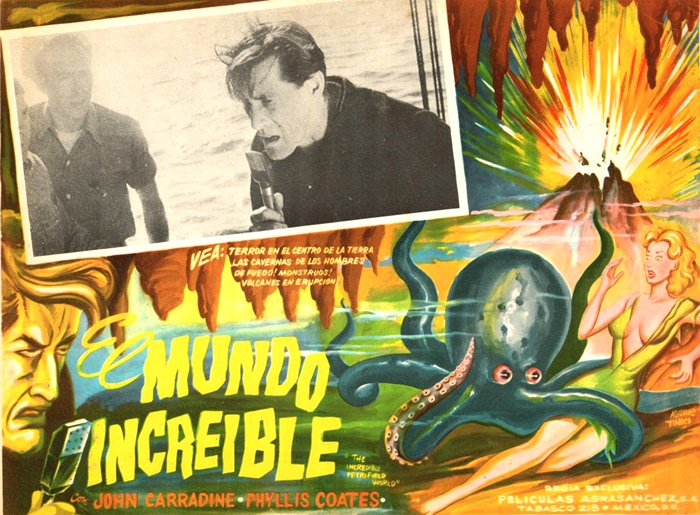
This is actually pretty good for a Jerry Warren film which means it's still pretty bad but could have been a whole lot worse. The poster writes a check ("Terror!" / "Monsters!") the film can't cash and the science elements are dated and ridiculous as is usually the case for this era, but the premise itself I quite liked. However, the budget isn't there to do much with it and there's not nearly enough plot to sustain things. In lieu of that, we get lots of talking and wandering around plus lots of cuts back to the surface where more people sit around talking. As far as drama and tension are concerned, the Dale character acts a bit bitchy at times, Craig and Lauri reveal their love for one another and the voyeuristic caveman falls for Dale and hopes she'll agree to his plan to kill off the others so they can have the cave all to themselves.


Despite the cheapness of the production, they filmed the underground scenes at Colossal Caves in Tucson, Arizona so at least those "sets" are convincing. There's also something unexpectedly lovely and (accidentally) poetic about the long diving scenes thanks to overbearing overhead lighting, bubbles and reflective surfaces mixed with ethereal stock music and the grainy black-and-white photography.


Brianne Murphy, Warren's wife at the time and co-owner of their company GBM Productions, was the production supervisor (as "G.B. Murphy") and dialogue director. She and Warren can also be spotted riding an airplane with Carradine. This was filmed in 1957 but not released until a few years later on a double with Warren's awful TEENAGE ZOMBIES. The budget is said to be a paltry 15,000 dollars (!), with 2K of that going to Carradine for two day's work and another chunk of it spent on making a rubber monster suit that they ended up not even using! The full running time is 66 minutes and the film is in the public domain so it's been released by a whole slew of labels on both VHS and DVD over the years.

1/2

Sunday, February 23, 2020

Journey to the Seventh Planet (1961)

... aka: Journey to the 7th Planet
... aka: Monstro do Planeta Perdido (Monster of the Lost Planet)
... aka: Objectif : Septième Planète (Objective: Seventh Planet)
... aka: Viaje al séptimo planeta (Travel to the Seventh Planet)

Directed by:
Sid (Sidney W.) Pink

How's this for optimism? It's 2001 and the world is entirely peaceful. All countries now get along and work together in perfect harmony for the betterment of all mankind. Instead of endless war, greed, ignorance and self interest, humans now have a collective insatiable thirst for knowledge, science and exploring the final frontier. Yes, I know this is just a cheesy old sci-fi movie, but the opening narration, woodenly delivered as it is, is so hopeful for a nice future for everyone that it can't help but put a smile on your face.

The United Nations is now leading the way in space exploration. Thus far teams of explorers - called the "space fleet" - have visited and mapped out every planet down through Saturn in their search for other life. We'll just make believe that Mercury doesn't have a daytime surface temperature that can melt lead and Saturn isn't comprised mostly of gas with an average temperature of -288 degrees Fahrenheit. As of yet, no sign of life has been discovered anywhere by the fleet... but we've not yet tried Uranus! Yes, the same Uranus that's basically a big ball of ice, gas and swirling fluids. And the same Uranus that doesn't even really have a surface to successfully land a spacecraft upon let alone a surface where one could hop out and go exploring. And the same Uranus that has an average temperature of -353 degrees F. I hope these guys bring a sweater!


Space Ship Explorer 12 is headed to the titular destination, where they will land, survey, map out and investigate the seventh planet over the course of ten days. They are also to look into a "radiation signal" that has been traced back to the planet. On board are girl-crazy American Captain Donald Graham (John Agar), who's obsessed with actress, model and former Miss Denmark Greta Thyssen and has "worked and schemed for two months" to get a date with her, only to have to cancel at the last minute so he could go on this trip. The British representative, and heading the mission, is the all-business Commander Eric Nilsson (Carl Ottosen). Lt. Karl Heinrich (Peter Mönch) is the young German novice who's making his very first trip to space. There's also Irish radio and radar technician Barry O'Sullivan (Ove Sprogøe) and atomic units expert Svend (Louis Miehe-Renard) from Sweden.

Once the men cross into Uranus' atmosphere, they all enter a state of suspended animation as an alien voice-over announces itself and its motivations. I have waited long for this moment. Give me your minds; your innermost thoughts. You are powerless. I shall drain your minds and bend your will to mine. You will submit and I shall possess you. Through your minds and bodies, I shall rule you and make your world mine! Once the men come to, they realize they've been under for quite some time; days or perhaps even months. They land the ship and make another startling discovery: Instead of the expected -200 degree frigid temperatures, noxious atmosphere made entirely of hydrogen, helium and methane gases and barren, rocky land made of frozen ammonia, they find the planet green and lush, with moderate temperatures, a low radiation level and an atmosphere similar to that of the Earth.


Before they can even run a thorough atmosphere test, something or someone opens their air lock for them. The men grab their guns and decide to take a look. Immediately, Svend recognizes the forest. It looks identical to the plot of woods where he spent his youth. However, the plants have no roots and the entire area is surrounded by a barrier that's penetrable but so cold on the other side it instantly freezes whatever breaks through. As Eric recalls his childhood of birch trees and a windmill, the images appear right on the horizon right behind him. But, as they soon discover, nothing on this planet actually exists. Whatever being is controlling things has the extraordinary power to take bits and pieces from the crew's minds; their thoughts, fears, desires and memories, and use those to create this deceptively welcoming environment.


Other pleasant scenery, namely seductive and scantily-clad young women, is being used either to distract or try to lure the men to their doom. Eric's family farm materializes and with it comes blonde, beautiful and bosomy village girl Ingrid (Ann Smyrner) and her sweet cakes, which he fondly remembers from his youth. U.N. biologist Lise (Ulla Moritz), whom Don was interested in dating back on Earth, appears outside the ship asking him to meet her later that night, followed by a surprise visit by Greta Thyssen herself, who does the same. And Karl is also haunted by the one who got away; childhood sweetheart Ursula (Mimi Heinrich), who eventually makes an appearance at a crucial moment to swipe a weapon. With it already established just what's going on, most of the men aren't going to fall for it, right? Well, they try their best at the start but their desires eventually get the better of a few of them.

Eric, Don and Karl decide to venture past the force-field like barrier. Inside is the Uranus they expected to see in the first place: freezing, rocky and filled with razor-sharp ice formations and "ammonia snow" which has no adhesive properties and acts more like quicksand. Inside they encounter a bubbling green substance that may contain the evil alien responsible. "You have come to me, evil, stupid men!" it says before unleashing a hairy, rodent-like one-eyed monster. After shooting out the creature's eye with their laser guns, the men flee back to their space ship. During a return trip, the main alien, which is a giant, super-intelligent brain capable of absorbing anyone who touches it, unleashes a giant tarantula on them, which they manage to crush with rocks. But clearly the brain creature itself isn't going to go down as easily, so they must concoct another plan.


This starts out promisingly enough. The general idea of an alien turning one's subconscious into a weapon and then crafting duplicate imagery based on memories is pretty ingenious, though this was possibly cribbed from an old Ray Bradbury story called "Mars Is Heaven!" that was published back in 1948. This is even a bit eerie upon the astronaut's initial arrival on the mysterious planet. But, sadly, the intrigue doesn't last for too long. Not much of interest is actually done once the premise is established and the action becomes a repetitive slog after awhile, only perked up by the appearances of the monsters. Setting expectations a bit lower, this works OK as colorful, silly sci-fi schlock. The dialogue is awful, the dubbing on the mostly Danish cast (except for Agar) is pretty bad and the sets and miniatures are cheap and unconvincing, but there's still some mild entertainment to be had here.


As for the special effects, we get a large, one-eyed brain creature that doesn't move aside from an eyelid that opens and closes and is usually covered with a psychedelic swirl effect. Other fx on the original cut were deemed so poor that they had to be redone once the film returned to U.S. distributor / financier American International Pictures and producer Samuel Z. Arkoff. Jim Danforth and Wah Chang then added the new rodent creature and other stop motion fx to replace many of the old ones. The tarantula effects were taken from Bert I. Gordon's Earth vs. the Spider (1958) and then tinted blue so they could be edited into this color film.


Prior to making this, Pink produced Bwana Devil (1952), a jungle adventure that single-handedly sparked the 3-D craze of the 50s, and THE ANGRY RED PLANET (1959), which was released with its own "CineMagic" gimmick and also a money-maker. Though born in Pittsburgh, he was a world traveler who lived in a number of other countries. He made this and the monster movie Reptilicus (1961) in Denmark but then moved to Spain and produced a number of other films there like Pyro: The Thing Without a Face (1964), The Sweet Sound of Death (1965) and The Witch Without a Broom (1967). Returning to the U.S., he produced Madigan's Millions, starring a pre-Graduate Dustin Hoffman in an early starring role.

Pink also co-wrote along with frequent collaborator Ib Melchior, who was from Denmark himself and also receives credit as montage director. Danish singer Otto Brandenburg croons the title theme song over the closing credits. The budget was around 75,000 dollars and the movie reportedly was highly profitable.


Journey received pretty wide theatrical distribution in North and South American and Europe and has been released in the U.S. a number of times on home video, starting with many VHS issuings. The Image laserdisc paired it up with Angry Red Planet. The first MGM Midnite Movies DVD release paired this up with INVISIBLE INVADERS (1958). Those two films were then later thrown into a four movie set from MGM that also included Strange Invaders (1983) and the remake of Invaders from Mars (1986). Finally, Kino Lorber restored this for a Blu-ray release in 2016. The print I viewed was the MGM release.

Related Posts Plugin for WordPress, Blogger...