... aka: Hosszú árnyak (Long Shadows)
... aka: House of Long Shadows, The
... aka: Kauhujen talo (House of Horrors)
... aka: La casa de las sombras del pasado (The House of Shadows of the Past)
... aka: Le manoir de la peur (The Manor of Fear)
Directed by:
Pete Walker
Most horror movies that become infamous earned their reputation via shocking content; graphic, tasteless and / or socially "objectionable" material. The key is to drum up controversy, go places others are unwilling to go and get people talking. And then you have those films that become notorious for entirely different reasons. Some are simply so terrible it's difficult to fathom how people could have ever made them with serious intentions. And then you have this anomaly, which quickly gained infamy as one of the biggest missed opportunities of all time. When you're bringing together four of the greatest horror stars of all time for the first time ever, it's going to be impossible to avoid setting the bar extremely high for yourself, especially when those actors are absolute genre royalty like Vincent Price, Christopher Lee, Peter Cushing and John Carradine. A lot of people fondly remember all four of these actors and also fondly remember the high quality of their better projects so the last thing you want to do is disappoint their longtime fans with something subpar or mediocre. Sadly, that's pretty much exactly what happened here, and critics of the day were merciless in ripping this thing apart. Horror fans didn't seem to care much for it either.
Now that plenty of time has passed and expectations have been somewhat tempered (most younger fans probably aren't even going to have expectations to begin with), we can now look at this once again minus some of the bias. Is it a masterpiece worthy of the talent on hand? Nope, it misses the mark there. Is it as bad as many critics said at the time? Absolutely not. Seeing all of these great veteran actors performing alongside each other and interacting in the same shots is so special that not even a mediocre script can diminish the enjoyment. Even better, the director makes sure that all four are allowed their moments to shine here.


American writer Kenneth Magee (Desi Arnaz Jr.), who's trying to rebound from disappointing sales of his latest novel "The Lie," arrives in London for a small publicity tour orchestrated by literary agent / publisher Sam Allyson (Richard Todd). Unlike all of those "over the top" classic novelists, the young, arrogant and brash Kenneth has a more contemporary attitude about his craft. Making money is "all that matters" to him, though he also enjoys some of the perks of being an author, namely access to a lot of women. As far as relationships themselves go, he doesn't believe in them. Sex is fine. Love doesn't even hit his radar. He still has a lot of growing up to do.
Sam thinks he's too sure of himself and is going to ruin his career by refusing to develop his talent further and take creative chances. After all, slumping recent sales are suggesting people are tiring of him writing about the same subject matter all the time. Over a discussion at lunch about classic literature, Kenneth smirks about the status of acclaimed authors like Tolstoy and Dickens. When Wuthering Heights comes up, he proclaims "Anyone can write one of those things!" That sparks a 20,000 wager that he can write something similar and just as good in just 24 hours (!) All he needs is an atmospheric setting, complete isolation and some quiet.
Coincidentally (or maybe not!), Sam has a friend named Sir Richard Thornton, who owns a remote rural property called Bllyddpaetwr in Wales that's currently in the process of being sold. The old manor house supposedly hasn't been occupied in 40 years and has no electricity, but it's the perfect setting for Magee to pen his next novel by candlelight. The bet is on.


After a brief detour at a train station, where the foreboding station master (Norman Rossington) warns that the home he's looking for is "cursed," the writer finally arrives at his destination on an appropriately stormy night. After fumbling through the dark, he finally locates a bedroom, lights some candles, sets up his typewriter and begins writing "Midnight Mansion." However, he's soon interrupted. Surveying his surroundings, he becomes suspicious that the home hasn't been unoccupied for 40 years like he's been told. There's fresh water in his room, the bedding has been washed and it's relatively clean... almost as if he, or someone else, was expected there. He then ventures out into the hallway, hears a noise and sees someone ducking into a room. Problem is, no one's supposed to be there and Kenneth was told that he has the only key.
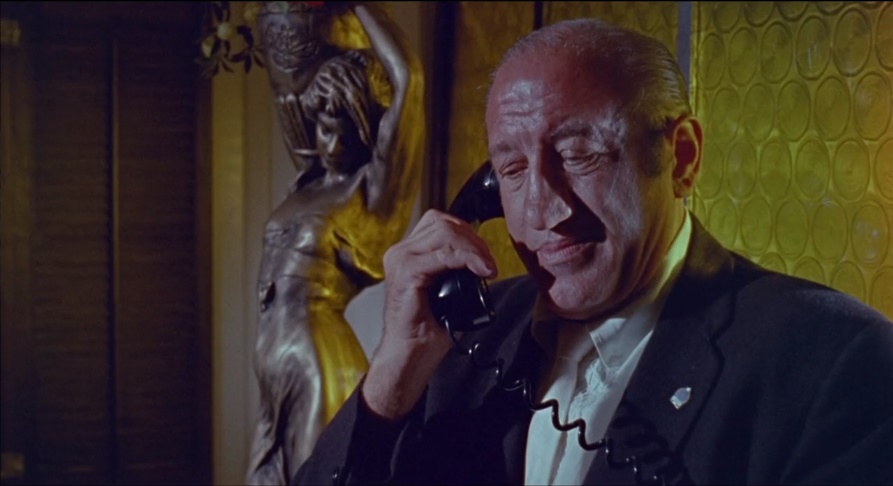
Kenneth is soon greeted (if that's the word for it!) by the elderly, grumpy Elijah Quinby (Carradine) and his sinister, hyper-religious daughter, Victoria (Sheila Keith), who claim to be the caretakers there. That's followed by the appearance of an old cloaked woman Kenneth had brief spotted at the train station earlier, who turns out to actually be masked young blonde Katherine De Corsi (Julie Peasgood), who Kenneth had briefly flirted with while in London. Speaking privately, she warns him that both of them will be killed if "they" - members of O.P.I.T. (The Organization for the Promotion of International Terrorism) - spot them talking. She, like most of the other people in this film, isn't who she claims to be.


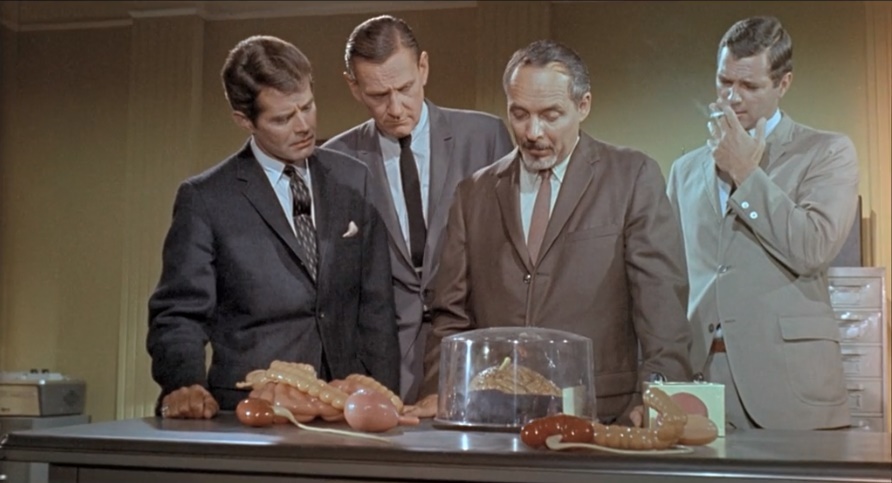
"Katherine" eventually outs herself as actually being Mary Norton, Allyson's personal secretary, and says he sent her there as a joke to distract him. Maybe she's telling the truth. Maybe she isn't. Other unexpected guests soon arrive and each seem to have their own key... and their own secret. Sebastian Rand (Cushing) claims to have been out driving in the horrible weather and has stopped there hoping for a place to spend the night. Soon after, Lionel Grisbane (Price) shows up there announcing himself as the eldest son of Lord Grisbane, adding that he's been living in America since World War II and has decided to pay one last visit to his ancestral home. Mr. Corrigan (Lee) pops in insisting he's about to purchase the property, but saw lights on and decided to investigate. Finally, a young, bickering newlywed couple; Diana (Louise English) and Andrew (Richard Hunter), swing by after having missed their train.
Kenneth eventually just throws up his hands in disbelief ("It's like I've gate crashed the social event of the year!") and stops even caring who's there or why they're even there. He's still got a book to write and 20 thousand dollars on the line, after all. Nonetheless, he gets dragged back out of his bedroom repeatedly when more horrific things start going on. I'd say it'd be hard to concentrate on your craft with people screaming and dying all around you.


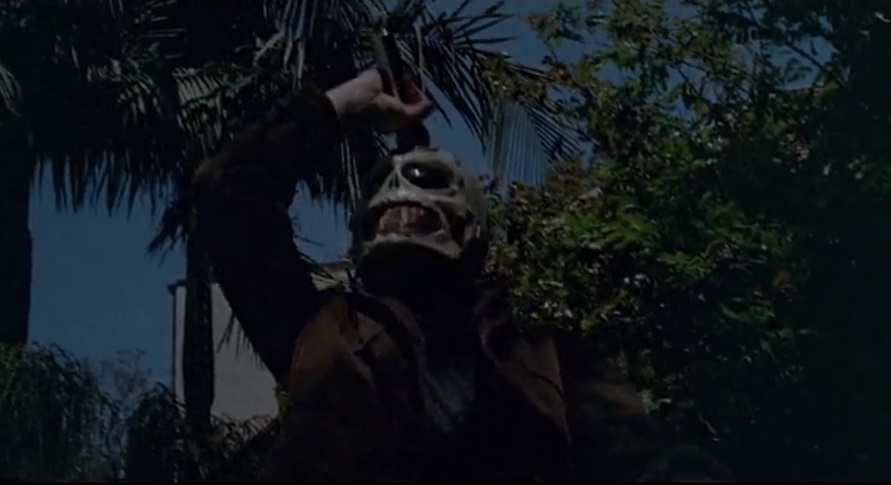
I can't reveal much more about who's really who and what's really what here without spoiling the entire film but let's just say there's a supposed family secret that's been locked away in the attic there for forty years. Said secret is a sadistic, psychotic man who supposedly murdered his pregnant girlfriend as a teenager and then had to be condemned to the attic ever since. He'd been fed for the past four decades by one of the guests but otherwise was unable to leave the small room for all that time and is now even madder than ever. Also, he's recently escaped. Remnants remaining in his cobweb-strewn room include destroyed toys, broken plates, dead rats, bones, claw marks on the walls and a dead, decaying corpse, and he's able to use secret passageways and underground catacombs to get around. Later murders involve everything from hanging and piano wire strangulation to sulfuric acid and poisoned wine.


While watching the four male horror legends (and Keith) do their thing is a real treat, there's no escaping the fact that this is otherwise a highly flawed film. The casting of Arnaz Jr. as the male lead proves to be an issue. Sure, he's got a famous family name to fall back on and perhaps they were banking on that, but he's not really charismatic enough to play this part, much of his dialogue delivery is awkward and stilted and he sticks out like a sore thumb trying to perform alongside such high caliber talent. Still, the fact he's surrounded by people who command interest just standing in the background helps us to somewhat gloss over his inadequacies.


The biggest issue here is really the writing. Michael Armstrong's (MARK OF THE DEVIL; SCREAMTIME) script boasts some sharp, witty dialogue and contains other fun material, but the plot is so dead-set on delivering twist after twist after twist it becomes ridiculously convoluted by the end; undermining a lot of the good that went on before. By the time the final plot revelations are revealed, this thing is so ridiculous it's downright insulting to anyone's intelligence. The film is at its best from the mid-point up to the climax, when the director finally has space to generate creepiness, suspense and a little excitement since he's no longer having to set aside time to have the actors reveal their second and third "true" identities.
Production values, photography, art direction, etc. are all solid, and an admirable job has been done to carefully shoot and light everything to capture a perfect throwback old dark house feel. We get a near-constant shroud of darkness yet are also able to see everything we need to see at the same time, so this is visually presented well.

This was "suggested by" the once-popular 1913 novel Seven Keys to Baldpate by Ohio-born Earl Derr Biggers, who's best known for his Charlie Chan detective novels. Keys had previously been adapted many times. It was the basis for a hit stage production and spawned half a dozen film versions in the silent era and 1930s. Just like with the Chan novels, this property was everywhere for a time but has rarely been resurrected since the 1940s.
Director Walker curiously didn't develop much of an international name for himself until the DVD era despite the fact many of his films had already been well-distributed on VHS in the prior decades. He spent most of the 60s making TV commercials and black-and-white “glamour” (stag) shorts showcasing the charms of nude models. By the end of the decade he'd graduated to profitable feature length soft sex films and then finally ventured into the horror genre, directing the handful of films he's best remembered for today. His work includes Die Screaming Marianne (1971), The Flesh and Blood Show (1972), FRIGHTMARE (1974), House of Whipcord (1974), THE CONFESSIONAL (1976), Schizo (1976) and The Comeback (1978). Long Shadows (his only PG-rated genre effort) was his final film before retiring from filmmaking for good.


Produced by Yoram Globus and Menahem Golan of Cannon Films, the film reputedly had a healthy 7.5 million budget but was a box office bomb and then quickly spat out on home video with little fanfare in 1984 by MGM / UA after its unsuccessful theatrical run. It wouldn't be until 2015 that it received a restored DVD and Blu-ray release courtesy of Kino Lorber, whose release also comes with a commentary track from the director.
★★1/2