.
.
.

Wednesday, September 4, 2013

Trauma (1962)

... aka: Appuntamento col cadavere (Appointment with the Dead)

Directed by:
Robert Malcolm Young

A psycho is running rampant in the small town of Oakmont and fifteen-year-old orphan Emmaline (Lorrie Richards) is shaken up after having to go to morgue to identify the body of one of the victims. Later that night she returns home to the large mansion she shares with her wheelchair-bound aunt Helen Garrison (Lynn Bari), who tells her headstrong niece to stop going out at night all alone less she wants to become the next victim. Emmaline is awoken from her sleep by the sounds of arguing and then screaming outside by the swimming pool. Before she can make it out there, her aunt has been drown. Witnessing the murder traumatizes Emmaline so badly she goes into a deep shock and suffers from amnesia. She's shipped off to live in Europe and undergoes years of therapy while developing a talent for painting. Finally cured, she marries Warren Clyner (John Conte), a much-older man who'd had business dealings with her late aunt, and the two return to States to take care of business. Since Emmaline was the last remaining descendant of the Garrison family, she's acquired a considerable fortune, which can now be dispersed to her and her husband because she's just turned 21.


Upon arrival, Warren instructs the hired hands not to stoke the fires of the past by saying anything that'll make Emmaline recall her previous life. She's since forgotten it and, in fact, cannot remember anything at all about her life after witnessing Helen's murder. Luther Schoonover (Warren J. Kemmerling), the handyman and caretaker of the estate who's known Emmaline since she was a child, and his nephew Craig (David Garner), an architect who's just here helping his old uncle out, are also around to help get things in order. Warren immediately calls up lawyer Thaddeus Hall (William Bissell) about getting the inheritance and learns they'll have to wait six to eight weeks to get it. Till then, it's just biding time. Despite being newlyweds, Warren seems highly annoyed by his attractive, sweet new wife. He's out of town a lot, ignores her when he is there, has a tendency to snap over small things and isn't the least bit interested in her paintings or her feelings. All he cares about is the money. It's no wonder Emmaline then finds herself being drawn to Craig instead.


Being back in the home triggers brief memories in our heroine, but just like dreams, they only come to her in small bits and pieces and are quickly forgotten. A image here, a voice there... None of it makes much sense. Her subconscious memories sometimes even manifest themselves in her paintings. One of a horse stable larger than it appears gets Craig thinking that there may be a secret room hidden inside and, sure enough, there is. Once he finds it behind some paneling, he and Emmaline discover it's a child's room. That child was Everett; Emmaline's mentally-impaired cousin, who suffered a brain injury when he was just 3 years old and became emotionally stunted. Helen claimed to the outside world that Everett had died when he was eight. In actuality, she faked his death and kept him hidden away in the secret room as the family shame. Since Warren turns out to be a con artist in desperate need of fast cash and Everett may still be alive and lurking the grounds, which of the two actually murdered Helen?


Advertised as an all-out horror film (the biggest startle is actually the announcement of the opening credits 15 minutes into it!), this is more of a mystery / psycho-drama. It's very low-budget (69,000 dollars) and very talky, but it's done with some basic skill, the mystery elements hold together reasonably well and it wisely saves most of its curve balls for the last 15 minutes. Top-billed "stars" Bari (who'd had lead roles in Shock [1946] with Vincent Price and The Amazing Mr. X [1948] with Turhan Bey) and Conte are not the actual stars. That honor goes to Richards; a pretty, competent actress whose only other credits were on TV and in the same year's fantasy-adventure The Magic Sword. In fact, Trauma is her last known credit. This was the only film for its director, who is best known as a writer who'd pen The Crawling Hand (1963), Escape from Witch Mountain (1975) for Disney and episodes of Night Gallery and Tales of the Unexpected.


Now in the public domain, Trauma is easy to find online to view for free (it's on both archive.org and Youtube). The most common DVD release is through Alpha Video Distributors.

★★1/2

Monday, September 2, 2013

Lady in a Cage (1964)

Directed by:
Walter Grauman

Some superb opening credits - a couple making out in their car in broad daylight, a child being mean to a passed-out drunken bum, firecrackers exploding trash cans, busy drivers obnoxiously laying on their horns, a dead dog lying in the middle of the road that passers-by simply gawk at it - set the stage for this potent commentary on man's casual inhumanity to his fellow man, looser mores and the increase in everyday violence and cruelty in society. Yes folks, the world sure can be an ugly, ugly place. The radio is full of news stories about traffic accidents, international strife, war, nude decapitated murder victims and other not-so-wonderful things. People aren't quite as nice, friendly and trust-worthy as they used to be. And some take it one step further in their willingness to take advantage of you when you're at your most vulnerable. Vulnerable like Cornelia Hilyard (Olivia de Havilland). Cornelia's a successful, wealthy writer who lives in a large, well-kept home full of antiques, silver and other expensive valuables, but she's recently broken her hip and has to walk with a cane. Unable to use the stairs, she's even had to install an elevator to move between floors. A very slow... and, as it turns out, very unreliable elevator.


Either divorced, never-married or widowed, Cornelia shares her home with her unhappy, almost-30-year-old grown son Malcolm (William Swan) and there's a strange, co-dependent and somewhat unhealthy dynamic going on between the two of them. They refer to each other as "darling" and "love," she gets kisses in the morning, leans in and complements the smell of his aftershave and gets giddy that he's left behind a "love letter" for her. If one didn't already hear him call her "mom" then one would assume the two are actually a couple, not mother and child. Malcolm shoots resentful looks her way when she's not looking and seems like he can't get out of the house soon enough for a trip he's going on. Malcolm won't be back for several days, but seeing how the letter he's left behind (which Cornelia has yet to read) has lines like "I can't go on this way" and "I'll kill myself" on it, one can assume the relationship is no longer working for him. Malcolm leaves, Cornelia gets in her elevator to go back upstairs, it lifts off the ground a good eight or so feet and then the power goes out.


Trapped in the elevator on a sweltering summer day, Cornelia uses an emergency button which rings an alarm bell outside her home. Instead of getting a concerned passer-by's attention, the bells attracts mentally-disturbed, stuttering wino George L. Brady Jr. (Jeff Corey) who pops in long enough to raid her liquor closet, break stuff and scream "Repent! Repent! Repent!" George steals a few things, runs down to the pawn shop and then enlists the aid of sleazy hustler Sade (Ann Sothern) in clearing out the place. George also managed to attract the attention of violent, formerly-incarcerated, woman-beating hoodlum Randall O'Connolly (James Caan), his sidekick Essie (Rafael Campos) and his spacey, drugged out girl Elaine (Jennifer Billingsley). Once Randall's on the scene, he promptly knocks out George and forces Sade to help them carry stuff out of the house. Helpless and trapped, Cornelia has no other choice but to observe all of the frantic action as it plays out before discovering the intruders are planning on killing her. Can she escape her "cage" (and the house) before it's too late?


Despite the sometimes clumsy use of voice-over, this top notch shocker - understandably quite controversial upon release (and even banned in the UK) - has managed to retain its bite for 50 long years. The premise is completely plausible, the character actions ring true, the violence is upfront and sometimes startlingly brutal, the entire cast give highly effective performances and the ending is truly surprising. Sothern is the stand-out amongst the supporting cast and de Havilland (in a role originally intended for Joan Crawford) gives a bravura, go-for-broke performance that's among her best work in a long and distinguished career. It's tense, suspenseful and unpredictable, tautly directed and written and quite beautifully photographed by Leo Garmes.


The film didn't do much to bolster director Grauman's future big screen prospects, so he ended up primarily working on television projects the remainder of his career. He made his feature debut with the jungle shocker / Allison Hayes vehicle The Disembodied (1957), and from there went on to make the made-for-TV horror flicks Daughter of the Mind (1969), Crowhaven Farm (1970), Are You in the House Alone? (1978), Covenant (1985) and Nightmare on the 13th Floor (1990).

★★★1/2

House on Haunted Hill (1959)

Directed by:
William Castle

"There'll be food and drink and ghosts... and perhaps a few murders."

Haunted Hill opens with the sounds of screaming, moaning, laughing and rattling chains over a black screen, all of which wonderfully bring to mind a carnival spook show; a spirit this low-budget outing successfully tries to emulate. Millionaire Frederick Loren (Vincent Price) is hosting a party for his wife Annabelle (Carol Ohmart). The two have rented a large, modern-looking mansion (exteriors were shot at the Frank Lloyd Wright-designed Ennis Brown House in L.A.) and have invited along five guests; promising each 10,000 dollars if they successfully spend the night there. Baby-faced test pilot Lance Schroeder (Richard Long) could really use the money and so could pretty Nora Manning (Carolyn Craig), an apparently underpaid employee of Frederick's whose entire income goes to support her family. Psychiatrist David Trent (Alan Marshall) is interested in coming along in hopes that it'll help in his studies on hysteria (plus he's just greedy) and newspaper columnist Ruth Bridgers (Julie Mitchum) is writing a feature article on ghosts (plus she's also in debt because of a gambling problem). Our group is rounded out by the nervous Watson Pritchard (Elisha Cook Jr.), a jittery, traumatized drunk who used to live in the house and can attest to its bad reputation.


Each guest - strangers all - arrive in an individual funeral car and are greeted to a strong steel door closing all by itself and a chandelier falling and almost hitting Nora immediately upon entering. When the clock strikes midnight, the caretakers leave and lock everyone inside, and once that happens, there's no way out. We soon learn that Frederick and Annabelle aren't a happily married couple. In fact, they can't stand one another. He's insanely jealous and she flaunts her infidelities in front of him. Frederick reminisces about her trying to kill him ("Remember the fun we had when you tried to poison me?") and offers to pay her a million bucks for a divorce but she refuses. Either one or perhaps both have an ulterior motive for this little get-together. Since she's previously already tried to bump him off and it was her idea to hold the party in this particular house and since he has a history of losing wives prematurely (all three of his previous ones died under mysterious circumstances) and it was his idea to invite a bunch of complete strangers, either may want to use this opportunity to end their union permanently.


Seven people have been killed there (stabbed, dissolved in an acid vat in the cellar, etc.) including Watson's own brother, and by the end of the night there are bound to be more. Loaded pistols in coffin-shapes boxes are passed out as party favors, an organ plays itself, blood drips from the ceilings, lights flicker, a noose seems to move all by itself, a severed head is found in a suitcase, secret passageways are discovered, Lance is conked over the head, Nora keeps seeing visions of a creepy, floating old lady and Annabelle is finally found hanging in the stairwell... but all is not as it appears to be as several last-minute plot twists are thrown out to cap things off. Thanks to a good cast, clever and often highly amusing dialogue courtesy of Robb White and some classic old-school scares (a few of which still work quite well), House has managed to retain its charm and sense of fun all of these years later.

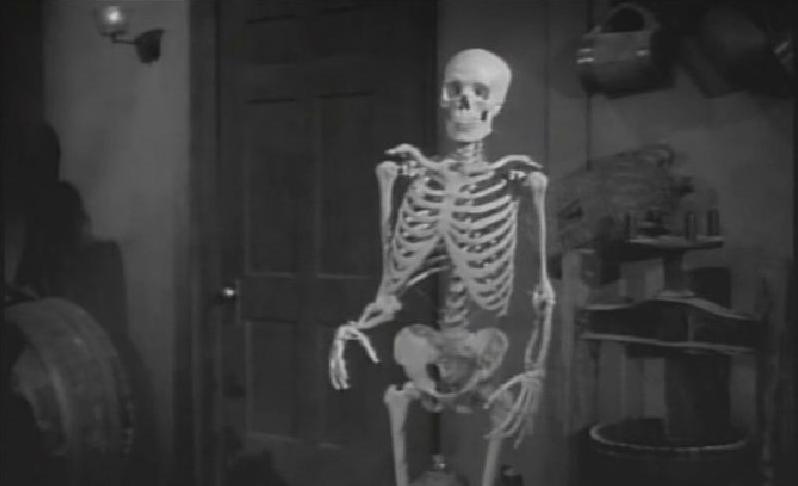
As with most Castle films, this was released in some theaters with its own gimmick. This time it was "Emerg-o;" a pulley system which flew a plastic skeleton over the audience's head. Filmed on a budget of just 200,000 dollars, House went on to make millions. It's success even encouraged Alfred Hitchcock to make his very own horror film; the following year's PSYCHO (1960). Warner first issued this on DVD and it was followed by a colorized version (distributed by 20th Century Fox) a few years later. And of course, there's always the remake...


House on Haunted Hill (1999) was the first effort from Dark Castle Entertainment (founded by Joel Silver and Robert Zemeckis) and was also one of the first films to usher in the highly-annoying contemporary remake trend that has yet to die. That version (starring Geoffrey Rush in Price's role and directed by William Malone) reused the same basic story (though upping the reward to a million bucks), piled on the KNB gore and added a new back story to the haunted home, but it forgot to be very fun. Still, it was far less offensive than the same year's utterly worthless remake of The Haunting.

★★★
Related Posts Plugin for WordPress, Blogger...