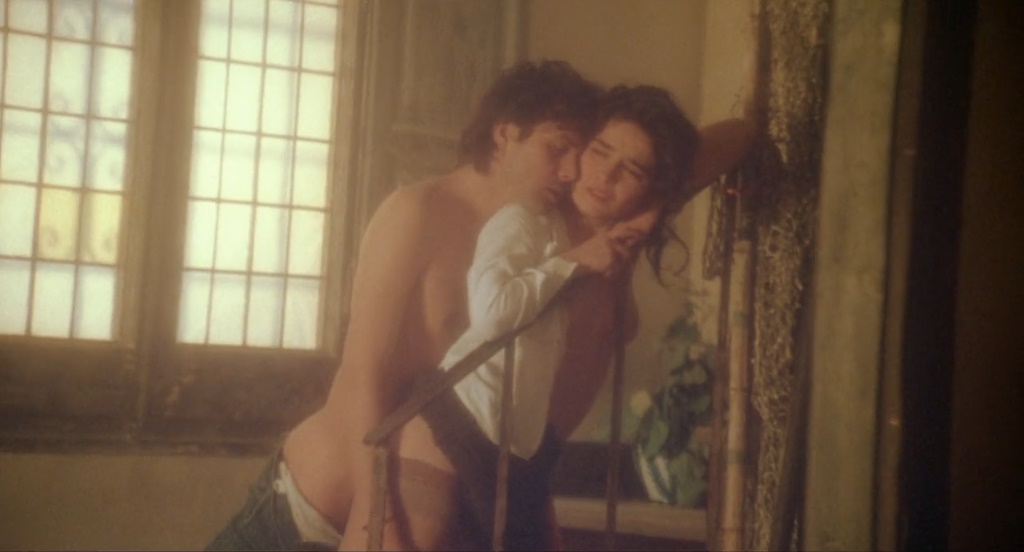
.
.
.
Showing posts with label psychological horror. Show all posts

Saturday, April 13, 2024

Scream of Fear (1961)

... aka: Ein Toter spielt Klavier (A Dead Man Plays the Piano)
... aka: Kyôfu (Fear)
... aka: La casa del terrore (The House of Terror)
... aka: Pelon tunne (A Feeling of Fear)
... aka: Taste of Fear, A
... aka: Un grito de terror (A Scream of Terror)

Directed by:
Seth Holt

Director Seth Holt started out as an actor before transitioning into editing at Ealing Studios, where he worked as an assistant (usually sans credit) on such classics as Dead of Night (1945) and, one of my personal favorites, Kind Hearts and Coronets (1948). From there, he moved on to primary editing, producing and, finally, a single shot at directing (the crime drama Nowhere to Go) at Ealing before the studio was absorbed by the BBC in the late 1950s. While Nowhere to Go was a box office flop and critical failure, it was enough to get his foot in the door with Hammer, who hired him for Scream of Fear (originally titled Taste of Fear). Instead of suffering from a sophomore slump, Scream was both a commercial and critical success in the UK, U.S. and throughout much of Europe. Despite that, he'd have a difficult time securing directing jobs until his death and was involved in a number of projects that either ultimately got assigned to other filmmakers or were abandoned altogether.

Holt is almost exclusively known these days for a trio of genre films he was able to make with Hammer, which also included the excellent The Nanny (1965) starring Bette Davis, and the lesser but still not bad Blood from the Mummy's Tomb (1971), which he was never able to finish because he died of a sudden and unexpected heart attack at the age of just 47 (producer Michael Carreras had to step in and complete the final week of shooting). What's obvious in retrospect is that he clearly should have been given far more chances to direct than he was, and Hammer in particular should have utilized him far more than what they did.


Having spent ten years away in Italy, wheelchair-bound Penny Appleby (Susan Strasberg), who was crippled in a horse-riding accident, returns to France to stay with her estranged father (Fred Johnson). Expecting him to meet her at the airport, she's surprised to instead see he's sent his chauffeur Robert (Ronald Lewis, who also starred in William Castle's MR. SARDONICUS this same year) to retrieve her. On the drive to the family villa, Robert informs Penny that her father went away four days earlier, he doesn't know where he went, doesn't know when he'll be back and that he has recently been ill but is now apparently doing better, at least well enough to travel abroad.

Upon arriving at her new home, Penny meets her stepmother Jane (Ann Todd) for the very first time and, bucking the evil stepmother stereotype, she seems friendly, affectionate, compassionate and even a bit motherly. They've transformed the father's sitting room into a bedroom for her, purchased new furnishings, put in ramps for her chair and even installed a buzzer that rings down to the kitchen and the parents' bedroom if she ever needs anything. As for the whereabouts of the father, Jane informs her that he went out out of town on a "business deal," even though she pleaded with him not to. Seeing how he's not seen her for an entire decade, it's basically impossible for Penny to not feel just a little hurt by his absence.


Penny has recently been through a lot of trauma and is in an especially vulnerable, perhaps even emotionally unstable, state. She didn't want to leave Italy, which has been her home since her parent's divorce, but felt she had no other choice after the passing of her mother and then the death of her nurse / best friend (perhaps even lover) in a mysterious drowning accident. After losing the two closest people to her, she grew depressed and suicidal, and that's when she received a letter from her father asking for her to return to France. It doesn't take her long to regret taking him up on the offer.

Her first night there, she gets up to fix a rattling shutter, sees a candlelight flickering in the summer house across the courtyard and goes to investigate. Inside, she's startled to discover what appears to be the corpse of her father. Panicking, she tries to wheel away and ends up falling into a swimming pool. She's saved by Robert and, when she awakens, she's being tended to by local physician Dr. Pierre Gerrard (Christopher Lee), who also happens to be her father's personal doctor (and his chess buddy). Robert had made mention already that Gerrard has recently been a regular presence in the home, and he appears to be plotting something with the stepmother. Determined to prove she's not a "mental defective," Penny insists they all go to where she saw the corpse, but no body is there and everyone claims the summer house is always kept locked up, anyway.


Unlike most other victimized, weepy heroines in films like this, Penny is refreshingly not about to just roll over and play the victim. While she's emotional and a bit neurotic, she's also smart, plucky, headstrong and maintains her wits. She knows what she sees isn't a delusion, senses some scheming going on behind her back and acts accordingly, approaching everyone around her with suspicion and distrust. She snoops around. She asks questions. She refuses pills from Dr. Gerrard, starts growing a bit distant from Jane and, while Robert seems like a potential ally (and a potential love interest), she has her apprehensions about him, as well. She's also careful about giving certain characters information that may conceivably be used against her, including additional sightings of her father's corpse around the house. Strasberg is one of those actresses who usually doesn't make an overwhelmingly positive nor negative impression on me, but she's pretty wonderful in this particular role.


Though Lee spoke highly of this film and the director in interviews, and said it was perhaps Hammer's best overall production, he's interestingly the weakest link of the central cast. That's due in part to his failed attempt at a French accent and in part to the fact his character simply isn't all that interesting. Thankfully, the other three stars are all great. Lewis is extremely magnetic as the chauffeur and had all that it took to become an A List leading man. Sadly, that never happened due to his alcoholism, which eventually led to bad press, troubles with the law, divorces, bankruptcy and a damaged career, culminating in his suicide in the early 80s. Often unfairly overlooked here is Todd, who gives an excellent performance; perhaps the best performance. The way she uses subtle facial expressions and body language to show cracks beneath the surface of her warm, caring exterior tells you this woman was a complete pro.

In addition to the strong direction and acting, this excels in the screenplay department too, with fine dialogue, characterizations and plotting. Just when you think you're getting a handle on what's going on and working out who's conspiring with who to get what (a sizable inheritance is naturally at stake), Jimmy Sangster's script pulls the rug out from under you and unleashes some genuine surprises in the last 20 or so minutes. These aren't surprises pulled out of thin air either, but one's carefully built into the story. This is also a handsome looking film. Multi-BAFTA winner and three time Oscar nominee Douglas Slocombe (who'd go on to work with Steven Spielberg, Roman Polanski and other notables) does a great job shooting it, using lots of low lighting, shadows and lush soft focus. Other production people, from composer Clifton Parker to production designer Bernard Robinson, offer up strong work, as well.


This film's success led Hammer to branch out from their usual period-set classic monster movies to produce more modern psychological genre films. The initial cycle of these (there would be another in the early 70s) included Maniac, Paranoiac (both 1963), Nightmare (1964), Fanatic (aka Die! Die! My Darling!), Hysteria and the aforementioned The Nanny (all 1965). Though some of these are better than others, all of them are at least decent.


Released theatrically here in the U.S. by Columbia (who also handled the British, Canadian and Mexican releases), this then turned up on home video (with rather horrible-looking box art) by RCA / Columbia in 1989. Since, there have been quite a few Blu-ray and DVD releases, including from Sony (as part of their "Icons of Horror" series) and Mill Creek (as part of their "Hammer Horror Collection" series).

Easily besting the above is the 2019 BR release on the UK label Indicator ("Volume Four" in their Hammer line of box sets). It not only comes with three other films; THE REVENGE OF FRANKENSTEIN (1958), THE TWO FACES OF DR. JEKYLL (1960) and The Damned (1962), plus plenty of accompanying materials for each of those, but also a wealth of Scream of Fear extras. Included are over three hours of archival interview material with Sangster (some video, some audio), an 82-minute archival audio interview with Slocombe, new interviews with Desmond Davis (the camera operator) and John Crome (the assistant sound editor), a rare condensed Super 8 version, profiles on actress Todd and composer Parker, a 36-page booklet and much, much more.

★★★1/2

Sunday, March 31, 2024

Il miedo del diavolo (1986)

... aka: Dämon in Seide (Demon in Silk)
... aka: Dangerous Obsession
... aka: Devil's Honey, The
... aka: Divine Obsession
... aka: Mrs. Brown
... aka: Plaisirs pervers (Perverse Pleasures)
... aka: Polttava himo (Burning Lust)

Directed by:
Lucio Fulci

In between a three-year run of popular early 80s gore films that he's best known for today and his later return to gore films at the end of the decade after he built a reputation for such films on the home video market, director Fulci was left in no man's land for a little while. Between 1983 and 1986, he attempted to broaden his horizons and made four films that were markedly different than what he was doing in the bookmarking years. While the Italian / Mexican / Spanish co-production CONQUEST (1983) piled on the gore per his usual, it did so within a Conan-inspired fantasy film context and with (literally!) cloudy artistic / visual aspirations. The New Gladiators (1984) was his attempt at a futuristic sci-fi action film in the same vein as Rollerball or The Running Man, while the almost hilariously glossy MURDEROCK (1984) attempted to meld your usual slasher flick with sweaty, Flashdance- style dance numbers and was relatively tame by Fulci's gore-soaked 80s standards. 

Finally, there was this "psycho erotic thriller" that the director claimed in a 1995 interview was never intended to be erotic nor thrilling but instead a dramatic character study about two lost souls. Now that I've actually seen the film, I see just where he's coming from.


Though it may just be a coincidence (unlikely, but we'll be fair here...), it's worth noting that The Devil's Honey went into production just one week after the erotic drama 9½ Weeks debuted in Italy. While Adrian Lyne's influential film flopped here in America during its theatrical run, it did big business in more liberal markets overseas and was a hit in Italy right out of the gate. Shot way back in 1984, the film managed to generate a lot of pre-release press buzz due to its strong sexual content and sadomasochistic themes, the MPAA slapping it with an X rating, the delayed release and offended test audiences (supposedly) leaving the theater in droves. In other words, it already had a reputation before most people even had a chance to see it. Ironically, this film, which appears to have been influenced by Lyne's work in some regards, is actually far more sexually graphic yet generated zero of the same controversy.

Stefano Madia, a baby-faced thirty-something with messy hair and designer stubble who's about the closest approximation to a Dollar Store Mickey Rourke as one could possibly imagine, has the role of Johnny. He also has the perfect occupation for the lead in one of these things: Saxophone player. Being a musician not only makes him popular with the ladies (and gay studio engineer Bernard Seray), but also makes sure a blaring sax is present during most of the sex scenes just like in every other 80s and 90s erotic film. This even takes it an amusing step further by presenting the sax itself as a literal object of arousal, with our protagonist pressing it up against his sort-of girlfriends privates and performing a song to bring her to climax in the film's very first scene.

After Johnny's little romp in the recording studio with his girl Jessica (Blanca Marsillach), we then meet up with surgeon Dr. Wendell Simpson (Brett Halsey). He calls home to inform his maid that he'll be working late and to relay that info back to his wife. Of course, "working late" is code for going to a sleazy pay-by-the-hour hotel with a prostitute. That opens the door for another erotic scene that's perhaps even stranger than the first. When the hired help (Eulàlia Ramon) gets a run in her stocking, she tries to fix it with red nail polish (?), which then prompts Wendell to instruct her to masturbate with the little brush (!) and then paint her crotch red (!!) He gets so excited watching her he finishes prematurely. On her way out of the door, the unsatisfied sex worker chimes in that having sex with him "is worse than fucking a monster" and they then exchange some other kind words ("Dumb hooker!" "Freak!") with one another.


Wendell may be getting his kicks on the side, but his wife Carole (Corinne Cléry) is on to him and starts following him around town. Her attempts to seduce him, or even talk to him, prove unsuccessful, so what's a neglected, middle-aged housewife to do with herself? Not much it turns out. Meanwhile, Johnny and Jessica are having their own issues. Even though she'll let him blow saxophone spit into her passion pit, she has yet to officially consummate things with him and cringes any time he tries to. He, on the other hand, is aggressive and pushy to the point of basically being a rapist whenever he's alone with her. In an attempt to speed her along, he forces her hand down his pants as he erratically drives down a country road on his motorcycle. Unlike Carole's tit-outta-the-slip bedtime routine falling on blind eyes, Johnny's more forceful technique somehow works and Jessica soon finds herself pregnant.

Things take a turn for the worse after Johnny hits his head on a rock after a motorcycle crash, which starts plaguing him with terrible headaches and causes him to lose focus on his recording career. He's soon passing out and in need of an emergency operation. Dr. Simpson is called in. Unfortunately he's called in immediately after having another argument with Carole ("You perform for strangers but never your wife!"), which ended with him tossing her out of his car ("There's a taxi stand. Take a cab and fuck off!") and her threatening divorce. This causes him to zone out during the surgery and Johnny ends up dying. Though it's never established whether he died due to negligence or was going to die from his injuries regardless, Jessica blames him for it all the same.


What follows is your standard psycho-thriller with an increasingly-crazed Jessica plotting to destroy the doctor's life. She starts out with notes ("Why did you let him die?) and threatening phone calls ("Killer!"), then pops up in the back seat of his car one day brandishing a gun. She forces him to drive her to the same seaside country villa she lost her virginity at, then chloroforms him, ties him up, destroys his car with an axe and terrorizes him a variety of ways. She threatens to hang, drown, stab and unleash her angry dog on him, chops him in the face with a hatchet, burns him with hot candle wax, walks him around on a leash and makes him eat dog food. In between that she strips, taunts him by walking around naked all of the time, masturbates, rubs Wendell's bloody face in her crotch and has sex fantasies / flashbacks about her deceased lover forcing her do odd things like making amateur porn tapes and sticking a pistol in her vagina.


While it's extremely common for people who make sleazy movies who don't want to admit they make sleazy to try to justify that by feigning artistic pretentions, I actually agree with Fulci when he said this was wrongly written off as a soft core sex film. Though there's endless nudity (including obviously exploitative close-up shots of female genitalia and crotches being rubbed), sex scenes and make-out sessions, that doesn't necessarily mean it's here for sole purpose of being erotic or stimulating. In fact, the primary characters are all so psychologically screwed up that every one of the encounters is awkward, uncomfortable and / or forced in some way. The movie instead seems to be pretty pointed in its commentary that the wrong kind of sex with the wrong kinds of people can be both unhealthy and destructive.

The frustrating Jessica can never seem to decide whether she enjoys or is repulsed by sex. Flashbacks provide some insight and indicate that any opportunity for a traditional, healthy romantic relationship (where consensual sex is an expression of love) was shattered when she fell for the wrong guy. She's now landed in a black-or-white realm of victim or aggressor, where only extreme dominance or extreme submissiveness exist on her sexuality spectrum. Her chosen path to regain control and banish the ghost of traumatic relationship past is to step into her initial abuser's shoes. (For the record, I'm not trying to imply this is an acceptable path to take - I'd personally recommend therapy over kidnapping and torture - just the one plausibly taken here by Jessica, who's mentally imbalanced after all.)


Having previously starred in the semi-notorious hit The Story of O (1975), which also dealt with sadomasochistic relationships, Cléry is cleverly cast here I suppose, but she's pretty much wasted, isn't given much of interest to do and vanishes by the midway point. However, she does get naked a few times and is involved in a memorably humiliating scene where she tries to reconcile with her husband at his behest only to get rejected yet again after pleading with him to "Treat me like a whore!" Third-billed Marsillach (younger sister of Cristina, from Argento's OPERA), is the film's real star, with Halsey her primary support, and both actors do a pretty good job with their roles.


This was originally released on home video here in the U.S. in 1989 by A. I. P. / Panther Entertainment under the title Dangerous Obsession. Though I've read this version is cut, the video box claims to its unrated and runs 83 minutes, which is the same length of the uncut version later released on DVD by Severin and Blu-ray by both Severin and 88 Films. Both releases come with the same interviews with Halsey, Cléry, producer Vincenzo Salviani and composer Claudio Natili.

★★1/2
Related Posts Plugin for WordPress, Blogger...