.
.
.

Sunday, December 16, 2012

Werewolf of Washington, The (1973)

Directed by:
Milton Moses Ginsberg

The horror genre always seems to go in cycles and there are always trends that are popular, go away and then make a comeback years later. Right now zombies and sparkly teen vampires are the big thing but that will eventually change once they wear out their welcome (thank God in the case of the latter). For some unknown reason werewolves saw an increase in popularity during the early 1970s. There was WEREWOLVES ON WHEELS (1971), THE RATS ARE COMING! THE WEREWOLVES ARE HERE! (1972), THE BOY WHO CRIED WEREWOLF (1973), the British THE BEAST MUST DIE (1974) and LEGEND OF THE WEREWOLF (1975), the made-for-TV movies MOON OF THE WOLF (1972), SCREAM OF THE WOLF (1974) and the hard-to-believe-it-was-actually-made WEREWOLF OF WOODSTOCK (1975) and others. Usually these are spurred on by the success of one particular film that becomes a hit, but I can't quite place my finger on what kick started the sudden boost in lycanthrope films at this time. My best guess is the international success of the Spanish Waldemar Daninsky movies starring Paul Naschy, but that's just a guess.


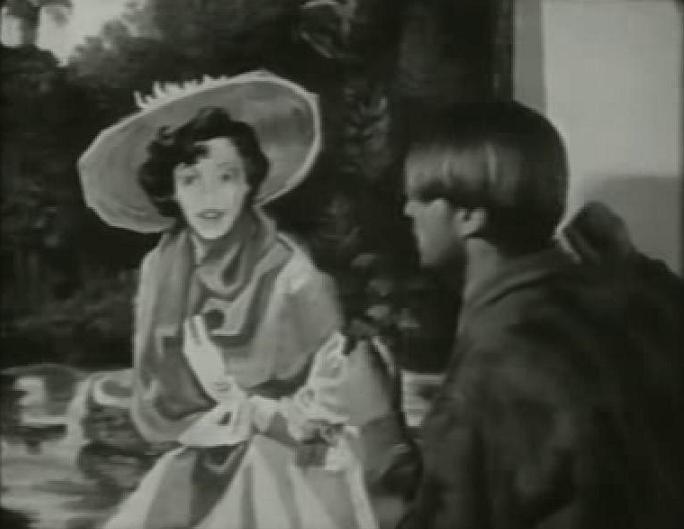
Jack Whittier (Dean Stockwell), member of the Washington Press Corp and its youngest rising star, wants an easy way out of his relationship with the U.S. President's daughter Marion (Jane House), so he arranges for a reassignment to Budapest. After a stint there and on the very night he's scheduled to return home, his car breaks down on a country road. After running into a band of gypsies, he's attacked and bitten by a wolf. He kills the wolf with a silver-tipped cane; a gift from his new Hungarian girlfriend, and then looks down and notices that the wolf is now a man. The authorities in Hungary strangely just brush the incident aside and, even more strangely, the dead man's mother tells Jack that her son needed to die and then gives him a pentagram ("the mark of the beast") necklace and informs him to "wear this charm over your heart always." After returning to America, Jack - who's a little foolish and lot arrogant - decides not to heed the gypsy's warning and immediately flushes the silver pentagram down the toilet. Uh oh.


Jack is appointed as the assistant U.S. Press Secretary and speech writer under the President (Biff McGuire), an aloof, good old Southern boy who is sick of hippies and "the current permissive trends" in this country. Jack looks up to him, just a little, and refers to him as "...a cross between Abraham Lincoln and Jesus Christ." He's still in love with Marion but she's gotten herself engaged while he was away. On the next full moon, Jack transforms and kills the drunken, obnoxious wife of a Supreme Court candidate (Nancy Andrews), who was embarrassing the party, anyway. Next up is a feminist magazine publisher (Jacqueline Brookes) Jack used to work for who doesn't always write the most flattering pieces on the President. From there, he goes after a couple who witnessed his last murder, only getting a chance to kill the man. In between, Jack tries to confide in the President and his army commander friend (Beeson Carroll) about what's going on but nobody believes him. He takes out a guard at the Pentagon, starts to transform during press conferences, board meetings and aboard a helicopter and gets his fingers stuck in a bowling ball when they swell.


A political satire with a werewolf sure sounds like it could be fun, but the director (who also scripted and edited) simply doesn't take the material far enough and has a real problem keeping any kind of consistent tone. Much of the time the material is presented and acted in a dead-serious fashion and at other times it's trying to be irreverent and silly. Any kind of commentary made about corruption in politics (naturally the government tries everything in their power to cover up what's going on) gets muted in the process. Even scenes that probably sound hilarious on paper (such as the U.S. President and a werewolf getting into a wrestling match on the White House lawn in front of a bunch of reporters) are so poorly set-up and presented that they don't get the expected guffaws. So while this isn't completely unwatchable (there are several amusing nods to the Universal classic THE WOLF MAN thrown in), it really could have been so much better.
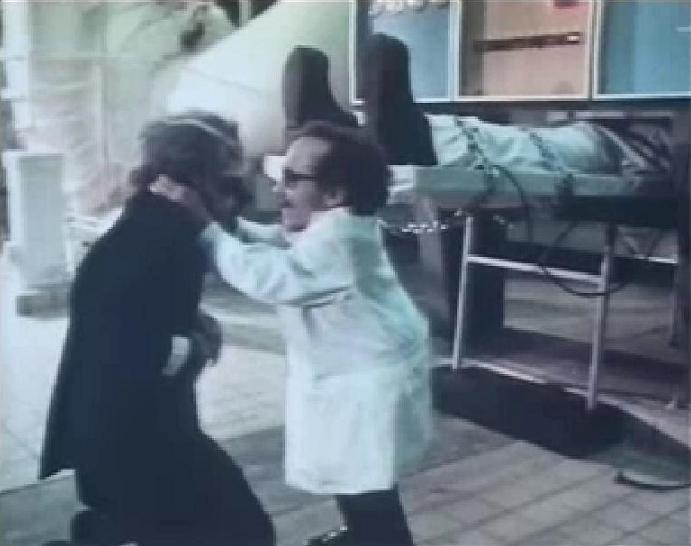


Stockwell certainly has the eyebrows to be playing a wolf man, though I doubt he'd list clenching his jaw, panting like a dog and crawling around on all fours chewing up a lamp amongst his finest on-screen moments. Dwarf character actor Michael Dunn has two brief scenes, which turn out to be incredibly pointless. Dunn, who'd received an Oscar nomination for 1965's SHIP OF FOOLS, had to toil around in low-budget horrors like this, FRANKENSTEIN'S CASTLE OF FREAKS (1973) and THE FREAK MAKER (1974) because his options were limited, Oscar nom or not. The cast also includes Clifton James as the racist Attorney General and Thayer David (TV's Dark Shadows) as one of the Hungarian inspector. Bob O'Bradovich's grey-haired werewolf makeups are adequate and old school time-lapse photography is used for the transformations.

Now a public domain title, this is an easy one to find. One recent release from Shout! Factory includes commentary from Elvira.

★★

Screaming Skull, The (1958)

Directed by:
Alex Nicol

It's always nice when people show you they care. The makers of The Screaming Skull sure do. They were kind enough to guarantee to pay for all of one's burial expenses if their film made them die of fright. Will you keel over as this motion picture "reaches its climax in shocking horror" and get a casket on the house? There's only one way to find out! Soon after losing his former wife Marion in a tragic accident, Eric Whitlock (John Hudson) has decided to remarry. His new bride is Jenni (Peggy Webber), a gentle, kind and timid woman who has her own troubled past she'd like to forget. The newlyweds arrive at their new home, which Eric has just inherited (it belonged to Marion's family). The estate comes with noisy peacocks wandering around the front yard, perfectly pruned hedges, luxurious flower gardens, a large and ornate fountain full of lily pads and toads and a mansion cleared of all furniture and ready for a fresh start. Also lurking around is shaggy-haired, slow-witted gardener Mickey (director Nicol), who was a childhood friend of Marion's and has been living there ever since he was a little boy and his father was the groundskeeper there.


Reverend Edward Snow (Russ Conway) and his wife (Tony Johnson) swing by for a visit and dinner, and with them bring along some information. Because Eric won't tell her, Jenni is able to find out from the reverend how Marion had actually died. No one knows for sure exactly what happened, but she was found dead floating in the fountain with the base of her skull smashed. It happened on a rainy day and was blamed on a fall. Jenni is emotionally fragile herself from witnessing both of her parents drowning after a boat accident and has spent some time in a psychiatric hospital as a result. Jenni also happens to come from a lot of money, just like the lady of the house before her. Oh, did I mention that Eric was only able to get the house and grounds and not any of Marion's money when she died?


Jenni is woken at night by screams (blamed on the peacocks), finds a painting of Marion and wet lily pads inside the home and keeps seeing a skull everywhere. Eric believes its Mickey trying to scare her. You see, Mickey never quite got over Marion's death. He continues to mourn her passing, refuses to believe she's actually dead, wanders the grounds at all hours looking for her and claims he hears her crying in the night.

Not nearly as bad as some say it is, The Screaming Skull has been written off as being slow, cheap and predictable. It is indeed slow (though not uninteresting), very low-budget (though not poorly made) and somewhat predictable (though it has about the same predictability level as most other mysteries). It breaks down its possible outcomes to about four. The first is that the spirit of Marion is haunting the place and trying to get her husband's new wife to leave her home. The second is that Eric is trying to either drive Jenni crazy or kill her for her money. The third is that it's all in the formerly institutionalized / suicidal, nightmare-plagued wife's mind. The fourth is that Mickey - who was in love with Marion and is weird, anyway - isn't too happy about the Marion being replaced and wants Jenni out of there. The film does stick to one of those four resolutions but borrows from another of them to give this an additional twist.


It's a small-cast film using just five actors, but all of the performances are good (especially Webber's) and the actors deliver their lines in a more natural, less stilted way than usual for the time. The director also shows a sense of visual style and some attention to atmosphere, especially considering the entire film is shot at just one location. There's some good POV camerawork, panning shots and zooms that keep this from feeling too static. There's a tuba-heavy score. Sure it's not the best thriller ever made, but it's an entertaining enough 68 minute psychological horror film. Its current undeserved low rating of 3.0 on IMDb is a result of it being featured on Mystery Science Theatre 3000.


The film takes inspiration from the Francis Marion Crawford story of the same name (which is not credited here) and was released theatrically on a double bill with TERROR FROM THE YEAR 5000 (1958). Star Hudson is the identical twin brother of ATTACK OF THE 50 FOOT WOMAN star William Hudson. Director Nicol also made POINT OF TERROR (1971) and acted in A*P*E (1976).

★★1/2

Saturday, December 15, 2012

Killer Shrews, The (1959)

... aka: Attack of the Killer Shrews, The

Directed by:
Ray Kellogg

Did you know that shrews, or Soricidae as the dudes in lab coats call them, are "the most horrible animals on the face of Earth?" The little suckers may look cute and harmless but they have voracious appetites. They'll attack anything for food regardless of size and must eat three times their body weight in 24 hours or risk starving to death. Not content with just eating all of the flesh and meat of their prey, shrews like to be members of the clean plate club by also eating the bones after sucking out all the yummy marrow. And for an encore, they also devour napkins, plates, eating utensils and tea cups, so next time you're entertaining shrews at a dinner party make sure you don't break out your fine china. On a small, uncharted island, brilliant scientist Dr. Marlowe Craigis (Baruch Lumet), his assistants Jerry Farrell (producer Ken Curtis) and geneticist Bradford Bain (Gordon McLendon) have unwisely chosen to use shrews as their guinea pigs. The men are working on prolonging lifespans and have come to the conclusion there's a correlation between decreasing size to increase metabolism to make animals live longer. (Oh, really? Is that how it works?) One day they hope to apply what they've learned to people.


Captain Thorne Sherman (James 'Rosco P. Coltrane' Best) and his assistant Rook (Judge Henry Dupree) have chosen the worst possible time to head to the island to deliver supplies. Not because a hurricane is brewing in the skies and not because Marlowe's zoologist daughter Anne (Ingrid Goude) is having a bitter falling out with her former flame Jerry, either. As you can probably gouge from the title, the experiments have backfired and they've backfired in a bad way. Instead of shrinking shrews, the doctors have accidentally made them grow to dog-sized proportions. Now there are between two and three hundred, 50 to 100 pound hungry shrews roaming free on the island. The fact shrews can reproduce only three weeks after birth adds an extra problem, as does the fact they creatures have already depleted their natural food sources on the small island. Well, most of it.


Ths shrews chase Rook up a tree and eat him when the tree falls and break into the barn and eat a horse and all the livestock. One shrew manages to get into the house and bites servant Mario (Alfredo DeSoto) on the leg. He dies immediately afterward and, if things couldn't look any more grim, the scientists discover there's an extremely high poison content in the saliva of the mutant shrews. A scratch or bite from them means death. Since the shrews cannot swim, the survivors hatch a plan (which is simultaneously clever and hilarious) to try to try to get to the boat.

The Killer Shrews is pretty famous for its shrew costumes. There are a few puppet models of shrew heads for close-ups (which aren't too bad), but for the most part they're played by dogs in shaggy suits! While that may sound hokey, in a strange way it give the creatures a natural movement that makes them seem more 'real' than the rubbery creatures we usually see in these things. Sure, some of the dialogue is extremely hokey and the acting isn't the greatest. At one point, Ann (who keeps calling the over-sized rodents "shoes" in her cute little Swedish accent) claims she's so disturbed by what's going on she's going to retire from science to become a housewife. If one can just laugh along with moments like those and chalk it up to the times, then this is actually a well-done, entertaining and utterly charming little B creature feature. Working with limited funds, the director manages to establish a claustrophobic, hopeless atmosphere and the writers have come up with an entertaining storyline. Everything leads up to an action-packed finale that's surprisingly exciting. The film may even be more influential that is has been given credit for...


One strange and interesting thing about this one is how much it has in common with NIGHT OF THE LIVING DEAD (1968). Sure, one has flesh-eating zombies and the other has flesh-eating shrews, but there are other obvious similarities present. For starters, our heroes are trapped inside a house and use furniture and wood to try to barricade themselves in. Then we have the shared idea that just a bite or scratch from one of the creatures results in death. And then there's the fight for power between Thorne and Jerry, which results in Jerry refusing to open the door for Thorne hoping the shrews will get him, just as Harry refused to open the door for Ben hoping the zombies would get him. In both instances, when the hero gets inside, they punch out the guilty party. They also continually fight over a rifle. To solidify the similarities, the two films use the same exact stock music at some of the same exact moments!


This was one of just two films made by independent, Texas-based company Hollywood Pictures Corporation. The other was THE GIANT GILA MONSTER (1959). Both were financed by co-star McLendon and played theatrically on a double-bill. A sequel; THE RETURN OF THE KILLER SHREWS (2012) followed over 50 years later, with Best returning in the same role! Can't wait to see that.

★★1/2
Related Posts Plugin for WordPress, Blogger...