... aka: Close Encounters of the Spooky Kind
... aka: Encounter of the Spooky Kind
... aka: Encounters of the Spooky Kind
... aka: Gwai da gwai (Ghost Against Ghost)
... aka: L'exorciste chinois (The Chinese Exorcist)
... aka: Spooky Encounters
Directed by:
Samo (Sammo) Hung
Seeing how I've seen at least two dozen later films that were heavily inspired by this one, I probably should have watched this a lot sooner than now but, hey, better late than never! Though not the very first of its type, Encounter is still one of the key titles in the development of both the jiangshi (hopping vampire) and slapstick ghost-comedy subgenres that would dominate fantastic cinema in Hong Kong in the second half of the 80s. These films typically placed more emphasis on the crazy than the narrative and gleefully mixed martial arts action, comedy, fantasy and horror elements into an entertaining, though often meandering and episodic, brew. The objective really was to pack so much into the film, and keep things moving at such a quick pace, that audiences didn't have time to get bored. Or question what they'd just seen. Prototypical brainless entertainment, if you will. And while there's not a damn thing wrong with that, the better examples of this type of film always contained at least a reasonably engaging and (if we're lucky!) coherent plot as well as some heart to go along with the gonzo.


Depending on which version you watch, Sammo stars as either "Bold," "Big Guts," "Fatty" OR "Courageous" Cheung (we'll settle for just "Cheung" from here on out), a none-too-bright cart driver of chubby proportions. He's poor, lazy, surrounds himself with all of the biggest losers in the village and is stuck in a terrible marriage with a lying, backstabbing social climber (Suet-Mei Leung). He begins to suspect something is up with his wife when she suddenly starts wearing expensive new clothes they can't afford on his measly salary. He later looks through a peephole and catches her right in the act, though she's somehow able to talk her way out of it. Little does he know, but she's been sleeping with Master Tam (Ha Huang), a wealthy old man he often chauffeurs who also has aspirations to become mayor.
Wanting the wife all to his own, and figuring Cheung will find out about the affair eventually anyway, Tam plots to eliminate him from the equation. His advisor Lau (Tai-Bo) comes up with the idea to enlist the aid of Hoi Chin (Peter Chan Lung), an unscrupulous black magician who's willing to do anything granted the price is right. Skilled in "Maoshan sorcery," Hoi Chin is tasked with setting up an altar at Tam's place where he can cast his spells in anonymity. His toadie, Old Dog Fah (Ma Wu), is then sent out to make a wager with Cheung. If he can spend the night locked inside a reputedly haunted ancestral crypt, he'll reward him with silver. Cheung takes him up on the offer.


Luckily for Cheung, Hoi Chin's understudy Tsui (Fat Chung) takes offense to his master's plans since their brand of sorcery is supposed to only be used for good. There are four taboos in the sect's doctrine: Insatiable greed, unprincipled killing, nefarious collusion with cronies and blasphemy against their three luminaries, and his former master is about to break all four of them in exchange for some gold. Instead of playing along, Tsui decides to secretly help Cheung out and guides the naïve bumpkin through various traps laid out for him. He's barely able to survive a night inside the crypt after Hoi Chin resurrects and controls a jiangshi, but then the wager is increased five times and Cheung accidentally accepts. Tsui orders him to gather black dog's blood, four dog's paws and fifty chicken eggs to do battle the next night. Against all odds, Cheung survives the night yet again.
The bad guys then step up their game by trying to implicate Cheung in his wife's murder. He comes home to find blood everywhere, but there's no body. Nonetheless, inept constable Ching-Ying Lam throws him in jail, though he's able to escape after beating up four guards. While trying to elude authorities, he encounters myriad other dangers like a rat-and-maggot-infested resurrected corpse and various magic spell attacks launched by the evil magician. In one of these, one of his hands becomes possessed and takes on a mind of its own, which then breaks dishes in a café, throws stuff around, starts attacks guests, punches its owner in the face, makes him flip, etc. in a scene that was later copied by Sam Raimi for Evil Dead 2. No chainsaw, though.


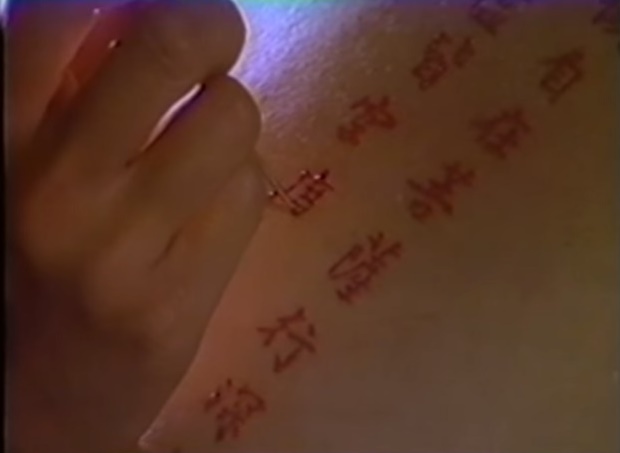
There's also a nightmare scene featuring skeletons, flying urns and ghosts biting off flesh, voodoo doll usage, a real chicken getting decapitated, a skull-faced warrior and two minions summoned from beyond, a clawed, half-purple female ghost that sucks a guy into a mirror and a ritual where Sammo gets red talismans painted all over his nude body to become Tsui's disciple. All of the fight scenes and stunts are excellently choreographed and performed by the cast and there's some nice pyro work thrown in here, too. Though the big finale gets a little too silly (with characters given high-pitched, sped-up voices and one getting possessed by a monkey spirit and acting accordingly), the last 30 seconds are hilarious and absolutely priceless.


The film is actually kind of a tour de force for Sammo, who wore many hats in the production. Aside from giving an energetic lead performance and directing, he also co-wrote (with Ying Wong), was an (uncredited) executive producer, did stunts and was one of the martial arts / action directors. This was the freshman effort from his newly-formed Bo Ho Films Company Ltd. and became a modest success in theaters. It was followed by The Dead and the Deadly (1982), which Hung starred in, co-wrote, co-produced and also did fight choreography on (directorial duties were passed off to Ma Wu). It ended up becoming an even bigger hit and helped to solidify this whole formula.
Hung's company would hit their apex with MR. VAMPIRE (1985), which was the highest grossing film of all of these, netted thirteen Hong Kong Film Award nominations and was followed by four successful sequels, a few spin-offs and many copycats. Other genre releases from this team, which all dependably grossed anywhere from 7 to 13 million HKD, were HOCUS POCUS (1984), Those Merry Souls (1985), MY COUSIN THE GHOST (1987), Scared Stiff (1987) and BURNING SENSATION (1989). By the end of the decade, audiences were starting to tire of this style of film and the companies last two horror-comedy hybrids; Mortuary Blues and Till Death Shall We Start (both 1990), saw a steep decrease in profits.


Though Hung certainly deserves the bulk of the praise, Fat Chung, a great mix of wily, wise, funny, professional and effortlessly cool, is also worth singling out for his standout performance as Cheung's protector. Other actors who appear in small roles are the cross-eyed Siu-Ming To (who has a giant, hairy fake mole glued to his face to complete his look), future directors Ricky Lau (the Mr. Vampire series) and Billy Chan (New Mr. Vampire), veteran actress Ying-Ying Hui as a gossipy village woman and extremely prolific (over 500 credits) veteran actor Pak-Kwong Ho as a peeping tom. Nearly everyone would be back in later films for the company.


This was released on VHS in France (as L'exorciste chinois / "The Chinese Exorcist" and dubbed into French), Hong Kong, Japan (dubbed into Japanese and on the Pony Video label), the U.S. and the UK, followed by DVD and Blu-ray releases in all of these countries. The American distributor was Tai Seng and there's another well-circulated release from Fortune Star. The Australian and UK releases offer an English dubbed audio track, though, as usual, I strongly recommend watching the subtitled Cantonese-language version instead.


A belated sequel, Encounters of the Spooky Kind II (1990), came ten years later. Also produced by and starring Hung (though for Bojon Films Company Ltd.; another of his film companies [there were at least three!]), it ended up grossing over twice as much at the box office.
★★★