.
.
.
Showing posts with label stripper. Show all posts

Sunday, February 19, 2023

Astro-Zombies, The (1968)

... aka: Astro-Zombies - Roboter des Grauens (Astro-Zombies: Robots of Horror)
... aka: Space Vampires
... aka: Space Zombies

Directed by:
Ted V. Mikels

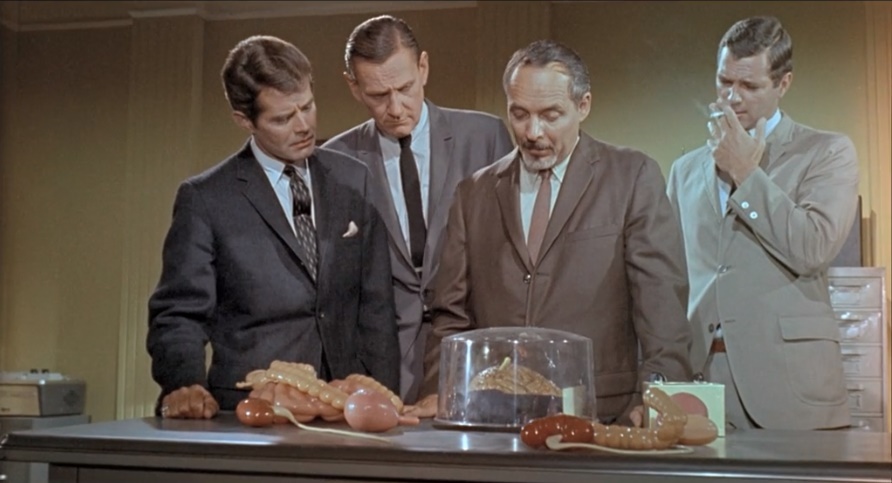
A woman killed in her garage by a masked fiend brandishing a gardening tool is but one of many recent "mutilation murders" in the Los Angeles area over the past six months. C.I.A. chief Mr. Holman (Wendell Corey) calls Dr. Eric Porter (Tom Pace) and Chuck Edwards (Joseph Hoover), from the C.I.A.'s "subversives division," into his office to try to get the bottom of things. Eric has spent the last few months undercover as an assistant to Dr. DeMarco (John Carradine), a brilliant scientist who'd already been tossed out of the government aerospace research center for his unorthodox experiments with organ transplants and "thought wave transmissions through radio frequencies" but has been continuing his work elsewhere. Dr. Petrovich (Victor Izay), a former colleague of DeMarco's, is called in to provide additional insight into just what DeMarco has been up to. It's Holman's belief that a foreign government may be interested in stealing DeMarco's research and using it for their own nefarious purposes. Either that or DeMarco is already willingly working with a hostile foreign country. The dialogue is so hopelessly muddled it's actually difficult to tell.


Elsewhere, DeMarco is busy in his basement lab creating what he calls "astro-men" while his loyal, mute hunchback helper Franchot (William Bagdad) is occasionally sent out to acquire victims (from car crashes and such). Whenever fresh corpses are procured, they are immediately strapped to a table and have some kind of a metal cap placed over their head, which is plugged into a machine that's hooked up to some kind of computer system. After a switch is flipped, they're then drained of all blood, placed in a "thermal freeze vault" to keep cellular deterioration from occurring and then must go through a "synthetic heart transplant." And that, along with specially-programmed computer chips and other attached gadgets and doodads, is how you create astro-men!

Carradine is handed a bunch of rambling, pseudo-scientific dialogue to "explain" the process, which is so needlessly complex it only succeeds in making viewers mentally check out. This wire goes there and this switch turns on that and that won't work without this special microchip or attachment and that transmitter operates this but not that... on and on it goes. I didn't have a clue what he was talking about most of the time!


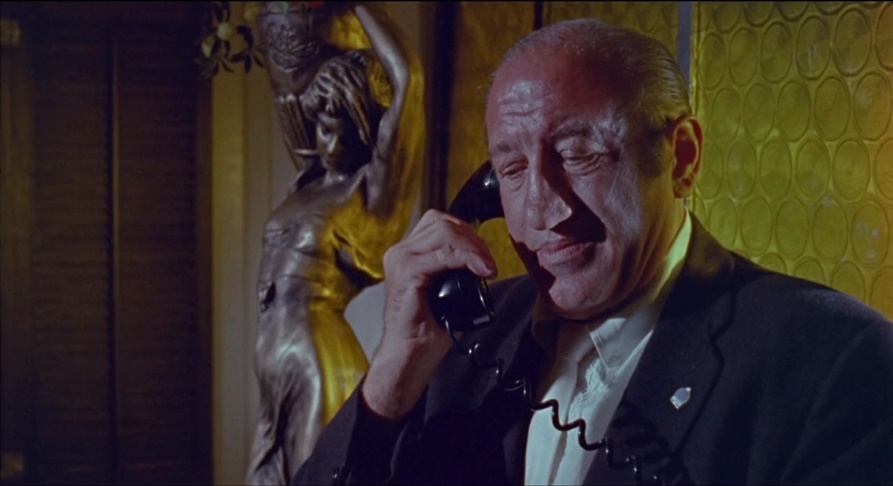


Other victims are claimed, both by a rogue astro-man, one of whom sneaks into Petrovich's lab and stabs his assistant Lynn (Janis Saul) to death before harvesting her organs, as well as foreign spies, who make short work of any C.I.A. agent who happens to be closing in on them at any given time. The latter are led by cult star Tura Satana (Faster Pussycat! Kill! Kill!), who plays a "Dragon Lady"-type spy named - you guessed it - Satana, and is after Carradine's secrets when she isn't putting lit cigarettes out on people's faces or nonchalantly unloading her gun into them. 

With her voluptuous body, pasty white face make-up, large fake eyelashes, thin drawn-on eyebrows, bright red lipstick over a tight mouth and amazing gown selections with slits in all the right places, Satana cuts quite the memorable figure here. Though her actual performance isn't quite up to par with her Russ Meyer film appearance, she's still clearly one of the most interesting aspects of the production. As for the Japanese-American actress' little spy ring, which includes Dominican Rafael Campos (LADY IN A CAGE) as the switchblade-happy Juan and stocky Italian Vincent Barbi as the barely-coherent Tiros, I'm not sure what organization or country they are supposed to represent exactly.

Joan Patrick co-stars as Janine Norwalk, who happens to be DeMarco's former assistant who also happens to be Petrovich's current assistant who also happens to be Dr. Porter's girlfriend who also happens to be a primary target of the escaped astro-man because he happens to have been a patient of hers prior to being transformed into an astro-man. Small world, eh? Janine eventually agrees to set herself up as bait to lure the zombie back to the lab but things don't go quite as planned.




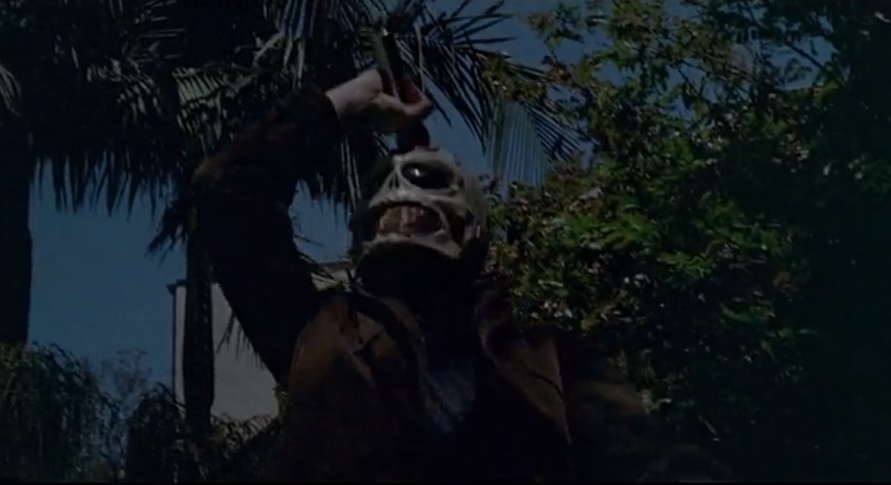
While a few of the scenes are admittedly entertaining or unintentionally funny, and there's some camp value here, it's not quite enough to send this into SBIG territory. The film mostly just comes off as cheap, slow, directionless and incoherent. The plot is poorly developed and difficult to follow, the bad guys' motivations are murky at best, the film is flat out ugly to look at most of the time and there aren't nearly enough scenes featuring the titular creatures. Not that the astro-zombies are much to look at (it's just some guy wearing a cheap rubber mask), but at least the few scenes with it / them attacking people inject some much-needed action into this otherwise lifeless film. Most disappointingly, and despite the title, there is only one "zombie" in the film until the very last scene when there are a whopping two. They're also not from outer space.



You know what's not a good use of screen time, talent or we - the viewers' - time? Having to sit and watch a static shot of Carradine's wobbly hands fumble around with some kind of computer for three minutes, which consists of him removing two screws from a panel, pulling out a box, unscrewing the box, putting some kind of microchip inside, screwing the box shut again, sliding the box back into the computer, shutting the panel again, tightening the two screws again, hitting a button and then unscrewing the two screws on the panel again, pulling the box back out again, unscrewing the box again and removing the microchip! In what universe is that not boring as fuck?

There are endless similar scenes that go on for far too long (people driving around, walking, talking...) and are completely pointless. Around three to four minutes are also set aside to show a body paint-covered topless dancer performing her bongo drum-accompanied routine in a club, which is a welcome diversion as it's at least pleasant to look at.


Carradine never once gets to leave his cheap lab set and his performance is further hampered by the indecipherable gibberish he's forced to spout. Just a decade earlier, top-billed Corey had been acting in major studio films for the likes of William Wellman and Alfred Hitchcock, so this was quite the fall from grace for him, though not a surprising one going by the anecdotes I've read about his real life. A lifelong alcoholic, he made an unsuccessful bid for Senator in 1965 but was defeated in the Republican primary and ended up passing away from cirrhosis of the liver just six months after this film was released at the age of 54. Unlike Carradine, who at least tries, Corey gives your standard don't-wanna-be-here paycheck performance and his two scenes are long, drawn out and extremely dull.

The budget was just 37,000 dollars. Mikels also co-scripted, edited (using his real name Theo Mikacevich) and produced, plus has an uncredited cameo as the drum player. Wayne Rogers, later of M*A*S*H fame, co-wrote and was the executive producer. Roger had previously collaborated with Mikels on the softcore film Dr. Sex (1964). In 1982, the punk band Misfits released a song titled "Astro Zombies" inspired by the film (and on their album Walk Among Us), so at least something good came from all this.


After its 1968 theatrical release, 1971 theatrical re-release and its run on TV as part of an AIP syndication package, this well-distributed title turned up on home video countless times. It was released no less than three different times on VHS by Wizard under three different titles, starting with its original title in 1981, then Space Vampires in 1985 and then again as Space Zombies in 1986. Wizard also recycled footage from this to pad out their compilation tapes Filmgore (1983) and ZOMBIETHON (1986). Additional VHS releases from Mad Monster Video, Troma Team and other companies followed. In 2000, it made its official DVD debut courtesy of Image, and then was put out on Blu-ray by Kino Lorber in 2016. Some of the earlier releases of the film had been cut to remove some of the minor gore (including a machete decapitation) and the dance scene. The full running time of the uncut version is 92 minutes.


Over thirty years later, Mikels returned with the extremely cheap sequel, Mark of the Astro-Zombies (2004), which featured Satana again, along with cult stars Liz Renay and Brinke Stevens. That was followed by Astro Zombies: M3 - Cloned in 2011, with Satana (in her final film role; she'd pass away the following year) and Francine York, and Astro Zombies M4: Invaders from Cyberspace in 2014, which featured Beverly Washburn, of Spider Baby fame.

Friday, April 22, 2022

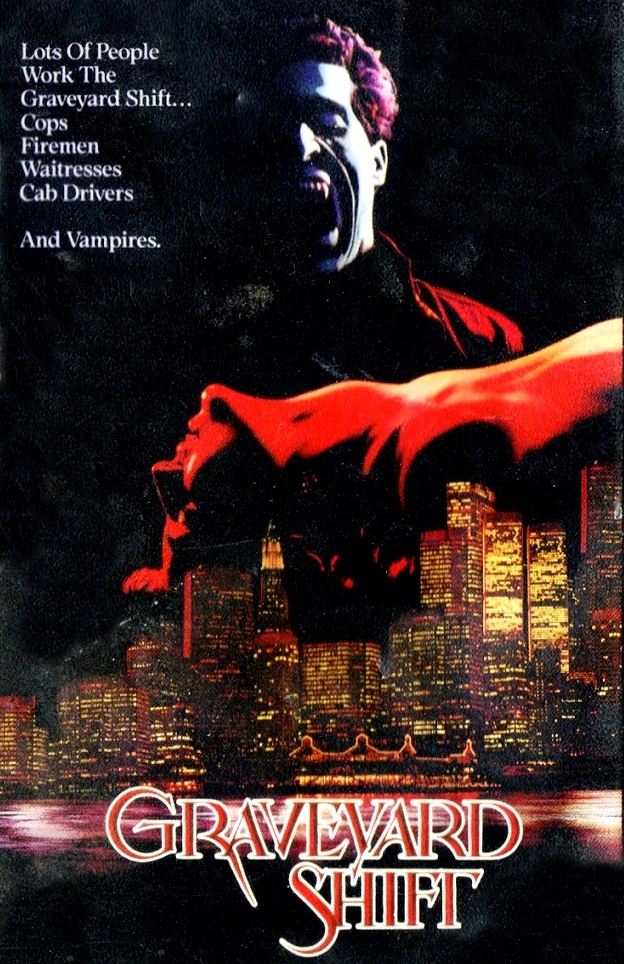
Graveyard Shift (1986)

... aka: Central Park Drifter
... aka: Nachtschicht (Night Shift)
... aka: New York Vampire
... aka: Noites Macabras de Nova York (New York Macabre Nights)
... aka: Turno de noche (Night Shift)
... aka: Upíří krev (Vampire Blood)
... aka: Verivuoro (Bloodshed)

Directed by:
Gerard Ciccoritti

Usually after I finish writing a review, I'll read other reviews because I get a kick out of seeing how my opinion matches up to other opinions. Sometimes we agree. Sometimes we don't. And it's all good. Still, I noticed something that annoyed me: the word "dated." Now, not the word in and of itself. I use it at times. But the word being used as if it's an insult. That's the primary recurring "criticism" I've seen for this particular film and it's a recurring "criticism" I've seen time and time again for many older films. Yes folks, a film made in the 1980s is going to look and feel like a film made in the 1980s. A film made in the 1980s is going to have hair styles and clothing and vehicles and music that are reflective of that time. I can't understand why reviewers constantly cite a film's age as if that's an automatic debit. Someone needs to explain to me what's so great about a "modern" look? What's so great about most movies being shot on digital? Do people really like how today's B movies look like they were shot with a cell phone camera, when they used to be professionally shot on 35mm? When did the general consensus decide that digital was a superior look to 35mm? Or 16mm. Hell, I'd even be willing to go as far back as Super 8 OR shot-on-VHS as those formats both have some character to them. 

If being "dated" is such a bad thing, why does every other indie movie try to emulate the style of older films? Why are there so many remakes? Why do directors constantly try to add fake film grain and other imperfections and distortions in post to try to give their digital films texture? Why do reviewers so often praise a new film for being "70s style" or "80s style" or "retro" or "throwback" and then go back and criticize the original films more harshly; films that, for the most part, weren't slavishly trying to emulate the exact look and feel of films from previous decades?


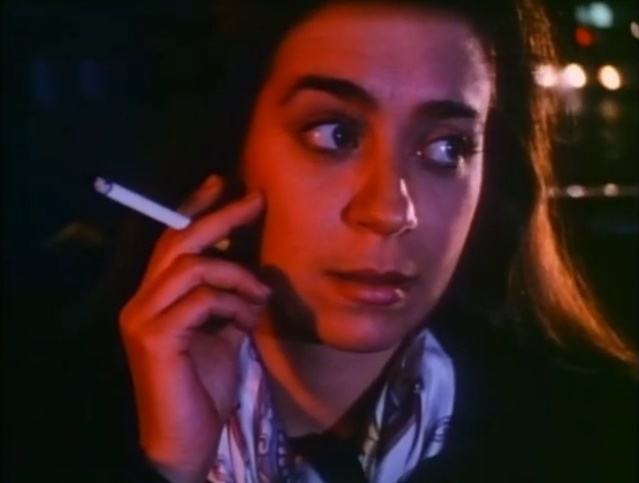
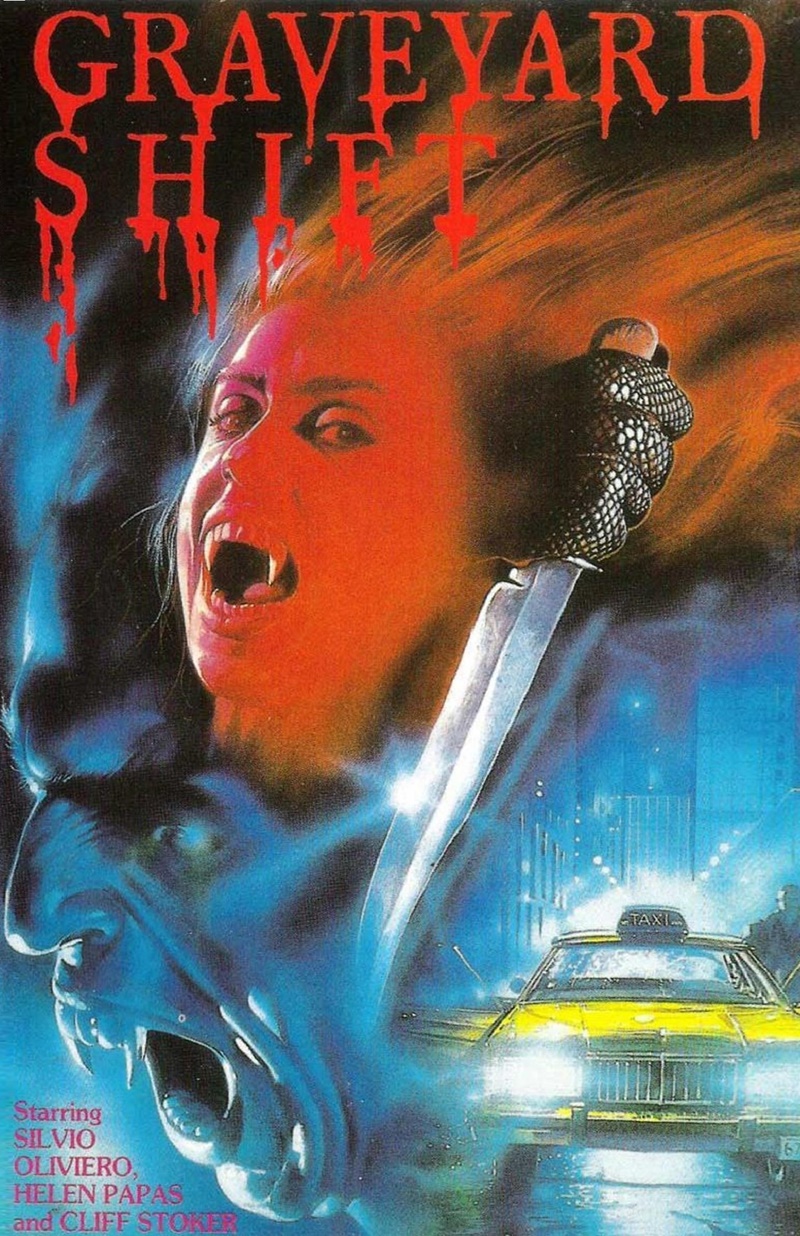
After being slightly miffed by all those "dated" comments, I went back and re-watched the opening ten minutes of this for some perspective. They're actually quite excellent. There are numerous beautifully and carefully composed, lit and photographed shots that bring us into the world of tired, soft-spoken, centuries old vampire Stephen Tsepes (Silvio Oliviero), a taxi driver obviously working the night shift in New York City. The rain-slicked streets reflect dots of white and green light from skyscrapers, colorful neon signs, the taxi and other things. Strong backlighting pours through trees to dress up what would otherwise be dull shots of car driving around. The color blue is prominently used when the vampire and his latest victim, Suzy (Kim Cayer), are getting acquainted in the back of his cab, but switch to red when it's feeding time. This colorful film even names one of its supporting characters Mario Bava (at a time when few were actually championing that director's work) as its obvious visual reference. But, let's just stop for a moment and admire how gorgeous some of the shots (which aren't even from a restored, widescreen version of the film, mind you) are...


Not only that, but these scenes also showcase some very slick scene transitions (panning down a kissing couple into darkness and then descending upon the same couple doing the same somewhere else; a drawn black curtain leading us into the next scene), plus offbeat but effective editing choices. Even the basic idea of a having the vampire work as a taxi driver is smart. A random person is going to hop into a random cab with a random driver and it's all rather arbitrary and insignificant and not something someone's going to be announcing to the entire world. So what if one of countless nightly customers happens to not make it to their destination every now and again? Furthermore, working the late night shift gives access to certain types of people; those who perhaps intentionally choose to be awake when most of the rest of the city sleeps, many of them on the vulnerable side: sex workers, vagrants, criminals, drug addicts and, in Suzy's case, a suicide waiting to happen. The quiet solitude that the night provides is a great place for the damaged to dwell.

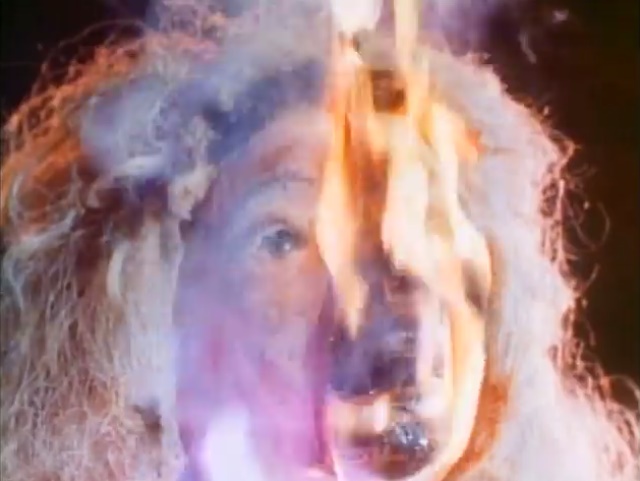
Just from the opening set piece alone, we can tell this is going to be visually stylish in a neon-soaked 80s kinda way, plus it has a clever premise and potential for great things within that premise. Unfortunately, the movie itself proves to be a very bumpy ride with both high highs and low lows. In fact, this is one of the most uneven films I've ever seen! Some of the acting is good and some of it is abysmal. Some of the dialogue is well-written but, at other times, terrible. Some of the scenes are effective, others are clumsy and don't work at all. Sometimes the editing choices are great, at other times inept. And sometimes the make-up fx are passable and at other times you have to pretend like a flaming plastic dummy head is a creature of the night exposed to direct sunlight.


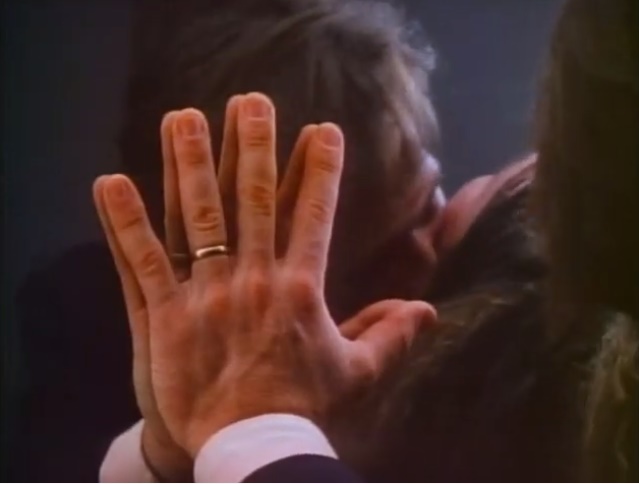
Michelle Hayden (Helen Papas), a thirty-something music video director, has become bitter and depressed about her life. She's been hard at work on pop musician Gilda's (Dorin Ferber) latest video, which has the plug pulled on it prematurely. Just another career setback of which there have apparently been many. Michelle's husband Eric (Cliff Stoker, which I highly doubt is this actor's real name!) doesn't respect her and thinks nothing about ruining an important shot by barging into her studio just so he can sneak into the dressing room for a quicky with Gilda, which is shown in quick flashes and finally settles on his wedding band-clad hand resting on a mirror. Not that Michelle isn't aware of what he's up to. She is, but their marriage has basically deteriorated into her acceptance of his casual adultery. And, if things couldn't get any bleaker, Michelle has recently gotten word she has terminal cancer and has as little as two months left to live.

All it takes is two brief cab rides, with sparse but meaningful dialogue and lots of unspoken looks, for the vampire and Michelle to connect and become drawn to one another. He finds his lovers when they've entered "the cycle of death" and gives them a renewed lease on life... at least until they start becoming more difficult to control. She's backed into a corner via her shaky career and a degraded marriage, yet decides to finally listen to her instincts when mortality starts rearing its ugly head. The film is at its very best during the scenes with Stephen, who's tired of life yet afraid to die, and Michelle, who had resigned herself to death yet is invigorated by her newfound love for Stephen, and does a very fine job establishing the attraction between the two. However, the more somber, subdued and thoughtful tone present during these bits is at odds with some of the other flashier and noisier material thrown in here.


Stephen's until-now fruitless quest for love with a series of troubled ladies has led to a number of big-haired vamp-chix prowling around the city. These women seem to have a telepathic link to Stephen, are jealous any time he pursues another and each finds a way to lash out. It's an ever-accumulating army of bitter, angry, cast-off ex-lovers, except these ladies refuse to ever leave his life for good; talk about a curse! At the Pink Pussycat strip club, a huge-haired, athletic-looking stripper played by one Sugar Bouche (whose last name MAY be pronounced "Boosh" but I wish it to be "Boo-Shay" so let it be) puts on a dominatrix act and then retreats to the back alley with a male admirer, whom she promptly slashes up with a straight razor so she can drink his blood. A sultry blonde in furs and pearls (Jessie Taylor) seduces a guy into a swimming pool and slits his throat, Suzy goes after a porn mag reading goober in a junkyard and there's also an Amazonian policewoman, Officer Arbus (Lesley Kelly), who's keeping her toothy proclivities a secret from her fellow officers and ends up a raving lunatic in a jail cell feasting on her own blood.


The second half isn't as interesting as the first, with pacing, editing and continuity issues, clunky, awkward dialogue scenes delivered amateurishly by the secondary actors and the script's lack of focus taking the film down a notch. Other characters get a little screen time that only detracts from the main story, including a pair of obnoxious police detectives (John Haslett Cuff and Don James) who make some tasteless comments about murder victims on the slab, an annoyed coroner (Martin Bockner) and a very poorly-established, cross-wielding Van Helsing type (Dan Rose) who makes an eleventh hour appearance. The big finale (which is a horribly-edited mess for the most part) features an attack by a bunch of "vampirettes," a head pulled off, vamps bursting into flames and customary stakes-through-the-heart, and takes place on a graveyard set at the production studio. There's an amusing twist at the very end, though.


The acting is extremely uneven, though the main roles are effectively played for the most part. Oliviero has a good look for the urban vampire role (gaunt and with sharp lines on his face yet also kind of handsome) and gives a decent performance, though some of his line readings are a little wooden. However, Papas (who bears a slight resemblance to Stockard Channing) is easily the standout here. This unknown actress (who previously only had a small part in the same director's Psycho Girls) has a slightly deep, soothing voice, a mature and likably pensive presence and can handle the dramatic demands of this character, which makes it a shame that she disappeared from film after appearing in this.


Due in no small part to the high amount of T&A and erotic scenes on display, this became a very big hit on home video and late night cable in the late 80s, which prompted the follow-up THE UNDERSTUDY: GRAVEYARD SHIFT II (1988) from the same director, who eventually moved on to a very successful career in television. The sequel again featured Oliviero, who started professionally using the name Michael A. Miranda in 2003, as a vampire, though a different character than what he plays here. Edited versions of both films aired frequently on the USA Network's much-missed Up All Night program. Though there have been several DVDs (starting with the Shriek Show release in 2001), to my knowledge all of these have been full screen presentations and the film has yet to receive a decent restoration.

★★1/2
Related Posts Plugin for WordPress, Blogger...