

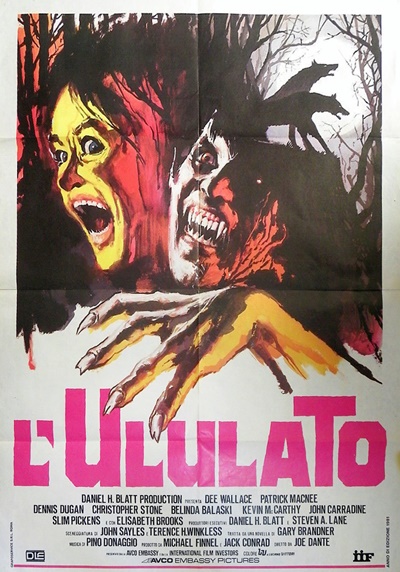
... aka: Das Tier (The Animal)
... aka: Gritos de Horror (Horror Scream)
... aka: Howling: The Beast
... aka: Hurlements
Directed by:
Joe Dante
"What's the best werewolf movie of the 80s: An American Werewolf in London or The Howling?" That's one of the most frequently debated topics in all of 80s horror and one I can finally provide a definitive answer to: Both! There really may be no "better" in this particular case. These two films both provide completely different pleasures with completely different werewolf transformations / make-up designs, a completely different attitude and a completely different sense of humor. So, like many things, this is strictly a matter of personal taste and no one is exactly right or wrong for preferring one over the other. Both are well-made, well-written, well-cast, manage to provide scares, laughs and atmosphere and deservedly hold their place in the genre as not only two of the best werewolf films of their decade but two of the best werewolf movies of all time.
What's really not up for debate is that An American Werewolf was the more popular and successful of the two right out of the gate. It received more critical praise, grossed nearly twice as much to become the highest-grossing horror movie of 1981 and even won the very first Academy Award handed out in the make-up category for Rick Baker's brilliant work. Meanwhile, The Howling was also praised (just not as much), also financially successful (just not as much) and also won some industry awards (just not as prestigious). However, it's worth noting that American Werewolf was significantly more expensive to produce and also had the luxury of being a heavily-promoted wider release from Universal, while Howling was distributed by the smaller (though not tiny by any means) AVCO Embassy. Preferences aside, one thing no one can ever take away from The Howling is its ability to pull off many of the same things American Werewolf did on a fraction of the cost, with Howling's 1.5 million budget dwarfed by the 10+ million it cost to bankroll Landis' movie.


Also typically left out of the conversation completely is the wide release of a third wolf-themed horror movie in 1981: Michael Wadleigh's Wolfen. It reputedly cost 17 million to produce (just a few million less than 1981's top-grossing film, Raiders of the Lost Ark!) and failed to match the box office of either American Werewolf or The Howling. Wolfen, which actually is a unique, stylish and pretty damn good movie in its own right, didn't come close to making back its budget in theaters. That likely cost its director (who'd made the Best Documentary Oscar winner Woodstock a decade earlier) his career while Dante and Landis both went on to successful careers in Hollywood.

Los Angeles-based TV newscaster Karen White (Dee Wallace) has been recently receiving calls from a local serial killer known as Eddie the Mangler (Robert Picardo), who uses a yellow smiley face as his calling card. In an effort to help finally end his reign of terror, Karen decides to act as a decoy for police and lures Eddie to an adult book shop where he's eventually shot dead. Unfortunately for our heroine, a police screw almost got her killed before Eddie bit the bullet and she's now traumatized to the point of temporary amnesia and unable to recall exactly what happened that night. Instead, she's haunted by nightmarish glimpses of the event, which reveal only small pieces of information at a time and are having a detrimental effect on both her personal and professional life. In an effort to "recharge her batteries," author, behavioral expert and psychiatrist Dr. George Waggner (Patrick Macnee) sends her off for a relaxing stay at his secluded "experimental living community" called The Colony, where she's to take part in seminars and group therapy in a peaceful, tranquil setting.


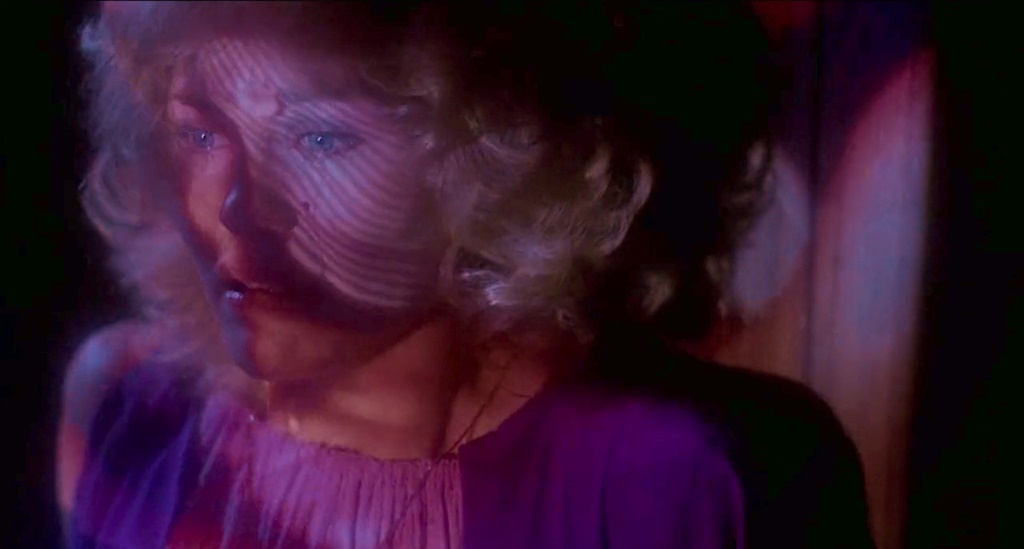


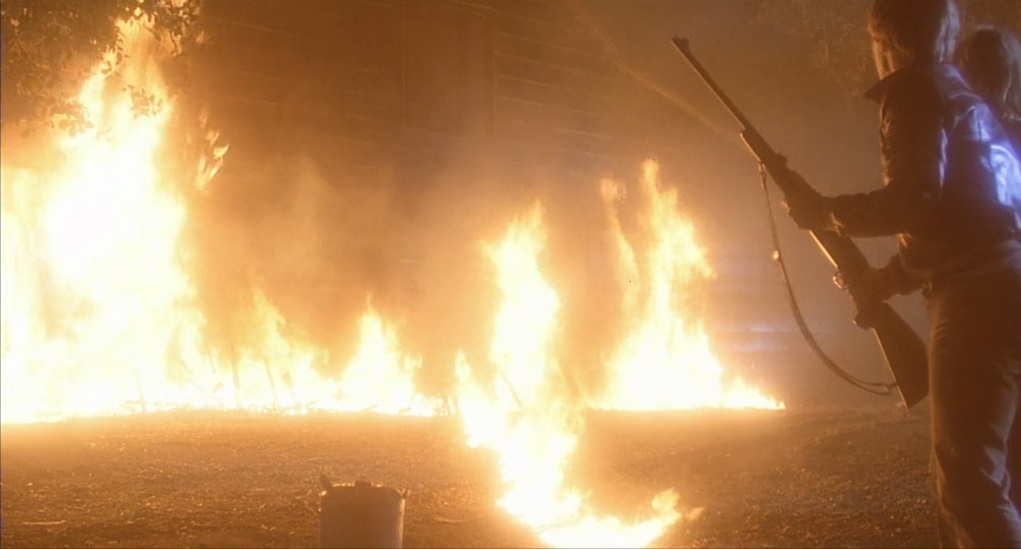
Along with increasingly frustrated vegetarian / health nut husband Bill (Wallace's late real-life husband Christopher Stone), Karen goes to the secluded Northern California commune, which she and hubby soon discover is populated by a bunch of eccentric, though seemingly harmless, kooks. They're introduced to some of their new neighbors at a nighttime beach bonfire where bitchy nymphomaniac Marsha (Elisabeth Brooks), who makes her attraction to Bill blatantly clear, and old timer Erle Kenton (John Carradine), who attempts to commit suicide by jumping into the fire because "I've gotta burn!," make the biggest impression. Later that night, a near-constant howling coming from the foggy forest proves to be the perfect soundtrack to accompany Karen's recurring nightmares. So much for rest and relaxation.
Dealing with the oddballs at The Colony, plus all of the howling and eerie noises coming from the woods, prompts Karen to want to head back to the city. Before that can happen, Bill is attacked and bitten by something in the forest. Dr. Waggner advises no travel until he's fully healed. Shortly thereafter, Bill develops a craving for meat and sudden disinterest in his wife; shrugging her off and instead sneaking into the woods late at night to meet up with the sultry Marsha.


Back in L.A., Karen's colleagues Chris (Dennis Dugan) and Terry (Belinda Balaski) are busy working on a new TV special tentatively titled "The Mind of Eddie Quist." This leads to the morgue where Eddie's body has mysteriously disappeared and then a trip to (the very funny) Dick Miller's bookstore for werewolf literature. After receiving a frantic phone call from Karen about Bill being bitten by a wolf, Terry decides to pay a visit to The Colony herself and soon regrets her decision. That's because the entire place is a haven for werewolves. And Karen ending up there herself is no coincidence.


Among other things, The Howling continues to serve as a good example of how to make a horror-comedy the right way. First and foremost, while the entire movie has a self-aware and satirical edge and is filled with humor, sight gags and inside jokes, much of that is kept on the periphery as not to be intrusive to the actual story. Clips of The Wolf Man are seen on a TV set, most of the characters are named after famous werewolf movie directors (which was clever in 1981 but not so much now because everyone does it) and you can spot all kinds of wolf-related references all over the place, from a framed picture of Lon Chaney in the doctor's office to a copy of Allen Ginsberg's "Howl" on a desk. Yet none of that diminishes the horror content in the least. When this wants to be creepy or scary, it is, especially a long sequence of Balaski's character being stalked through the woods.


Like many other Dante films, the cast has been chosen specifically to please genre fans. In addition to those already mentioned, we also get fun roles for Kevin McCarthy (TV station director), Slim Pickens (friendly local sheriff), Noble Willingham (cattle rancher) and Kenneth Tobey (cop). James MacKrell has a funny part as a newscaster (a role he'd reprise in Dante's Gremlins a few years later) and Don McLeod is memorable as Marsha's "part bloodhound" brother. Also showing up in uncredited cameos, are writer John Sayles (morgue attendant) and art director Robert A. Burns plus Roger Corman (seen outside a phone booth), Forrest J. Ackerman (seen holding a copy of Famous Monsters in a bookstore) and Jonathan Kaplan (gas station attendant).



Another obvious highlight are the make-up effects. While Rick Baker received a supervisor credit, Rob Bottin (an assistant to Baker at the time) was the main man in charge of the fx. A lengthy man-to-wolf transformation scene continues to impress today and his wolf designs themselves remain some of the most menacing and effective in any werewolf film all these years later. Other fx contributions come from Doug Beswick (mechanical fx), David Allen (stop motion), Greg Cannom and Roger George. Outside of a brief but silly-looking cartoon werewolf sex silhouette, the effects have held up very well. Pino Donaggio also contributes a good score with echoes of some of the music he'd previously done for Brian De Palma movies.


Though some character names and the basic plot outline come from the 1977 Gary Brandner novel of the same name, the film itself doesn't really have much to do with that mostly humorless book. That has a lot to do the screenplay going through a number of hands, including Jack Conrad and Terence H. Winkless, before John Sayles was brought in to do the same Sayles magic he did with ALLIGATOR (1980) and his previous Dante collaboration Piranha (1978). The closest adaptation to the novel is actually the third sequel - HOWLING IV: THE ORIGINAL NIGHTMARE (1988). All other sequels in this long-running series credit one of three, or all three, of Brandner's Howling novels as a basis though they too have little, and sometimes absolutely nothing, to do with anything Brandner wrote.
★★★1/2


