.
.
.

Wednesday, February 13, 2019

Attack of the 50 Foot Woman (1958)

... aka: Attack of the 50 Ft. Woman
... aka: La mujer gigante (The Giant Woman)

Directed by:
Nathan "Hertz" (Juran)

Poor Nancy Archer. Sure, she's worth 50 million bucks and owns the world's largest diamond ("The Star of India"), but she's saddled with far more problems than your usual pampered California socialite. Nancy (Allison Hayes) has already spent some time in a private institution for mental issues, suffers from violent headaches and also has a bad drinking problem, all of which she's trying to overcome with help from the compassionate Dr. Isaac Cushing (Roy Gordon). Unfortunately, she has other forces conspiring against her: namely her greedy, no-good husband Harry (William Hudson), who is only with her because when they'd previously separated he "couldn't pry a nickel out of her," and his sexpot mistress Honey Parker (Yvette Vickers). The adulterous duo are first seen discussing how to finally rid themselves of his pesky wife. They decide to exacerbate her mental condition ("Once she's in the booby hatch, throw the key away!") so they can get their hands on her money. 

During a night out, a jealous Nancy storms out of the bar when she sees hubby and Honey flirting and goes for a drive. At the same time, a large, meteor-like object, previously seen hovering over the skies in Europe and Africa, finally makes it way to California and lands right on the road. Nancy almost hits it, gets out of her car in a panic and runs off into the desert when a giant floppy hand reaches out toward her.


A frantic Nancy arrives back in town but when she, the local sheriff (George Douglas) and his goofy deputy (Frank Chase) return to where she abandoned her car, there's no sign of the giant golf ball-looking spaceship or the 30-foot-tall alien being she claims she saw. Nancy returns home and tells her story to her husband, who brushes her off, gives her some sleeping pills and sends her to bed. Overjoyed she seems to be cracking up once again, Harry goes to report his discoveries to Honey. The two call Dr. Cushing, hoping he'll commit her again but the doctor recommends Harry just be nice and supportive and Nancy'll get better.

Insistent on proving she's sane, Nancy forces her husband to accompany her to the desert to look for the saucer. After driving around all day, the two finally come across it, as well as the giant. Doing what all good husbands do, Harry takes off and leaves Nancy at the whim of the alien. He gets into an altercation with Nancy's loyal servant Jess (Ken Terrell) when he returns to the home, then decides to go get Honey so the two can split town. Both, however, are apprehended by the police for questioning and forbidden to leave.


Nancy mysteriously reappears back at her home, only she's out of it, has strange scratches on her throat and is also highly radioactive. Despite being in a coma, she keeps on growing... and growing... and growing... Dr. Cushing places a special order for chains, 40 gallons of plasma and an elephant syringe to care for his newly-oversized patient. The Sheriff and Jess follow giant footprints from the home all the way to the spaceship. Once inside they discover the alien has taken possession of Nancy's Star of India necklace and is using it to operate the ship. The two barely escape from the alien, who picks up their car and throws it before taking off. Back at the Archer residence, Nancy finally awakens in hysterics. All she wants is her "miserable parasite" of a husband, but naturally he's off at the bar drunk and messing with Honey. What's a spurned giantess to do other than go to the bar and tear the roof off the place?


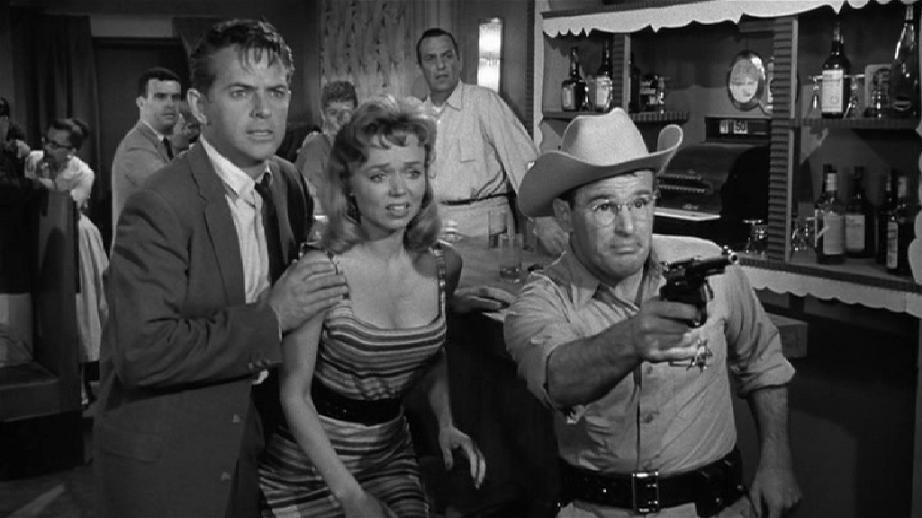

Boasting really awful special effects, a silly premise and a memorably schlocky title, this went on to become a favorite of bad movie devotees. While amusing at times, it's actually pretty average / ordinary for the budget / era. This is undoubtedly lead actress Hayes' most iconic role, but it's hardly her best. She spends the first 25 minutes behaving like a drunken bitch, is out of the film for the entire mid-section and then reemerges during the last 7 minutes with an echo voice pining for her beloved Harry. The 50-foot-woman's rampage involves escaping through the roof of her home, tearing down a utility pole, scaring a couple of necking teenagers, busting out a window and, finally, crushing the mistress with a board and picking up a (very poorly scaled) Harry doll, who goes down when she finally goes down. Wires holding up the spaceship can easily be seen numerous times.


Prior to this, director Nathan Juran (billed as "Nathan Hertz" here; reportedly out of embarrassment) had made several solid genre films, such as THE BLACK CASTLE (1952) with Boris Karloff and Lon Chaney Jr. and the sci-fi favorite 20 MILLION MILES TO EARTH (1957). The screenplay was from Mark Hanna, who'd co-written (and carried many ideas over from) the similar THE AMAZING COLOSSAL MAN (1957). It played theatrically on a double bill with WAR OF THE SATELLITES (1958).


A made-for-cable (intentional) comedy remake directed by Christopher Guest and starring Daryl Hannah was released in 1993 and there have been numerous spin-offs, such as Fred Olen Ray's Attack of the 60 Foot Centerfold (1994) and the more recent Attack of the 50 Foot Cheerleader (2012). Premiere Magazine ranked this #8 on its list of "25 Best Movie Posters Ever."

Tuesday, February 12, 2019

Gospodin oformitel (1987)

... aka: Господин оформитель
... aka: Mister Designer
... aka: Mr. Designer

Directed by:
Oleg Teptsov

St. Petersburg, 1908. Renowned artist and designer Platon Andreyevich (Viktor Avilov) seems to have magic fingers as everything he touches turns to gold. He's well-known for designing not only elaborate, artistic stage productions but also putting together store window displays that bring the customers in in droves. He's made a great deal of money doing what he does but he's also so off-the-wall in his approach and ideas that he's just as apt to alienate or even offend. He's sought out to design a jewelry store window. While the owner wants to display as many diamonds as he can, Platon wants to concentrate entirely on a snake bracelet that catches his eye. What he puts together - a morbid display featuring a child in a coffin - isn't to the customer's liking but Platon is so good and so trusted as an artiste that the jeweler (Vadim Lobanov) goes along with it. It ends up being to his own detriment and Platon's reputation takes a hit as a result.

Six years later, a depressed (yet still off-putting, arrogant and pretentious) Platon is living in poverty and squalor as a junkie, and his landlord / flatmate (Ivan Krasko) may have to throw him out and auction off his belongings if he doesn't pull it together soon. But a potential savior, and a much-needed source of income, appears in the form of wealthy, secretive and mysterious Mr. Grilliot (Mikhail Kozakov), who's wanting Platon's design services for his newly-purchased home. The home, located on an island, is mostly empty and Platon will pretty much have free reign to do as he wants. Upon arriving, he learns that it was actually Grilliot's wife, Maria (Anna Demyanenko), who wanted him to do the designing. When Platon meets Maria he finds she's a dead ringer for Anna (also Demyanenko), a sickly 14-year-old girl from the slums who used to do nude modeling for him. In fact, he's fully convinced it's her despite her insisting otherwise.


Platon keeps chipping away at Maria, eventually showing her a picture of his painting of Anna from years earlier so she can no longer deny who she really is. And yet she still stubbornly does. Mr. Grilliot, who refuses to elaborate on what he does for a living, comes to Platon asking about his wife's past. When Platon refuses to answer (and is outright rude), he's fired. Returning home empty-handed, the artist has to choose between his vanity and pride and finishing his job. Otherwise he may end up in debtors prison. When he goes to beg "Maria" for a chance to fulfill his contract, she basically admits she only married Grilliot for his money and says he'll have to talk to her husband to get his job back. But, as good fortune would have it, there's no real need. Platon manages to weasel his way into a poker game with Grilliot and his friends, where he wins a fortune.


Now that he's wealthy again, Platon asks Maria / Anna to leave Grilliot and be with him. He's also overwhelmed by the bizarre urge to strangle her to death. She disappears soon after. Platon tries to find her, only to discover that she may have died back in 1908 from tuberculosis. After all, she does have a death certificate as well as a grave. However, she may also be either a ghost, a mannequin somehow brought to life or a Frankenstein-like creation, as Platon previously scoured through morgues looking for young bodies. For what purpose? Though vague, it may explain why Maria / Anna is still around despite being on record as dead. Platon's entire career has been centered around vainly trying to "create something better than what God has made," so perhaps he's succeeded.


Nearly everything about Mister Designer screams "Debut film from someone fresh out of film school who wants to be taken seriously as an artist." Although I don't know if the director was indeed fresh out of film school when he made this, or even attended film school for that matter, this feels like a calculated attempt to impress utilizing a lot of tried and true "artsy" / "stylish" tricks. One thing that irks me to no end is that the vast majority of new directors eager to prove themselves default to a deliberately confounding narrative and make everything irritatingly vague. I don't mind directors emptying out their bag of visual tricks to show off but, for the love of God, start with a strong script and stop assuming you can stylize your way out of a needlessly confusing narrative.

Where I found this most lacking though was is in its absence of a humanizing central focus. Unless you can relate to the arrogant, self-important lead and intentionally obtuse and thinly-drawn supporting characters, you're not going to be the least bit affected when this attempts to be dramatic or romantic. Scenes meant to give this a bit of emotional depth fall flat simply because you don't really care about any of these people.


Now with all of the above out of the way, I should admit one last thing: I actually LIKED this film. I know it doesn't sound like it but I tend to be tougher on good films that I know could have been great with a better script or a few tweaks here and there. It's far more frustrating than sitting through something that outright sucks. Truly bad films may have a redeeming quality or two but seldom exemplary ones. This one has many.

For starters, it's beautiful to look at and often so creatively directed that you find yourself forgiving, if not entirely forgetting, about the muddled plot and under baked fantasy elements. The director really does have some great visual ideas and impresses with his ability to utilize both light and slow motion to eerie effect. Especially nice is his approach to flashback scenes, which are tinted sepia and slowed down to the point where the the film grain itself seems alive with movement. The texture of these scenes bring to mind the look of a weathered drawing and it's a really cool touch. So here you get a big win with the photography and imaginative presentation. You also get a big win with the art direction and costume design, both of which are great throughout.


But my absolute favorite thing going on here was Sergei Kuryokhin's score. It's heavy on the elegant / classical compositions, but with infusions of progressive rock, metal guitar, New Wave synthesizer and even opera. And it's fuckin' amazing! The score alone helped to boost my rating as I was going to rate it a notch lower until I factored the music into the equation.

Nominated for three Nika Awards (basically the Russian Oscar equivalent) for production design (Natalya Vasilyeva), sound (Aleksandr Gruzdev) and costumes (Larisa Konnikova) and winning for the latter, this was also one of the nominated films at Fantasporto in 1989. It never played theatrically in America to my knowledge and hasn't been given any kind of U.S. home video release, though there was a 2016 DVD from Lenfilm that comes with English subtitles. I've seen the release year listed as 1987, 1988, 1989 and 1990, though multiple sources say this was a December 1988 theatrical release date in Russia so we'll go with that.

★★
Related Posts Plugin for WordPress, Blogger...