.
.
.

Friday, November 1, 2013

Ren xia gui (1984)

... aka: 人嚇鬼
... aka: Hocus Pocus
... aka: Hogus Pogus
... aka: Yan hak gwai

Directed by:
Yuet Sang Chin

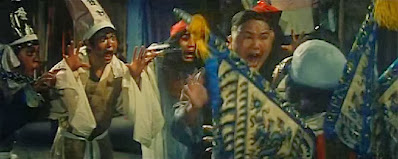
Ghost comedies were all the rage in Hong Kong during the 80s... and here's yet another one from Golden Harvest. Things begin with an elaborately-staged theater production full of lavish costumes and stunts being put on by a traveling Chinese opera company. The leader Uncle Sheng is played by Ching-Ying Lam, the one-eyebrow priest from the later hit Mr. Vampire films. Though his profession in this one is different, he's already sporting a major facial imperfection (this time a hairy mole on his chin) and playing straight comic foil to a bunch of mugging costars during various supernatural gags. Lam's character is in charge of a bunch of immature young actors who are constantly pulling pranks on one another, which in the earlier scenes makes this seem like the Asian equivalent of an American summer camp movie. Kuei (Wei Tung) is usually the ringleader behind it. He easily swindles money and the best bed from the dumb Piao (Peter Chan) and pretends to be an angry ghost to trick another guy into eating mud that he'd just pissed all over. Kuei and the others stage a full-scale haunting to scare the shit out of smirky, arrogant star attraction Chia (Ho Kai Law). Maybe it'll teach everyone a lesson not to take all this stuff so lightly if a real haunting were to occur... and that's just what happens.


Deep in the netherworld, a mistreated, mischievous 300-year-old ghost with a blue bulbous head escapes into our world. Now let me stop here for a second and note that I couldn't tell whether this spirit was intended to be a male or a female. Though played by the male director, it behaves like a woman and even appears to have been dubbed over by a female voice. Whatever gender, it giggles and mugs for the camera constantly and quickly grates on the nerves tripping people, knocking things over and doing other obnoxious, destruction things. Not technically a ghost, it's actually a poltergeist and gets in the middle of a choreographed fight to ruin a performance and then decides to wreck havoc in Chia's room and destroy all of his wardrobe. So basically, the poltergeist stirs up shit, someone else becomes the scapegoat and the guys, blaming each other, get into long fights to make sure the martial arts quotient is met. Chia is eventually possessed by the spirit, threatens to kill everyone, threatens to kill himself, beats his head against a wall and then is rescued when they fetch a baby to piss on his head (!)


Realizing their troupe is now cursed by a destructive ghost, Uncle Sheng decides to kill two birds with one stone by working an exorcism into a stage show. They call forth the poltergeist and learn that in her human existence she was murdered and is now a wandering spirit who'll continue to live between our world and the next until her bones are properly buried. They find her remains underneath the stage, bury them in a nice location and then put her soul to rest. The end? Nope, there's still fifteen minutes to spare so this goes off on an entirely different (and suddenly serious) direction when a malicious, long-haired demon shows up to spoil the opera company's lavish celebratory feast. Lasers shoot out of nowhere and fry a guy, tables split in half, stuff explodes, chairs and people start flying around the room, cooked fish come to life, ghost POV shots weave over and under tables and a portal opens up on the wall and starts sucking stuff inside. Things end with an elaborate battle between our heroes and the flying, super-strong demon after they trap it inside a large room with blood-covered floors and blood-soaked nets. Whoa, where the hell did all that come from?


Though I thoroughly enjoyed the last 15 minutes (the action and fight choreography are great), it's tough to really recommend this one because of the slow and highly uneven start and the abrupt last minute change in tone. You also may think you're losing your mind during a sequence where the female cook has her finger bitten off by a turtle that pops out of a pot of soup and then gets tossed around a room by an invisible force while the famous Goblin score from Suspiria (1977) erupts on the soundtrack. Not content with just swiping the music from just one source, this also buffers its entire score with stolen and, in some cases very famous, music from Night of the Living Dead (1968), Carrie (1976), The Amityville Horror (1979), The Shining (1980) and even Tourist Trap (1979). I guess if nothing else, they at least they have great taste in horror film scores.


Filmed in 1983, Hocus Pocus (called "Hogus Pogus" on the DVD cover) was a money-maker in Asia for producer Sammo Hung and his production company, though they'd  have much bigger hits than this. It has never been released in the U.S. (possibly because the entire music score would have to be replaced).

★★

Muñecos infernales (1961)

... aka: Curse of the Doll People, The
... aka: Devil Doll Men

Directed by:
Benito Alazraki

While on vacation in Haiti, a quartet of men snuck into a secret voodoo ceremony and stole a small stone voodoo Idol, which collector Luis (Jorge Mondragón) now has sitting in his home in Mexico. During a dinner party, acquaintance Karina (Elvira Quintana), who's well versed in not only modern and ancient world customs but also the occult sciences thanks to her late archaeologist father, decides to lay it all out for them: You guys seriously screwed up. Not only was it not wise to watch the voodoo ceremony in the first place, but the men have managed to swipe "The Sacred Idol of the Houngans" and the Houngans are among the most powerful of all voodoo cults. Not only capable of raising the dead, these men also wield enough power to call forth evil spirits to help avenge themselves. Since someone witnessed what the men did, they're all now marked for death. Karina adds that they've not only cursed themselves but also their descendants. They won't be able to hide from the curse and the Houngans won't even bother retrieving the Idol until all four men are dead. Though everyone shrugs off Karina's warnings, the party ends with Luis dead at the bottom of his staircase as the clock strikes midnight; the exact time the curse was supposed to begin its cycle.


Luis' death is blamed on an accident. Karina, a doctor who works alongside her skeptical fiancé Armando (Ramón Gay) in the same hospital, notices some small puncture wounds on the body during an autopsy. It is only when a second of the men who desecrated the voodoo temple - Juan (Xavier Loya) - shows up at the hospital in a zombie-like state only to die soon after again marked with the tiny puncture, that people begin taking Karina seriously. A voodoo priest (Quintín Bulnes) with long hair, a goatee and thick eyebrows is the sinister dude responsible, and he's brought along a few friends to help him out. The first is Staloon, a big, mute, prune-faced zombie, who stays put in his sarcophagus unless he's needed to go beat people up or make special deliveries. Special deliveries of what, you ask? Why dolls, of course. Each victim's soul is transferred into a doll in their likeness, reanimating it. They then must go about helping the priest enact his revenge by sticking long pins through victims' necks and chests. If the dollies refuse to comply or cause any problems, the voodoo master punishes them by driving pins through through them instead.


Muñecos infernales is one of the best-remembered and most-viewed of all 60s Mexican horror films here in America thanks to decent distribution by K. Gordon Murray, who re-titled it Curse of the Doll People, had it horribly English dubbed for mass consumption and excised some of the more violent footage for same (and so it could play on American TV in 1964). Regardless, children of the day were still completely horrified by this one! 

Plot-wise, it's a pretty simple, competent set-up with just enough plot and a predictably corny "Whip-out-that-cross-and-praise-Jesus!" resolution. However, the doll designs are so memorable it hardly even matters. The effects were achieved by scaling certain props either up or down and using dwarfs decked out in suits and creepy waxen masks. Having real people play the dolls really does bring them to life (albeit sometimes clunky, uncoordinated and very slowww life) and the makeups on these dolls are excellent for the time. The little quirks given to them, such as them being controlled by a knotted rope of female hair called a "sorcerer's ladder," them responding to a flute played by the zombie man and having their own self-destruct system, are pretty neat, as well.


When it came time to re-watch this one again for a review, I bypassed the cut English-dubbed version (the same one distributed by Murray, which was available on numerous budget labels throughout the years) and went straight for the original 82 minute version in Spanish with English subs. I recommend you do the same. While the dialogue in the original version isn't exactly Shakespeare, it's not downright laughable either. This is also noteworthy in that the lead female character isn't a clueless, useless ditz like usually seen in these older films and she's highly intelligent and surprisingly well-rounded. The cast also includes Mexi horror regulars Roberto G. Rivera as an underworld thug who becomes involved, and Nora Veryán, Luis Aragón and Salvador Lozano as victims. Alfredo Salazar's script is loosely based on the novel "Burn Witch Burn!" by A. Merritt and the filmmakers seem to have seen CULT OF THE COBRA (1955) while crafting the Haitian back story.


Doll People was paired with NIGHT OF THE BLOODY APES (1968) for the Deimos DVD release "Crypt of Terror, Vol.1." Other companies (Cine Vu, MediaOutlet) released it separately.

★★1/2

Thursday, October 31, 2013

"Brivido giallo" - Per sempre (1987)

... aka: Changeling 2: The Return, The
... aka: Changeling 2: The Revenge
... aka: Fino alla morte
... aka: Per sempre (Forever)
... aka: Until Death

Directed by:
Lamberto Bava

Brivido Giallo was a 1986 cable TV series featuring four movies; all running about 90 minutes, all directed by Lamberto Bava, all co-written by the prolific Dardano Sacchetti and all boasting a score by Simon Boswell. Per sempre / "Forever" was the second of these aired; following right behind the so-so Una notte al cimitero / "A Night in the Cemetery" (U.S. title = GRAVEYARD DISTURBANCE). The third and fourth entries were La casa dell'orco / "The House of the Ogre" (U.S. title = The Ogre) and "A cena col vampio" / Dinner with a Vampire. Of these four, The Ogre was the only one to receive decent distribution here in America after it was misleadingly re-titled Demons III to be sold as the third entry in Bava's extremely popular Demons series. Per sempre itself was also the subject of a bogus re-titling and was released on VHS in some countries (though not America) as either The Changeling 2: The Return or Changeling 2: The Revenge as a fake follow-up to the very good 1980 Canadian ghost story starring George C. Scott.


Lovers Carlo (David Brandon) and Linda (Gioia Scola) murder her husband Luca (Roberto Pedicini) and bury his body in a shallow grave in the woods. Six years pass and the duo now run a restaurant in the small fishing village of Carabinieri where the customers seem more interested in checking out the sexy Linda than eating the food. Linda's lonely, neglected young son Alex (Marco Vivio), whom she conceived with her deceased former husband, is scared of the dark and plagued by nightmares of his dead father emerging from his grave. Carlo has since turned bitter and angry over the years and not only detests the little boy but is also abusive in numerous ways toward Linda. Late one night during a thunderstorm, a mysterious, hunky drifter named Marco (Demons star Urbano Barberini) appears at the doorstep looking for food, clothing, lodging and a job. Since Marco is kind to Alex and Linda needs a hand around the restaurant anyway, they hire him on and soon come to realize that he may be more than he seems.


Marco is amiable, charming, friendly and good-looking, but he also seems to know a lot of things he shouldn't know, like secret ingredients that go into Linda's food and where clothing that belonged to Luca is stored. Once he starts cooking in the restaurant, business picks up and customers begin commenting about the food tasting as good as it did before Luca vanished. Carlo quickly becomes jealous and paranoid of the new man in town. He wonders why Marco disappears for hours each day, whether or not Linda is sleeping with him and how he seems to know his way around the establishment so well. He then begins to fear that he's actually an undercover policeman investigating the dead husband's disappearance after he catches him having a discussion with the town's marshal (Stefano De Sando). Soon, things buried in the husband's grave - including a wedding ring with "Per sempre" inscribed inside - begin turning up inside the home. The son continues to have nightmares, dead pigeons fill the attic, fresh meat spoils and maggots show up all over the place. Just who or what is Marco and what does he want to accomplish?


Though unoriginal and somewhat predictable, this is a passable and fairly well-made thriller with some colorful visual style; particularly striking during various red-filtered shots of the lake and handsomely shot blue-tinted night scenes. However, it also clearly owes a huge debt of gratitude to Tay Garnett's torrid 1946 crime melodrama The Postman Always Rings Twice (an adaptation of James M. Cain's novel, which was remade in 1981 starring Jack Nicholson and Jessica Lange), and lifts its basic plot and three main characters from that film. Given the overheated story line and sexy leads, this actually would have benefited from being steamier and more (sexually) graphic than it actually is and seems a little too chaste in a PG-13 kind of way. Adding a horror twist to the premise are the possibility of Marco being either a ghost or possessed by the wrong husband's spirit and the child's frequent nightmares about his dead, zombie-like father being fished out of the lake, reaching his hand out of the ground and grabbing his leg and busting through the plaster walls of his bedroom.


As an interesting footnote, Lucio Fulci claimed in interviews to have actually written the original story this was based upon and also said he was originally supposed to direct it, but it was taken from him and copyrighted behind his back by credited writer Sacchetti. Sacchetti, on the other hand, claimed in interviews to have actually written the story (for the record, his wife - Elisa Briganti - is credited as co-writer) and says Fulci was lying about all that; sour grapes over the project going to Lamberto Bava instead. Either way, the film effectively ended future collaborations between the two men.


In 2009, MYA Communications released this and the other two previously-unseen-in-America Brivido Giallo titles. (The Ogre had already been issued in 2003 by Shriek Show.)

★★1/2
Related Posts Plugin for WordPress, Blogger...