

... aka: Freibeuter des Todes (Privateer of Death)
... aka: Fruktans ö (Island of Fear)
... aka: Het Eiland der Verschrikking (The Island of Terror)
... aka: Les zombies de l'île sanglante (Zombies of the Bleeding Island)
... aka: L'île sanglante (The Bloody Island)
... aka: Rémségek szigete (Island of Horrors)
Directed by:
Michael Ritchie
Big things were expected from The Island back in 1980. For starters, it was another terror-on-the-high-seas concept based on a best-selling novel by Peter Benchley, whose previous novel Jaws became the basis for the #1 highest grossing film of the entire previous decade. Jaws producers David Brown and Richard D. Zanuck returned and Benchley was even able to adapt his own book. Second, The Island had a production budget of 22 million dollars. While that sounds like peanuts for a major studio release these days, it was quite a large budget back then, equivalent to over 90 million dollars when adjusted for inflation. For a reference point, consider the budget of The Empire Strikes Back, the top grossing film of 1980, was 18 million dollars, and the budget of The Shining, which rather famously took forever to be planned, cast and filmed due to Kubrick's meticulous nature and demand for massive sets to be constructed, was 19 million. Throw in a director who'd made several surprise hits the previous decade, a score from the ever-reliable Ennio Morricone, a well-known cast headlined by Michael Caine and a plot touching on the then-topical Bermuda Triangle myth and what do you get? Well, in this case, a financial bomb that received scathing reviews and the worst kind of press imaginable.
Upon release, The Island debuted at #4 at the box office and sunk pretty quickly after that. Critics lambasted the acting, the plot, the often-laughable dialogue, the bloated production and (most especially) the level of violence. Several of the actors (including Caine) refused to discuss the movie or help promote it. The film was also included in the very first Razzie Awards ceremony, receiving nominations for Worst Actor and Worst Director. And, in some strange way, already knowing much of the above going in and setting my expectations accordingly actually helped my enjoyment of this one somewhat.


A boat full of old rich guys get slaughtered somewhere in the Caribbean but there's no sign of the boat, wreckage or any bodies later. If this were an isolated incident, New York newspaper columnist Blair Maynard (Caine) probably wouldn't think much of it but, in just three years' time, 600 ships and several thousand people have vanished in the same area according to Coast Guard records. When John asks for funds from his editor to go to Florida to investigate, he's greeted with skepticism ("Bermuda Triangle bullshit!") but manages to talk him into it. Afterward, Maynard learns that his ex-wife has slipped town with her new boyfriend and left their 12-year-old son, Justin (Jeffrey Frank), in his care for the weekend. Maynard decides to take Justin along with him to Florida, figuring after he asks a few questions and snoops around they may have time to swing over to Disney World.


Upon arrival in Miami, Maynard charters a plane from the sketchy Stark (Brad Sullivan), whose half-burnt face red flags how successfully he's pulled off his previous flights, to get them to the barely-populated island of Navidad located deep within "the asshole of the Western world." Stark manages to get them there... barely. The plane blows up soon after skidding down the runway with the wheels still up, prompting local cop Westcott (Zakes Mokae) to arrest the pilot until he can be compensated for the damages. The following morning, Maynard and Justin are able to charter a boat from Dr. Windsor (Frank Middlemass) to go fishing. While out on the ocean, the two run across a young girl floating in the water and, next thing they know, they're being attacked, knocked out and awakening somewhere else entirely.
The island of the title is an uncharted one lost in a sea of over 1200 others that's populated by a fairly large group of dirty, rotten-toothed buccaneers who have somehow managed to avoid civilization for the past 300+ years. Of course, they're also the ones who've been responsible for the rash of disappearances; attacking various boats, pillaging their goods, killing most of the adults and kidnapping the children to add to their ranks. Due to the amount of inbreeding over the years, most of the pirate population is infertile, so they must replenish their numbers by kidnapping whatever children they can get their hands on, as well as some of the more youthful adult females to use as "breeding stock."


The pirates (played almost exclusively by British character actors) speak broken, sometimes incoherent English with some Spanish words and some seemingly made-up words sprinkled throughout their banter, often making their gibberish a real headache to get through. The society has a majority-rule democratic governance of sorts, as well as a guide book of laws they call "Covenant". The book claims that that "A child shall lead" them and pirate chieftain John David Nau (David Warner) starts to suspect that child may be Justin because he shares a last name with the man who killed Blackbeard and thus may be one of his descendants. Justin is promptly separated from his father and goes through a torture / brainwashing regime conducted by Hizzoner (Colin Jeavons).
Meanwhile, Caine's character has to make amends for his past actions. Prior to blacking out, he had shot and killed one of the pirate men and is now required to take that man's place. That also means taking over husbandly duties and impregnating the now-widowed Beth (Angela Punch McGregor). After he's nursed back to health, Caine is shackled in the woman's hut, walked around on a chain like a dog on a leash, gets a Vaseline handjob (!) and is basically treated like a sex slave. Maynard, a Korean War vet who possesses some survivalist skills, attempts several unsuccessful escapes and somehow manages to avoid being executed despite constant threats of such. Developing feelings for him, Beth becomes somewhat of an ally and helps save him multiple times, but will he be able to escape and find a way to deprogram his son, who has now been turned against him?


I've seen some cinematic tonal nightmares in my day, but this about takes the cake! Part of the time it feels like a kid's adventure movie. The entire set-up of a busy career man and his estranged son trying to reconnect over holiday, which takes up most of the first half hour, has been used a number of times in various family movies. In addition, quite a bit of focus is put on the juvenile characters, there are dumb gags involving things like stinky feet, cartoon-like scalawags constantly acting goofy and mugging for the camera and out-of-left-field attempts at humor, including an embarrassing scene where the pirates attack a schooner transporting cocaine and have to do battle with some martial artist who makes kung fu movie "hee-ya!" noises as he fights (!)
Needless to say, none of the above blends well with the more adult-oriented content. There's nudity, sex, a high body count, slasher-style gore murders with hatchets going into heads, throats being slashed and an bloody axe disembowelment, kidnapping, drugs, and even jellyfish nipple torture. Sometimes the film seems like it wants to be taken seriously, at other times it doesn't, and there are many scenes where you have no clue what kind of tone they were even shooting for. That's especially obvious in a bit where the pirates slaughter an entire Coast Guard crew, which is set to heroic-sounding swashbuckling music and - I think - was supposed to be funny. I'm also not sure if the finale, featuring Caine mowing down nearly the entire supporting cast with a machine gun Rambo-style, is supposed to be hilarious or not, though it is.


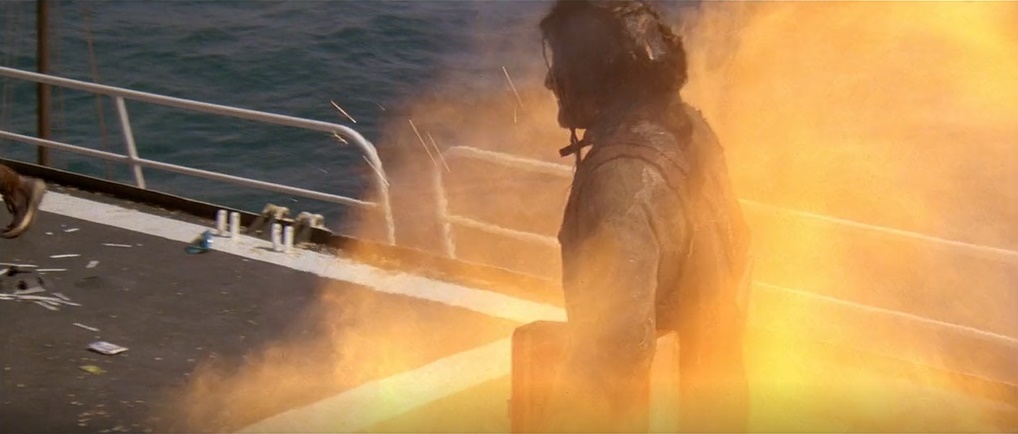


On the plus side, the Antigua and Barbuda locations are nicely-photographed by Henri Decaë, the production values are lavish and the art direction, costumes (from Ann Roth, who'd later win two Oscars), props and such are all good. The action scenes are proficiently directed and edited and the cast (also including Don Henderson, Dudley Sutton and Reg Evans as pirates) isn't terrible. So while this can certainly be considered a misfire, it's at least not a boring one.


As is the case with most other major studio films, this has been well-distributed on the global home video market ever since its 1981 VHS debut on the MCA label. Universal gave the film a DVD release in 2011 as part of their "Vault Series" and that was followed by a 2012 Blu-ray release from Shout! Factory. Both of these releases are bare bones with no notable special features, which I suppose is to be expected when it comes to a bastard stepchild movie that most of the key players would rather forget.
★★


