... aka: 菩薩咒
... aka: Heavenly Devil
... aka: Heavenly Spell
... aka: Pu sa zhou
... aka: Two Ghosts
Directed by:
ฤทธิรงค์ (Rittirong) (credited on Thai version)
On Ma (credited on HK version)
Depending on the source you consult, this film was first released in either 1987, 1989, 1990 or 1991 and you'll also notice completely different actors listed as being the stars and as many as five different directors credited with making it! That's not too uncommon with Asian co-productions or films made in one country and then released in another, though. Often times these movies had their titles and credits completely changed to give the impression someone else had made it or that it's a homegrown production and not one from a neighboring country. At other times, the original film was re-edited and had new scenes shot with new actors for release in certain markets. Sometimes the same film was essentially made twice, with parallel productions shot simultaneously with different actors speaking different languages. And then there were the times that films were indeed co-productions between two or three countries, but completely different edits were made and completely different footage used. This understandably leads to a lot of disinformation being spread around online that blogging film nerds like me have to try to clean up.

Best I can figure with this one is that it was either a solely Thai production or a Hong Kong / Thai co-production. The latter seems more accurate judging by the mixed cast, though the film is based on a famous folklore tale that I believe is specific to Thailand. The earliest release I could find for this one was a 1989 Thai theatrical release under the title ผีสองนาง, which translates to Two Ghosts. This was released in Hong Kong two years later under the new title 菩薩咒 / Pu sa zhou, which translates to Bodhisattva Mantra. A bodhisattva is a being who has achieved a high level of enlightenment in their quest to achieve complete Buddhahood. Since that would have no meaning to most non-Buddhist Western audiences, the English title used on the HK poster is Heavenly Spell. I took a look at both the Thai language VCD release and the Mandarin language HK DVD release and the two cuts of the film are identical.
As for who actually directed this, the Thai print credits ฤทธิรงค์ (Rittirong) while the HK print credits On Ma (who is called "Gon Man" on IMDb and several other names on several other websites). Many of the same people involved in this were also involved in another obscure film called Curse of the Zombi, which was also filmed in Thailand for the same producer and features many of the same actors. The two were likely shot back-to-back.


Considering how frustrating it was trying to make heads or tails of the cast and crew and dig up additional background info on this title, that wasn't anywhere near as annoying as actually having to try to sit through the film itself! Yikes. Just half an hour in, after the hundredth new character was introduced and the multiple dead end story threads started piling up, I was praying that everything would eventually start making sense. An hour later I was hoping for the exact same thing. It just never happened.


While passing through the woods with some treasure, noblewoman Fang (Siu-Yin Tsang) and her unnamed sister (Wasidtee Srilofung, a Miss Thailand finalist), plus their entourage, are attacked by a group of bandits while the theme music from Halloween plays. A villager named Shao-jun (played by former Shaw Brothers stable actor Siu-Kwan Gau) tries to come to their rescue but is only able to save one of the sisters after they fall into a river. The other sister drowns, as does a servant girl (Sasimaporn Chaikomol, another Miss Thailand runner-up) who was pushed in. Apparently none of these chicks can swim the ten feet necessary to make it back to the shore. Shao-jun brings Fang back to his home, where she's visited by her sister's weeping ghost, who promises to help take care of and protect her. And that she does whenever the main bandit, Xing (Kawee Sirikhanerut), shows up there looking for her. While Shao-jun and Fang are set up as primary characters early on, they're curiously dropped from most of the rest of the film.


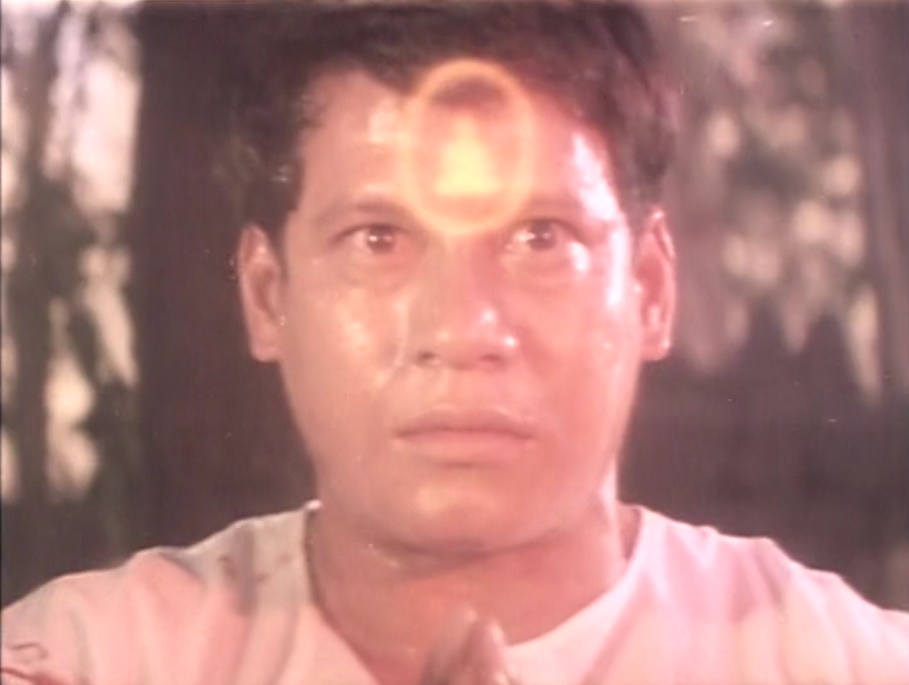
The locals all worship and pay daily reverence to a female spirit called the "River Goddess," who's played by some unbelievably gorgeous yet unknown actress who may have been plucked from the pageant circuit herself. She has a shrine built by the river and, if anyone doesn't show their respect when passing it, the angry ghost lures them to their doom. A teenage girl named Jiao, daughter of district officer Bing (Paen Pleumsachai), is one such victim. After she's coaxed to the river and promptly vanishes underneath the water, Jiao's parents seek the help of young wizard Master Ling-hua (Bin Banleurit), a powerful practitioner of white magic. With help from an old witch, they're able to track Jiao's location down. Ling-hua jumps into the river and does battle with a pair of sea monsters, which look huge and amazing on the Thai poster up above but small, pitiful and strangely like plastic Chinese New Year dragon heads fastened to rubber tubes in the film itself. Jiao is located tied up underwater and, after Ling-hua and a monk plead with the River Goddess, the young girl is revived.
However, the River Goddess was injured in the fight and now needs to replenish herself. She pops up in the woods in her snake-dragon form, bites and kills a man, which angers his witchdoctor mentor (Suchao Pongwilai) and their other followers, who vow revenge. The witchdoctor seeks advice from a talking skull (?!) that tells him he has to combine a snake staff he's already in possession of with a "Yang element" before he can do battle with her. And then the wizard and his followers curiously disappear from the rest of the film never to be seen again. Not enough useless characters for your tastes? Well, you ain't seen nothing yet! The film also cuts back and forth between these three plot threads and some old man in the village rehashing all of the things we're watching to two other guys.


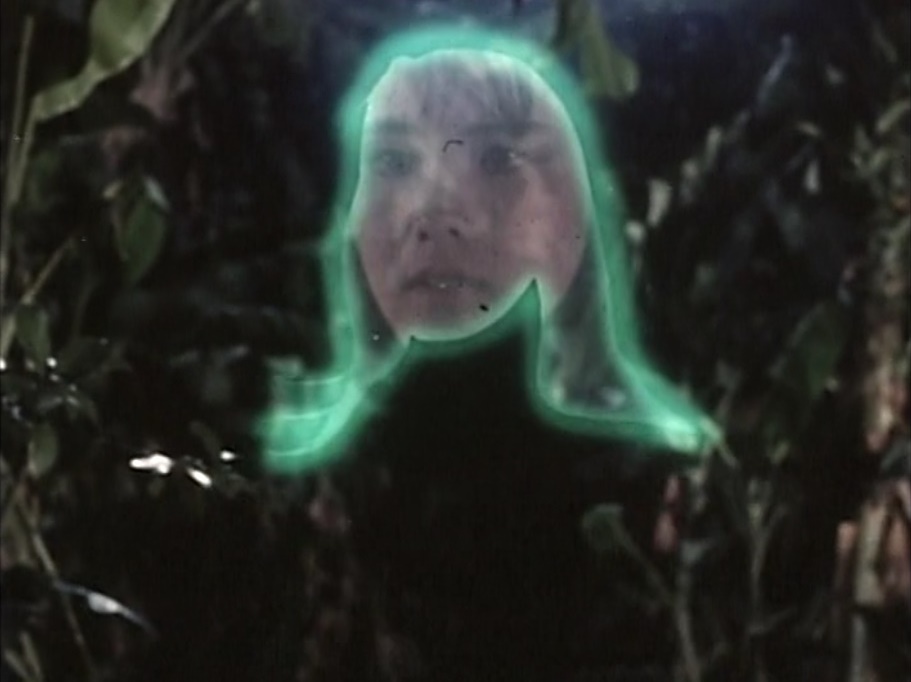
There were a number of things that left me scratching my head here, including whether or not these storyteller bits were meant to be set in the present day while the other stuff (or at least SOME of it) is in the past. The folk tale this is based off of is set the early 1800s, yet most of the other trappings seem pretty modern. Speaking of the folk tale, major liberties were clearly taken with it here. The original story has two murdered sisters haunting the lake. In this one, only one sister dies yet there are two dragon-snake monsters so we're to assume the River Goddess has transformed the dead sister into one of her minions or something. And then a second helper of the River Goddess, who appears to be the ghost of the servant of the drowned noblewomen, shows up toward the end. It's basically impossible to keep up with any of this!
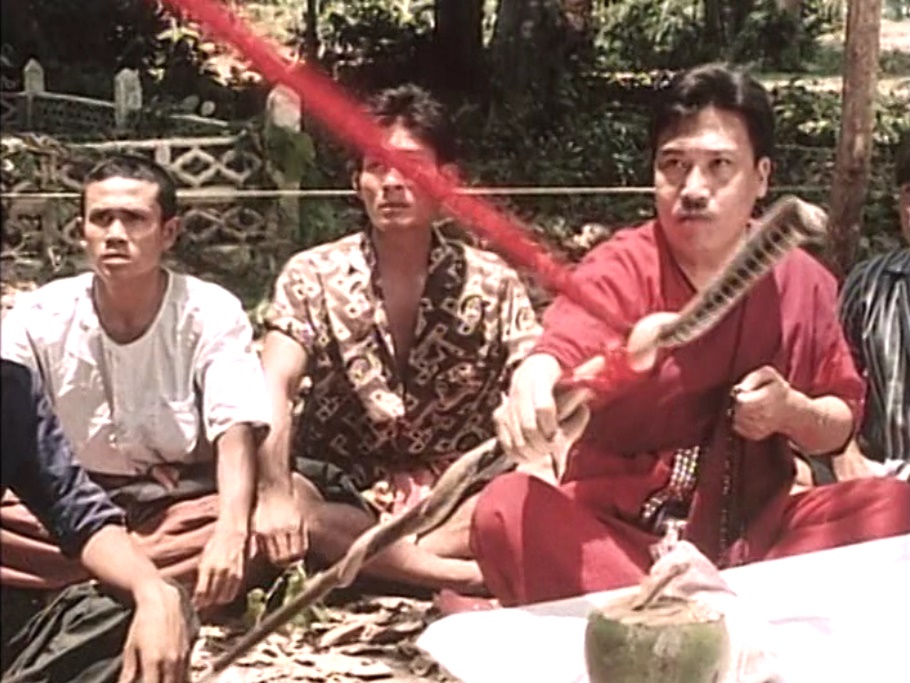
Since apparently there wasn't enough going on already, we then next meet another evil black magician named Master Mao (played by director / writer / production manager Ma), who is actually an underling of yet another evil black magician called Grand Master (Tse-Lin Yang) and they are all somehow in cahoots with both the River Goddess and the group of bandits. Two remote magic duels take place; one between Mao and Ling-hau, and a second between Grand Master and Ling-hau, which include a flying cardboard bat monster, cobras, whipping, arrows, someone eaten alive by piranha and lots of laser lights shooting out all over the place. Most of the fighting is over a treasure chest filled with jewels that had sunk into the river.


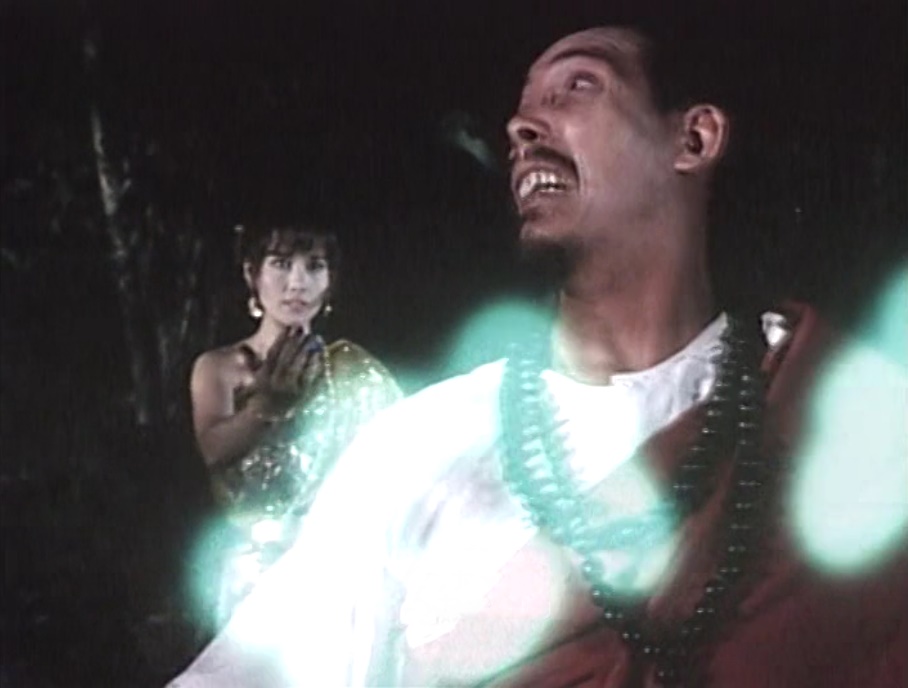


There have been multiple VCD and DVD releases for this one. The Taiwanese DVD from Scholar comes with English subtitles. There was also a full screen, VHS-transfer Malaysian DVD release from YesAsia which is the one I viewed. It comes with English, Malay and traditional Chinese subtitles. Amazing how a film filled with things you should like, and usually do like, can end up being so tedious, isn't it?
★1/2