
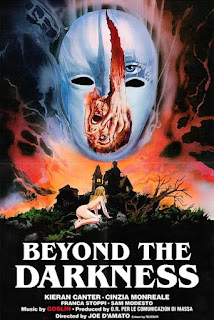
... aka: Blue Holocaust
... aka: Buried Alive
... aka: Demencia (Dementia)
... aka: Final Darkness, The
... aka: Folie sanglante (Bloody Madness)
... aka: House 6: El terror continua (House 6: The Terror Continues)
... aka: In quella casa buio omega (In That House... Blue Omega)
... aka: Mroczny instynkt (Dark Instincts)
... aka: Saddo
... aka: Sado - Stoß das Tor zur Hölle auf (Sado: Open the Gate to Hell)
Directed by:
Joe D'Amato
Along with Lucio Fulci, Ruggero Deodato and perhaps a few others, D'Amato was one of a handful of Italian genre directors to get a huge boost in international popularity during the VHS era. In D'Amato's case, that popularity existed almost exclusively because of one title, this disturbing little number, which became one of the most notorious genre films of the entire decade on the home video market. Here in America, it was given an unrated theatrical run by Aquarius Releasing in 1984, followed by a big box VHS release from ThrillerVideo in 1986, both under the new title Buried Alive. Advertisements for the film were very memorable, with the theatrical poster promising such lovely sights as "acid bath revenge," "savage dismemberments," "pails of entrails" and women being torn "limb from limb" and getting "chewed to death," while the VHS box featured a huge yellow "WARNING" sticker on the front, followed by a disclaimer on the back stating "This motion picture is one of the most violent films ever made. There are scenes of sadistic cruelty graphically shown. If the presentation of disgusting and graphic material upsets you, please do not view this film." Of course that "warning" resulted in anyone who read it immediately snatching the film up and heading straight to the counter.

While D'Amato had other films on the market that received a bit of notoriety; most notably The Grim Reaper (1980) and Absurd / Monster Hunter (1981), both of which were prosecuted video nasties in the UK, and several entries in the Emanuelle series, none achieved quite the infamy this one did. So was all that hoopla warranted? Sure. While there have been countless more graphic and disgusting films made since 1979, placed within the context of when this was made, this is pretty strong stuff.


Frank Wyler (Kieran Canter) is a lonely young taxidermist who inherited a ton of money when his parents passed away in car accident and lives in a large gated villa (more like a compound) with his, shall we say, very dedicated housekeeper, Iris (Franca Stoppi). Frank's fallen madly in love with Anna Völkl (Cinzia Monreale) but, unfortunately, she's on her deathbed. Frank ensures her that "Death is not going to separate us" while giving her a final kiss... and boy does he mean it! In order to keep her fresh, he sneaks her injections of formaldehyde before she's buried. After the funeral, he sneaks into the graveyard with a flashlight, crowbar, shovel and sack, digs up her corpse and throws it in the back of his van.
On his way back home, he has to pull over to change a flat tire. An obnoxious, chubby tourist named Jan (Lucia D'Elia), who's been hitchhiking around the country, hops into his vehicle and passes out after smoking a joint. Frank returns home and leaves the girl in the van in his garage while he gets to work preserving Anna's corpse, which involves slicing her open with a scalpel, yanking out her guts, pulling out her organs, replacing her eyeballs with glass ones and sucking out her brains through tubes stuck in her skull through her nostrils (!) It does not involve eating her heart, though he does that, anyway. When Jan wakes up, stumbles upon the gory scene and starts attacking Frank, he pins her down, rips off her fingernails with pliers and suffocates her with a rag.


Soon enough, Iris finds out what Frank's up to. Instead of going to the police, she opts to help him out. After all, Iris is in love with Frank herself and was always jealous of his relationship with Anna, even to the point of trying to speed along her demise by enlisting the aid of a sorceress to kill her using voodoo dolls! Her and Frank's very bizarre relationship includes her comforting him by whipping out her tit and breastfeeding him (!) and helping him dismember corpses with a meat cleaver and dissolving them in acid baths. Now that Anna is dead but of no real threat to her, she helps dress her corpse, paints her fingernails, makes her look presentable and is even willing to give Frankie Boy a hand so he can get off ogling her corpse. Yikes.


Frank soon claims another victim. He brings an injured female jogger (Anna Cardini) back home, seduces her onto the bed he shares with his dead girlfriend, rips out her throat with his teeth and then eats the skin. He and Iris then throw the (still-living) girl into an oven and burn her alive. Their cozy little arrangement is threatened by a number of people, including a pair of police detectives (who thankfully barely factor into the film), an older gentleman (Sam Modesto) who starts snooping around, taking photos and occasionally breaking into the villa and Anna's lookalike sister, Elena (also played by Monreale), who shows up to say goodbye at a very inopportune time.


It's easy to see why this became such a favorite of gore-hounds and sleazy exploitation fans. There's plenty of bloody violence (a crotch is stabbed, a cheek is bitten off, a head and limbs are hacked, eyeballs gets ripped out with bare hands...), perversity, tastelessness and nudity, with three women going full frontal, including a blonde Frank picks up at a disco who comes back to his home and immediately jumps into the bathtub for some strange reason. There's also a pretty great Goblin score to complete the package.
Apparently having a leading role in an internationally-released film like this didn't do Canter's career any favors. He was appearing in hardcore sex films like Erotic Flash and The Bisexual Lover almost immediately afterward. He also played Satan in the filmed-in-Italy The Devil in Mr. Holmes (1987), which was the final film John Holmes made prior to passing away from AIDS in 1988. The female stars seemed to fair a bit better. Stoppi, who gives the best performance here by a country mile, went on appear in a number of Bruno Mattei films, like The Other Hell and Women's Prison Massacre, which some viewers may view as being only a small step up from porn. Monreale (who was sometimes billed as "Sarah Keller") would act for Lucio Fulci in three films, as well as Dario Argento and others, and is still acting today.


For decades, no one seemed to realize that this is actually a remake of a long-forgotten 1966 Psycho-inspired chiller called Il terzo occhio / THE THIRD EYE. That film, which starred a young Franco Nero and Erika Blanc, plays out almost identically to this one save for the ending. Naturally, the 1966 film features no explicit nudity or graphic gore like this re-do, but it surprisingly does maintain nearly the same level of perversity.


Original Italian posters featured a phony quote attributed to Alfred Hitchcock (who passed away in 1980) singing the film's praises! Even though this was primarily known as Buried Alive (a bit of a misleading title) in the U.S. through the VHS era, it's become much better known as of late as Beyond the Darkness; the title used for most of the subsequent DVD and Blu-ray releases from companies like Shriek Show and Severin. In Spain, it was released on VHS as House 6: El terror continua ("House 6: The Terror Continues") and it was re-titled and re-released in Italy to try to trick viewers into thinking it was an Evil Dead sequel.
★★★


