.
.
.
Showing posts with label bigfoot/yeti. Show all posts

Thursday, December 22, 2022

Man Beast (1956)

... aka: El hombre bestia (The Beast Man)

Directed by:
Jerry Warren

One person's filmography I was decidedly not in a big rush to get back to was Jerry Warren's. He holds the distinction here of being one of the only directors to make multiple NO STAR-rated films not even fit for bad movie connoisseur consumption. Furthermore, Warren himself flat out admitted he had zero interest in making good or entertaining films, which I guess makes him a cinematic charlatan of sorts. He was in the business solely to make money, which required cheap as possible investments on what he hoped would be big returns. That's his entire dispassionate career in a nutshell. While I'll never begrudge anyone trying to make an honest living, what Warren was doing ventured more into the realm of hucksterism. Any filmmaker who's worth a damn is either an artist or someone at least attempting to make enjoyable product for consumers. Warren was neither. His usual routine consisted of buying the distribution rights to unreleased-in-the-U.S. foreign films, having them hacked up and re-dubbed (or simply narrated over) and adding cheap, talky scenes featuring American actors so he had names to put on the poster to lure in unsuspecting genre fans. In doing so, he simultaneously destroyed the original director's work, showed genuine contempt for his target audience and became quite possibly the laziest director to have ever walked the face of the Earth.

Though most of his work was pilfered material, Warren did make a handful of his own films. These included the God awful bore TEENAGE ZOMBIES (1959), the almost tolerable THE INCREDIBLE PETRIFIED WORLD (1959), Frankenstein Island (1981), which I've not yet seen, and this one, which was also his directorial debut. Still, even most of these "original" works depended strongly on recycled stock footage to fill in the budget gaps and boost the running time, and this barely hour-long effort is no exception.


After a strenuous hike through the Himalayan mountains, determined blonde Connie Hayward (Virginia [Asa] Maynor) and her sourpuss friend Trevor Hudson (Lloyd "Cameron" / Nelson) arrive at a remote outpost. They're there because Connie is searching for her missing brother, Dr. James Hayward, who'd taken an "experimental injection" back in the states and now may die due to a side effect caused by high altitudes. Along with a small team, James had set out to explore the area ten days earlier and hasn't been seen or heard from since.

In the same area, there've been occasional Yeti sightings going back decades. More recent Yeti footprints have been discovered, which merit further investigation. Four previous expeditions to find the fabled creature have turned up nothing though, and every expedition had lost at least one man. Connie manages to sweet talk reluctant expert climber Steve Cameron (Tom Maruzzi) into escorting them to where he believes the brother has set up camp.


From there, it's a dangerous ascent up the mountainside and then a long trek through the snow-covered, rocky terrain. They finally catch up to famous anthropologist and evolutionary scientist Professor Erickson (George Wells Lewis) and his two local guides, who are on their way to meet up with Connie's brother at base camp. Everyone decides to do the rest of the journey together. Like the brother, Erickson's ultimate goal is to try to locate and capture a live Yeti, which he believes to be the missing link. Coming across the previous expedition's camp, they find it wrecked, abandoned and in total disarray. Setting up there for the night, they awaken the next morning to find Erickson's hired help have run off and left them.

Eventually turning up at the camp is the "half-Mongolian" Varga (George Skaff), one of the best and most requested local guides in the area, who's so experienced at what he does that he never runs out of breath and seems almost immune to the freezing temperatures. Varga had brought Connie's brother up to the mountain and claims to have been out scouting for tracks when whatever happened back at the camp went down. Still, Connie and the others are skeptical of his story and find him to be shady. There's a ludicrous, though amusing and, I must admit, original, plot twist here involving the species of Yeti attempting to incorporate themselves into our society. That involves killing human men so they can kidnap and then knock up human women to produce human/Yeti hybrids. Naturally, we never actually get to see anything of the sort in the film itself!


All of the impressive mountain climbing footage and aerial shots seen here have been snatched from an unfinished film of unknown origin (some sources claim it's Mexican). Having that footage in his possession, Warren then had a script fashioned specifically around it, attempting to match up his new footage, using the same amount of characters, trying to dress them all similarly to the climbers, etc. Surprisingly enough, he actually does do fairly good job of splicing it all together! If one were to nitpick specific details they can certainly find discrepancies between wardrobe, gear, locations, cast appearance, etc., but very few things really leap out as being extremely obvious either. And, in a way, this approach is really not all that dissimilar to how major studios work, where they'll send a 2nd unit director and crew off to shoot location footage with stunt doubles while the primary director handles all of the close-ups and actor stuff.

Warren has also lucked out that the footage he acquired is actually excellent and features some thrilling moments, imaginative camera shots and beautiful locations. That said, most of what Warren himself brings to the table is, as expected, not very good. He's shot mostly dialogue scenes here but, unlike some of his other films, at least he put some effort into finding snowy / rocky outdoor locations to use instead of filming scenes of people sitting around on some porn-grade set talking to each other as he'd later do. The Yeti suit, which is (supposedly) the same costume used for White Pongo and The White Gorilla (both 1945 releases), also isn't too bad.
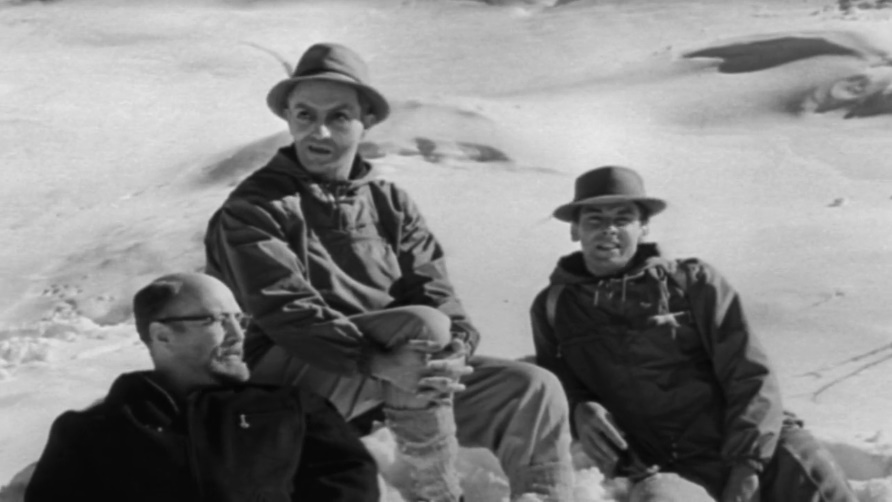


Most of the performances are pretty lousy, with the actors sometimes randomly looking off to the side as if searching for cue cards, stumbling over lines or even looking directly at the camera as others are speaking. The sole standout here is Skaff, who puts in a good campy turn as the mysterious guide. His hilarious facial expressions alone almost make this one worthwhile all by themselves. Skaff would go on to a decent career as a character actor and later appeared in some good movies, like Michael Ritchie's Smile (1975) and John Carpenter's Someone's Watching Me! (1978). Warren's soon-to-be wife Brianne Murphy, who'd go on to a respected career as a cinematographer, plays the Yeti in some scenes and was also the script supervisor. 

Top billed above everyone else in the cast is one "Rock Madison," who plays, well, nobody! This was a fake name added to the credits for some reason, though I'm not exactly sure what that reason was. Perhaps attempting to confuse fans of Rock Hudson and Guy Madison?


This was, I believe, only the third genre movie made about the Yeti / Abominable Snowman. It was preceded by the dreadful THE SNOW CREATURE (1954) and the decent Japanese BEAST MAN SNOW MAN (1955), which later became the basis for an "Americanized" version called Half Human (released in 1957). Amusingly, Man Beast wasn't even Warren's only Yeti movie. He also purchased the rights to a 1959 Swedish / American co-production called Rymdinvasion i Lappland (given many English titles like TERROR IN THE MIDNIGHT SUN), did his usual butcher routine on it (adding boring new scenes and narration from John Carradine) and released it as Invasion of the Animal People in 1962.


In theaters, this played on a double bill with Prehistoric Women (1950). There were numerous VHS releases here in America, two from Rhino in 1985 (paired with 1948's Human Gorilla / Behind Locked Doors for their release "Saturday Night Shockers: Volume 2") and 1988, and another from Acme (a subdivision of Rhino) in 1996. Rhino also released a DVD in 2002. In 2013, Kit Parker Films released three multi-disc DVD sets of Warren's work. Man Beast is included on the first volume along with Curse of the Stone Hand (1965), which was mostly bastardized footage from several 1940s Chilean films, and The Wild World of Batwoman (1966).

Wednesday, July 4, 2018

Jû jin yuki otoko (1955)

... aka: 獣人雪男
... aka: Beast Man Snow Man
... aka: Half Human
... aka: Half Human: The Story of the Abominable Snowman
... aka: Monster Snowman
... aka: S
... aka: S-Project

Directed by:
Ishirô Honda

Due to several factors, Jû jin yuki otoko ("Beast Man Snow Man") is one of the most difficult Toho productions to find in its original form. For starters, it was pulled from circulation by the company itself because it contains what they feel is an offensive depiction of native villagers as dumb, inbred, dirty and deformed, which some feel could be seen as a jab at either the indigenous Ainu People or the burakumin, an outcast group descended from workers in "impure" or death-related trades. As a result, this has never been given TV, VHS and DVD distribution over the years like most of the rest of Toho's horror / fantasy / science fiction output. Second, the full version of the film was never released here in America in English. Instead, it ended up in the hands of producer Robert B. Homel, who hired director / editor Kenneth G. Crane (THE MANSTER) to create a new version. Crane scrapped over half of the original footage and partially replaced that with around 20 minutes worth of new scenes starring John Carradine and Morris Ankrum. Narration (by Carradine) was added and the original Masaru Satô soundtrack was also replaced by a "new" generic canned music score and sound effects.

To give you an idea of how much was actually cut, the original film runs about 94 minutes while the U.S. version (titled Half Human) runs just 63. That's 30 minutes shorter, not even accounting for everything else that was cut to make room for the new scenes. Doing the math, that leaves about just 45 minutes of the original film in the U.S. release. The Half Human cut was released theatrically in 1958 by Distributors Corporation of America (DCA), who also handled a re-cut / shortened / English-dubbed version of Toho's RODAN (1956) as well as Ed Wood's infamous Plan 9 from Outer Space (1957). It usually played on the bottom half of a double bill with Monster from Green Hell (1957).


Reporter Kodama (Yasuhisa Tsutsumi) shows up at a remote train station to look into a mysterious "recent incident" that occurred in the mountains. He's directed to a shaken student named Takeshi Iijima (Akira Takarada). Feeling he can't even adequately put into words what's occurred, Takeshi hands the reporter a bunch of notes taken by one of his ill-fated peers, which start out describing "a terrifying incident unparalleled in human history" and then make mention of a "monster." We then go into flashback mode to see just what the friend was talking about...


Five members of a mountaineering / alpine skiing club from Towa University are spending their New Year's holiday on the slopes. Among them are Takeshi, lone female Michiko (Momoko Kôchi) and Michiko's older brother, Takeno (Tadashi Okabe). After a long day of skiing, everyone decides it's time to head back to the lodge except for Takeno and another student, Kaji (Akira Yamada), who want to visit a local named Mr. Gen first. Soon after, there's a terrible blizzard (the worst seen there in years), followed by a massive avalanche (ditto). And then there's a scary phone call to the lodge, with screaming, gunshots and some kind of animal noise coming from the other end. Nakata and Kaji never make it back to the lodge. A search party later finds Gen's place ransacked, strange footprints, patches of fur and both Gen and Kaji dead. But still no sign of Takeno.


Deciding to wait until the spring thaw to look into matters more thoroughly, an expedition is put together by Takeshi and Michiko in hopes of finding her brother. Having analyzed the fur and determining it doesn't belong to any known animal species, zoologist Koizumi (Nobuo Nakamura) accompanies them, along with a number of others, including Michiko's younger brother Shinsuke (Kenji Kasahara) and lodge owner Mr. Matsui (Akira Sera). After they head out, the local hired guides refuse to go any further once they learn the final destination is going to be Garan Valley as no man who's gone there has ever returned. Several bad omens, including finding a mutilated bear and one of their men being injured in a rock slide, solidify their decision to get the hell out of there. The rest of the expedition forges on without them.


While everyone's asleep, the "beast man" (a human-sized man-in-a-suit abominable snowman) finally makes its presence known. The creature is especially fond of Michiko and can't resist trying to touch her while she's asleep in her tent. When Michiko wakes and screams, Takeshi takes off after it in the dark and falls down an embankment. Little does he or the rest of the science expedition know, but there's a rival expedition nearby that's been keeping tabs on them the entire time. The evil Oba (Yoshio Kosugi), carnival owner and boss of rare animal peddlers Oba Incorporated, hopes to find and capture the creature before they can. They stumble upon Takeshi lost in the dark, beat him and leave him for dead. He's rescued and taken back to a village by defiant native girl Chika (Akemi Negishi), who's torn between loyalty to her people and wanting to experience the "civilized" world.


Once Chika's fellow villagers find out what she's done, they're enraged. She's chastised for breaking the rules and is slapped, pushed down and even beaten with a stick by the white-bearded Grand Elder (Kokuten Kôdô) of the tribe. As for Takeshi, they tie him up with rope and dangle him over a cliff, where he hangs around as patient vultures circle waiting for him to croak. The tribe worship the Beast Man as their "Mountain Lord" and bring offerings of fresh meat to the cave where he lives. Beast Man also happens to be a single father with a young son. As for the mother, she likely died after eating poisonous mushrooms found inside the cave, along with the rest of their kind.


Oba and his group capture both the baby and adult creatures, which ends in tragedy. People and vehicles get hurled over a cliff, an entire village burns to the ground, many of the peripheral characters die and Michiko finds herself being kidnapped and dragged back to the cave by the lonely monster, where a bubbling lava pit factors into a demise or two. As with many older creature features, the Beast Man is feared at first but is basically just misunderstood and becomes more sympathetic as the film progressives. King Kong (1933) comparisons are pretty much unavoidable as this shares too many similarities to even mention.


This was Honda's genre follow-up to the legendary Gojira (1954) so it's a shame it's suffered the fate it has. With its outdoor location photography at picturesque locations and elaborate sets, it very well could be a lovely film, visually-speaking. We just don't get to experience any of that as the only available print of the full Japanese version is blurry, dark and murky. Also, the monsters look great in stills taken during production (see below) but the lack of detail in this substandard print doesn't showcase them well at all. Regardless, I suppose we should still be thankful someone leaked this or else we'd only have the Half Human version to go on. Because of the film's public domain status, a lot of bootleggers are now selling the original Japanese version (using the Half Human or The Story of the Abominable Man titles) but all use this same print.


So, what about the unflattering depiction of the natives in the film? Well, they're unkempt, smeared with dirt, dressed in animal hide scraps, don't appear to be very intelligent and hate big city folks to the point of trying to kill one for no real reason. I've seen offensive portrayals of basically every ethnic or minority group under the sun in films no one even bats an eyelash at, but I'm never on board for censorship nor the decision to hide this title from the public eye. For starters, intent is important. The tribe is never named (at least not on the subbed version) and, even if one could connect them to an existing group, that doesn't mean any of that was intentional. In fact, I laugh at the very notion due to Honda's consistent empathetic treatment toward, and virtual hero worship of, monsters. And who is more of a societal outcast than a monster? Honda also typically has scientists, intellectuals and blue collar types all working together using their skills to stop whatever menace they face. If he ever has anything negative to say about anyone it's the corrupted elite and (perhaps most especially) greedy industrialists. I flat out refuse to believe he'd intentionally slander a marginalized group of people who face systemic caste discrimination in this film as that's wholly out of character for him.

★★1/2
Related Posts Plugin for WordPress, Blogger...