

... aka: 哥吉拉的誕生
... aka: Birth of Godzilla
... aka: Godzilla
... aka: Japón bajo el terror del monstruo (Japan Under the Terror of the Monster)
... aka: O Monstro do Oceano Pacífico (The Pacific Ocean Monster)
Directed by:
Ishirô Honda
At this point in time, Godzilla is really less a movie than a property, institution and merchandising juggernaut, but approaching this original film and being able to fully appreciate what it has to offer requires one important thing from viewers: Putting everything that followed in the back of your mind. That includes not only the numerous remakes, spin-offs and sequels, but also (for us English speakers who haven't yet seen either) resisting the urge to view the 1956 U.S. re-cut titled Godzilla: King of the Monsters! starring Raymond Burr first. Despite Big G becoming an enduring international pop culture icon (and star of the longest film series of all time according to the Guinness Book of World Records), the franchise itself would garner a reputation as being bad / schlocky kid's fare as time went on. That reputation has been somewhat tempered by the more recent releases. Now we blockbusters with A List stars, state-of-the-art special effects and huge budgets (not that that makes them any better per se), but those films still don't change the fact that when most people think of Godzilla or kaiju in general, they immediately envision cheesy special effects, terrible English dubbed dialogue and frantic Japanese actors running around in a panic.
While certain early Godzilla entries have certainly earned that reputation (some later entries really are intentionally silly and geared more toward children), painting the entire series with that same broad brush is not only unfair but it also ignores the entries that are meaningful, well-made and quite artistic when viewed in their originally intended forms. In other words, all of these films should be judged separately on their own merits as there's a lot of variance between films. Of course, we also have to take into consideration that the original filmmakers had no control over what other countries did with these films in regards to re-cutting and dubbing. Nowadays viewing English-dubbed cuts when the original Japanese versions are readily available (from The Criterion Collection and other companies) is not even really giving these films a fair chance.


The original begins with a familiar sound, that of thunderous, echoing booms over the credits, which we will all later recognize as the titular beast's footsteps, yet also clearly have another meaning. Much has been made of the film's allusions to real-life societal ills, natural disasters, wars and human atrocities; something evident even from the opening scene where a bright light shining from underneath the water somehow manages to blow up a large, crowded shipping freighter. That intentionally recalls radiation contamination suffered by fishermen aboard the tuna fishing boat Daigo Fukuryū Maru ("Lucky Dragon #5") after it was accidentally caught up in an American thermonuclear weapon test at Bikini Atoll just months before Godzilla went into production.
The disappearance of the ship is compared to the 1952 eruption of the underwater volcano Myōjin-shō, which managed to destroy a survey ship and kill the 31 men on board. A second ship then disappears. And then a fishing boat follows suit. Villagers on Odo Island soon start feeling the sting of whatever it is out there. Some of their men start disappearing. A few come back dead. Their fishing nets are filled with rocks instead of fish. And the villagers seem to know who's to blame. Back in the old days when their fish supply ran low, they'd offer up a female sacrifice; sending her out into the ocean to appease the beast named Godzilla. Now in our more enlightened age of laws and such, that's no longer an option. When newspaper report Hagiwara (Sachio Sakai) shows up to investigate what's going on, an old fisherman (Kokuten Kôdô) notes that once the monster eats up all the fish he'll come inland and start eating up all the people.


The villagers conduct an "exorcism ritual" in an effort to banish the beast, but it doesn't do any good. Soon enough, houses are being destroyed in the middle of the night and both livestock and locals are disappearing or being found dead. Paleontologist Dr. Kyohei Yamane (Takashi Shimura) shows up to inform officials that the oceans are the final frontier of Earth and we don't know for sure what may be lurking in the countless underwater caverns deep below the sea. An emergency research group is organized to look into matters, which includes the professor, his daughter and assistant Emiko (Momoko Kôchi), Emiko's boyfriend Hideto Ogata (Akira Takarada), who's a naval officer and salvage company employee, the reporter and others. Discoveries of a giant animal print, a living trilobite and high levels of radioactivity are present and soon the 165 foot tall reptile makes his presence known.


Ships continue to be sunk, city council members argue about what to do (and whether or not to tell the city folk in Tokyo about any of this), emergency centers are opened and the Japanese army set off explosives in the ocean in an attempt to kill the creature. Despite it being dangerous, Dr. Yamane feels sympathy for the beast because. After all, it's a truly miraculous creature but, mostly, it never asked to be part of our civilization. We foolish humans and our national pride, with our obsessions with one-upping other nations with our military forces, bombs and weaponry, have destroyed its natural habitat with H bomb blasts and thus given it no other place to go. Questions are then raised about whether to try to destroy the beast, the tactic of choice of the government, or try to study the beast, which is the professor's preference, especially seeing how it possesses radiation resistant properties and that would be a game changer for a war-inclined world. After Godzilla ventures into the city, derails a train, tears up a bridge and kills some people, the decision is made.
A barbed wire barrier to constructed around parts of the bay to administer 50,000 volts to the creature if it tries to enter. That technique not only doesn't work at containing the creature, but it actively angers it and Godzilla goes on one of his patented citywide rampages, leveling buildings with its tail and making liberal use of its atomic breath to blow stuff up along the way.




Emiko tries to get Dr. Daisuke Serizawa (Akihiko Hirata), a former childhood friend who has unrequited romantic interest in her (and is unaware she's planning to marry Hideto), to help. However, the reclusive and highly secretive scientist, who'd already lost an eye fighting in WWII and now runs a research facility, is reluctant and wants no part of any of it. He has developed something called an "Oxygen Destroyer," which is able to destroy oxygen in water by splitting atoms and suffocates and then liquefies organisms within its reach. It's a technology that could conceivably be used to stop the creature, but no one knows about it but Emiko, and he's made her swear she'll never tell anyone about it. Dr. Serizawa is afraid that, just like with the atomic bomb, it will be used for all the wrong purposes by all the wrong people.


This is not schlock. This is smart, serious, well-made and thoughtful. It's also not just a monster movie. It's a country reflecting on the devastating effects of war, what that has done to its cities and reputation on the world stage, its people trying to navigate through their collective trauma and the moral quandary it finds itself in when it comes to developing even more powerful weapons after having had one already used against its own populace. Nagasaki is mentioned by name numerous times as a reference point as the chaos ushered in by the creature in the dead of night turns cities into smoking, fiery piles of rubble, claims countless victims and fills hospitals with bandaged, bloodied people and crying children who can't find their (probably dead) parents. The ever-present sounds of Godzilla's footsteps create a constant air of tension and, certainly not coincidentally, sound just like muffled bomb drops or missile strikes off somewhere in the distance. Those sounds, not that close yet not that far away, may one day come crashing down right on your home with the same weight as a 165-foot-tall monster.
The characters are believable, well-rounded and face real ethical and moral dilemmas that also make we the viewer think about the consequences of our own actions as well as the consequences of how who and what we support may negatively effect others. Clashes between the science community and government are dealt with in a subdued, but mature and thoughtful way, though these are not really the primary focus of the film. A universal plea for peace and nuclear disarmament, coming from a country that knows first hand just how bad these things can get, is.


Whatever shortcomings this has in the fx department are quite easy to overlook in the face of all the other areas this excels. That is, unless you are like Roger Ebert. Upon a 2004 limited theatrical re-release of the original Japanese version here in America (the first time it had been officially screened here since 1955), Ebert released a review writing the film off off as "idiotic," saying the dialogue was "harebrained" and criticizing its special effects as being "crude" in the face of today's "flawless special effects" LOL, seriously? He also makes the claim that the bastardized U.S. version that strips the film of all its meaning is no better or worse than the original. What?!
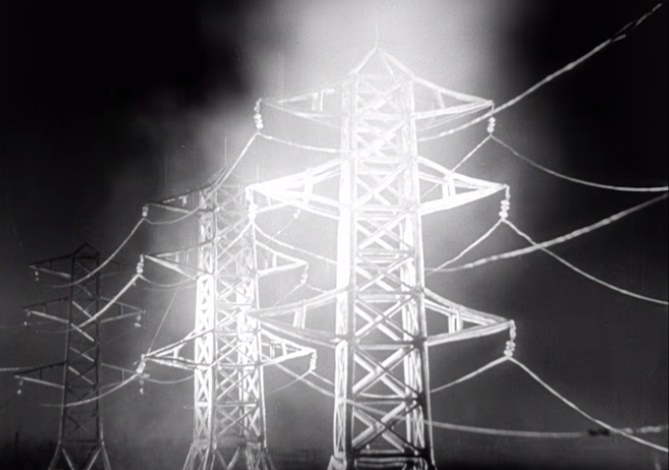
As far as the actual effects are concerned, Eiji Tsuburaya actually did an admirable job (utilizing suitmation, optical effects, blue screen, hand drawn animation and even some brief stop motion) given the limited technology available at the time. A lot of the miniature city designs by Kintaro Makino and crew are excellent and images of Godzilla standing in the dark barely illuminated by light and enveloped in clouds of billowing smoke as the city burns before him are haunting and atmospheric. I have no problem whatsoever accepting the man-in-a-suit approach, and I wasn't especially bothered by the curiously flexible rubber dummy head use for some of the close-ups either. The worst and least convincing fx aren't even the monster, but some toy vehicle and jet models.


Haruo Nakajima (who holds the record for playing Godzilla the most times - 12) and Katsumi Tezuka inhabit the Godzilla suit and both men would go on to do same in some of the sequels, plus play monsters in other kaiju. Kenji Sahara, soon to become a star of the subsequent sequels, has a small role. Director Honda would go to make numerous other genre films, starting with BEAST MAN SNOW MAN (1955), which also starred Takarada and Kôchi.
Initially receiving mixed reviews upon release, Godzilla is now rightly heralded as one of the best Japanese films of all time by critics and was the primary catalyst to help usher in a wave of popular horror and science fiction films in the country, which have garnered international recognition and a formidable worldwide fan base. The film's huge box office success led Toho to immediately produce Godzilla Raids Again (1955), which was given over four times the budget of the original and would also become a big hit. It remains among the top ticket sellers in Japanese film history.
★★★★


