.
.
.
Showing posts with label Riccardo Freda. Show all posts

Wednesday, November 21, 2012

I vampiri (1957)

... aka: Devil's Commandment, The
... aka: Evil's Commandment
... aka: Lady Vampire
... aka: Lust of the Vampire
... aka: Vampire of Notre Dame, The
... aka: Vampires, The

Directed by:
Mario Bava (uncredited)
Riccardo Freda

First released in the U.S. as The Devil's Commandment (in a reduced English-dubbed form), I vampiri was the first horror film to be made in Italy since the silent era and has been given its due credit in the history books as the film to help usher in a new wave of Italian gothic horror films. It's also noteworthy as the first genre film of both Riccardo Freda and Mario Bava. Despite walking off the set before completion, Freda received sole director credit for this one. History would repeat itself on Freda's follow-up, CALTIKI, THE IMMORTAL MONSTER (1959), Italy's second post-war horror film. It was Mr. Bava who ended up stepping in and completing both films, though he only received credit for the cinematography. Regardless, both Freda and Bava would go on to make their marks in the subgenre with films that rivaled and sometimes even eclipsed the popular Gothic horror efforts being produced in the UK (from Hammer Studios) and the US (namely Roger Corman's Edgar Allan Poe series). Freda made THE HORRIBLE DR. HICHCOCK (1962), THE GHOST (1963) and several others and the multi-talented Bava - who's rightfully more famous than Freda - had even greater moments with such films as BLACK SUNDAY (1960) and THE WHIP AND THE BODY (1963).


Essentially a spin on the Countess Elisabeth Bathory legend, I vampiri sets its action in France. A female corpse showing no notable signs of injury and completely drained of blood is fished out of a lake. The victim turns out to be the fourth in a period of sixth months. All have been young females with the same blood type, forensics uncovers each victim have small, syringe-like puncture wounds on their bodies and the local newspapers are full of headlines about a vampire killer on the loose. Seeing as how the police - led by Inspector Chantal (Carlo D'Angelo) - don't seem to have a clue, famous reporter Pierre Lantin (Dario Michaelis) decides to step in and investigate. One evening, while left alone in her theatre, a dancer is accosted by a tall, pale man, who chloroforms and then kidnaps her. The assailant - Joseph Signoret (genre star Paul Muller in an early role) - turns out to be a pathetic junkie so desperate for a fix he's at the whim of an enraptured mad doctor and his assistant, who are experimenting in youth restoration. Schoolgirl Lorette (Wandisa Guida), who seems to have eyes for Pierre and vice versa, turns up missing next after agreeing to deliver a letter to an apartment for a blind man.


Clues lead our hero to the extravagant castle home of the wealthy and mysterious du Grand clan. Aged duchess Margherita barely ever shows her face in public and never without wearing a veil. Her striking niece Giselle (Gianna Maria Canale) is a bit more social and outgoing, but there's still something a bit off about her. Still, nearly every man in the area lusts after her... except for the one she happens to be in love with. Years earlier, Margherita fell in love with Pierre's father; a love that wasn't reciprocated. Now Giselle faces a similar fate. Regardless of her youth, beauty and wealth, Pierre just isn't all that interested in her. His photographer buddy Ronald, however, is, and disappears inside the castle walls after sneaking inside Giselle's bedroom. Because of his obsession with uncovering the identity of the murderer, Pierre is thrown off the case by his boss, but continues to keep tabs on the du Grand family.


While the storyline is rather predictable, this is quite well-done if you're in the mood for a tame, bloodless Gothic horror with subdued horror elements. The actors (especially Canale) are all pretty good, the writing (particularly in regards to the dialogue and characters) is better than usual, it's entertaining and the whole thing looks really fantastic: no surprise with Bava as the cinematographer. One area this particularly shines in is the set / art direction (courtesy of Beni Montresor and Piero Donati). The eye-catching interiors of the castle are a really superb Gothic design. I'll usually find the occasional striking image scanning through films looking for screen caps. This movie is chock full of those.


The widescreen version I watched (released by Image Entertainment in 2001) was in Italian with English subtitles. I'd recommend avoiding the cut English-language version if possible (especially the cropped ones which don't show off the sets to full effect). Some version are cut down by as much as 20 minutes. Freda appears unbilled as an autopsy doctor.

★★★

Wednesday, June 20, 2012

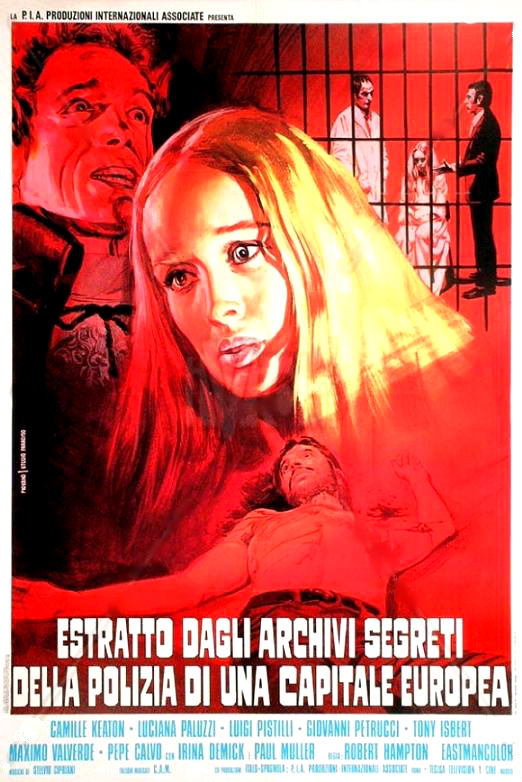
Estratto dagli archivi segreti della polizia di una capitale europea (1972)

... aka: From the Secret Police Files of a European Capital
... aka: Trágica ceremonia en villa Alexander
... aka: Tragic Ceremony
... aka: Tragic Ceremony at Villa Alexander
... aka: Tragic Experience at Villa Alexander

Directed by:
"Robert Hampton" (Riccardo Freda)

Originally titled Estratto dagli archivi segreti della polizia di una capitale Europa (roughly: "From the Secret Police Files of a European Capital"), this attempt at a modern Gothic pretty much flat lines. After some sailing, four young hippies - pretty Jane (Camille Keaton), her boyfriend Joe (Máximo Valverde), wannabe musician Fred (Giovanni "Petrucci" / Petti) and rich, spoiled industrialist's son Bill (Tony Isbert) - decide to camp out on Lighthouse Point beach. Bill has the hots for Jane and tries to impress her by giving her a pearl necklace. We discover that there's a strange legend behind the necklace. Supposedly, it belonged to a crazy old woman believed to be possessed by the devil and the possession was thought to have been brought on by the cursed pearls themselves. The woman who owned them was exorcized but she and her entire family died anyway. Bill had tried to give them to his mother (Irina Demick) but she gave them back to him because she found it to be in bad taste. So now they're Jane's. She accepts the gift but refuses to kiss him for it. After all, she already has a boyfriend. Now I need to stop right now and point out that this "possessed pearls" subplot has absolutely nothing to do with the rest of the film, so why it required about ten minutes of screen time, a lengthy flashback and constant shots of Jane strumming the pearls is anyone's guess.


All four decide to take a trip to town in Bill's dune-buggy like "Scarabo" vehicle. They run out of gas and have to push it to the nearest gas station. When they arrive, the attendant ("Pepe" / José Calvo) acts like a prick and refuses to take their traveler's checks without an ID. Just to get rid of them, he pumps a tiny amount in and sends them off. The little bit of gas doesn't take them very far and they end up stranded by a large villa. A voice over the intercom tells them to park their car in the garage and come inside. They briefly meet the home's bizarre-acting owners: Lady (Luciana Paluzzi) and Lord (Luigi Pistilli) Alexander and are welcomed to spend the night. While bathing, Jane falls into a trance, wanders downstairs and finds herself stretched out on a sacrificial table with her hostess hovering over her with a knife. The guy stumble in just in time and disrupt the black mass. Over a struggle for the knife, Bill accidentally stabs Lady Alexander and they take off. Make-up artist Carlo Rambaldi then gets to take over as the cultists start slaughtering each other set to the tune of Stelvio Cipriani's classical score.


Jane and company then make a pit stop at Bill's home, his mother gives them money for a hotel (dad's away on a hunting trip and her lover is spending the night) and they end up going to Bill's father's country home to hide out and try to decide what to do. A news broadcast compares the Alexander home massacre to the Manson murders and authorities already suspect the presence of hippies (Fred left his guitar behind). We also learn that Lady Alexander's body has disappeared and that the gas station owner died fifteen years ago. One by one, the young folks are mysteriously killed off - or forced to kill themselves - by some unseen force. The sole survivor is rushed off to a nuthouse in a catatonic state where doctor Paul Muller tries to explain the nonsense we just witnessed.


One might expect a bit better from director Freda (using the alias "Robert Hampton" here), one of the pioneering forces behind the late 50s / early 60s Italian Gothic revival. The film has some nicely composed shots here and there - including one of Jane descending a staircase holding a candelabra while the curtains blow in the wind - but otherwise it's pretty bland. In interviews, Freda has stated that he hated this movie and regrets making it, and it's easy to see why. One thing that does breath a little occasional life into the proceedings are the Rambaldi fx. There are some very gory moments in here, such as a gunshot to the head and a man slashing his own throat. The best however is a man getting his head hacked in two with a sword. It's so good the filmmakers decided to repeat it at least five times. Keaton - best known for her starring role as the vengeful rape victim in the notorious I SPIT ON YOUR GRAVE (1978) - also has some nudity.


The DVD - titled Tragic Ceremony on the cover but Estratto dagli... on the actual print - is from Dark Sky. The disc also comes with a 13-minute interview with Keaton titled Camille's European Adventures, where she briefly discusses her work in WHAT HAVE YOU DONE TO SOLANGE? (1971), SEX OF THE WITCH (1973), this film and MADELINE, STUDY OF A NIGHTMARE (1974), which has never been released in America but she claims is her favorite of all her films.

1/2

Friday, June 15, 2012

Murder obsession (Follia omicida) (1981)

... aka: Fear
... aka: Murder Obsession
... aka: Murder Syndrome
... aka: Paura
... aka: Satan's Altar
... aka: Unconscious
... aka: Wailing, The

Directed by:
"Robert Hampton" (Riccardo Freda)

Actor Michael Stanford (Stefano Patrizi) is playing a psycho in a new horror film and seems to be getting a little too into his role, actually strangling actress Beryl (Laura Gemser) until the crew intervenes and pulls him off of her. Though his co-star is slightly shaken up (though not nearly as much as she should be!), director Hans (Henri Garcin) seems happy about his convincing portrayal. While going through some old family pictures later that evening, Michael decides to go visit his estranged mother Glenda (Anita Strindberg), whom he hasn't seen in years. Flashbacks show how Michael's father William (also played by Patrizi) keeled over from a heart attack while conducting an orchestra and also reveal that Michael may have stabbed him to death as a child. Michael decides to bring along his girlfriend Debora Jordan (Silvia Dionisio) on the trip and invites part of the crew to come out later so they can discuss the film they're working on. Upon arriving to his childhood home - a dark and very gloomy mansion, naturally - the butler and estate caretaker Oliver (John Richardson) informs Michael that his mother is very sick... Indeed she is!


Glenda seems a little too close for comfort with her son, who's a dead ringer for her deceased husband. She kisses him, caresses him, lets her breast fall out of her nightgown while he hugs her and constantly gives him loving looks... and I don't mean harmless knowing glances usually shared between parents and children. Strangely, Michael introduces his girlfriend to his mother as being his secretary, presumably not to upset her, which understandably pisses Debora off. She's also not too happy that she's stuck sleeping in a bedroom alone on the other side of the house as Michael. The next day, director Hans, leading lady Beryl and assistant director Shirley (Martine Brochard) all arrive at the home. Glenda welcomes them and seems glad to have some company. Later that night everyone sits around sipping wine and discussing the supernatural. And it isn't long before people start experiencing something supernatural. The home shakes, muddy foot prints appear on the floor, doors seem to open and close on their own, lights flicker (blamed on the home's poor wiring) and Beryl is almost drown while taking a bath by a mysterious gloved assailant who seems to disappear into thin air.


During a nightmare sequence which lasts nearly ten minutes, Debora (breasts flopping out of her nightgown the entire time) is attacked by a guy with a disfigured face, runs into a web with a giant rubber spider on it, gets attacked by bats on strings, gets caught up in some tree branches and then passes out when a bunch of skulls cry blood on her. When she comes to, she's tied to a cross, gets her clothes ripped off by a mutant cultist, is forced to drink fresh chicken blood (from a real chicken they've just killed) and is attacked by the big spider, whose legs turn into fuzzy arms. Michael finally admits to having murdered his father as a child and now claims to suffer from "psycho traumatic disassociation," which involving blacking out for several minutes at a time only to awaken with no recollection of what he's done. While out in the forest, Beryl, already almost strangled by Michael on the movie set and already almost drowned in her bath just the night before, turns around and spots Michael glaring at her and holding a knife. So what does she do? Run? Scream for help? Say "What the hell is your problems?" Nope. She has sex with him (!) while Hans hides in the bushes snapping pictures.


People eventually start dropping like flies. When Michael wakes up from his encounter with Beryl, she's dead and there's a bloody knife next to them. Hans, having witnessed the murder, runs back to the house and tries to leave but someone surprises him with an axe to the head instead. Suspicious Hans left his camera behind (he never goes anywhere without it), Shirley decides to develop the film in an attic darkroom and gets decapitated with a chainsaw. After finding Shirley's head, Debora tries to run off during a rainstorm and ends up in black-gloved clutches of the killer instead. All that's left is to unveil a few skeletons in the family closet. The hopelessly muddled plot tells two conflicting stories from mother and servant and everything from adultery, blackmail, spousal abuse, sleepwalking, rape and even Satanism is trotted out in the last fifteen minutes.


Freda's film - which first saw the light of day in the U.S. under the title Fear (released on the Wizard VHS label) - is a very mediocre little mystery with Gothic trappings, slasher moments and a convoluted plot about on par with most gialli. There's nudity provided by Dionisio, Gemser and Strindberg (in one of her last film appearances) and a few poorly-done gore effects. It opens with a quote from Hieronimus A. Steinback. The music score is good and it's fairly well photographed but there's not enough style present to really overcome the script shortcomings.

Wizard recycled clips from this for their living dead-themed pastiche ZOMBIEGEDDON (1986). In 2011, Raro Video released it on DVD (using the Murder Obsession title).

★★
Related Posts Plugin for WordPress, Blogger...