.
.
.
Showing posts with label Clu Gulager. Show all posts

Monday, February 4, 2019

Terror at London Bridge (1985) (TV)

... aka: Arizona Ripper
... aka: Big Blue
... aka: Bridge Across Time
... aka: Der City Cop (The City Cop)
... aka: Le retour de Jack l'éventreur (The Return of Jack the Ripper)
... aka: Masakra na London Bridge (Massacre on London Bridge)

Directed by:
E.W. Swackhamer

In a pre-credits sequence set in 1888, Jack the Ripper is hunted down, shot and killed by an angry mob on the London Bridge. Since then, the bridge has been moved to the U.S. and meticulously reconstructed stone by stone in the desert tourist trap of Lake Havasu City, Arizona. While the relocation project was mostly completed back in 1971, there was one missing stone that didn't make the trip that has since been found at the bottom of the Thames River, been shipped to Havasu and added to the bridge. On their way to Las Vegas, newlyweds Dave (Michael Boyle) and Alice Williamson (Barbara Bingham) stumble into town late one evening. Alice decides to go check out the bridge on her own, cuts her finger on some scaffolding, bleeds on the bridge and ends up awakening the long dormant spirit of Jack the Ripper himself. She does not return to her hotel that night.


The following day, right after the re-dedication of the bridge's "true and final completion," Alice's corpse is discovered floating in the river by river tour / fishing boat operator Angie (Stepfanie Kramer). Her throat's been cut and she has clothing fragments under her fingernails as potential evidence. The pathologist also discovers a different type of blood mixed in with Alice's, which means the same knife has possibly been used to murder someone else. Samples are sent off to Phoenix to be tested. In the meantime detectives Don Gregory (David Hasselhoff), who transferred there from Chicago only a month prior, and Joe Nez (Randolph Mantooth) are assigned the case. They face hurdles in the form of city councilman Anson Whitfield (Lane Smith), who wants the murder written off as a one-time mugging by a transient as not to effect tourism. Don, a true crime buff, knows better.


San Francisco Dispatch reporter Elaine Gardner (Lindsay Bloom) shows up in town to do a story and gets Don to speak to her, promising it will be off the record. Instead, she prints his theories about the killing in the paper, which infuriates Don's boss, Police Chief Pete Dawson (Clu Gulager), who's more in the city council's corner than his own detectives. When test results from the fabric and second blood samples return, both prove to be over a century old. The reporter then disappears without a trace, with all evidence pointing in the direction that she never even left town.


Meanwhile, a mysterious, sinister-looking British man (David Fox-Brenton) checks into a flea pit run by nosy old lady Alma (Rose Marie). While he doesn't provide a home address, he does sign the register Edward Latting Esq. The following day, yet another British man, the tall and debonair Roger Eddington (Paul Rossilli), shows up at the library looking for books on modern American history. It seems he has some catch-up work to do. Roger claims to be working in the village as a tour guide but expresses how lonely and homesick he is to librarian Lynn Chandler (Adrienne Barbeau). Lynn, a single lady and Angie's best friend, agrees to go to dinner with him. After crossing paths with both Brits, Lynn ends up the next victim and her throat-slashed body is discovered floating in the lake by a group of schoolkids.
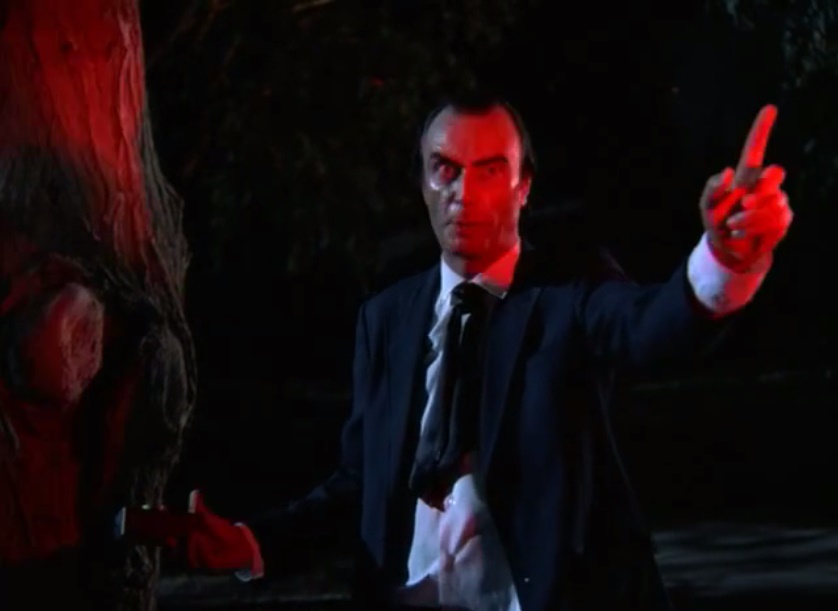


Despite two murders, one disappearance and the ripper going so far as to send taunting letters to the press, Chief Dawson is still reluctant to close down the village until the killer is apprehended, which means Don is pretty much on his own in stopping the psycho. He's able to eventually draft Angie (whom he's - of course! - become romantically involved with) and Joe into helping him out, which involves a pursuit through a horror museum and a slaughterhouse and back to the bridge, where the ripper reveals he's using the blood of victims to return to 1800s. Not sure how that's supposed to work out but, whatever.


This competently directed and produced, though formulaic, NBC TV movie movie seems like it was made to give Hasselhoff and Kramer something to do between seasons of their hit NBC shows Knight Rider and Hunter. And though most of the cast is pleasant or professional enough to keep this at least passable as a "There's nothing else on..." time filler, the plot (devised by Logan's Run writer William F. Nolan) lacks complication and the film is simply too predictable and bland to provoke much interest. The bridge was also used as the centerpiece of Ulli Lommel's (much more entertaining and intriguing) film OLIVIA (1983).


This Charles Fries production debuted on NBC TV right before Halloween in 1985 under the title Bridge Across Time. Most of its subsequent VHS releases (starting in 1990 on the Fries Home Video label) have used the Terror at London Bridge title and restored some blood that had to be cut from TV showings. There are multiple DVD releases as well, including a 2013 one from TGG Direct that pairs it up with Night Game (1989).

★★

Friday, August 17, 2018

Nightmare on Elm Street Part 2: Freddy's Revenge, A (1985)

... aka: Le revanche de Freddy (Freddy's Revenge)
... aka: Morderisk mareridt 2 (Murderous Nightmare 2)
... aka: Nightmare 2
... aka: Nightmare 2 - Die Rache (Nightmare 2: The Revenge)
... aka: Nightmare 2 - La rivincita (Nightmare 2: The Revenge)
... aka: Nightmare - Mörderische Träume (Nightmare - Murderous Dreams)
... aka: Nightmare on Elm Street II: Freddy's Revenge
... aka: Pesadilla en la calle del infierno (Nightmare on Hell Street 2)
... aka: Terror på Elm Street 2: Freddys hämnd (Terror on Elm Street 2: Freddy's Revenge)

Directed by:
Jack Sholder

"Isn't that the gay one?" It seems so much attention has been drawn to the gay content in this film in recent years that people just ignore the entire rest of the movie as if there aren't other things to discuss. It's even been called "the gayest horror film ever made" by people who apparently haven't explored the filmographies of Bruce La Bruce or David DeCoteau. So we'll go right ahead and address the elephant in the room. Yes, there is indeed a lot of gay stuff going on here. Some of it is subtle. Some of it is (rather surprisingly for the time) right out in the open. The grappling with same sex attraction theme does not in any way make this a bad film, nor does it necessarily make it a good one. It does however make this stand out as unique in the 80s slasher canon and that's never a bad thing.

Even though pretty much everyone who worked on this film denied the gay content was intentional (or were just completely unaware while filming), writer David Chaskin eventually came forward and said that, yes, he had all of this in mind when he wrote the script. Robert Englund apparently was able to read between the lines and has stated he always interpreted this as being about a teenage boy struggling with his sexuality. The actor even went so far as to try to ad lib something blatantly homoerotic during one scene, which was rejected by producers. Director Sholder said he was completely unaware of any gay subtext due to his own naivety at the time and how busy he was during the entire shoot. Listening to the various cast and crew members discussing this over the years is nearly as interesting as the content itself.


Jesse Walsh (Mark Patton) has just moved to Springwood, Ohio with his parents Ken (Clu Gulager) and Cheryl (Hope Lange) and his kid sister Angela (Christie Clark)... and they also happen to move right into Nancy Thompson's former home on Elm Street, which still has the bars over all the windows. Even though he's the new kid in town, Jesse has already made a female friend named Lisa (Kim Myers), but he's more interested in palling around with a popular, immature jock named Grady (Robert Rusler). Grady tells him about what went down in his home five years earlier and about how Nancy went crazy after seeing her boyfriend butchered in the house across the street. He also warns him to stay away from their drill instructor-like gym teacher Coach Schneider (Marshall Bell) because he "hangs out at queer S&M joints downtown" and "likes pretty boys like you."


Like Nancy and her ill-fated friends before him, Jesse is plagued by nightmares of Freddy, only this time Freddy isn't exactly out to kill him. He makes his intentions known caressing Jesse's face with his glove and then ripping back the skin on his head: "You've got the body. I've got the brains." This time out, Freddy wants to possess a human so that he may return to life and do his thing. Breaking with the format of the original in a big way, the Thompson home is now basically viewed as a haunted house and Freddy is the ghost inhabiting it. The original's premise, with Freddy out for revenge against the people who torched him by going after their kids, is dropped altogether. Jesse is, after all, an innocent bystander who just happens to be in the wrong place at the wrong time.


Jesse's body is eventually taken over by Freddy to the point where he can control him and force him to do his dirty work ("Kill for me!"). First up is the mean coach. After Jesse goes to the gay club in the middle of the night, the coach drags him back to the school and forces him to run laps. He's then pummeled with balls and sporting equipment, dragged to the shower room by jump ropes, has his clothes stripped off and then gets his ass whipped bloody with towels before Freddy slashes him to death.

Afterward, Jesse is found naked, disoriented and wandering the highway by police. While his mother immediately wants to put him in therapy, his hard-assed dad thinks he's on drugs and needs "a good god damn kick in the butt!" But that doesn't explain the strange occurrences in the home either. It always feels 100 degrees inside, an unplugged toaster catches fire and a parakeet goes crazy, attacks everyone and then explodes! After Jesse completely loses his battle to contain Freddy, more deaths follow, culminating in an attack at a pool party at Lisa's home and then a visit to Freddy's former stomping grounds at the power plant.


Viewing Freddy as symbolic of the confused lead's repressed homosexual urges really does make this a much more interesting watch than it otherwise would have been; certainly more conceptually interesting than most of the other sequels. When Jesse starts getting intimate with Lisa and feels "him [Freddy] coming," he immediately flees to Grady's house, sneaks in his window and jumps into bed with him, right on top of him, prompting a startled "You want to sleep with me?!" from his friend.


I've seen numerous viewers claim this film is actually homophobic but those sharing that opinion seem to think the filmmakers are trying to equate being gay with being evil. However, it's important to note that Jesse's personal interpretation of his own urges at a time when said urges wouldn't be socially acceptable is just that: a character's interpretation. There's probably nothing scarier to most teens than knowing being their true self would make them an outcast and a target for ridicule within their peer group. Thus the Jesse character viewing these differences as a "monster" that must be contained is more about self-preservation than anything else. Jesse ultimately being saved by Lisa's love for him is also used by those crying homophobia but they also fail to point out the ending, which, if anything, implies Lisa was only a temporary fix. "Freddy" still hasn't gone away.


It was not only unusual to have a male protagonist in one of these things instead of the virginal final girl trope, but it was also unusual for that lead male to give such a full-blown dramatic performance when depictions of quiet male composure even in the most horrifying of circumstances were typically the norm in horror. Patton gives it his all and is on 10 in the hysterics department much of the time, though considering what's actually happening to his character that was pretty much the only way to go. I'd even dare to say that Patton's performance is clearly the best lead performance in any of the Elm Street films. Being gay himself, the actor appreciates that the film eventually found a cult following but has mostly negative things to say about what the film did to his career. He's even made a documentary about this and Hollywood homophobia called Scream, Queen: My Nightmare on Elm Street, which hasn't been released yet.


The subtext in Freddy's Revenge wasn't really examined thoroughly until recent years so it had no bearing on the film's reception and box office back in 1985. This was critically more or less viewed as you standard lesser sequel upon release. The reviews weren't good but it was financially successful and made more money than the original during its theatrical run. In fact, if one discounts the werewolf comedy Teen Wolf, it was the top-grossing horror film of 1985, outperforming the likes of Fright Night (another film frequently called out for its homoerotic content), THE RETURN OF THE LIVING DEAD and the fifth Friday the 13th installment.


Also in the cast are Melinda O. Fee and Tom McFadden as Lisa's parents, Sydney Walsh (To Die For), Lyman Ward (Ferris Bueller's dad), Allison Barron (NIGHT OF THE DEMONS), JoAnn Willette (who co-starred with Heather Langenkamp on the TV series Just the Ten of Us), Kerry Remsen (Pumpkinhead), Brian Wimmer and Steve Eastin. Producer Robert Shaye also has an uncredited cameo as a bartender in the S&M club. The score was by Christopher Young and this also features some fun special effects by Kevin Yagher, Mark Shostrom, Bart Mixon and others, including a great bit where Freddy rips out of Jesse's body. Rachel Talalay (who went on to direct Freddy's Dead) was the production manager.

★★1/2
Related Posts Plugin for WordPress, Blogger...