.
.
.

Saturday, June 11, 2022

La mano che nutre la morte (1974)

... aka: Dykhaniye smerti (Shadow of Death)
... aka: Evil Face
... aka: Hand That Feeds Death, The
... aka: Hand That Feeds the Dead, The
... aka: Ölümün nefesi (Breath of Death)

Directed by:
Sergio Garrone

Newlyweds Masha (Katia Christine) and Alex (Ayhan Işık) are passing through the countryside when their stagecoach overturns. The driver is killed and both Masha and Alex sustain minor injuries. Thankfully, there are people nearby who hear the crash, come to their aid and take them back to their large, secluded villa to recuperate. Unfortunately, those people also happen to be Professor Sergei Nijinsky (Klaus Kinski) and his crippled hunchback servant Vania (Erol Taş). Nijinsky is the former assistant to the late Baron Ivan Rassimov (who not coincidentally shares the same name as the Italian actor who starred in the same director's debut feature; the spaghetti western If You Want to Live... Shoot!). Very controversial in his day, Rassimov was considered a madman by some and a genius by others, but he was never quite able to prove his theories since he died in a mysterious fire / lab accident.

Nijinsky is married to Rassimov's daughter, Tanja (also played by Christine), and has since become the heir to the family estate. Though he claims Rassimov took his scientific knowledge to his grave, Nijinsky's secretly carries on his experiments with skin and organ transplants. He has an array of young, unconscious, topless female victims on hand that he's kidnapped and is keeping prisoner in his basement lab, where they're hooked up to tubes constantly circulating their blood. As for wife Tanja, she was also caught up in the accident that killed her father and now has a horrible, fire-scarred face that she keeps hidden behind a black veil most of the time. If you've seen the French classic EYES WITHOUT A FACE (1959), I'm sure you already have some idea where this is going...


There are two other women present in the home. The first is a bisexual prostitute named Sonia (Carmen Silva), who's been invited to come stay there by Nijinsky. After a week of no nookie, she's at a loss as to why exactly she's there. He keeps telling her he'll have a use for her soon enough and, since she's being paid to hang out there, that's good enough for her. There's also Miss Holleroch (Marzia Damon), a writer staying there temporarily under the guise of working on a book about the enigmatic Baron. While she is indeed working on a book, she is also, unbeknownst to her host, using a fake name (her real one is Katya Olenov) and also trying to find out what happened to her sister, who vanished there not long ago. After finding a ring that she believes belonged to her missing sibling, Katya knows she's on the right trail. Fearing for her safety, her boyfriend Theodore (Alessandro Perrella) goes to a police inspector (Bruno Ariè), who agrees something fishy is going on but adds that he lacks the evidence to start slinging accusations about such an "esteemed" family.
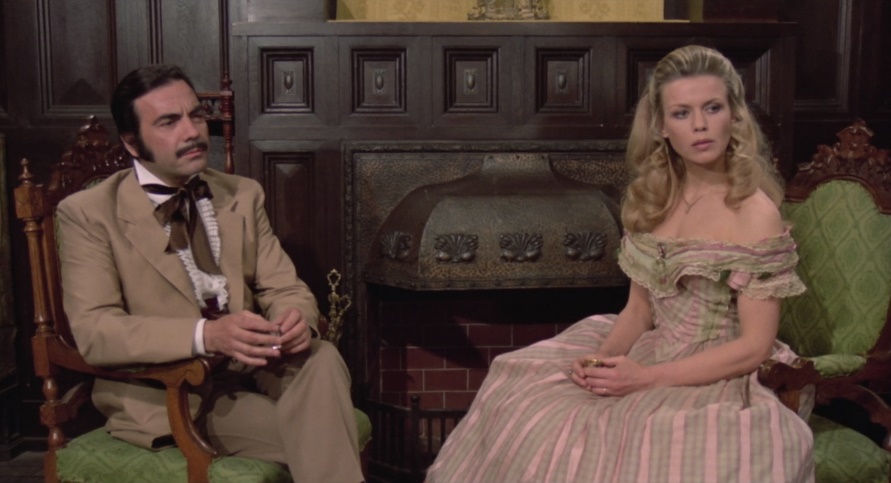


The manipulative Tanja exerts a strong hold over her husband. She refuses to make love to him unless he's able to restore her beauty while he proves to be willing to do whatever it takes (no matter how ghastly) to try to repair her and thus their marriage. Using a tuning fork-like device that emits loud sonic vibrations, Tanja is able to control Vania and force him to do her evil deeds, including kidnapping and murder. When she suspects Katya is on to them, she sends the servant out to murder Theodore. For some reason that doesn't really gel with the character (especially since she doesn't even KNOW her boyfriend has been murdered), Katya gives in to the advances of Sonia. The two are surprised in bed by Nijinsky and the servant, who attack and try to kill them. Masha, who plans on leaving in the morning, is also kidnapped and taken to the lab, while Alex finds himself entombed alive with the corpse of the late family matriarch. Things take a few unexpected turns toward the end.


Part of a two film package deal between Turkish and Italian producers, this was shot over an eight week period in both Istanbul and Rome along with Le amanti del mostro / "Lover of the Monster." Both are Gothic horror films with a 19th Century period setting that utilize the same secluded villa for exterior locations and feature most of the same actors, sets, lab equipment, costumes and props. There are plot similarities between the two (starting with the fact both stories involve mad doctors), and they even share some of the same scenes and the same solarized red-and-blue opening credits. In fact, the two are so similar that for years people thought them to be one in the same.

I went into this expecting outright trash (not that one would expect otherwise from the director of S.S. EXPERIMENT LOVE CAMP and S.S. CAMP 5: WOMEN'S HELL!), so the fact this was competently directed, written and performed was quite the surprise. Not that there aren't some problems here, especially in regards to the pacing and the fact it isn't terribly original, but the production values are solid across the board, there's OK set design (of particular interest is the lab filled with bubbling beakers of blood, tubes, wires, high-voltage traveling arcs and gold-painted lab equipment lit with flashing red and green lights) and it delivers the expected female nudity, blood (the mediocre gore effects are provided by Carlo Rambaldi) and well-placed moments of questionable taste (like the rapist manservant continuing the pump away on one of female victims after he believes she's dead!) to keep you interested.


The cast also manage to sell whatever there is to sell here. The biggest drawing card, both then and now, is the presence of Kinski, who was an expert at playing crazed degenerates because, well, he actually WAS a crazed degenerate! Just don't expect much of that here. While he plays a man of questionable morals and sanity, he's rather subdued most of the time until his final scene allows him to emote somewhat. I certainly don't agree with criticisms that he's disengaged, disinterested or phoning it in. His specific character is subservient to the domineering wife and has grown weary trying to please her, which doesn't require him to rant, rave and chew the scenery, even if that's what audiences expect or want out of him.

Most attention will probably be focused on lead actresses Christine and Damon, who not only look gorgeous but also deliver adequate acting performances. Both made numerous other genre films so I'm glad I'll be getting to see more of them in the future. Male co-stars Işık and Taş, representing the Turkish contingent of the film, were two of the most popular and beloved actors in the country at this time and are both good here.


The Turkish version of the film (Ölümün nefesi) is an alternate re-edit supervised by Yilmaz Duru, who is (misleadingly) listed on both the film's poster and in the opening credits as the director. The Turkish print lists additional cast members (Gülen Aygün, Eva Curtis, Turgut Giray, Jahn Colins...) not shown in the Italian credits, though these might just be fake names. Conversely, none of the Turkish actors (not even stars Işık and Taş) are credited on the Italian print. This was held back for release until 1986 in Turkey; bypassing a theatrical release altogether and going straight to video and television. Fifteen minutes were cut for this 77 minute version and, though I only browsed through it, most of what's missing appear to be dialogue scenes.


Ignoring unsanctioned releases from bootleg companies like Cinefear, this was never officially available in the U.S. until somewhat recently. Mya Communication (who carried this under the title Evil Face) first released an English-friendly DVD in 2009 but it was a poor VHS transfer. Full Moon Features then swooped in and released a remastered version on Blu-ray in 2021. They use both English-language titles: The Hand That Feeds the Dead (for the physical release) and Evil Face (for streaming services).

★★1/2

Friday, June 10, 2022

Scalps (1983)

... aka: Der Fluch des blutigen Schatzes (The Curse of the Bloody Treasure)
... aka: El cementerio indio (The Indian Graveyard)
... aka: Scalps canibal (Cannibal Scalps)

Directed by:
Fred Olen Ray

If you're a fan of the director and his usual style, you get something a bit different with this one... though that's not always a good thing! This was Ray's third feature (out of 160+ to date!) and you can tell he was still trying to iron out the wrinkles and wasn't quite sure just what he wanted to do at this early stage. As a matter of fact, if you went into this blindly you'd probably have no clue this WAS a Ray film. The only aspect I'd really consider a typical Ray-ism is his eagerness to cast a couple of washed-up former stars and genre-friendly actors in small cameo roles that were probably filmed in a day or so. He'd already done it once before by getting elderly Buster Crabbe (a former Olympic gold medalist best known for playing Tarzan and Flash Gordon in the 1930s and 40s) into Alien Dead and does it here again, only we get three veteran performers in brief parts. This accomplishes two important things: One, being a smart business decision to help sell the film later on and, two, throwing a bone to all us horror and sci-fi fans who'd be more enticed to see this based on the cast. Aside from that, this is unlike most of what would come later from Ray...


The most obvious difference you'll notice is that Scalps is quite serious in tone, while most of Ray's subsequent output would be much sillier and campier. This is also by far one of Ray's goriest films and also his rawest and most mean-spirited. When he finally gained some traction on the home video market and started making the films he actually wanted to make, he usually shied away from graphic gore and slasher-style violence and concentrated mostly on the comedy and T&A ends of the exploitation spectrum.

Visually, this also feels a lot different, with its grainy 16mm photography, shaky camerawork, rough audio, frequently terrible lighting and, due to several different cameras being used, abrupt changes in picture quality from scene to scene. Made for just 15 thousand dollars, this is lacking the workman-like competence Ray would start displaying soon after with his 35mm productions. However, warts and all, this is actually more visually interesting than most of Ray's other work, with more varied camerawork, more extensive exterior location work and much more gloomy atmosphere. It feels like it probably took a lot longer for him to make than his later one-week wonders.


If you're confused by the pre-credits opening sequence, featuring a snarling, mountain lion-faced (?!) man in a robe, a mutant Native American decapitating some random guy and an old prospector slitting his own throat after a white-eyed latex puppet head flashes on the screen, you're not alone! Ray himself was also left scratching his head. According to the director, he gave a finished cut of the film, along with extra footage from the shoot, to the theatrical distributors, who then took it upon themselves to completely re-cut the film without his knowledge or consent. In doing so, they crammed in test shots and outtakes never meant to go into the movie in the first place, and give us unnecessary early looks at the later murders. As for why they did this, it was likely an attempt to punch up the talky, slow-moving first half. Instead, it gives this an inept, though sometimes accidentally surreal, quality that is also absent from the director's other work.


As far as guest starts are concerned, Ray pretty much gets that all out of the way at the beginning. Kirk Alyn (the very first actor to portray the Man of Steel in the live action Superman serials) pops up as Howard Machen, an absent-minded archaeology professor, while Mark of the Vampire co-star Carroll Borland (who hadn't been seen in a film since the 1930s) plays his unamused superior, Dr. Sharon Reynolds, and Famous Monsters of Filmland's Forrest J. Ackerman plays Professor Trentwood, who's fittingly seen with a monster mag in hand and exits stage left after saying a couple of lines. Due to a new California law forbidding excavation and removal of ancient Indian artifacts without permission, Dr. Reynolds informs Machen that he'll now be under strict supervision and also has to account for everything he's unearthed on previous digs. That means he has to make adjustments to a current planned expedition so he can meet an inventory deadline that's already a month overdue.


As for D.J. (Jo-Ann Robinson), Randy (Richard Alan Hench, who posed for Playgirl magazine the following year), Kershaw (Roger Maycock), Louise (Carol Sue Flockhart), Ben (Frank McDonald) and Ellen (Barbara Magnusson), the six students he was to accompany to the desert site, Machen gives them a map to their destination, doesn't say a word about digging being prohibited and then tells them to go along without him. He plans to join them in a few days after he finishes his work at the university. On their way, the students stop at a gas station, where they ignore the warnings of wise man Billy Ironwing (George Randall), who tells them to stay out of the Black Trees area. Over a century earlier, hundreds of Native Americans were slaughtered there and the area is rumored to be cursed. Naturally, that's exactly where the students end up going.

D.J., the "weird" one of the group, starts having premonitions and visions of scary faces, though her attempts at warning her friends not to dig in the Indian burial ground fall on deaf ears. Soon enough, everyone's regretting their decision. A corn grinding bowl starts bleeding, the sound of drums and chanting start emanating from the Earth and, while out walking, Ellen is chased around by the lion-faced spirit. Stumbling upon a tepee and a campfire that doesn't put out heat but somehow manages to explode, Randy is possessed by Black Claw, an ancient warrior and black magician who died there 100 years earlier, and goes about slaughtering all of his friends.


As far as the bloodshed is concerned, there's more than enough here to satisfy goremongers. The back of a head gets whacked off with a tomahawk, someone is shot with a bunch of arrows, there's a bloody decapitation, an eye gouging, a gunshot to the head, an exploding head and, during the film's nastiest sequence, one of the girls is slapped, thrown on the ground, raped, has her throat cut and is then scalped as blood sprays out all over the place. 

Despite the endless technical deficiencies, this does possess a gritty, nightmarish feel to it that I quite enjoyed, has some surprisingly potent horror imagery and lots of fun make-up effects (I even liked that random animatronic lion mask). Also an A+ for the poster and the eerie synth score is quite good, though it does drown out some of the dialogue at times.


After an unsuccessful limited theatrical release from 21st Century Film Corporation (in 1984, per the copyright date found in the trailer), this was released the following year on VHS by Continental Video, who put a slightly condensed version of it on the same tape with THE SLAYER (1982). Ray's company Retromedia then put it out on both DVD (in 2004) and Blu-ray (in 2016). A heavily-censored, Spanish-dubbed version titled El cementerio indio contains alternate shots not seen in the U.S. release and has also removed the more explicit gore shots and substituted Native American paintings, stills and artifacts in their place! Here are a few shots specific to that version...


While I can't attest to the quality (or lack thereof) of the BR release, the full screen Spanish VHS has sharper picture and colors, and is overall of superior quality, to many of the highly-damaged "widescreen" (or, as it appears, stretched to take on the appearance of widescreen) film elements used for the DVD release! See for yourself...


A sequel, Scalps II: The Return of D.J., was announced in the end credits as a joke, though low budget filmmaker Dustin Ferguson took it upon himself to make it as a 25-minute, shot-on-video short. Too bad he hasn't gotten around to making Student Chainsaw Nurses yet. Both the DVD and Blu-ray releases come with a commentary track from Ray and co-writer  / producer T.L. Lankford, while the BR also includes the 21-minute documentary short Remembering 'Scalps', which features interviews with Ray, Hench and McDonald.

★★
Related Posts Plugin for WordPress, Blogger...