.
.
.

Sunday, January 8, 2012

Nazareno Cruz y el lobo (1975)

... aka: Love of the Wolf, The
... aka: Nazarene Cross and the Wolf, The
... aka: Nazareno Cruz and the Wolf

Directed by:
Leonardo Favio


Many films have used the werewolf theme metaphorically, as a way to announce that a boy has become a man. What better way to signal puberty than by having a mild-mannered teenage boy suddenly transform into a hairy, instinctually-driven beast who starts stealthily stalking his female prey? Taking their cue from Universal's The Wolf Man, and sticking to the lycanthrope mythology devised for that film by writer Curt Siodmak for the most part, one of the first notable entries in this arena was the hit I WAS A TEENAGE WEREWOLF (1957), with its high school setting and nice guy Michael Landon transforming into a ferocious beast. During one sequence, as a "beast" Mr. Landon silently watches a tighty-clad gymnast in the high school's gymnasium before deciding to attack; a clear-cut example of pent up sexual desire finally being unleashed upon the unsuspecting female. There were other similar films about young men becoming more aggressive thanks to the curse of the beast. They were usually also dangerous, but not always. Take for instance the terrible Teen Wolf comedies, where Michael J. Fox's character becomes athletic and popular (even with the ladies!) thanks to his transformation. In Neil Jordan's The Company of Wolves, set inside a Red Riding Hood-esque fever dream of a young girl having her very first period, our heroine is continually advised to steer clear of men because of "the beast" they have lurking inside. In the film - "the beast" - naturally takes literal shape when one of Rosaleen's sneaky and mysterious potential suitors ends up transforming into a werewolf.


The lead character in Nazareno Cruz y el lobo faces a similar curse-of-the-wolf problem that decides to kick in right when he starts becoming a man. An explanation behind the curse is laid out in the first ten minutes. After her husband Jeremias and six (!) sons die in a freak flooding accident, pregnant Damiana (Elcira Olivera Garcés) is determined to have her child, despite warnings that if she bears a seventh son he'll be "fed by the devil's breast." Knowing the boy is going to have a tough road to hoe, wise, toothless old witch Lechiguana (Nora Cullen) becomes his godmother and insists he be named something extremely holy to help ward off the curse, and thus the boy is named Nazareno Cruz ("The Nazarene Cross"). The baby is baptized and many years pass. With no signs of the curse taking place and because of his good looks and outgoing personality, a now-grown Nazareno (Juan José Camero) has won over the respect, admiration and love of the entire village. That is, until he decides to fall in love Griselda (Marina Magali), a young beauty who stands out amongst the crowd because of her uncommon blonde hair. 


As it turns out, love is what stirs the dormant wolf inside Nazareno. He's warned by his mother and godmother, but can't control himself when he's around Giselda. A mysterious, nameless, sinister-looking man (Alfredo Alcón) who possesses supernatural abilities also shows up to also warn him. The man - who claims to have known Nazareno's father and brothers before they were killed - tells Nazareno he can avoid his tragic fate if he'll simply forget about love. He also promises that in he can avoid Griselda for an entire week that he'll leave gold and jewels at his doorstep each and every day. Still, Nazareno carries on in the relationship and on the first full moon transforms into a wolf (not really a werewolf, just a black dog that looks like a German Shepherd) and kills a farmer, some sheep and some dogs. When word gets around the village, an armed posse is organized to hunt down and kill Nazareno. 


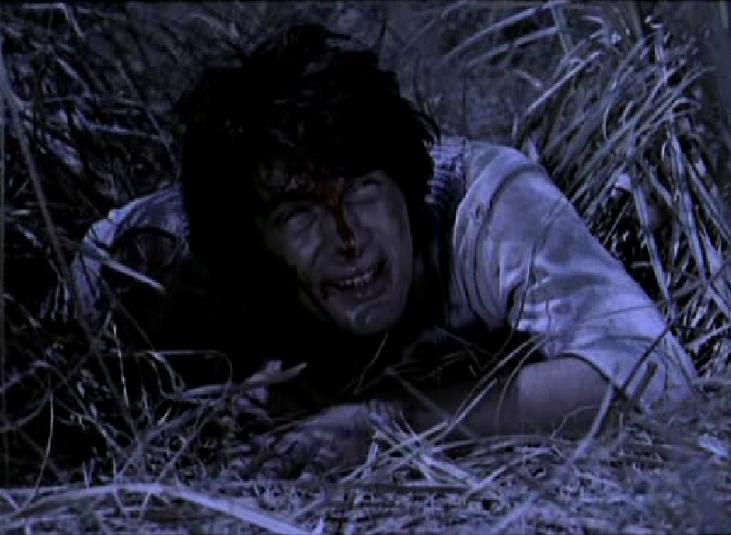
After managing to avoid the mob one night, Nazareno gets scared by chicken with a snake on it, falls into a hole, tumbles down and ends up in some kind of cave, where he encounters a cackling old woman who transforms into a sheep, snake, fox and chicken (!!) She leads him through some water to an underground cavern... which happens to be hell! Hell is a dusty, boring place with burning fires, black-robed cultists sitting about, witches stirring bubbling cauldrons, nooses hanging from windows, people being whipped, nude women acting as tables, crucified men hanging on crosses and the like. The mysterious man who had warned Nazareno turns out to be Satan himself. In an interesting spin on things, the devil isn't really such a bad guy after all. Just misunderstood. His stay in hell brief, Nazareno must then return to Earth to meet his fate. 


Not really just a 'coming of age' fable dressed in wolf's clothing, this semi-surrealistic tale has other points to make about spirituality, life and love. It's dramatically uneven, a bit unfocused and not all of the director's artistic choices work (some are distracting, indulgent and downright annoying), but everything really looks great thanks to cinematographer Juan José Stagnaro. The film has a beautiful, earthy, washed-out look to it, the shot compositions are frequently excellent and there are some interesting camera placements (including at water level where water sloppily splashes on the lens; distorting the image), camera movements (including rapid 360 degree spins) and editing choices. The art direction is solid, there's a haunting score (by Juan José García Caffi) and good use made of blur and slow-motion. All of the actors are good; Alcón and Cullen in particular. The film has a very organic sense to it and the director really manages to exploit natural beauty for all it's worth, from lingering shots of hazy skies to rocky cliff backdrops and tall weeds blowing in the wind. For some reason, there are almost obsessive shots of animals throughout; birds flying in slow-motion, dogs running through fields, frogs and lizards seen in close-up with the action going on behind them, etc. 


The director is one of the most acclaimed in his country (having won several of their Oscar equivalents) and based this on an Argentinean radio program by Juan Carlos Chiappe. It's one of the most popular and viewed films in its home country, though it's virtually unknown here in America (since it's never been released here). Interestingly, it did receive a VHS release in South Korea of all places, under the title The Love of the Wolf.

Thursday, January 5, 2012

La casa del sortilegio (1989)

... aka: Doomed Houses: The House of Witchcraft
... aka: House of Witchcraft, The
... aka: Le case maledette: La casa del sortilegio

Directed by:
Umberto Lenzi


Luke Palmer (Andy J. Forest) has been having a recurring nightmare for the past six months. In it, he encounters a grinning hag witch (Maria Clementina Cumani Quasimodo) after going to a large country home, and the dream always ends the same way: "...with my head boiling in that God damn huge cauldron!" So troubling are the dreams that Luke's checked himself into a hospital for a nervous breakdown. His widowed sister-in-law Elsa (Susanna Martinková) is his doctor. She gives him a few pills and asks about how his six-month-long marriage to Martha (Sonia Petrovna) is going. Not well, he says. There's no sex and she's obsessed with the occult. Elsa tells him to stop "dwelling on the morbid." Luke checks out and is picked up by his wife, who has arranged one final little get-away so the two can determine whether or not their marriage is worth saving. Going by the fact they sleep in separate bedrooms upon arrival and she refers to him as "the most abominable being in the world" at a larger junction, my advice is "Time for a divorce!" The house Martha has rented ends up being the same large country home from Luke's nightmare. If the bad omens couldn't get any worse, Luke and Martha are involved in a car accident where the passengers of the other vehicle end up dead. She shrugs it off and demands they split before the police arrive.


Upon arriving at the house, the couple meets the owner of the house; blind former concert pianist Andrew Mason (Paul Muller) and his German Shepherd, Eram. Andy tells them that he hasn't rented the home because it "exherts a sorcery upon whoever lives in it." Andrew's niece Sharon (Marina Giulia Cavalli) is headed there for a break between studies at "architecture school." Immediately, Luke begins seeing and hearing mysterious things. For starters, he witnesses a priest getting beat to death with a crow bar in the front lawn by the witch. The body disappears, but Luke finds a bloody bible and later discovers that the man's death was attributed to a hit-and-run accident. Does Luke do what any other rational human being would do and get the hell out of there? Of course not! Instead he invites his sister-in-law and her teenage daughter Deborah (Maria Stella Musy) down for the weekend. And things only get worse from there.


Everything becomes hopelessly convoluted after awhile. I guess we have the director to thank for that since he scripted this thing (basing it on a story from the prolific Gianfranco Clerici and Daniele Stroppa). Andrew tells Sharon their family is cursed because his wife had burned to death in a fire and her mother died giving birth to her, but what does any of that have to do with Martha; who dresses up in a white robe and - in a trance-like state - takes midnight strolls through the garden in a white robe? Martha also may be able to transform into a black cat; which pops up every time there's a death. She leaves Death tarot cards all over the place and the dog constantly "senses her evil" and won't stop barking. Martha also tries to run over Sharon and the dog with her car and may be possessed by the spirit of a witch who was bricked up behind a wall in the home several centuries earlier.


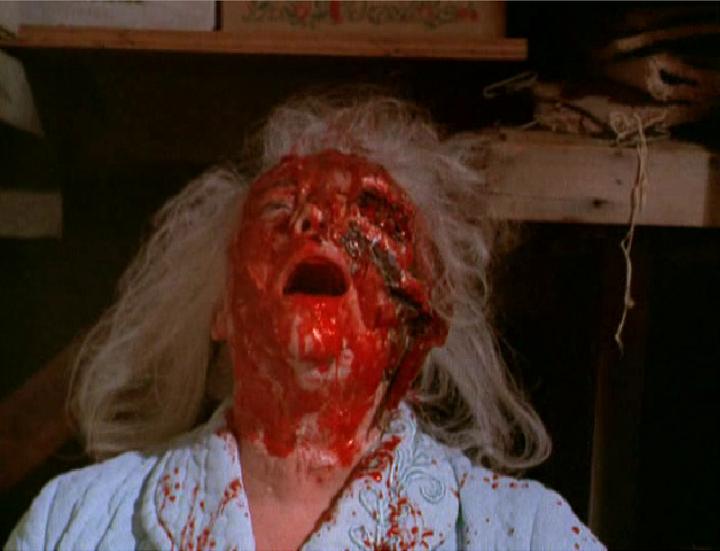
Deborah's boyfriend Steven (Alberto Frasca) tries to sneak over for some lovin' but "banana oil" (her pet name for him - gag!) gets chopped with a pair of hedge clipped and pushed down a artesian well. Deborah herself ends up trapped in the cellar and gets stabbed to death. In the film's only standout scene, Deb's mama goes down to the basement only to find that it's snowing and her daughter is a rotten-faced ghost. There are sudden gusts of wind, flying feathers, vases and lights exploding in slow-motion and plants wilting, bleeding and smelling like rotten flesh. The film has a very confused sense to the paranormal elements. Aside from the standard witchcraft, tarot cards and the family curse, there's mention of the madness-inducing orchids from the West Indies and Haitian voodoo, plus a special medallion full of Egyptian symbols. A skeletal, maggot-faced grim reaper with a scythe even makes a special appearance during the finale.


The production values are fair, the music score's OK, there's a decent shooting location as well as some blood (including several decapitations) and brief nudity (which doesn't happen until the last ten minutes). Cast-wise, the actress playing the old witch does an effective enough job and it's nice to see genre vet Muller again. Sadly, all of the positives are constantly at odds with the terribly muddled plotting and laughable dialogue (the horrid English dub certainly doesn't help matters), which keep this from realizing its full potential.


Amongst his fellow Italian directors, Lenzi had one of the most varied careers. He all but started the Italian cannibal craze with 1972's MAN FROM DEEP RIVER (later adding EATEN ALIVE BY CANNIBALS and CANNIBAL FEROX to the cycle), made many gialli (four of which starred American actress Carroll Baker) and even made slasher (1988's NIGHTMARE BEACH), zombie (1980's NIGHTMARE CITY), haunted house (1987's Ghosthouse) and demon (1991's Black Demons) movies. Sadly, this trip to the witch well (a popular subgenre at the time) sinks.


This was the third entry in a proposed four-part series entitled "Le case maledette" (or "The Doomed Houses"), which were intended to play on Italian TV, though some apparently didn't. The others were THE HOUSE OF CLOCKS This was the third entery and The Sweet House of Horrors (both directed by Lucio Fulci) and House of Lost Souls, also from Lenzi.

1/2

Death Weekend (1976)

... aka: House by the Lake, The

Directed by:
William Fruet


Thrillers featuring "normal" people being held hostage and terrorized by criminal degenerates were mighty popular during the 70s, thanks in no due part to the success of Sam Peckinpah's STRAW DOGS (1971) and Wes Craven's THE LAST HOUSE ON THE LEFT (1972). While Peckinpah's film was about the unfortunate *need* for violence (and how pacifism is more idealistic than realistic in contemporary society), Craven's dealt with how violence dehumanizes everyone involved, not just victims and their attackers, but also those involved in using violence to enact revenge. Most of the films influenced by these two trailblazers really didn't have much to say outside of what had already been said and usually went for straight-up exploitation. Death Weekend is something of a happy medium between exploitative thrills and substantative content. While many others of this type are a bit lopsided in painting those in the lower-class as the bad guys and the successful, wealthy ones as the victims, this film smartly counteracts that by making the rich guy 'victim' a scumbag, too. The key character to pay attention to here is the woman caught in the middle of it all. How she deals with the constant sexual threats and attempts by men to manipulate and violate her, and eventually triumphs over all of the macho bullshit, is the core of the film.


Rich, womanizing oral surgeon Harry (Chuck Shamata), who's used to having his way with the ladies, and a thrill-seeking, independent-minded model / actress Diane (Brenda Vaccaro) plan to spend a weekend at his isolated country mansion ten miles removed from civilization. He's promised a weekend party, but in actuality has lured her there simply to try to get her in the sack. On the road heading toward his place, Harry and Diane are harassed by a quartet of thugs, which escalates to a dangerous car chase. The thugs, led by the sadistic Lep (Don Stroud), end up wrecking their car and then go about hunting the duo down to enact their revenge. Thinking they've eluded the thugs, Harry and Diane make it to his home. He immediately gets to work trying to conquer his prey; attempting to impress her with his material possessions, complementing her physique, trying to ply her with drinks to loosen her up, etc. He's a bit disappointed to find out that Diane is having none of it. She's not naive... and after his spectacle, she's now not interested. Little does she know, Harry has already spied on her taking a shower and took photographs of her naked utilizing a two-way mirror.


When Diane figures out Harry isn't having a party and she's been tricked into going there, she insists he take her back to town. He tells her to walk. Before anyone can go anywhere, the thugs (who'd already taken time out of their busy schedule to drag a park ranger with their car) show up to turn Diane's annoyance with one man into a struggle for survival against four. Lep and company proceed to guzzle down liquor, bust out windows, destroy Harry's expensive decorations, grope and threaten Diane with rape and trash the entire home. After they take a ride in his speed boat and run over and kill two men, Diane realizes that if she doesn't manage to escape, she's going to be raped and killed. And later on that evening, after Harry is murdered, and she's set to get assaulted and sliced up with a razor, Diane's survivalist instincts kick in. Because she's shown to be a strong, assertive and intelligent woman from the very beginning, her resorting to violence in order to protect herself is a bit more plausible than usual for this type of film.


But don't get me wrong, not once does the director blatantly beat viewers over the head with the feminism stick. The film can simply be enjoyed as a rape-revenge or home invasion suspense thriller and that's that. I'm just pointing out that it happens to involve a woman who refuses to be influenced, compromised or overpowered by a man's wealth, power or physical strength and that certainly is no coincidence. In an interview with director Fruet I read years ago he stated that the husky-voiced Vaccaro basically shrugged this film off after she'd received an Oscar nomination for JACQUELINE SUSANN'S ONCE IS NOT ENOUGH (which was released the same year). I've read elsewhere that Vaccaro went all the way to England to plead the BBFC censors to allow the film to pass uncut; successfully. Either way, she needn't be embarrassed by her work here, nor the film itself. Her performance is very good and this material is actually far less offensive than brainless modern 'girl power' crap like CHARLIE'S ANGELS.


Aside from Vaccaro, the other actors all do fine work. All four of the men cast as the assailants (also including Richard Ayres, Kyle Edwards and Don Granberry) are convincing, display varying degrees of instability, actually look their parts and are given some kind of quirk to differentiate them from the others. From top to bottom, it's made with skill, and things get pretty grisly and violent at the end. The "road rage" incident that opens the film is based on an actual occurrence that happened to the director and his friend; who were harassed by a group of drunken thugs who tried to run them off the road while out driving in the country.


The film was released on VHS by Vestron. Sadly, there's no DVD release.

★★★

Thursday, December 22, 2011

Merry Christmas!

I won't be posting any reviews for a little while since I'm busy at work on another little project (... horror movie related, naturally!), but I just wanted to stop in and wish all of my blog buddies and any other visitor a very Merry Christmas! Take care, best wishes to all and I hope everyone has a wonderful holiday.

Monday, December 5, 2011

Child, The (1977)

... aka: Kill and Go Hide
... aka: La casa degli zombi
... aka: Zombie Child

Directed by:
Robert Voskanian


Alicianne Del Mar (Laurel Barnett) decides to travel back to the small country town she grew up in to take a live-in nanny position at the Nordon home. On her way there, she runs her car off the road to avoid a barrel, decides to walk the rest of the way and crosses paths with elderly, gossipy widow Mrs. Whitfield (Ruth Ballen), who invites her inside for tea and promptly informs her that her new charge Rosalie (Rosalie Cole) is a strange, trouble-making little girl whose now deceased mother had spent much of her time in mental institutions. Mrs. Whitfield also insists Alicianne stay on the path and not wander into the woods since she's been hearing strange noises there and small animals have recently been discovered dead. Since the opening credits sequence shows Rosalie feeding a kitten to some kind of cemetery ghoul, we already known poor Alicianne's gonna have her hands full. Still, since she lost both of her parents at a young age and Rosalie has recently lost her mother, Alicianne figures they'll relate on some level.


Upon arriving at the Nordon home, Alicianne meets patriarch Joshua (Frank Janson), a cranky old prick who warns "I hope you're not a nervous woman," as well as Joshua's grown son Len (Richard Hanners) and, of course, young Rosalie (who actually looks like a teenager; not the little girl I was expecting). There's also an Chinese gardener (Slosson Bing Jong) who works there but his few scenes seem removed from the rest of the film and he's not once seen in the same shot with anyone else from the cast, possibly because his scenes were added later on. Alicianne discovers that Rosalie is a pouty, obnoxious little brat who hates other kids ("Aw, they're all dumb!"), grapefruit ("I hate grapefruit!") and donuts ("Donuts!?"), gets pissed at Alicianne for going horseback riding with her older brother and giggles at a story her father tells her about a bunch of boy scouts who got poisoned by oleander sap and died. Rosalie also enjoys drawing morbid pictures and makes frequent midnight trips to the cemetery to visit her "friends." Her "friends" turn out to be a bunch of zombies that she's summoned forth and controls to do her bidding. And her bidding is basically to kill anyone who rubs her the wrong way.


Why Rosalie even wants everyone dead is one of many muddled story points you'll encounter in this film. I've seen this advertised as a revenge picture, but I could never quite figure out just who exactly the little psycho was going after, or why she was going after them. We never learn for sure if the mother had actually been murdered or just died of natural causes. However, I'm willing to accept that Rosalie could just be mad about her mother's death and doesn't know how to cope. Or she's simply just evil. She basically just comes off like a whiny little beotch who uses her zombie pals to punish people who don't let her get her way. And her powers (vague and unexplained as they may be) extend beyond just the zombies, as she's also able to make inanimate objects move, including a scarecrow that she brings to life to kill when the zombies are too busy eating kittens.


What I can't accept is the horrendous acting and dialogue. It's difficult to blame the actors so much because it appears that their dialogue was all dubbed in later. Still, you'd be hard pressed to find more stilted, awkward and unnatural- sounding dialogue readings than you'll find in this film. Nothing that comes out of anyone's mouth is delivered with the least bit of believability or conviction. And I mean nothing. The editing is done with the same level of ineptitude, and it has a habit of switching from night to day back to night again in the same scene. The film has a early America period setting for some reason, which seems to be the 1920s, though not all of the clothing and home decor really bespeak that era.


It's not all bad news, though. The film does have some nice atmospheric, foggy moments here and there, and a couple of the dialogue-free sequences (such as when our heroine has a nightmare where she's dancing with Len and he turns into the scarecrow) are effective. There's enough gore to please (faces ripped off, an eyeball gouging, a head getting chopped with an axe, etc.), the zombie designs by Jay Owens (mostly saved for the NIGHT OF THE LIVING DEAD-inspired finale) are pretty good and I quite liked the bizarre polymoog synthesizer soundtrack. It's pretty slow-going until near the end, when Alicianne and Len are besieged by a horde of zombies and try to barricade themselves inside a shed. Even these scenes are partially spoiled because our "heroine" proves to be utterly useless and just stands around shrieking the entire time, refusing to be of much help to poor Len as he tries to fight off the ghouls.


Released theatrically by Boxoffice International (and executive produced by Harry Novak), this title has been well-serviced on both VHS (Paragon, Best and Monterey were but a few of the distributors) and DVD (by Something Weird). The Canadian release title was Zombie Child.

★★

Related Posts Plugin for WordPress, Blogger...