.
.
.
Showing posts with label abortion. Show all posts

Friday, September 29, 2023

Tsuitô no zawameki (1988)

... aka: 追悼のざわめき
... aka: Noisy Requiem, The

Directed by:
Yoshihiko Matsui

The seriously disturbed Makoto Ishikawa (Kazuhiro Sano) is first seen aimlessly wandering around the slums of the impoverished Kamagasaki district of Osaka. He stops to feed pigeons, then suddenly bludgeons one with a hammer and rips its head off, adding it to a collection of dead birds he keeps hidden in the sewer. He treats his human prey about the same way. A serial killer, Makoto beats his victims, robs them, defiles their corpses and then dumps them in junkyards, trash heaps and abandoned buildings around the city when he's done with them. He sometimes strips naked, takes the entrails from his victims and stuffs them into a hole bored out of the crotch of his mannequin "girlfriend," whom he shares a "home" (actually a rooftop) with, buys an engagement ring and expensive dresses for, dances naked with, cuddles with, has sex with and licks bird droppings off the face of (!) Also, great news for the couple: She's recently become "pregnant."

A schoolgirl discusses a dream she had that involved gray pigeons preventing a single white one from eating some beans, the white pigeon turning into a crow, the beans turning into starving people ("Like in that song 'We Are the World'!"), the starving people turning into dead bodies and the crow feasting upon those bodies, finally noting that we all have the capacity to be that crow picking at the carcasses of the weak and dying, granted we're hungry enough. This prompts her to give more than her friend thinks she should to a pair of disabled Pacific War vets panhandling by a fountain. Immediately after, Makoto extinguishes that good deed by accusing the men of being Koreans faking being Japanese. He knocks them both down, bites them, stomps on them and stabs one of them in the leg with a crowbar, which he then twists around to intensify the pain. He then steals their money.


No doubt like many others living there, Makoto has a long criminal record, though he's still free to roam the streets among the other undesirables. Aside from the assorted criminals are the mentally ill, the homeless, the poor, the deformed, the disabled, the different; all of those folks "polite society" has no place, and often no compassion, for. At the end of the day everyone wants love in any way they can find it, even those whose idea of love would be viewed as sick, immoral or perverse by the standards of the world at large. And we get to meet many such folks here.

A drooling, filthy bum (Isamu Osuga) who's been reduced to having sex with a tree stump (!) stumbles upon Makoto's mannequin, attempts to have sex with it and ends up cutting his dick on a broken bottle top shoved inside her crotch hole (an extra precaution from her man to prevent "cheating" I suppose). Makoto is hired by a dwarf (Toshihiko Hino) and his dwarf sister, Natsuko (Mamiko Nakai), to clean out sewers. She has bad burn scars all over her neck, arm and chest from getting splashed with hot oil as a kid, is constantly laughed at and ridiculed and manages to drive people away simply by existing. Lacking in the romance department, she's reduced to sex toys and the occasional hookup with pedophiles who try to pretend like she's a child. Oh yeah, and once a year her brother gives it to her out of pity, per their dead mother's final request!


Also weaved into the film is a touching story of a teenage boy (Simon Kumai) and his sweet young sister (Yukiko Murata). They chill at the beach, play hopscotch and give each other knowing, loving looks. And then he decides to rape her to death, tries to spit her blood back into her mouth, paints her face, buries her in a lot, digs her back up and then cannibalizes her corpse. After stripping all of the flesh off, he then carries around her bones in a bag. He's not the only person to go mad either. Poor Makoto loses it too, starts killing people with a claw hammer, burns down a building and, in a very striking and surprisingly moving scene captured in long shots, runs toward a hundred or so schoolgirls for help, only for them to flee from her in horror.

There's an out of body experience, a headless Buddha statue with eggs on its neck stump, a dead parakeet, a ghost, a hand getting impaled, self-mutilation, spitting up half-chewed food, a disembowelment, a fetus getting ripped apart, a close-up shot of a dirty asshole, puking on someone's face, accidental death by discus hit to the back of the head and many, many incidents of casual, seemingly senseless cruelty and violence.

Societal alienation has always been a key theme in all of the director's films. His debut, Rusty Empty Can (1979), dealt with a homosexual love affair at a time when gays were heavily discriminated against in Japan. That was followed by Pig-Chicken Suicide (1981), which dealt with racism against Koreans living in Japan and also reputedly has many scenes of real animal slaughter, which is why I've avoided it thus far. Many of the same themes, namely the search for love and affection in a world filled with prejudices and obstacles, have carried on over to this one.


This proved to be something of a challenging view for me and it took three separate tries to finally make it all the way to the end. The controversial content didn't bother me at all, nor did the grotesque and gory imagery. What was more of a struggle was the formless plot, which takes seemingly forever to start taking shape, and the repulsive, thinly-drawn characters, This really could have used some tightening up in the editing room as well. While I don't necessarily have a problem with a 2 1/2 hour movie, I do have a problem with a 2 1/2 hour movie packed with unnecessary long shots of mundane things that seem to go on forever. There's making a point and then there's making a point and then beating the audience over the head with that point for an additional hour.

Aside from the prolific Sano, who's a director himself and a regular presence in Hisayasu Satô movies like RE-WIND and SURVEY MAP OF A PARADISE LOST, the cast is comprised almost entirely of amateurs, though everyone plays their part effectively.


What really saves the day here is the style. This is one of the most visually remarkable pieces I've seen in quite awhile. It's shot in grainy 16mm and black-and-white (one of my personal favorite aesthetic choices), with lots of unsteady handheld camerawork roaming about, great framing and very striking shots and camera placements. There's one great high contrast shot after another and the whole thing looks fantastically gritty. That by itself is enough of an incentive to give this a look, though the narrative and the content may not be to everyone's tastes. I'm a bit torn. Even though I really appreciate the artistry and imagination behind this, and there are a number of powerful moments worth seeing, it's definitely not something I'll ever sit through again.


This project began all the way back in 1983, took three years to complete and another two years to release. It caused controversy in its home country but became a big underground cult hit, playing in one theater until 2004! However, the film didn't make much of an impact in other parts of the world. Supposedly a number of film festivals, even those outside of Japan, refused to show it. It also didn't do much for the career of the director, who wouldn't make anything else until twenty years later. His next and, as of this writing, last film, Where Are We Going? (2008), once again dealt with love among the marginalized, this time between a young male factory worker with a traumatic past and a transsexual.

While the film took forever to release on home video (which wouldn't occur until the late 2000s), there are several Japanese DVDs on the market now and English subs are available. Though uncredited, Shinya Tsukamoto (Tetsuo: The Iron Man), Gakuryû 'Sogo' Ishii (Burst City) and Takahisa Zeze (In the Wake), all supposedly worked on this in some capacity.

★★

Friday, March 18, 2022

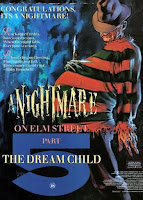
Nightmare on Elm Street 5: The Dream Child, A (1989)

... aka: Freddy 5: L'héritier du rêve (Freddy 5: Heir to the Throne)
... aka: Freddys sidste mareridt (Freddy's Last Nightmare)
... aka: Nightmare 5 - Il mito (Nightmare 5: The Myth)
... aka: Nightmare on Elm Street 5 - Das Trauma (Nightmare on Elm Street 5: The Trauma)
... aka: Nightmare on Elm Street: The Dream Child, A

Directed by:
Stephen Hopkins

The raging success of the Elm Street series couldn't last forever. The first four films were all huge box office hits, with each installment grossing more than the last. Things hit their zenith in 1988 with THE DREAM MASTER, which became a Top 20 box office draw by year's end. Soon after, Freddy received his own syndicated TV series, enabling fans to watch him every single week. For free. This easy access to the popular dream slayer combined with market over-saturation, including endless silly Elm Street merchandise, led to consumer exhaustion by the time part 5 hit theaters in the summer of 1989. It also didn't help that this particular entry was notably different than the two previous films in both tone and execution. Sure, we still get plenty of the terrible one-liners, but this is still darker, drearier, more serious and less "fun" in the traditional sense. Director Hopkins was dead set on making a gloomy, more Gothic-style horror film as opposed to a colorful, comedic slasher, and that's precisely what he did here. However, that change didn't sit well with series fans and helped contribute to The Dream Child falling far short of audience and box office expectations. And by far short, I mean to the tune of nearly 30 million dollars. That's quite a fall from grace in just one year!


In a 1990 interview with Fangoria, the director stated that he was content with the product that he initially delivered to the studio, but that interference from both New Line and the MPAA (who forced them to cut down some of the violence to secure an R rating) ruined the final film and now he considers it "a complete embarrassment." In the 2010 Never Sleep Again retrospective documentary, various cast and crew members bemoaned endless script rewrites and basically admitted they just started making things up as they went along. Co-writer John Skipp claimed they "liposuctioned all of the soul and intelligence out of the story" and producer Robert Shaye wrote off the whole affair as "arguably lame."

Reception of the film, both then and now, and from fans and critics alike, pretty much align with cast and crew assessment. To date, this is the second lowest-grossing of the entire franchise. It's also the third lowest-rated Elm Street film on Rotten Tomatoes and Letterboxd and the second lowest rated Elm Street film on IMDb, which puts it right there at the bottom with the dreadful Freddy's Dead and awful 2010 remake. Have you actually ever met anyone who thinks The Dream Child is the best Elm Street film? I mean, I guess it's possible, I just never have.


Lisa Wilcox, with a more attractive look and somewhat improved acting skills, reprises her role as Alice Johnson. In the previous film, Alice started out as a shy, mousy pushover with a since-recovered alcoholic father (Nicholas Mele) but, thanks to her special ability to acquire standout qualities from her deceased peers, emerged as an ass-kicking dream realm heroine. Alice was able to acquire enough skills to put an end to Freddy's reign of terror for the time being and snagged football jock Dan (Danny Hassel) as a boyfriend in the process.

Now Alice and Dan have moved on with their lives and just graduated from Springwood High. She's still working at the diner and not entirely sure what she's going to do with herself while he's eyeing football scholarships. The two have a new (and much smaller) clique of friends, including candy striper / diver Yvonne (Kelly Jo Minter), aspiring model Greta (Erika Anderson) and comic book nerd Mark (Joe Seely), and have also consummated their relationship. Which, ya know, who cares, right? I wouldn't either except for the fact this directly factors into the plot and they've decided to show us all that during the opening credits of the film as if we wouldn't be able to put two and two together ourselves.


Alice begins to suspect something sinister is afoot when the nightmares suddenly start all over again. She first dreams about nun Amanda Krueger (Beatrice Boepple), starting with her getting locked in a nuthouse overnight where she's gang raped by a hundred loons, followed by the eventual birth of the baby conceived in said rape. Only this isn't a normal infant but instead a little IT'S ALIVE-style evil demon baby. The creature goes into a cathedral, where Freddy (Robert Englund) is reborn. The catch? Alice doesn't even have to be asleep to encounter Freddy now. It's as if something, or someone, is able to pull her in.


Dan becomes Freddy's first victim, when he causes him to crash his truck after making him envision a motorcycle he's driving rips off all of his flesh. Alice then learns she's pregnant with Dan's child. She's visited in the hospital by a young boy named Jacob (Whitby Hertford), who turns out to be the child Alice's fetus has the potential of growing up to be. However, it's soon discovered that Freddy is using Jacob's dreams (?) as a way to lure unsuspecting victims to their doom so he can then feed the souls of the victims to the fetus (?!) in an effort to be reborn. Why he needs to be, or would even want to be, a mortal human again when he can already slaughter countless people in the relative safety of a nightmare world has me scratching my head. Yes, this is convoluted. Yes, this is all just a silly and desperate gimmick to keep the series going. Yes, this is all dumb as hell. And, yes, I feel dumber for having to even type all this nonsense out.

Some of the worst plot points from DREAM WARRIORS get recycled, with the ghost of Freddy's dead nun mama heavily factoring into the proceedings. According to local legend, she went crazy after giving birth, was committed to an asylum and hung herself. In reality, she was likely murdered by Freddy. For some reason, a bogus funeral was held after she died and her funeral plot was left empty, while her actual remains were hidden somewhere else. Alice suspects she'll have to find those remains in the now-abandoned asylum and give the nun a proper Christian burial on consecrated ground in order to stop Freddy. Blah blah blah.


The film does seem like it's trying to say a few things about teen pregnancy... I just can't figure out WHAT exactly. Adoption and abortion are both given as options, but our heroine isn't the least bit interested. Instead, she insists on keeping the baby come hell or high water. However, in the context of this film, that turns out to be an appallingly selfish decision. Keeping the baby means she's willing to sacrifice the lives of others in the process. Innocent people die as a direct result and she doesn't seem to really care all that much about it. In fact, at one point she even flat out says that SHE has nothing to worry about. Since Freddy is mostly invested in her fetus, he can't kill her, after all. As for the reasoning behind her decision... Well, Alice "saw him inside of me growing," while getting an ultrasound. That's it. Not sure that justifies letting a psycho have a go at everyone you know, but hey.

Hilariously, the pregnancy content is so muddled and poorly thought out that the film was condemned both by Pro Life and Pro Choice camps. According to the AFI Catalogue: "The movie's opening at Mann's National Theater in the Westwood district of Los Angeles, CA, was protested by both the National Coalition on Television Violence and the Alliance for Survival over its violent content, as reported in the 12 Aug 1989 LAHExam. Although the film had yet to be screened for the general public, the groups based their protests on past violence in the series and from a press release and promotional advertisement they claimed showed the character "Freddy" possessing the mind of an unborn child to hurt the mother. The film also brought the ire of several "pro-choice" groups which claimed the movie was "anti-abortion propaganda." Carol Lieberman, a University of California psychologist, claimed the film was arguing that a woman should never abort her fetus even if it means death and destruction to herself and the people around her."


Nearly all of the pluses here are primarily things money can buy. Dream Child had a healthy enough budget (8 million dollars [equivalent to around 17 million today]) to afford top notch special effects artists and production designers so at least the whole thing looks polished and it has some pretty impressive make-up and visual effects, including some cool stop motion work from Doug Beswick, a character doing battle with "Super Freddy" (Michael Bailey Smith) in a black-and-white comic book world, KNB gore make-ups like a victim being force-fed to death and an M. C. Escher-inspired finale. Unfortunately, that's not enough to really make up for the all the other areas where this film fails. Visualizing things discussed in previous entries feels cheap, lazy and redundant and the whole film feels lifeless and bland, which is matched with the rather dreary visual look, resulting in a film that's neither fun nor scary.


There were two soundtrack albums; one with Jay Ferguson's score released by Varèse Sarabande and a second featuring both heavy metal and rap songs, which was released by Jive. The song "Bring Your Daughter... to the Slaughter" by Iron Maiden's Bruce Dickinson, which won the Razzie Award for Worst Original Song, was a surprise #1 hit in the UK. There were also tie-in music videos for Whodini's "Any Way I Gotta Swing It" (which was also an extra tacked onto the end of the original Media VHS release) and Romeo's Daughter's "Heaven in the Backseat."

1/2
Related Posts Plugin for WordPress, Blogger...