.
.
.
Showing posts with label M.R. James. Show all posts

Saturday, September 24, 2016

Treasure of Abbot Thomas, The (1974) (TV)

... aka: Ghost Story for Christmas: The Treasure of Abbot Thomas

Directed by:
Lawrence Gordon Clark

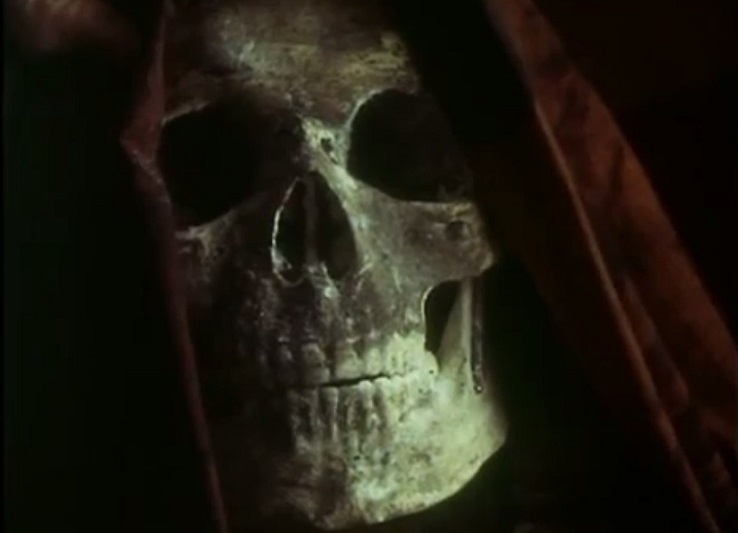
Wealthy Lady Dattering (Virginia Balfour) hasn't quite gotten over the death of her husband and as a result conducts a séance every evening in hopes of contacting his spirit. She's even invited a shady married couple; Mr. and Mrs. Tyson (Frank Mills, Sheila Dunn), to come live with her. The Tyson's possess what they call “the gift” and claim to be in tune with the spirit world. Lady Dattering's bright, clever, college-aged son Peter (Paul Lavers) suspects the couple are a fraud leeching off his gullible mother's hospitality, so he goes to the church and asks friend and mentor Reverend Justin Somerton (the excellent Michael Bryant) to come to one of their gatherings to help prove it. The couple have supposedly been in contact with a spirit guide named Father Dominic who's been relaying messages to Lady Dattering from her late husband by possessing Lady Tyson and using her as a mouthpiece. Using Latin, Justin is able to expose the duo as con artists and they're quickly shown the door. The experience however gets both Peter and Justin more interested in the spirit world and they begin tampering with things best left alone.


According to some old church documents, a 15th century churchman named Abbot Thomas was practicing the black arts and alchemy and was sentenced to death as a result. Rumor has it that before he could burn he was whisked away by Satan himself but not before revealing that he'd hidden a cache of gold somewhere on the grounds of the monastery where Justin works. Teacher and pupil then begin examining the church grounds, starting with taking photographs of an ancient stained glass mural to bring out further detail. In one of the photos they notice a strange black smudge over one of the images that doesn't appear in any of the other photos. Further inspection of the smudge reveals it is one of the many gargoyles lining the church roof. From there, the men start to put together pieces of a very elaborate puzzle, which requires transcribing Latin and figuring out the hidden meanings in the text and images on the mural and using math to decipher cryptograms found hidden behind layers of paint. All fingers end up pointing to an old underground tomb in the church graveyard and exploration of that proves yet again that some riddles are best left unsolved.


This was the fourth of eight entries in the first crop of BBC Ghost Story for Christmas presentations and was based on the M.R. James story of the same name, which was contained in the collection Ghost Stories of an Antiquary published in 1904. Like many of James' stories it centers around academic types whose realist beliefs get turned upside down by a taste of the supernatural. Many of the protagonists in these stories are cynics who happen to have their own spiritual beliefs yet still doubt the potential of an other-worldly evil manifesting itself in the real world and that ends up eventually hitting them where it hurts. This one has all of that, is very well-acted, atmospheric and efficiently directed; adeptly mixing mystery and ghost story in that measured, moody, subtle way the Brits seem to excel at. The 37-minute running time moves things along at a brisk pace and this also happens to have one of the most chilling conclusions of any of these adaptations, which is pretty much the main point.


THE ASH TREE and LOST HEARTS were also adapted from James' Antiquary by Clark for the annual 70s series. When the series was revived in 2005, Pier Wilkie tackled the story Number 13. Prior to the Christmas series, Jonathan Miller had adapted WHISTLE AND I'LL COME TO YOU (1968) for the BBC series Omnibus and numerous other stories from the collection were filmed for the Mystery and Imagination (1966-68) series.

★★

Saturday, April 16, 2016

Stalls of Barchester, The (1971) (TV)

... aka: Ghost Story for Christmas: The Stalls of Barchester

Directed by:
Lawrence Gordon Clark

With this 45-minute offering began a series of “Ghost Story for Christmas” films that became a holiday tradition in the UK from 1971 until 1978. Each were shot on 16mm and in color, ran less than an hour (some were as short as 30 minutes) and played on BBC 1 either right before or right after Christmas. The first five of these productions, including this one, A WARNING TO THE CURIOUS (1972), LOST HEARTS (1973), The Treasure of Abbot Thomas (1974) and THE ASH TREE (1975) were adaptations of M.R. James ghost tales and were directed by Clark. The director followed those with THE SIGNALMAN (1976); an eerie adaptation of a Charles Dickens story, and then STIGMA (1977), an atypically bloody offering which was based on a new original script and not a classic short story. The initial series wrapped up with Derek Lister's THE ICE HOUSE (1978), which was the only one not directed by Clark and also based on an original script. In 2000, the Ghost Story for Christmas banner was revived for a four-part TV special starring Christopher Lee as James. BBC 4 would bring it back yet again in 2005, starting with Luke Watson's A View from a Hill. This one's an adaptation of the story The Stalls of Barchester Cathedral, which was contained in James' second collection of stories titled More Ghost Stories, published in 1911.

In 1932, Dr. Black (Clive Swift) is brought in to catalogue the dusty library at Barchester Cathedral. The books and papers there disappoint him... that is until the librarian (Will Leighton) digs up a locked box whose contents the now-deceased former college dean refused to look at. Naturally, this strikes Dr. Black's curiosity and he insists on checking out what's inside the box inscribed “Papers of the venerable Archdeacon Haynes. Bequeathed in 1894 by his sister Leticia Haynes.” Black (who narrates the story) cracks open the box, finds a series of letters and a black book and begins reading from the latter. We're then whisked away to 1872 where the bulk of our story takes place.


With ambitions of quickly moving up the ladder and taking control, Haynes (Robert Hardy) arrives in Barchester, takes up resident with his gossipy busybody spinster sister Letitia (Thelma Barlow) and begins work as a junior deacon under 84-year-old Archdeacon Pulteney (Harold Bennett). Haynes secretly wishes the old man would kick the bucket already but next thing he knows Pulteney is still 90 and going strong. Two years later, the old deacon takes a fatal plunge down a set of slippery oak stairs. A stair rod put in for protection was suspiciously missing from the scene of the “accident” and many blamed a maid for being careless. The actual culprit was Haynes himself, who was sick of waiting for his promotion. Haynes indeed gets the title of Archbishop but it's not without a price. Not only does the maid attempt to extort money out of him but, after his sister leaves town to go stay with a cousin, he's left all alone in their large home and starts feeling like someone or something is still around. He hears voices, whispering and laughter, the sounds of bells and footsteps and senses the presence of a cat even though they don't have one. Then bizarre things happen in church, particularly at his hand-carved wooden stall...


As Dr. Black and the librarian delve further into the journal, they begin to suspect that loneliness and fatigue from long hours of work are driving the man mad, but it may also be something more sinister. After all, the wood used to build Haynes' stall came from something called “The Hanging Oak;” which had been used hundreds of year earlier to execute witches. Human bones were even found between its roots when it was cut down. Despite being a man of the cloth, Haynes ironically refuses to believe in any “superstitious foolery” and is convinced it's some psychological malady and he must stay firm. In fact, “I must stay firm” is the last thing written in his journal before his untimely and mysterious passing. He was found with his neck broken and a deep gash on his face. Did he go mad? Was he killed by a vengeance-seeking ghost? Or was this all a completely coincidental yet karmic visit from the demonic cat and hooded figure depicted on his stall?


This lays down the groundwork for the tone and feel of most of the later entries in this series. It's not as unnerving, interesting and creepy as some of the better later entries (most notably Warning and Signalman), but it's still well-acted, well-made, classy, subtle, atmospheric and ambiguous. Worth watching.

★★1/2

Wednesday, August 14, 2013

Warning to the Curious, A (1972) (TV)


... aka: Ghost Story for Christmas: A Warning to the Curious, A
... aka: M.R. James' A Warning to the Curious

Directed by:
Lawrence Gordon Clark

Part of the annual BBC series A Ghost Story for Christmas, which lasted from 1971 to 1978 and debuted a new supernatural tale (running from 30 to 50 minutes apiece) each year around Christmastime, Warning was the second of these TV specials. It was preceded by THE STALLS OF BARCHESTER (1971) and followed by LOST HEARTS (1973), THE TREASURE OF ABBOT THOMAS (1974) and THE ASH TREE (1975) - all from director / writer / producer Lawrence Gordon Clark and all based on stories by famed British author M.R. James - as well as THE SIGNALMAN (1976), which was also directed by Clark but based on a short story by Charles Dickens, STIGMA (1977) - again from Clark but based on an original screenplay by Clive Exton, and finally THE ICE HOUSE (1978), which was directed by Derek Lister and based on an original screenplay by John Bowen. The series lied dormant after that for nearly two decades, but was revived once again in 2005 for BBC Four. Warning now stands as the crown jewel in the entire early series. Not only is it the clear best of the lot, but I also consider it one of the scariest films I've ever seen.


According to legend, in the Dark Ages three sacred crowns were each buried in three separate places to protect villagers from an onslaught of Vikings who'd been terrorizing the land. As long as the crowns lie undisturbed, the land would be protected. Since then, one of the crowns had been found by thieves, who had it melted it down for the gold content, another was lost to the encroaching sea and the third has somehow managed to stay buried and undiscovered for all this time. An archaeologist (Julian Herrington) who's out excavating a plot of wooded land near the sea thinks he's going to find it. That is, until a strange, cloaked man named William Ager (John Kearney) mysteriously pops up and warns him "No digging here!" When his warnings are ignored, Ager picks up a sharp blade and starts hacking into the intruder.


Twelve years pass and Mr. Paxton (Peter Vaughan) arrives from London via train to the same secluded area of Norfolk (a popular tourist spot on off-season because it's winter) neat where the previous events took place. He gets a room at a nearly vacant, seaside hotel and then sets about exploring the Anglian legend in a small local village in Seaburg. The down-on-his-luck, unemployed former blue collar worker Paxton, only an amateur antiquarian, is hoping to turn his life around by locating the crown and prove "you don't have to have a string of letters after your name to be recognized." He goes to a cemetery and learns from the vicar (George Benson) that William Ager, a mentally-disturbed man rumored to be the crown's last "guardian," has long since passed away. Then it's off to an antique store, where he finds a book that belonged to the Ager family. From that, he's able to find Ager's former home, and learns from the young woman who now lives there that there was a specific plot of land near the home that Ager spent most of his life guarding.


Equipped with all of the information he needs, Paxton now knows just where to start digging. He isn't, however, wise enough to heed the ample warnings that he shouldn't be doing so. Not only does he ignore the legend and what the crowns represent, but he also has been spotting a figure cloaked in black silently, ominously standing off in the distance watching his every move. The night before he leaves, someone even sneaks into his room, cuts up the Ager family book and leaves his razor threatening sitting on the pages right under William's name. Still undeterred, Paxton sneaks out of the hotel late one night, goes to Seaburg, begins digging and finally locates the fabled crown. But the entire time he feels the presence of someone watching... someone drawing closer...

A perfectly-realized ghost story with no bells and whistles, no gore, no needless filler and no special effects. Instead this offers up excellent direction, fine performances, a low-key, otherworldly score punctuated by frantic violins and stark, low-budget 16mm photography that manages to brilliantly draw the eerie supernatural elements of the story out of the everyday world. I doubt you'll see many movies that utilize barren landscape as well as this one; which it does to creepy effect throughout. We only really see Ager in the brief opening sequence and from there on out, he's mostly seen as a silhouette in the distance, but his black garb and cape-like coat make him stand out prominently from the blue ocean waters, light sandy beaches and fields of long, dead, brown grass. Other shots of Ager chasing our protagonist around have been cleverly blurred to obscure him; turning him more into a faceless force of nature like the wind that blows through the tree limbs to signify his presence. The sounds of hoarse breathing can sometimes be heard and Ager's ghost can sometimes be seen by people, but he can disappear just as quickly.


The following year, Vaughan appeared in THE RETURN (1973); an excellent and, sadly, seldom seen 30-minute ghost story based on a story by Ambrose Bierce. Clive Swift (who'd previously appeared in the Stalls of Barchester entry as well as the great BBC holiday horror DEAD OF NIGHT: THE EXORCISM [filmed the same year]) co-stars as the only other guest in the hotel: a doctor there to get away from his wife and sketch.

BBC has issued this one on VHS and DVD. It's also available in a box set with the other titles in the series.

★★
Related Posts Plugin for WordPress, Blogger...