.
.
.
Showing posts with label John Carl Buechler. Show all posts

Saturday, August 28, 2021

Slave Girls from Beyond Infinity (1987)

... aka: Esclavas del espacio (Slaves of Space)
... aka: Esclaves du futur (Slaves of the Future)
... aka: Jäger der verschollenen Galaxie (Hunter of the Lost Galaxy)
... aka: Les captives de l'espace (Space Captives)
... aka: Mujeres Encadenadas (Chained Women)
... aka: Otrokyne z konce vesmíru (A Slave from the End of the Universe)
... aka: Rebelião nas Galáxias (Rebel of the Galaxies)
... aka: Slave Girls

Directed by:
Ken Dixon

Aboard a prison spaceship, a pair of bikini-clad captives; the soft and curvaceous Daria (Elizabeth "Cayton" / Kaitan) and the athletic and toned Tisa (Cindy Beal), break their chains, escape their cell, conk a few dumb guards over the head with a metal pipe, steal a spaceship and then crash land in the ocean on an unknown, though human-friendly, planet. Well, human-friendly when it comes to the atmosphere, at least! Daria crawls out of the water onto a tropical island, makes her way through the jungle and ends up at a castle fortress filled with very peculiar things. For starters, the main room of the fortress is filled with weapons and all manner of dead, stuffed animals, plus nearly all of the windows have been barred. Second, the crazy-eyed, black-clad castle owner, Zed (Don Scribner), is shady and sinister from the second he first introduces himself and spends his days sleeping and his nights hunting. Third, Zed has two android assistants who've been programmed not to divulge too much information to strangers and one of them is tasked with keeping guard over his secretive "trophy room." Finally, two other "guests;" Shela (Brinke Stevens) and her brother Rik (Carl Horner), are also present and ended up stranded there under similar, mysterious circumstances. In both cases, it appears their spaceships were intentionally drawn there by gravitational pull. On the more positive side, Daria's sister in crime shows up there unharmed, so at least there's that.


Our plucky heroine soon learns that there were four guests there only a week earlier, but two have since mysteriously disappeared without a trace. No explanation is provided by their host as to where they went. However, each had been invited into the trophy room prior to vanishing. Rik confesses to Daria that he believes they're all being kept prisoner there. For what reason, he doesn't quite know. However, the excuse Zed uses for why he can't take any of the stranded travelers off the planet - his own spaceship needs repairs - doesn't quite fly since his androids sneak out to make supply runs with it.

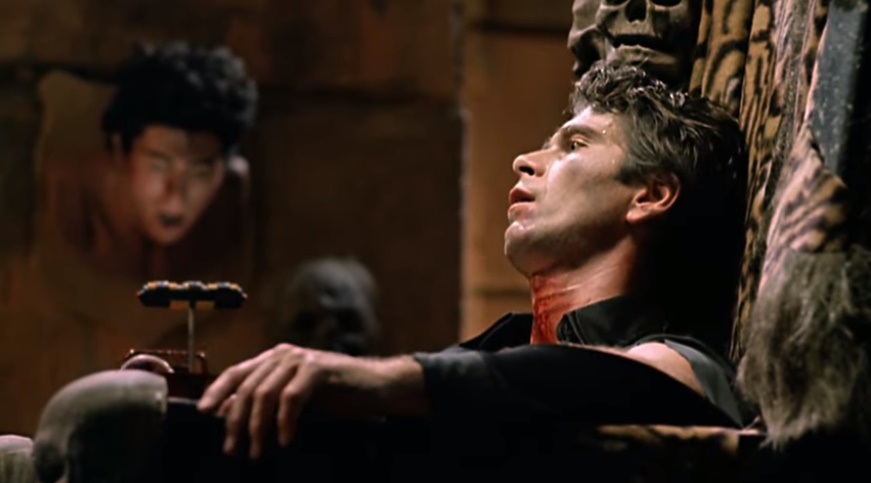
As it turns out, Zed isn't just interested in hunting wild animals, but also humans. After killing his victims, he decapitates them to add another "trophy" to his collection and is also a sexual sadist who likes chaining naked girls up, knocking them out and then raping them. During one memorable shot, Stevens is seen lying unconscious and naked on a slab while a shirtless Zed smokes a post-rape ciggie and one of his robots gives him a back massage! Afterward, Stevens' character is used to force the brother into another hunting "game." It doesn't end well for Rik when he becomes ensnared in a giant spiderweb and is shot to death. Wanting more of a challenge, Zed then decides to release all three women into the woods simultaneously, giving them only hunting knives and a one-hour head start. He then goes after them with his crossbow.


Not a bad idea at all here, an updating of Richard Connell's classic 1924 short story The Most Dangerous Game (most famously adapted for the screen way back in 1932), given a sci-fi twist and home video exploitation elements. This is also the kind of competently-crafted B-movie that's all but extinct nowadays. You know, actually shot on film (35mm even) with real production design, hand-crafted John Carl Buechler monsters (they throw in robots, mutants, green-blooded zombies AND an impressive Predator-like "Phantazoid Warrior") and whatever optical and visual effects they could squeeze in for the meager budget (in this case, 90,000 bucks). I'd say about every penny of that ended up on the screen. Crucial elements for this type of film (energy, swift pacing, atmosphere, spirited acting, nice colors...) are all here, as well as some humor (my favorite bit being the bickering robots), minor gore, sometimes hilariously pseudo-philosophical dialogue and plenty of skin from the three lovely female stars, though done with some restraint and as an accompaniment to the story, not the entire reason for the film's existence.


Leading lady Kaitan was always considered a second tier Scream Queen during the 80s and 90s and spent most of her time fighting a losing battle competing for bubbly blonde B-movie roles against the reigning queen of such parts: Linnea Quigley. Though Kaitan's career had some promising blips of life during the 80s, it eventually devolved to the point where she appeared to just be getting Linnea's leftovers; evidenced by the fact she was first in line to replace Quigley when she bailed out early from the Vice Academy comedy series. I'm not saying this to denigrate Kaitan in any way as I quite like her as an actress. She was gorgeous, came off as very pleasant on-screen and had fair acting chops. Just like Quigley (here's that comparison again!) she was underrated for her comedic talents, which can be seen in all their glory in Assault of the Killer Bimbos (1988) and several other films. I'm only pointing out that the lane she was traveling in during much of her heyday was already very much occupied, which probably explains why she didn't have quite the staying power of Quigley. Her co-star here, Stevens, has also had a more enduring career, though I don't find her darkly alluring qualities at all comparable to the much more sprightly Kaitan and Quigley. Nonetheless, the three of them always get grouped together.

I must also admit that I was taken aback seeing what became of Kaitan (now going by her married name Elizabeth Ruiz) after she finally threw in the towel on her acting career in the mid-90s. I know one can't expect an actor to be anything like their roles in real life, but her working as a personal assistant for truly nasty hatemonger David Horowitz, author of such books as Hating Whitey and Other Progressive Causes and BLITZ: Trump Will Smash the Left and Win (published just a few months before he lost the election by over 7 million votes) did genuinely surprise me. But, as this film poetically reminds us, "Fate certainly weaves a curious tapestry."




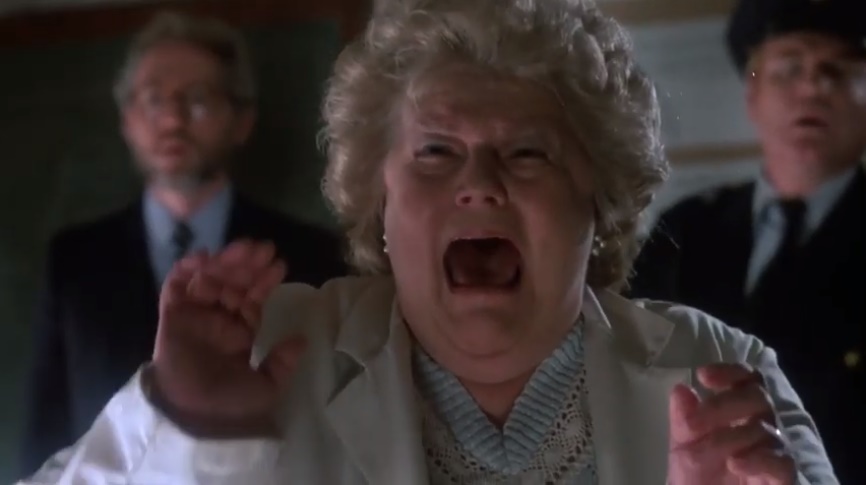
Slave Girls received another sort of notoriety in its day when the late Jesse Helms, former North Carolina Senator / Moral Majority co-founder, whose beliefs were pretty aligned with where Horowitz is today, actually brought this movie up on the Senate floor as an example of an "indecent" film that should be banned from TV as part of a failed Cable Act amendment he was pushing. That piece of moronic legislation finally had the final nail put through it by the Supreme Court in 1996. After this brief setback, Helms went back to fighting for other worthwhile Christian causes like defunding AIDS research and eliminating free school lunches for impoverished children.


Fully financed and pre-sold around the world on the basis of its title alone, this was a video store and late night cable (including frequent airings on USA Up All Night) staple here in America and much of the rest of the world for many years. It's also one of the most profitable films from the entire Charles Band universe and has been released on VHS (Urban Classics) and DVD (Cult Video, Koch Vision) numerous times, plus received a Blu-ray release in 2019 courtesy of Full Moon. With all that in mind, it's a surprise that director Ken Dixon did not make any other films after this. Prior, he was tasked with putting together a bunch of film clip compilation shelf fillers for Band, including The Best of Sex and Violence (1982), hosted by John Carradine, Famous T&A (1982), hosted by Sybil Danning, Filmgore (1983), hosted by Elvira, and ZOMBIETHON (1986), which had fun new zombie scenes shot to link together the archive footage. Slave Girls certainly showed enough promise to merit additional work for Band but it never occurred.

Clips from this were later repurposed into the utterly useless T&A compilation Bimbo Movie Bash (1997), which was released on VHS and DVD and as a CD-ROM "game" by Full Moon. Nearly 30 years later, Brinke got to duplicate her death scene for Band's surprisingly fun Trophy Heads (2004), which seems to have otherwise taken quite a bit of inspiration from this.

★★1/2

Thursday, October 22, 2020

Re-Animator (1985)

... aka: A Hora dos Mortos-Vivos (The Hour of the Living Dead)
... aka: H.P. Lovecraft's Re-Animator
... aka: Resurrección satánica (Satanic Resurrection)
... aka: Zombio

Directed by:
Stuart Gordon

Re-Animator basically came about because Gordon (then mostly associated with stage productions and founding the Organic Theater Company) wanted to make something Frankenstein-like to counter the overabundance of vampire movies being produced. That led him to H.P. Lovecraft's previously-unfilmed 1922 six-part serial Herbert West, Reanimator, which he first considered turning into a stage adaptation and then a TV pilot before being convinced by eventual producer Brian Yuzna to go the feature film route instead. It was eventually filmed in Hollywood over the course of 18 days in the winter of 1984 for around 900,000 dollars.

What probably came as a surprise to most involved, especially in a decade where many were coming down especially hard on gory horror films, was that the film would become a huge success with critics despite the fact it was bloodier and gorier than most of its competition. It hit the Cannes Film Festival to rave reviews and won a special award there, before heading to other film festivals and replicating its success. Critics for The New York Times, The Washington Post, The Village Voice (who selected it as one of the Top 10 films of the year) and other major magazines doled out praise and even many of the stuffier critics like Pauline Kael and Roger Ebert jumped on board. The positive word of mouth was enough to turn this into a box office success and it doubled its budget back in U.S. theaters alone. The film likely would have been an even bigger hit had the MPAA not slapped it with an X rating, which forced the distributors to release it unrated instead.


When it was time for a VHS release, original U.S. distributor Vestron opted to release two versions: An R-rated cut and an uncut / unrated one. I'm sure you can guess which version was more popular! Oddly, the R-rated version runs 93 minutes while the uncut version runs just 86. That's because the cut version contains more dialogue scenes, which were removed from the gorier version to improve its pacing. A 105-minute "integral cut" was later assembled utilizing all of the footage. All three versions are now available on various DVD and Blu-ray releases.

Re-Animator's success ended up leading to a lot of other things, starting with opening the door for many more Lovecraft film adaptations (or Lovecraft "inspired" films) plus a resurgence in the author's popularity. Gordon and Yuzna both became top genre directors over the next few years while both male star Jeffrey Combs and female star Barbara Crampton became genre mainstays. If anything, the film's cult reputation has only grown stronger in recent years. It was name dropped in 2000's Best Picture Academy Award winner American Beauty and is now a frequent fixture of Top Horror Movies of All Time lists. A critic's poll done for Time Out placed it at #93 while Rotten Tomatoes methodology has it listed as the 58th best reviewed horror film of all time. And that's just the tip of the iceberg.


We're first introduced to two very different third year students at Miskatonic Medical School in Arkham, Massachusetts. The first is Dan Cain (Bruce Abbott), who's bright, clean-cut, well-respected, studious, compassionate and conscientious. He's the type of guy who actually feels something if he loses a patient, just as he later feels something when he loses his cat. Dan's the exact type of person who should be pursuing a career as a doctor and it's not because he's still young, idealistic and hasn't had the time to get completely burnt-out and desensitized yet. It's because he seems like a genuinely good guy. On the flip side there's Herbert West (Combs), who's much more into the research side of the medical profession. West is intense, brilliant, short-fused, socially off-putting, more than a little bit arrogant and something of a sociopath. Once he puts his mind to something, there's just no stopping him. Ethics and morals be damned.

Herbert has just transferred to the school from Switzerland, where he was doing some kind of "independent research" with the renowned Dr. Hans Gruber (Al Berry)... only Gruber ended up dead at the end of it. He immediately manages to get on brain researcher / teacher Dr. Carl Hill's (David Gale) bad side by calling his work outmoded and accusing him of plagiarizing his late mentor's work. Dan puts an ad on a school bulletin board looking for a roommate to share expenses with. Guess who shows up at his door? Despite Dan's fiancée Megan (Crampton) picking up bad vibes from the sketchy-acting Herbert (he seems more interested in the home having a large basement than anything else), Dan takes his money and reluctantly allows him to move in.


Megan's initial feelings prove to be correct. Herbert keeps himself locked up in his room at all times and doesn't interact with anyone outside of school. She finds Dan's cat, Rufus, dead in Herbert's refrigerator alongside a bottle of dayglo green liquid of unknown origin. Herbert claims that the cat got its head stuck in a jar and suffocated. Megan doesn't believe him. Still, Herbert knows she and Dan have been sleeping with each other and if Alan Halsey (Robert Sampson), Megan's puritanical father and the school Dean, finds out about it he very well could expel Dan from the program. Late one night, Dan is awaken by strange noises coming from the basement and discovers his new roomie has somehow managed to bring Rufus back to life. The cat's now out of the bag. Literally.


Herbert explains to Dan what he's been experimenting on all this time: reanimation; bringing the dead back to life. He's already been successful in resurrecting various animals using his patented reagent (the green stuff), which is injected directly into the brain. The problem is that the revived animals have all been vicious and violent and had to be put down soon after. Herbert is convinced it's because he hasn't had a fresh enough test subject... yet. Understandably concerned, Dan goes to Dean Halsey and reveals what he's discovered only to have the Dean immediately expel Herbert from the program and threaten him with expulsion and losing his financial aid. Nevertheless, Dan sneaks Herbert into the morgue so they can try out the reagent on a fresh corpse. It's resurrected as a zombie, goes on a violent rampage, kills the Dean and then things spiral further out of control from there.


Though perhaps lacking in more substantive qualities that would have really put it over the top, Gordon does such a commendable job with the pacing and balancing the bloodshed with black humor it hardly even matters. It's pretty easy to see why this became so popular in the 80s and why it's continued to endure as a top cult title over the years. Gorehounds get exploding eyeballs, brains extracted from heads, a bone saw thrust through a chest, a shovel decapitation, eyes gouged out, fingers bitten off, arms axed off, attacking intestines (later copied by Peter Jackson for Braindead), zombies and much more. Most famously of all, Gale's character spends about half of his screen time carrying his own still-living severed head around in a dish and then has a memorably tasteless scene with Crampton as she's tied down to a slab and sexually violated. The make-up and special effects from Anthony Doublin, John Nualin, Everett Burrell and John Carl Buechler are great.

Combs and Gale have received the lion's share of praise as far as the cast is concerned and, while it's true they're both memorable in the showier roles, Abbott and Crampton are just as deserving of praise for their contributions if you ask me. Both get to show a lot of emotional range here and, without them keeping things grounded and giving the more unhinged, outrageous characters something believable to play off of, the film wouldn't be nearly as successful. Sampson does a great job, too. The cast also includes Gerry Black as a security guard who really enjoys his breaks, Carolyn Purdy-Gordon (the director's wife, who appeared in most of his other films) as a doctor, Peter Kent (formerly Arnold Schwarzenegger's stunt double) as a naked zombie and Ian Patrick Williams, who'd go on to star in the director's Dolls (1987), along with Gordon's wife.


Richard Band's score is often criticized for copying Bernard Herrmann's famous Psycho score, which is understandable once you hear it. What I don't see mentioned is that there's a passage near the end that's just as much a rip-off of Jerry Goldsmith's score for The Omen! Either way, it's noticeable but not a deal breaker. Mac Ahlberg did a nice job shooting it and the art direction is from Robert A. Burns (The Texas Chainsaw Massacre).

Two official sequels followed: 1990's Bride of Re-Animator, which was directed by Yuzna and had Combs, Abbott and Gale all reprising their roles, and Beyond Re-Animator (2003), which was filmed in Spain, also directed by Yuzna and starred Combs. In 2011, there was also the stage production Re-Animator: The Musical.

★★1/2
Related Posts Plugin for WordPress, Blogger...