.
.
.

Sunday, September 6, 2020

La mansión del terror (1989)

... aka: Hasta que la muerte nos separe (Till Death Do Us Part)
... aka: Mansion of Terror, The

Directed by:
Ramón Obón

Hugo Stiglitz (in a ridiculous poofy wig that doesn't match his beard) stars as Orlando, a well-to-do, turn-of-the-century pianist obsessed with a theater actress named Griselda (Luz María Jerez). Griselda's recently been cast as the female lead in a small production of Othello. Orlando makes sure to attend every single one of her showings (where he gets to see her being strangled on stage every night), sends her flowers nightly and makes his romantic intentions pretty obvious as he intently watches her from his balcony seat. Late one night at a trolley station, he approaches Griselda and, despite his intense and persistent nature (and the fact he initially creeped her out), charms her into having dinner with him. He then invites her to attend one of his performances. The two develop a mutual admiration for each other's talent and become lovers. Soon enough, Orlando is presenting her with expensive jewelry and asking her to become his wife. Griselda is initially apprehensive and has no interest in giving up her career for marriage and family. However, she ends up caving in and the two have an impromptu wedding on the theater stage in the presence of Griselda's friend / roommate Emilia (Lizetta Romo) and the rest of the Othello cast.


Orlando takes Griselda to his home, a secluded but well-kept mansion, located deep within the desert. She almost immediately regrets her decision as the ice cold maid Tencha (Dacia González) gives her dirty looks, almost completely refuses to acknowledge her and clearly doesn't want her to be there. Not just that, but she hears voices coming from the cellar, hears Orlando arguing with someone upstairs and then has a vision of a blonde woman being strangled by someone wearing a wedding gown while she's in the middle of trying to make love to her new hubby. Was it a ghost? A hallucination, perhaps? The next morning, she finally meets Orlando's mother, Eloisa (Rosita Quintana), who's surprisingly bubbly and friendly and eases her mind by letting her know that the mansion is now also her home. She gives her a tour of the estate, including of her beloved greenhouse.


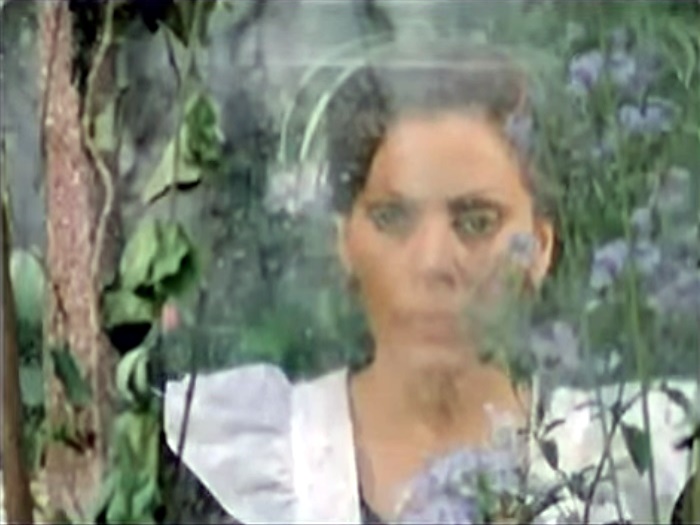


The relief doesn't last long, however, as Eloisa casually reveals that Orlando was previously married, something he never bothered telling her. The family may even keep a portrait of her on the wall and a weird shrine for the dead woman, with her wedding gown as the centerpiece, in the home, though it's also claimed that the woman is a relative. According to Eloisa, the woman in the portrait is her sister, she went crazy and then had to be locked up in an institution. She also looks an awful lot like Orlando's new wife. When Griselda confronts her hubby about her, he shouts at her, clutches his head as weird sci-fi sounding music plays, almost strikes her with a lash and then storms off. Griselda then begins seeing a wedding gown-clad figure lurking around the mansion grounds, which leads her to an abandoned, overgrown old church filled with creepy religious statues that's unfortunately never used again after this one brief scene.

While she's in the bathroom washing her hair, our heroine is vicious attacked by the bride. She pulls her hair, wrestles her to the floor and slices her up with a wire before Griselda's able to lock her out of the room. Meanwhile, Orlando starts mentally deteriorating into a piano key-pounding, migraine-suffering maniac and the two older ladies are both harboring their own dark secrets. There are character revelations, black-and-white flashbacks, nightmares and ghostly visions, plus a corpse hidden under the floorboards in the cellar.


By late 80s genre standards, this is incredibly tame, old-school, talky, slow-paced and non-exploitative. In other words, it's something that could conceivably be shown on television with just a few minor trims. It's also one of those movies that doesn't quite have the budget to effectively realize its period setting (though effort is at least made with the costumes, hair, vehicles, sets, etc.) nor is it fully able to achieve much in the way of gloomy Gothic atmosphere because the bulk of it takes place in a pristine, brightly white, sparsely decorated house. That said, this is competently directed, written and shot. There's decent camerawork, stylish touches using colors and lens flares and, most importantly as this is a dialogue-driven film, a strong cast who's able to sell it. Jerez is strong in the lead and gets solid support from veterans Quintana and González. Top-billed Stiglitz is OK but gets overshadowed by all three of his female co-stars.

This was the directorial debut of Costa Rican-born Obón, who had previously written or co-written around 100 (!) other films, including The Empire of Dracula (1967), MADAME DEATH (1969), The Perverse Doll (1969), PANICO (1970), The Whip Against Satan (1979) and a number of Santo adventures. He was clearly heavily-inspired by a number of Hitchcock films here, most notably Rebecca (1940). There's also a bit of Flowers in the Attic in here, especially at the end.


I'm not sure what the original release title for this one was. It's listed on most websites as Hasta que la muerte nos separe ("Till Death Do Us Part"), though I was only able to track down a later VHS release utilizing that title. The original theatrical lobby card calls it La mansión del terror ("The Mansion of Terror") so that's the title I'll be using here. Like many other late 80s Mexican films, this has never been available in English.

★★1/2

Saturday, September 5, 2020

Santo en El tesoro de Drácula (1969)

... aka: El vampiro y el sexo (The Vampire and Sex)
... aka: Le trésor de l'horreur (The Treasure of Horror)
... aka: Santo and Dracula's Treasure
... aka: Santo in 'The Treasure of Dracula'
... aka: Santo, le mutant (Santo, the Mutant)
... aka: Sex and the Vampire
... aka: Treasure of Dracula, The
... aka: Vita sessuale di un vampiro (Sex Life of a Vampire)

Directed by:
René Cardona

An interesting entry in the Santo series in that two distinctly different versions of the film exist. Prior to this, the series was rather family friendly. Sure there were always horror elements and some violence present, but these films didn't have much objectionable content otherwise and they weren't something that parents couldn't safely drop their kids off at the theater to watch. Still, by the end of the 60s exploitation films were starting to take off in a big way so continuing on as is with old fashioned serial-type Santo adventures meant limiting your potential audience. Director Cardona obviously realized this. He'd just made the glorious exploitation romp NIGHT OF THE BLOODY APES (1969), which had all of the usual ingredients like wrestlers, a mad doctor and a gorilla-monster, but with the added attraction of eye-gouging gore, sex, nudity and even full color shots of real open heart surgery spliced in. The film was a big hit and, due to the high exploitative content, was dubbed into different languages and distributed in many other countries.

For this Santo film, Cardona shot two separate versions simultaneously. The first was in black-and-white, kept pretty much in line with the tamer previous films, runs about 82 minutes and was titled Santo en El tesoro de Drácula ("Santo in the Treasure of Dracula"). Version #2, meant for international distribution, was shot in color, features a LOT of female nudity (including full frontal) and runs about 87 minutes. The black-and-white film was released in Mexico while the more exploitative color film was released in the U.S. and throughout Europe under many different titles. In Italy this racier cut was called Vita sessuale di un vampiro ("Sex Life of a Vampire"), in France it was Le trésor de l'horreur ("The Treasure of Horror") and in the U.S. it was released theatrically as El vampiro y el sexo ("The Vampire and Sex") in a Spanish-language only version. The English subs on the print I viewed called it "Sex and the Vampire."


Nuclear physicist Dr. César Sepúlveda (Carlos Agostí) invites distinguished members in metaphysical studies to his home to inform them that brilliant scientist / pro wrestler / crime fighter Santo, who has always kept his identity hidden behind his trademark silver mask, has made some miraculous new findings. After his introduction, Santo informs the group that he's found a way to uncover the past lives of individuals using the decomposition of matter (?!) He then takes them to his lab and shows him the device he's just created, which he says is "basically a time machine." The machine is able to de-materialize a person's atomic structure and then project them through time and space to their previous incarnation. Sounds simple enough (ha!) except for one catch: Santo hasn't yet tested out his machine. Most of the men laugh at him and walk out.

The test subject needed is ideally female because of their biological makeup and the fact women are "four times stronger than men" so it "would be easier to send female cells across time." The only female around who could possibly quality is Dr. Sepúlveda's daughter, Alicia (Noelia Noel), who also happens to be Santo's girlfriend and is helping to raise Paquita (Pili González), Santo's orphaned niece whose parents had been killed by the mafia. As the group discuss what to do, someone wearing a black hood who is referred to as "Black Mask" spies on them from the window. It's finally agreed upon that Alicia will be "decomposed" by the machine and sent back in time.


It's at this moment I realized that, save for a few minor details, this is the exact same set-up as THE AZTEC MUMMY (1957) to the point where this could actually be considered a remake of that film! Same basic characters (younger scientist out to prove himself, older scientist, scientist's daughter / younger scientist's love interest, little kid...), same bit where the scientist is laughed at by his peers, same spy peeking from behind the curtains, same spinning wheel, same "return to a past life" set-up... Hell, the older scientists are both called Sepúlveda and each has a nerdy, cowardly "comic" assistant; Aztec had Pinacate while the one here is called Perico / "Parakeet" (Alberto Rojas). It comes as no surprise that both of these films were written by the same man: Alfredo Salazar. The real question is whether or not anyone other than Salazar knew that he was only slightly re-purposing an old script here that had already been produced!

After getting sucked into the machine's wheel, Alicia is transported to a Victorian-looking bedroom circa the late 1800s. She's now Luisa Soler and she's so ill she can barely even leave her bed. Many other girls in the same village have already mysteriously fallen ill and then died; each with two small puncture wounds on their neck. Hmm. Luisa's dad (Jorge Mondragón) sends for a doctor friend, Professor Van Roth (Fernando Mendoza), to help out. A plastic bat shows up at the window, which Van Roth drives away with a special herb that only grows in Transylvania called, uh, Mistletoe. Coinciding with the attacks was the arrival of one Alucard (Aldo Monti), a deep-voiced, well-dressed and suave count from Europe, who's recently purchased a ruined old mansion in the area.


Alucard turns out to be a vampire (I know, I know, I really didn't even need to tell you this) who's been feasting on the young ladies in the area and is keeping a harem of hottie vampire girls hidden away in his home who are probably played by real-life strippers as most of them would certainly get the Russ Meyer seal of approval. Each is put through a ceremony that involves being chained to an altar, being bitten and then being stabbed. Afterward they're stamped with a bat on their chest and added to his collection. He then suggests they go out to quench their thirst with fresh human blood. These scenes are where there are some very noticeable difference between cuts. What kind of differences, you ask? Well, allow me show you...


I usually try to limit the amount of bare breasts and asses I include in my screen caps due to Blogger flooding my inbox with warnings about potentially flagging this as a porno site, but sometimes it's needed for comparison purposes, like during the next scene where the vampire visits Luisa. In the b/w version he crawls into bed and bites her. In the color version she writhes around in bed moaning as she rubs her breasts and then the vampire gets into her bed to help her out. That's followed by the count visiting the maid Lupe (Gina Morett). In the tame version he bites her and then mesmerizing her; making her do his bidding. In the other version, this process somehow also requires him to first rip open her blouse.


Alucard / Dracula soon whisks Luisa to his lair. He has decided to keep her as his lifetime companion and the other naked vampire chicks are to be her "vampire court." As a show of trust, he first shows her the whereabouts of his treasure and lets her know that the map is written in Serbian on his medallion necklace and ring. As he and Luisa lay down in their coffins, the vampire hunter finds them and prepares to stake them through the chest. Santo and company, who have been watching things on a TV set back in the lab (?!) then brings Alicia back to the present day. And then things revert back to ripping Aztec Mummy off and it stays that way for the rest of the film, save for an eight-minute-long wrestling match that's shoehorned into the works towards the end.

Having spied on their successful experiment, the hooded man reveals himself to be the evil Dr. Kur (Roberto G. Rivera), who is called Dr. Krupp in Aztec. He, his wrestler / weightlifter son Atlas and their gang of thugs (who have intimidating-sounding names like "Dandy" and "Mouse") decide to go after the treasure. Kur orders his men to sneak into the house, bug it and set up cameras so they can keep an eyes on Santo. In Aztec, they wanted the breastplate as proof of their experiment; here they want the treasure. Santo, Alicia, Dr. S and Parakeet head to the cemetery, locate Dracula's tomb and take the medallion while Kur and his men end up with the ring. However, both are needed to find the treasure. In order to settle the dispute, a wrestling match is arranged between Santo and Atlas to take place before a live audience. Whoever wins will get the treasure. And, of course, the bad guys have no intention of actually sticking by the agreement.


The scenes taking place in the 1800s I quite enjoyed and not just because of all of the gratuitous nudity but also because they're atmospheric and pretty fun, with decent art direction and photography. I kept jumping back and forth between the two versions as I watched this and, visually, much preferred these Gothic horror bits in the tamer black-and-white print. Of course the film only spends about half an hour in the past and the ambiance is mostly lost once we return to the present day. Sadly, my interest went along with it. The bulk of this being a virtual repeat of Aztec Mummy with nearly identical characters, events and plot developments proved to be a disappointment. As for which cut you should view, it depends entirely on what you're wanting out of this.


Cardona was undoubtedly the right person for this particular assignment as he'd already made plenty of movies covering this same ground: crime-horror hybrids (1943's El espectro de la novia / "Spectre of the Bride"; 1944's La mujer sin cabeza / "The Headless Woman"), Gothic horror films (1960's La Llorona / "The Crying Woman"), wrestling films (1964's WRESTLING WOMEN VS. THE AZTEC MUMMY; 1967's Las mujeres panteras / THE PANTHER WOMEN) and Santo films (1965's Santo vs. the Strangler; 1966's Santo vs. the Ghost of the Strangler). He also directed a number of other films in the series after this, including Santo vs. Capulina (1969), Santo vs. the Riders of Terror (1970), Santo in the Vengeance of the Mummy (1971) and Santo vs. the Head Hunters (1971).

★★
Related Posts Plugin for WordPress, Blogger...