.
.
.

Saturday, January 4, 2014

El vampiro (1957)

... aka: Vampire, The

Directed by:
Fernando Méndez


It's amazing at what the right visual presentation can do to enhance a hoary old plot, and yet it's seldom ever enough to completely overcome one. Here we have that old standby; the gothic vampire story, complete with musty old crypts, creaking caskets, blankets of swirling, wind-blown fog, cobwebs, rubber bats on wires, secret passageways and pretty much everything else you'd expect to see in one of these things, but it's all just so wonderfully atmospheric you can't help but get at least somewhat swept up in the story despite the fact you've already seen it numerous times before. Things begin at a train station in the small village of Sierra Negra ("Black Mountain"), Mexico as a crate full of dirt arrives from Romania addressed to one Mr. Duval. Aboard the same train is Marta Gonzales (Ariadna Welter), who's just arrived in town at her uncle Emilio's (José Luis Jiménez) request to visit her ailing aunt Eloise (Carmen Montejo). A landslide has cut off the main roads in and out of town, so finding a lift is next to impossible for both Marta and a doctor (who first claims to be a traveling salesman) named Enrique (Abel Salazar, also the film's producer) that she meets there. Thankfully, a horse-drawn wagon arrives to pick up the crate and the driver begrudgingly agrees to give them a lift part of the way. After they're dropped off, the two are trailed through the forest by a mysterious woman dressed in black.


Our heroine arrives at her family's home - The Sycamores - only to find it in ruins because they can't keep a full staff there. They do have a maid and a butler, but what they do instead of cleaning up the pigsty is anyone's guess. Marta is shocked to discover that a second aunt - Maria Teresa (Alicia Montoya) - has passed away just a day earlier and that her supposedly sick aunt Eloise is in seemingly perfect health. In fact, she looks better than ever and is quite youthful and vibrant considering her age... but something isn't quite right about her. She's cold, stern and doesn't cast a reflection in mirrors (uh oh). She's also the same black-clad lady who'd been secretly lurking behind Marta and Enrique as they walked to their destination. Their next door neighbor, distinguished dirt importer Mr. Duval (Germán Robles), arrives there to pay them a visit. It's made pretty clear right away that Duval is a vampire who's been feeding on the populace of Sierra Negra and also that Eloise is under his spell. Duval may also be trying to resurrect a long-dead vampire ancestor named Count Karol de Lavud, who was executed in 1840 and whose body is kept in a crypt in the dungeon of the Sycamores estates (which he's been unsuccessfully trying to purchase). Hmmm. Mr. Duval. Count Lavud. You happen to have a mirror handy, Mr. Alucard?


This is one movie that is heavily dependent on its atmosphere because most horror buffs are going to find little else here they have not seen numerous times elsewhere in films made both before and after this one. In fact, nearly every aspect of this film has clearly been influenced by the original Universal classic Dracula (1931), from the script to the (overbearing) score to the visual presentation to the bright lighting framing the vampire's eyes. Most of the bloodsucker mythos have been carried over (crucifix, sunlight, stake through the heart, etc.) from the Stoker novel and Browning's film as well, to the point where this offers up no real surprises. 

Robles made a name for himself in this role (at least in Mexico where the film was a hit), which led to numerous other genre roles for the actor, including several other vampire parts. While he's dashing and sophisticated enough, two things he is not are intimidating and scary. He also doesn't really possess the charisma or magnetism of other actors who've donned the cape and fang over the years, like Bela Lugosi or Christopher Lee. The standout performance here is actually from Montoya, whose character has been prematurely entombed after being slipped a drug that makes her only appear to be dead. With help from the superstitious maid Maria (Mercedes Soler) - you know, that woman who doesn't like to do her job - she escapes from her tomb as a raving madwoman and in a strange way ends up becoming the Van Helsing of the piece. That Poe-inspired aspect of the story, the atmospheric black-and-white photography and very good art direction and sets help enliven this otherwise extremely familiar material.


A sub-par, English-dubbed print (slapped together by Mr. K. Gordon Murray, of course!) was distributed in America for a number of years; first on TV in 1964, then theatrically in 1968 and then on VHS in the 80s by Something Weird. Thankfully, CasaNegra Entertainment stepped in and gave us a restored, Spanish-language version of the film with English subtitles in 2006. Now it can be enjoyed in its original form minus any unintended guffaws due to the formerly atrocious dubbing. The sadly short-lived CasaNegra also issued this film's sequel; The Vampire's Coffin (1958), made by the same director / writers (Ramón Obón and Ramon Rodriguez) / producer and featuring much of the same cast, as well as The Black Pit of Dr. M (1959), The Living Coffin (1959), THE MAN AND THE MONSTER (1959), The Brainiac (1962), The Witch's Mirror (1962) and The Curse of the Crying Woman (1963). After just a handful of releases, the company went belly up. Regardless, I'd say they've done their part in giving some previously ignored Mexican genre gems a renewed life and respectability they never had before. Synapse later picked up many of the CasaNegra collection for release. El vampiro was also distributed in the UK on the Mondo Macabro label.

★★1/2

Thursday, January 2, 2014

Deadly Possession (1987)

... aka: Coda
... aka: Symphony of Evil

Directed by:
Craig Lahiff

Music student Anna (Vivienne Greaves) returns to her flat from a date and starts getting ready for a shower when there's a knock on the door. Blindly answering (remember ladies, use that peephole or at least ask who it is before opening!), a creep barges in, there's a struggle and he throws her out the second story window. Outside, a man steals a key she's clutching in her hand before some of the neighbors chase him off. The killer didn't quite finish the job, though, as Anna survives the attack and is rushed to the hospital. Her next door neighbor, Kate Martin (Penny Cook), who studies at the same music conservatory, returns home to all the chaos. She's taken to the police station, where she's questioned by Sgt. Turner (Olivia Hamnett, from Peter Weir's excellent THE LAST WAVE [1977]) about her friend, and makes a startling discovery when she takes a glance at what the sketch artist has come up with. The man witnesses saw outside with Anna's body bears a striking resembles to her ex-husband, Mike (Patrick Frost)... and that's because the man was her ex-husband Mike.


After leaving the police station, Kate and her glamorous, wealthy lesbian professor, Dr. Leslie Steiner (Arna-Maria Winchester), who's been having a secret affair with the victim that she lies to the police about, swing by the hospital to visit the critically injured and unconscious Anna before Kate's dropped back off at her apartment. Mike soon turns up proclaiming his innocence. He claims that he was indeed there, did take the key from Anna (which he accidentally later dropped down a storm drain) and was then chased off, but that he wasn't the one who attacked her and tossed her out the window. She lets him use her car, he goes to the hospital and, immediately after the real killer has snuck in to murder Anna before she can squeal, then is arrested by the police and thrown into jail. Though Kate may not like Mike enough to stay married to him, she does know him well enough to know he isn't capable of killing and sets out to prove his innocence, simply because there's a small part of her that still cares.


Kate finds the storm drain and the old, distinctive key Mike was talking about but she accidentally loses it while trying to retrieve it. Soon after, she begins to suspect Dr. Steiner may somehow be involved when she sees an identical key (which is revealed to be a hundred-year-old padlock key) on Steiner's key chain. She manages to steal it and then sets about trying to find out just what it opens... While she's trying to solve the mystery, someone wearing a clear plastic mask and wig begins stalking her, steals her car and kills several other people. With the police being of very little help, Kate finds an ally in eccentric geology student Sally Reid (Liddy Clark), who's taken up the vacancy in Kate's building after Anna's murder.


I often see Deadly Possession (originally released to Australian TV as Coda) included on lists of 80s slasher movies, but it really has little business being there. Sure, there's a masked killer and a few sequences which clearly owe a debt of gratitude to Carpenter's Halloween, but this has a low body count, no real gore, no nudity or sex, no moralizing and very little offensive language. It's actually more in tune with Hitchcock in both its style and its execution. There's the poor man caught up in a web of circumstantial evidence he needs to be freed from, personable characters, dry humor, slow-building suspense sequences and some fairly elaborate camerawork, including numerous tracking, crane, pan and POV shots. The opening attack sequence is shot from outside the apartment building voyeuristically passing by and returning to three different windows in one take. Another shot goes from inside a bedroom to outside through the window. The scene transitions are smooth and fluid and many of the suspense sequences are very nicely directed, edited and shot. All of the lead roles are played by women, which is a neat touch made even more novel by the fact the actresses cast in these parts look like real, everyday women instead of your usual model types. It's not all good news, though...


After admirably managing to build up a good bit of suspense and intrigue for well over an hour, the final fifteen-minutes somewhat betray what has come before it. The cat-and-mouse finale - with our heroine trying to elude the psycho in a dimly-lit building - is somewhat sloppy and almost chaotic in its attempt to provide jump scares in a rapid succession. By the time the killer's identity and his / her motivation is revealed, it almost seems like an afterthought. Until then, this is quite enjoyable; more enjoyable than it has been given credit for actually. This is yet another case of inappropriate ad art and misleading packaging roping in the wrong kind of audience and pissing people off by setting up certain expectations. I'm going to cut this a little slack on the rating since the horribly dark transfer on the Vestron VHS tape I viewed hampered many of the scenes (including a lot of what goes on during the finale).

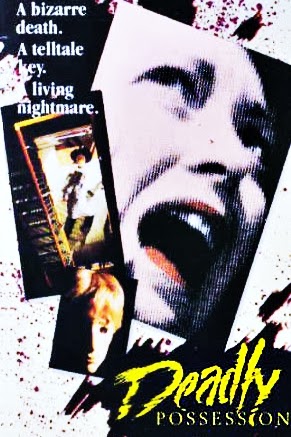
Notice the original poster honestly and accurately sells this on its suspense...

And here's what became of it on home video to rope in (and ultimately piss off) slasher fans.

Interestingly, there are a few moments in here that directly recall Dario Argento's OPERA, which was released four months later. In fact, there's a scene in both that's striking similar, with the musically-inclined heroine lying in bed at night listening to the Vincenzo Bellini-composed "Norma" from "Costa Diva" while the curtains by an open window blow in the wind and the black-gloved mystery killer stalks around outside. Hey, you never know, right?

★★★

Kaidan Honsho nanafushigi (1957)

... aka: Ghost Stories of Wanderer of Honjo
... aka: Ghost Story of the Seven Wonders of Honsho
... aka: Ghost Story of the Wanderer of Honsho
... aka: Kaidan Honjo nanafushigi
... aka: Seven Mysteries
... aka: Seven Wonders of Honjo, The

Directed by:
Gorô Kadono

One of many familiar tales of wronged samurai and avenging ghosts to follow the widely-acclaimed Ugetsu (1953), this is given some minor distinction by the inclusion of some extremely weird ghosts and by working various Japanese folk stories into the plot; namely The Seven Wonders of Honjo. Back in the Edo era, the village of Honjo was a barely-populated land with vast, quiet fields, which visitors found to be somewhat eerie. Numerous ghost legends are attributed to the area and these include (1) a voice calling out from a pond demanding fishers leave their catch behind (2) a human head being pulled out of a well (3) the sounds of drums being heard but the source being unable to be located (4) lanterns that float on their own through the woods or refuse to go out even when blown on, and several others. Seven Wonders opens by briefly explaining those ghost legends and then proceeds to work each into its story line. It begins with the fish story, where two men hear a disembodied voice telling them to "Leave the fish!" They ignore it and then are faced with a bunch of strange mutant ghosts. After seeing a faceless woman, a hulking man with three glowing eyes, a Cyclops, a girl with an extremely long, elastic neck and an umbrella with a human leg bouncing around, the guys run off and forget about their fish. Things then settle into a more routine revenge plot.


Upon becoming a man, Yuminosuke (Jûzaburô Akechi) is off to try to make his way in the world; leaving behind his father Sazen (Hiroshi Hayashi), his stepmother Sawa (Akiko Yamashita), not-so-loyal servant Gosuke (Saburô Sawai) and Yae (Namiji Matsuura), a young maid who's in love with him, in the process. While he's away, his wicked cousin Gonkurô (Shigeru Amachi), who's been disowned by the entire family, returns. Though he claims he's there to pay respect to his deceased Aunt on the anniversary of her death, Gonkurô actually is there for one reason and one reason only: to get his hands on some money. He and Sawa used to be lovers before she remarried and the two start getting together behind Sazen's back; finally hatching a plan to murder him for the inheritance. Gonkurô and a group of his thugs slay Sazen and one of the servants; taking control of the house soon after. Not content with just that, he also attempts to rape Yae but Yuminosuke returns just in time to save her. Gonkurô then decides to do away with his cousin, so he pays off Gosuke to do the dirty work. After stabbing him in the back, Gosuke is shocked that his master's body immediately disappears afterward. Yuminosuke then returns to the home as if nothing has happened. Just what's going on?


The strange events are all attributed to a Tanuki, which the subtitles tell us is a "were-badger" that occupies the Sumida River Valley. Though I'm not so sure how a "were-badger" differs from a regular badger, the mythology here says the animals are pests that trick people out of food but can also be helpful critters with supernatural abilities if you somehow win their loyalty. The Father happened to save one of them before being killed, and the animal vowed to spend the rest of its life protecting him and his family. The Tanuki takes human form as a woman named Tebeydanuki (Michiko Tachibana), and since she was busy doing some dance while the murders were taking place, she now has a few deaths to avenge. As it turns out, the Yuminosuke who has show up at the house and managed to miraculously survive a stabbing isn't actually the real Yuminosuke (who's fallen ill and hasn't even returned yet), but Tebeydanuki impersonating him. Eventually, a monk is called in to perform an exorcism, the real Yuminosuke returns to the home and discovers what's been going on and some of the weird ghost things from the opening scene make a return visit.


This is well-made, doesn't wear out its welcome at just 55 minutes and though the midsection is extremely familiar, the opening and closing scenes partially make up for it, though the weird-looking ghosts are underutilized. The only cast member I recognized was Amachi, who seemed to corner the market on bad guy roles in Nobuo Nakagawa films like THE LADY VAMPIRE (1959), The Ghost of Yotsuya (1959) and Jigoku (1960). In 1983, he even co-starred in the Paul Naschy vehicle The Beast with the Magic Sword, which was shot in Japan with partial Japanese backing. Director Kadono also made the kaidan THE MOTHER TREE (1958) and Ghost of the Girl Diver (1960).

★★1/2
Related Posts Plugin for WordPress, Blogger...