

... aka: La conquista de la tierra perdida (The Conquest of the Lost Land)
... aka: Mace the Outcast
Directed by:
Lucio Fulci
Because of the huge success of Conan the Barbarian (1982), tons of violent, R-rated, sword-and-sandal fantasy-adventures made for adults followed from all over the place over the next decade. Most of these came from Italy and pretty much every Italian Z grade / cult / horror / exploitation director of the day got to make at least one of these things, including Joe D'Amato, Sergio Martino, Franco Prosperi, Umberto Lenzi, Antonio Margheriti, Luigi Cozzi, Claudio Fragasso, Bruno Mattei and Ruggero Deodato. Of course Fulci, who'd just spent much of the past three years of his career riding on the coattails of DAWN OF THE DEAD (1978), wouldn't be left out of the loop and soon tossed his own entry into the overcrowded ring. Though the genre was different, Fulci's formula stayed pretty much the same and he piled on the gore as much here as he had in his previous gore-fests, shifting this firmly into horror territory in the process. Fulci was commissioned by producers to direct what he said (in a 1992 Draculina interview) was a “prehistoric movie” and apparently this is what he came up with. It was filmed mostly in Mexico with Mexican, Italian and Spanish funding, with all three countries well-represented here both in front of and behind the camera.

Teenager Ilias (Andrea Occhipinti, star of Fulci's previous effort THE NEW YORK RIPPER) is becoming a man, so an elder decides to send him off to a “dark and evil domain” so that he can help to defeat the evil (I think) and then return there with knowledge and skills to help the next generation of his race. Meanwhile, in that other nameless land, evil queen Ocron (Sabrina “Sellers” / Siani), who speaks in an electronically-echoed voice and is decked out in just a gold mask and g-string, along with her wolf-headed minions, led by Nabyuk (José Gras), are all up to no good. They invade a cave, chop an old man on the head with an axe and then grab a piece of “young (naked female) flesh” and rip her in two, wishbone-style. She's then decapitated, has her head smashed open and the wolf man pass a piece of brain through a straw between each other and finally spit it into the queen's nostril (?) as she gets off with a huge python (!?) and has visions of Ilias (minus a face) making her chest explode with a glowing blue arrow (?!)

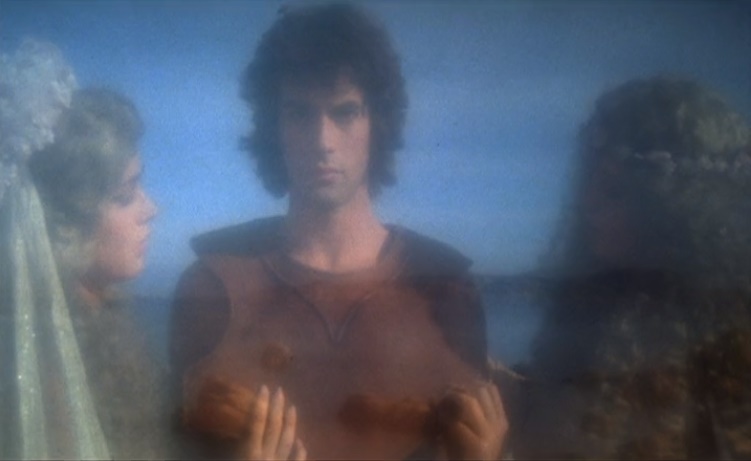


Ilias arrives with his special bow, saves a young woman named Ayana (“Maria Escola” / Gioia Scola) from a snake and then finds himself being chased down by Ocron's henchman until Mace (“George” / Jorge Rivero in a long wig) shows up on the scene with his nunchaku weapon to save him. Though Mace believes that “every man is an enemy,” he has a soft spot for animals and refuses to kill them... though he has no moral issue with killing an innocent human and then taking their meat. Some hero, eh? In exchange for teaching him how to use his bow, Mace agrees to let Ilias accompany him “wherever our feet may take us,” which, in screenwriter lingo, roughly translates to "aimlessly wander through fields because we have no real plot." The two travelers then set off on a series of mist-drenched little adventures. After getting lost in a cave, the two briefly seek refuge with Ayana and her mother Aza, but Ocron's men show up, kill the ladies, kidnap Ilias and take the bow. Mace rescues him from certain death but only manages to piss the evil queen off further. Now desperate for revenge, Ocron calls forth the great, masked spirit Zora (Conrado San Martín) and offers up her body and soul to have him make our heroes “suffer a thousand deaths” by conjuring up various creatures to attack them.


This was shot by Alejandro Ulloa, who'd done a more-than-competent job shooting both black-and-white (Jess Franco's wonderful The Diabolical Dr. Z) and color (the minor classic Horror Express) genre films in the past. However, it really needs to be pointed out that the photography here, despite some occasionally nice and even beautiful shots sprinkled throughout, is appallingly awful for the most part. Seems someone, clearly intending to give this whole thing a “dream-like” sheen, went way overboard with the Vaseline smears and layers of gauze and ruined many of the scenes in the process. After all, there's a huge difference between the picture being soft and lush and a picture being blurry and frequently impossible to make out. Shame too about much of this because they really found some lovely and picturesque places to shoot at and downplay that aspect through poor aesthetic choices, plus there's very nice use of filters to make the sky appear a multitude of different colors.


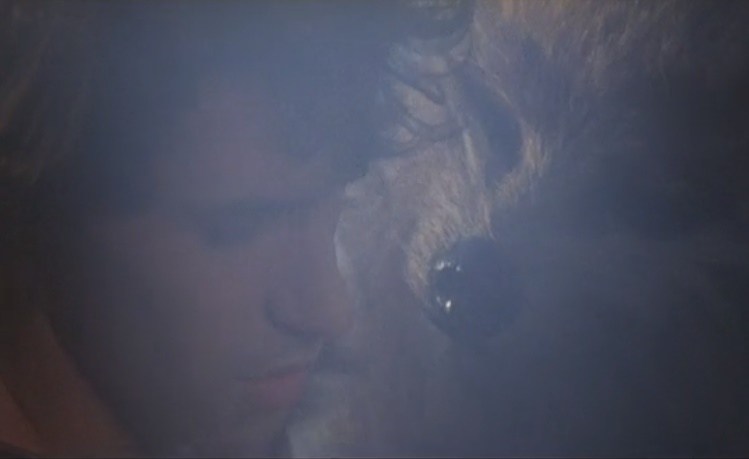
To make matters even more annoying, the camera obsessively points right up to the sun to cast people in gratuitous silhouette at least two dozen times. Sure, it looks cool once or twice but dozens of times? Geesh, learn some restraint! They also unwisely decided to compound the already-hazy imagery problem by draping a dense layer of fog over top of pretty much everything. As for the night scenes (including the finale), well, imagine an already out-of-focus shot with next to no lighting and I'm pretty sure you can figure out how well that all turned out. I've seen it mentioned that they were trying out something new and different here, but there's a good reason a film hadn't been shot like this before: Viewers typically like to see what in the hell is going on! In a career spanning over 30 years and around 150 films, it's certainly no coincidence this is one of only two instances where “Alejandro Alonso Garcia” opted not to use his real name.


The saddest thing about this film's abject failure, is that it's filled with potentially enjoyable material the director has no clue how to make interesting, exciting or even fun. Aside from what's already been mentioned, there's a porcupine plant shooting poison arrows, another plant with healing leaves, a body covered with puss-oozing infected sores, our warrior hero sharing a telepathic link with the animals (ripped off from the previous year's The Beastmaster), impalements, beheadings, heads smashed to bloody pulp with prehistoric weaponry, a crucifixion, a bat attack, a doppelganger fight, people turning into dogs, cocoon-wrapped, marble-eyed mummies that see in green and speak in synthesized voices, some underground-dweller creatures that are impossible to see because it's too dark, poorly-choreographed, ineptly-edited slow-mo fight scenes and, of course, the all-important random dolphin rescue. Hell, Fulci even manages to throw in a handful of moaning swampland zombies. He probably couldn't even help himself by this point.


Despite the cheap-looking effects and monster masks, the film had a rather healthy budget; one of the director's highest actually, but was a flop pretty much everywhere except for in Mexico, due entirely to the presence of Mexi matinee star / heartthrob Rivero. Here in America, it was given a brief and limited theatrical run in 1984 before being dumped on video by Media in 1985. A DVD came in 2004 courtesy of Blue Underground. Only Fulci completists, who'll no doubt fall over themselves about how “dream-like” *cough* incomprehensible *cough* the whole thing is, need apply. Even taken as just a dumb, undemanding little adventure, this doesn't have near the excitement level or amount of fun necessary to elevate it to "good trash" status. Claudio Simonetti of Goblin fame contributed an electro-rock score to the works.
★1/2


