.
.
.
Showing posts with label Austria. Show all posts

Wednesday, August 4, 2021

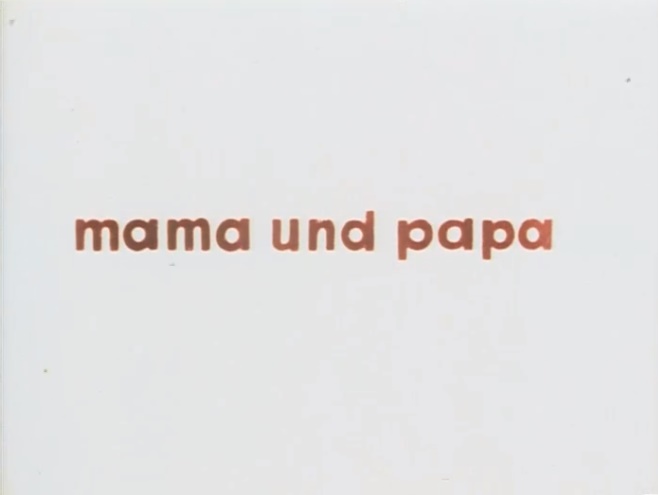
6/64: Mama und Papa (Materialaktion Otto Mühl) (1964)

... aka: 6/64: Mom and Dad (An Otto Mühl Happening)

Directed by:
Kurt Kren

I viewed a handful of Kurt Kren and Otto Muehl's early shorts a long time ago when they turned up on a list of disturbing films. While I can't say I was necessarily disturbed by anything I viewed, I was a little grossed out by some of it, so I guess that's something. I recall also being very, very bored with what I was watching, which tends to happen to me when I watch so-called Transgressive Art Films™ made by folks who either have a very high opinion of themselves or are just weird and perverted and feel like sharing that with the world at large for whatever reason. Congrats, I guess? However, I must say these "films" were a little bit different than the norm. As Muehl was heavily involved in the art non-movement Viennese Actionism, he shied away from "commercial" pieces in favor of live performance art "happenings." During these "aktions," Muehl and company would show how rebellious, subversive and artistic they were by doing sexy-time and engaging in gross acts like drinking urine, killing animals and defecating on sheets of plastic before a live audience. However, seeing how much of this live performance art was itself filmed for posterity, none of it really makes a whole lot of sense to me personally.

This plot, dialogue and music-free 4-minute 16mm silent short involves a naked woman who strikes various posses as various substances are poured all over her body. There's strawberry syrup, chocolate, milk, water and powdered sugar. Well, at least that's what I'm going to tell myself it is. It's hard to tell with these freaks. Also visible are eggs being cracked over her nude body, sticking a rose up her ass, throwing dirt on her ass, someone peeing in a cup, the woman sucking on the rubber nipple of a baby bottle, a guy sucking on the woman's nipple, something involving corn cobs, countless close-ups of food-smeared genitalia and, well, I'm pretty sure I saw some bathroom activities occurring on Muehl's creepy, grinning face at certain points. Occasionally a pair of red lips in front of a white background appear. "Experimental" rapid-fire editing is employed throughout and no single frame seems to last more than a few seconds, which makes much of the imagery difficult to make out, something I'm certainly grateful for.


Welp, I reckon I'll just cut to the chase here. While I'm sure this meant something to the people who made it when they made it, this kind of stuff does absolutely nothing for me, even when the desperation to try to shock in the more conservative 60s is palpable. And the fact that real-life sex predator and convicted / jailed child molester Muehl has become an posthumous art scene "It" guy since his death in 2013 does nothing to change that. As the great Peggy Gravel (Mink Stole) once said in John Waters' Desperate Living, "I have never found the antics of deviants to be one bit amusing!" However, there's at least one image here that did have me rolling on the floor. It's when a fully-clothed man has the naked woman bent over and is behind her and there's a big yellow balloon between them. When he tries to thrust, the balloon pops and feathers fly around everywhere, and it's hilariously repeated over and over again. Someone needs to turn that into a GIF.


While Kren is credited as director, Muehl is given credit for the "material action" seen on screen. So I guess I will leave the rest of this review in the better-equipped hands of Austrian author and avant-garde filmmaker Peter Tscherkassky, since this is clearly over my head. He explains, "In 6/64 Mama und Papa, Kren's editing leads to many interlocking continuous shots; central takes recur like a leitmotif, circular motion and networking can be observed throughout the film. Kren painstakingly weaves the fury in front of his camera lens into dense geometrical figures. Shot/countershot sequences alternate, lumping back and forth between single frames, they turn the Actionist turmoil into ornaments, rigid geometrical patterns, the equivalent in time to what Mondrian used to distill on canvas in space." Yeah!

NO STARS!

Monday, October 3, 2011

El secreto del Dr. Orloff (1964)

... aka: Brides of Dr. Jekyll
... aka: Dr. Jekyll's Mistresses
... aka: Dr. Orloff's Monster
... aka: Maîtresses du Docteur Jekyll, Les
... aka: Mistresses of Dr. Orloff, The
... aka: Secret of Dr. Orloff, The

Directed by:
"Jess Frank" (Jesus Franco)

An Austrian / Spanish / French co-production, this was originally released in both America (Dr. Orloff's Monster) and Spain (El secreto del Dr. Orloff / "The Secret of Dr. Orloff") as a sequel to Franco's earlier hit Gritos en la noche (1961) aka THE AWFUL DR. ORLOFF (1961), though not in France, where it was titled Les maîtresses du Docteur Jekyll ("The Mistresses of Dr. Jekyll"). So, is it a sequel to the original Orloff film or not? Well, yes and no. Technically-speaking, the French title is the most accurate since the film deals primarily with Professor Jekyll, though there's a brief appearance by an elderly man who's presumably Dr. Orloff. Sort of passing the torch down if you will. Sequel or not, the two films have much in common, including similar characters (though the names have been changed), bawdy musical numbers, an old castle setting, numerous scenes in jazz clubs and a disfigured killer being controlled by an evil, intelligent scientist / doctor mastermind. Most seem to think this one isn't nearly as good as the first Orloff film, but I beg to differ. It's just as good.


Ditching the period setting of the first, this updates the story to modern times but keeps the atmospheric Gothic trappings intact. Dr. Conrad Jekyll (Marcelo Arroita-Jáuregui) has just learned (from his elderly superior Dr. Orloff) the secret of how to use ultrasonic sound to activate and control a humanoid robot. So what's the first thing he does with his newfound power? Why, make the robot strangle a topless stripper, of course! Conrad is constantly haunted by memories of an affair his wife Ingrid (Luisa Sala) had with his brother, which angered him so much he ended up killing his sibling. Actually, the robot killer, Andros (played by "Hugh White" / Hugo Blanco), is his brother. Andros (who's tall, pale, gloved, dressed in all-black, walks upright and stiff and will instantly remind viewers of Cesare in the silent classic The Cabinet of Dr. Caligari) still has vague memories of his past, but is at the mercy of Conrad, who keeps him locked up in an upright glass coffin when he's not using him to kill.


Because of an inheritance she's supposed to get on her twenty-first birthday, Jekyll's niece Melissa (Agnès Spaak) arrives over Christmas break with a male admirer of hers named Juan Manuel (José Rubio) in tow. Melissa never got to actually meet her father, and her mother passed away after saving enough money for her to attend college. Melissa is immediately perplexed at her aunt and uncle's erratic behavior. Ingrid is a sickly, bitter and reclusive alcoholic who hates her unfaithful, neglectful husband and suffers from nightmares where she screams "Murderer!" over and over again. Uncle Conrad forbids anyone from going into either his tower laboratory or his dead brother's room and refuses to allow Melissa's beau to come inside and forces him to stay at a hotel in town. After seeing a picture of the father she's never met and then seeing Andros walking about, Melissa decides to try to solve the mystery before heading back to school.


While not quite as atmospheric as the first Orloff opus, this is still fairly stylish (the art direction, photography and lighting are all good) and has the superior screenplay. There's more of an actual plot here, better-defined characters and more natural, sometimes even humorous, dialogue. There are also surprisingly affecting scenes of Andros going to visit his own grave and sneaking into his daughter's bedroom at night to take a gander at the now-grown daughter he never got to meet and now refuses to harm. Franco's favorite milieus; smoky jazz clubs, seedy strip bars and even an opium den, are exploited as the mad Dr. Jekyll gets his jollies sending Andros out to murder innocent (well, sort of...) women. Perla Cristal , who played Orloff's reluctant female companion is the first film, shows up in this one, too, as a victim who performs a memorable song called 'Pepita.' Also in the cast are Pastor Serrador as the obligatory police inspector, Manuel Guitián as the Jekyll family's servant and José Truchado and Ramón Lillo as cops. Franco himself has a cameo as a blind piano player whose girlfriend is attacked after taking a bath; one of two instances of nudity in the film. Daniel White contributes an outstanding score to the proceedings.


Based on a novel by David Khune (Franco). Image handled the DVD release and put out a nice-looking, subtitled print. Other films in Franco's Orloff series include THE ORGIES OF DR. ORLOFF (1969), THE INVISIBLE DEAD (1971), THE SINISTER EYES OF DR. ORLOFF (1973) and THE SINISTER DR. ORLOFF (1984).

★★★

Sunday, November 30, 2008

Dark Echoes (1977)

...aka: Curse of Captain Ghor, The
...aka: Dark Echo
...aka: Deep Echo
...aka: Maldiocao de Ghor, A

Directed by:
George Robotham

What we have here is an extremely hard-to-find Austrian / Hungarian / Yugoslavian 'underwater ghost / zombie' flick that, to my knowledge, was never released legitimately on DVD or VHS anywhere other than Argentina (who had a video released many years back through TVE), Poland (thanks for the info Humanoid!) and either Brazil or Portugal (judging by the Portuguese subtitles on the print I watched). I also can't find any verification online about whether it ever played theatrically or not. It's one of those movies that doesn't seem to have a poster or a video cover anywhere online. In fact, there isn't even very much information about this title over on IMDb either. Dark Echoes is very slow-going and is probably of minimal interest to most because of that, but still has some merit and parts of it are quite interesting. And since there actually weren't that many zombie movies released during the 1970s (LET SLEEPING CORPSES LIE, DAWN OF THE DEAD and ZOMBI 2 being the three major ones), it's probably worth a look for die-hard zombie movie completists.

Watching a combination of American, British and European (French, Hungarian, German...) actors filling out the cast, all of whom speak English with varying degrees of success, makes it a bit hard to get a feel for the location. The plot (which reminded me of the later The Fog) involves a series of mysterious murders plaguing a small, lakeside village in Austria. The local police (headed by Wolfgang Brook) are aided in their investigation by American psychic Bill Cross (Joel Fabiani), local writer Lisa Brueckner (Karin Dor) and others. The killer turns out to be a skull-faced zombie / ghost sea captain who resides in wreckage at the bottom of the lake during the day but sneaks up to the village at night to kill off the descendants of those responsible for his death years earlier. There's also some old backwoods witch with a raven on her shoulder who secretly leads a cult of young villagers. These scenes didn't seem to have a lot to do with the main plot but they're colorful and do provide some gratuitous nudity.

First, the negatives...
- It takes about an hour to actually get a good look at the killer, and the first introduction of it (which should have been jarring) is a bit fumbled.
- It's extremely talky and some of the dialogue is terrible.
- The 'idiot plot' syndrome rears its ugly head quite a few times, especially when Dor's character - one of the killer's targets - is left alone out in the middle of a field while a mob goes off into the woods chasing after the killer.
- It's lacking in blood / gore aside from one underwater stabbing and a gory decapitation.

Now on to the better stuff...
- The acting is decent.
- It's well photographed, including some decent underwater photography.
- The village setting is atmospheric, and good use is made out of crumbling old buildings.
- The music score is excellent.
- The zombie design (from John Chambers and Tom Burman) is actually really good.
- Despite the fact the zombie is kept off screen until near the end, the POV camerawork of a growling, heavy-breathing killer is well done and creepy.
- Several of the deaths, while lacking blood, are still effective, including a woman pushed out of a window and landing on a rocky embankment below.

And finally a little bit of trivia...
The director was born in Germany, relocated to the US where he played on UCLA's football team and then went on to work in Hollywood as a stunt double for the likes of Rock Hudson, Clark Gable and John Wayne. Dark Echoes marks his first and only film as director. He was married to lead actress Dor from 1988 until his death last year from Alzheimer's complications last year.

★★
Related Posts Plugin for WordPress, Blogger...