.
.
.

Sunday, December 2, 2012

Cosmic Man, The (1959)

... aka: O Monstro da Era Atômica (Monster of the Atomic Era)

Directed by:
Herbert S. Greene

A UFGB (Unidentified Flying Golf Ball) traveling 50 miles a second, which is so fast it can neither be seen nor heard in the skies and so fast that it should disintigrate but doesn't, yet can somehow still be picked up on the military's radar screen, decides to pay a visit to our fine planet. It's neither a bird nor a plane, but whatever it is has decided to go into the mountains. Forest rangers call in to report some "ball-shaped thing" that looks like a satellite. Colonel Matthews (Paul Langton) of the U.S. Air Force decides to head out that way to investigate and calls up Dr. Carl Sorenson (Bruce Bennett), an astrophysicist at the Pacific Institute of Technology, to meet him there. Upon arrival, Matthews and Sorenson discover a large white spherical object levitating a few feet off the ground. It's radioactive. It may look like egg but it's not so easy to crack and cannot even be accessed by a powerful blowtorch reaching temperatures of 10,000 degrees Fahrenheit. And even though it's not that big in size, it's not going anywhere. Not even a the strength of a bulldozer can move it.


Both Matthews and Sorenson come to the conclusion that there couldn't possibly be anything the side the orb, but both are mistaken. Inside is an alien visitor (John Carradine) here to simply study us and then be on his way. And so begins another tale of science and the military butting heads. The military demands they open up the spaceship and try to trap the alien for further study so that we humans can have "space supremacy." They also view the docile alien as being a menace simply because his snooping around has managed to contaminate millions of dollars in valuable resources. The scientists on the other hand would like to study and learn from the alien, just as long as the alien isn't hurt. They opt for a more peaceful approach that may benefit us in the future. After all, you really don't want to piss off beings who are far more advanced in their technologies and thinking, right? Tell that to the military.


Much of this well-intentioned low-budget film is about how we humans are scared of things we do not understand and how we're more apt to destroy those things than challenge our own beliefs. As the Cosmic Man tells the scientist, he respects him because he searches for truth in a society that fears the truth. This film is also about the dangers of scientific advancement; more specifically the misuse of scientific advancement. The Dr. Sorenson character is apprehensive about his involvement with the military because his past research resulted in the development of the atomic bomb, which was in turn used to destroy many lives in Hiroshima. And his apprehensions are well founded since the military's gut instinct when discovering the spaceship is to learn more about its "anti-gravity" and how that can advance their weaponry. Perhaps most importantly, the movie is a plea for rational, reasonable, non-reactionary thought and how new discoveries and knowledge should be applied only to positive endeavors instead of things like war, just as the alien applies his own abilities to cure a terminally-ill young boy (Scotty Morrow) when he could just as easily destroy this planet.


Elements from this were clearly swiped from THE DAY THE EARTH STOOD STILL (1951), but its sincere and the moral and ethical dillemas faced by our protagonists still ring true. It's better thought-out than what it's been given credit for (thanks to Arthur C. Pierce's script). One of the great things about many of these older sci-fi films is that they have a message and regardless of how heavy-handed and obvious it's delivered, it's usually something worth listening to. I didn't even find The Cosmic Man to be all that hokey to be quite honest. Even the obligatory love interest, a widowed lodge owner / single mother (played by Angela Greene) serves a purpose. She's representative of the rest of us, simultaneously wooed by a member of the military / government and a member of the science community. When the two are at odds with one another, we use our own judgment and / or moral compass to pick a side just as Greene's character does in this film.


The budget didn't allow for any fancy special effects. The Cosmic Man himself is seen either as a silhouette or Carradine wearing a coat, hat and weird sunglasses. And the script is a little heavy on the science talk (some of which is absurd given what we know now), but it's still interesting to hear characters discussing the possibility of converting solar energy into electricity. The cast also includes Harry Fleer (THE UNEARTHLY) and Lyn Osborn (INVASION OF THE SAUCER MEN).

Multiple DVD and VHS issuings means this is an easy title to find. It's worth watching.

★★1/2

Saturday, December 1, 2012

Touch of Her Flesh, The (1967)

... aka: Touch of Her, The
... aka: Touch of Her Life, The
... aka: Touch of Her Passion, The
... aka: Way Out Love

Directed by:
"Julian Marsh" (Michael Findlay)

After opening credits reflected off of nude female body parts, we meet one Richard Jennings (played by the director under the name "Robert West"). Richard, a writer and weapons expect, is off to Boston for a convention, leaving behind his young wife Claudia (Angelique). And you know what mice do when the cat's away... Claudia immediately invites her lover over and the two start getting busy. He tells her "With all those weapon's, he could be a real lady killer!" And he doesn't know the half of it. Forgetting some papers, Richard comes home early and peeks in on what his wife is doing in the bedroom. Instead of confronting her, he runs away and out into the street where he's struck down by a car. When Richard comes to he's at the hospital. A doctor informs him that he'll be temporarily paralyzed and that he's lost an eye. Richard tells him his name is Stanley Blenda and that he has no home and no relatives to contact.


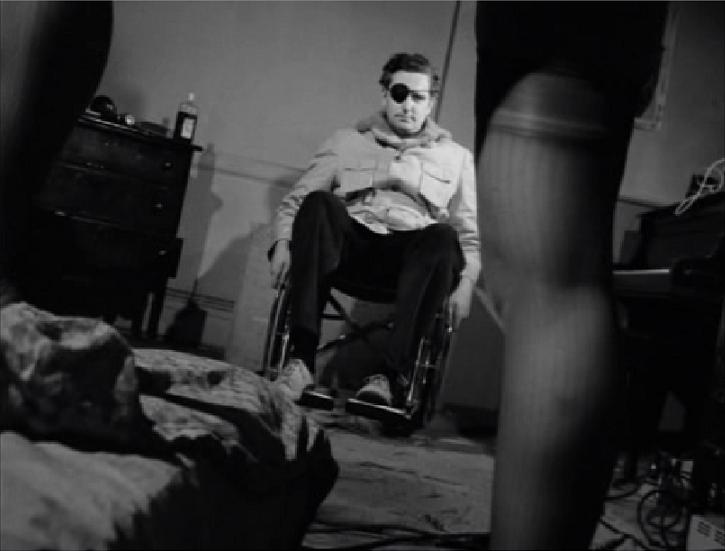
Now in a wheelchair and wearing an eye patch, Richard rents out an apartment and starts drinking heavily. He has a trip out scene full of swirling camera shots of various women massaging their breasts and writhing in bed, and of visions of Claudia in bed with the other man. His voice over explains what men should do if they're ever caught in the "soft pink trap" or "the hot vice of love." Richard informs us that "The only true escape for any man trapped in the sexual vortex of the female being... It is to destroy her and all who act like her... Kill her naked, in public!... Kill the filthy beast so that those gates of flesh shall never open again!" Yes, you gotta love that colorful Findlay dialogue. I know I sure do!


Richard plans on killing his wife, but first he wants to teach a few other "filthy sluts" a lesson they won't soon forget. He goes to a club where a black go-go dancer has just finished her act. She goes backstage to change, where she gets a special poison rose "to symbolize the innocent pubescence she once had" from Richard. After pricking her finger on one of the thorns, the dancer heads back out on the stage to do a topless dance to a song called "The Right Kind of Lovin" before keeling over. So thanks for the dance, Vivian Del Rio. And thank you for sharing your amazingly nice rack with the world. Richard next goes to a burlesque show to watch a stripper (Sally Farb) do a routine with a boa on a leopard-print couch. Once she's done, he uses a blow gun to shoot a poison dart into her neck!


Scared her husband is out to get her, Claudia has been hiding out at an art / woodworking studio in Oyster Bay where she plays piano and paints. Her friend Janet (Suzanne Marre), whom Richard refers to as "the pig who poses nude," is her model. Richard spies on Janet having a conversation with her hooker friend ("Marie Lamont" / Peggy Steffans) and then picks the hooker up, takes her back to his apartment, makes her strip and then makes her lie down on the bed while he leaves the room to "prepare himself." He comes back with a knife and gets the hooker to rat out where his wife and Janet have been hiding before stabbing her in the stomach. Richard then shows up at the studio armed with a crossbow for an ineptly staged MOST DANGEROUS GAME where tops will get ripped off, someone gets their head cut off with a table saw and another is shot with an arrow.


The first entry in the financially successful "Flesh Trilogy" (which is followed by THE CURSE OF HER FLESH and THE KISS OF HER FLESH), this is typical late 60s Findlay "roughie" stuff. Made without recorded sound, all of the dialogue was dubbed in later. Not that it really matters since the acting is absolutely terrible. Most of the actresses don't even try acting scared, but that's not quite why they were hired. There's lots of nudity and these ladies aren't the stick figures we see today, but rather "healthy" women with some meat on their bones. All but one have really large breasts. Some even have a really large gut to match what they've got up top. Michael Findlay also wrote, produced and edited under the alias "Julian Marsh." His wife and co-conspirator, Roberta Findlay (using the name "Anna Riva"), co-produced, shot it, lit it, provided the voice of Claudia and also appears as the nude body during the opening credits and it the nightmare sequence.


While not traditionally good, and there's not as much crazy camerawork as I'd hoped, the storyline is entertaining and it has its moments here and there. Most of the nude scenes go on for a very long time, which will try the patience of some viewers. The DVD distributor is (surprise!) Something Weird.

★★

Frauengefängnis (1976)

... aka: Barbed Wire Dolls
... aka: Caged Women
... aka: Gardiennes du Pénitencier, Les
... aka: Femmes en cage
... aka: Jailhouse Wardress
... aka: Woman Caged
... aka: Women's Penitentiary IV

Directed by:
Jesus Franco

There's wall-to-wall female nudity and sadism galore in this very sleazy Swiss / West German women-in-prison torture flick. Along with ILSA, THE WICKED WARDEN (1977) and WOMEN IN CELLBLOCK 9 (1977), it made up a troika of w-i-p flicks that Franco made for Swiss producer Erwin C. Dietrich over the course of three years. If one wanted to be a little more lenient then WOMEN WITHOUT INNOCENCE (1977), another Franco / Dietrich collaboration, could be thrown in there, as well. Even though it's set in a mental asylum for female patients instead of a prison, it was basically the same thing. These kind of films of course came back into vogue in the early 70s thanks to the success of the Roger Corman-produced, Jack Hill-directed films like The Big Bird Cage (1971) and The Big Doll House (1972), which became such big hits that hundreds of similar efforts were made around the world well into the '90s. Prior to the Corman films, Franco had already made at least one women's prison feature, 99 Women (1969), which is very mild in comparison to what he'd later do. His later ventures into this genre were also, tonally, a bit different than what others were doing with the same format. The female empowerment angle present in nearly all other w-i-p films, used perhaps as a crutch to justify all of the torture and nudity, is thrown right out of the window in favor of degradation and graphic nudity. Cellblock 9, for instance, found every single one of its female captives getting killed off at the end. Some reward for enduring such torture, huh? One of ladies fares a little better in this one, but most do not.


Things open with a long sequence of a starving, chained woman being treated like a dog while she desperately pleads for food and a guard barks out things like "Bitch!" and "Filthy whore!" while whipping her. It'll be a sign of things to come for poor Maria (Lina Romay), the newest prisoner in this women's island rehabilitation camp. Maria has been tried by some tribunal and given a life sentence for the murder of her father. Naturally she's actually innocent of the crime as a ludicrous later plot twist will reveal. Instead of having to work 14 hour days in the salt mines at another prison, the evil directress (Monica Swinn) has convinced authorities Maria is insane, so now she'll be subjected to these wacko's idea of therapy. Dr. Carlos Costa (Paul Muller), who is actually Dr. Moore but killed the real Costa and is now impersonating him, has her sign papers allowing them to do shock treatment on her. Next thing she knows she's tied down naked to electrified bedsprings getting jolted into submission.


The corrupt prison staff are breaking each girl's will and then pimping them out to high ranking government officials on the side. One girl goes to an impotent Governor (Roger Darton) who has Nestor (Eric Falk), chief torturer at the prison, rape her while he watches. One of the prisoners gets a letter out they're being tortured but it's intercepted. For punishment, they have their food rations cut in half and more girls get tortured and violated. Most of the prisoners being held there have gone crazy from all of the psychological and physical abuse they've had to endure. Ingrid (Peggy Markoff), who murdered her own brother because she had incestuous designs on him, is a delusional nymphomaniac who constantly plays with herself and keeps talking about Christopher Columbus and Queen Isabella. Rosa (Beni Cardoso) has been reduced to a giggly, child-like state. And the virginal Berta (Martine Stedil) has somehow managed to keep it all together since she's been there, but the staff's still working on that. After getting simultaneously electro shocked and anally raped with a cane, Maria gets thrown into a cell with those three and eventually several of them plot to escape.


If this film belongs to anyone, it's probably Swinn as the cruel lesbian wardress. She has dialogue like "This isn't some country club!" and refers to the prisoners as "the lowest kind of scum" while prancing around in an outfit consisting of an ill-fitting monocle, an unbuttoned shirt, a belt, panties, knee-high black boots and a riding crop. During one scene, she bends the virgin over a table to test her virginity with her finger, has sex with her then instructs the girl to slap her around. Afterward she has the girl thrown into solitary confinement. And solitary confinement here means being denied food or water, getting chained up on the floor naked and having Nestor whip and degrade you. Swinn's character also makes the occasional aside about how much she detests "bleeding heart liberals" and journalists who want to expose the abuse going on at her prison. I suppose in Franco's mind this is all probably a parable about the need for prison reform.


By far the strangest scene in here is when Maria flashes back to her father (played by Franco himself) sneaking into her bedroom at night and trying to "show his affection." The scene is oddly shot in slow-motion. And I don't mean that the film itself is put in slow-motion, but Franco and Romay move in slow-motion! Aside from that one scene of unintentional hilarity, this film falls into a really gray area. It's too ridiculous to be taken seriously and too nasty and one-note to be "fun." Even the torture and humiliation scenes are boring and tiresome because they're drawn out for so long. The breakout "action" at the end is just plain pitiful. Naked ladies will be the film's chief drawing card and the nudity here is about as graphic as you can get outside of a straight-up porn film, with close-up spread eagle shots, zooms into crotches and fingers (and a lit cigarette!) being inserted into vaginas.


Frauengefängnis was originally released in the U.S. in a heavily cut version as Barbed Wire Dolls (the DVD with the same title is uncut) and would later be issued on VHS (again, drastically cut) under the titles Caged Women and Women's Penitentiary IV. In 1979, hack distributors Eurocine blended scenes from it with Hell Train (1977) and Elsa Fraulein SS (1977) and released it as a new film called Jailhouse Wardress.

1/2
Related Posts Plugin for WordPress, Blogger...