.
.
.
Showing posts with label brain surgery. Show all posts

Saturday, September 26, 2020

Zaveshchaniye professora Douelya (1984)

... aka: Завещание профессора Доуэля
... aka: Завещанието на професор Доуел
... aka: Head of Professor Dowell, The
... aka: Il testamento del dottor Dowell (The Will of Doctor Dowell)
... aka: Professor Dowell's Testament
... aka: Professor Dowell's Will
... aka: Testament of Professor Dowell, The

Directed by:
Leonid Menaker

Renowned scientist Professor Dowell (Olgert Kroders) has passed away. He was getting so into his work, and staying up so many consecutive days and nights, that when he went out driving (an activity that relaxed him) he was in no state to control his car when it skidded during a rainstorm and then went into a canyon. At least that's the official story. Now his work has been left in the hands of his two assistants, Dr. Robert Korn (Igor Vasilev), who started out as a surgeon in a provincial clinic before impressing the esteemed professor, and loyal Dr. Marie Laurent (Valentina Titova), who's been by the professor's side for a long time and seems to have been in love with him.

Dowell was so obsessed with his work that he left behind some collateral damage though, most notably a wife who was driven to an early grave and a bitter, estranged adult son named Arthur (Aleksey Bobrov), who doesn't have many nice things to say about him. Though Dowell was trying to find ways to help humanity, his work was appropriated by the military in the development of atomic weapons which actually have done the opposite. That's steered Arthur into a career as a documentary filmmaker whose latest film highlights war atrocities. It's a way for him to come to terms with the damage his father inadvertently caused.


A gathering is held at the professor's seaside home / lab where a group of scientists and potential investors are shown just some of the results of Dowell and Korn's experiments with animals. Thus far they've created a cat with webbed feet, a still-living dog head hooked up to a machine and a chimpanzee named Lilly who has had her head grafted onto another chimp's body and has thus far survived for a solid month, though judging by the droopy mouth and drool, none-too-well. They've managed to accomplish all of this by combining electronics, surgery a special blue serum. Ingredients top secret, of course. Professor Richardson (Ernst Romanov) and Dr. Gould (Aleksandr Porokhovshchikov) from the chemical corporation Mercury Inc. are interested in an exchange of data. Dr. Korn is interested in their money to further fund these experiments.

After screening black-and-white home movies of the late professor, they head outside onto the terrace where a statue to the late professor is revealed. It's his head atop a large stone pillar with the inscription, "Both my life and my death belong to science." Arthur plans on leaving after the ceremony but is pulled aside by groundskeeper Willie (Boris Tsymba), who informs him that he suspects foul play. Arthur decides to look into the accusations, starting with an examination of the accident site which reveals that Dr. Korn was likely with the professor on the night of this death. Arthur is able to enlist some help from childhood friend Baxter (Nikolay Lavrov), who's now a policeman.


As you can probably tell from the various posters, Dr. Korn is actually keeping Dowell's still-living head hooked up to some electronic contraption. As per the professor's last will, he's given Korn the right to actually do this so he could continue his experiments into death but he's now having a change of heart. For starters, he has deep regrets about the life he'd lived prior to "dying." Second, now that he's incapacitated, he's basically the captive of Korn, who won't allow him to see his son or even speak to Marie. He can only be audible as long as a special wire is plugged in, which Marie doesn't even know about.

Time is quickly running out for Korn. The Mercury Inc. reps are blackmailing him. After he rejects their initial offer of unlimited credit and state-of-the-art equipment in exchange for his data to use for their own nefarious purposes, they're quick to inform him that they own his debt and will simply shut him down and take whatever they want, anyway. And these guys are such terrible corporate scum they take great pride in the fact their chemicals have polluted six out of the seven continents on Earth. Getting more desperate, Dr. Korn and Marie start acquiring fresh corpses for their experiments, with the ultimate goal being to give Dowell a healthy human body to place his head upon.


Meanwhile, Arthur gets reacquainted with Angelika Guy (Natalya Sayko), an old flame of his who's now a famous actress and is back in town to visit and hiding under the alias "Anne Smith" so the press doesn't bother her. The two happen to be at a sleazy nightclub when a shoot-out occurs between police and smugglers over drugs hidden inside a nude sex doll (!) Many are killed, including Angelika, whose skull is crushed, and a singer / burlesque performer named Monica Brown (also Sayko). Dr. Korn and Marie end up with both bodies and construct a new being out of her, with Monica's head on top of Angelika's body. They rename their Frankenstein creation Eve, fit her with a metal collar to cover her scars and then study how well she does doing physical activities. However, she's conflicted about who she is and has shuffled memories from both of her components. Further complications arise once Arthur starts snooping around the lab.


It's pretty easy to see why this has received a lukewarm response from so many horror and sci-fi fans online but I honestly think much of this boils down to expectations. For starters, you have fans of the source novel objecting to all of the changes made for this adaptation. And then you have viewers seeing the living head on the cover, probably expecting a film similar to THE BRAIN THAT WOULDN'T DIE (1962) and then sitting down to watch this only to be disappointed that the effects are minimal, the action is virtually nonexistent, the pacing is slow, there's lots of dialogue and this never really strives to be overtly horrific or shocking. It's far too competently-made and serious to be good camp, yet not violent or exploitative enough to be good trash. Then what is it exactly? Well, to me, it's a mature and sometimes thoughtful rumination exploring medical ethics and the pitfalls of scientific discovery, most especially its abuse at the hands of the wealthy, greedy and / or powerful, with an aside about not letting one's own personal ambition destroy or harm others, including animals.

These same topics are tackled in countless other "mad scientist" films and, while the moral of the story is rather blatantly hammered out at the very end, I can't say I was horribly disappointed in how they handled this otherwise. On the contrary, I rather enjoyed how the genre tropes were placed front-and-center yet still utilized in a subtler and less obvious fashion than what is the norm. The fantastic is treated in such a sober, matter-of-fact way that this manages to take completely outlandish things and ground them firmly in reality.


On another note, the setting is rather unexpected for a Soviet film, as this is clearly shooting for a tropical atmosphere. There are lots of palm trees, beaches, monkeys, talks of the humidity and heat, men walking around with their shirts open like they're somewhere in the jungles of South America and a bunch of black actors cast in small roles and as background extras. This is all compromised by the fact much of the outdoor footage is overcast and looks gloomy. Signs are all written in English. I'm not even sure where this is supposed to be set.

This was (supposedly very loosely) based on Aleksandr Belyaev's popular 1925 novel Golova profesora Dovelja. An English version of that book was released in 1980 by Macmillan, uses the title Professor Dowell's Head and features an introduction by Theodore Sturgeon. A 2001 DVD release from Image Entertainment (under the title Professor Dowell's Testament) comes with English subtitles. An English dubbed version was also released.

1/2

Sunday, September 20, 2020

Manden der tænkte ting (1969)

... aka: Czlowiek, który wymyslil zycie (The Man Who Invented Life)
... aka: Dr. Holst fantasztikus esete (Dr. Holst's Fantastic Case)
... aka: Mannen som tenkte ting (The Man Who Thought Things Through)
... aka: Man Who Thought Life, The
... aka: Mies joka pohtii elämää (The Man Who Reflects on Life)

Directed by:
Jens Ravn

Renowned brain surgeon and psychiatrist Dr. Max Holst (Preben Neergaard), who works at a state mental hospital and specializes in the central nervous system, receives a phone call from colleague Robert Klausen (Lars Lunøe). An older man was found wandering around a bridge and behaving like a madman so he was picked up by police and then involuntarily committed to the hospital. Robert informs Max that the man - who goes by the name of Steinmetz (John Price) - claims to know him and refuses to talk to anyone else other than him. The name doesn't ring a bell, but he assumes it's a patient from long ago that he's forgotten about. Upon arriving at the hospital, he realizes that's not the case. He has no clue who this man is.

Steinmetz has already broken hospital rules by sneaking in cigars and cognac (both forbidden there) but just how did he possibly sneak that stuff past the hospital staff? He claims that he's been following Max and his work for awhile but refuses to give any further details. And he claims to be perfectly sane and tries to coerce Max into signing his release; promising to show him "a new science" and "a world you could never even have dreamed of" if he helps. Dr. Holst instead decides to keep Steinmetz right where he's at until he can examine this man further.

Soon after, the bizarre patient manages to vanish from his room despite his door being locked and there being bars over the windows. Nothing seems to have been tampered with. The cigars and cognac which were taken away from him earlier are back on the table. A mysterious duplicate key that has to no reason to really exist is found hanging from the lock. A note is left behind for Max. Steinmetz urges him to meet him at a bridge at dusk. And to come alone. Max decides to take him up of the offer and finds Steinmetz waiting for him on the bridge with a chauffeured car.


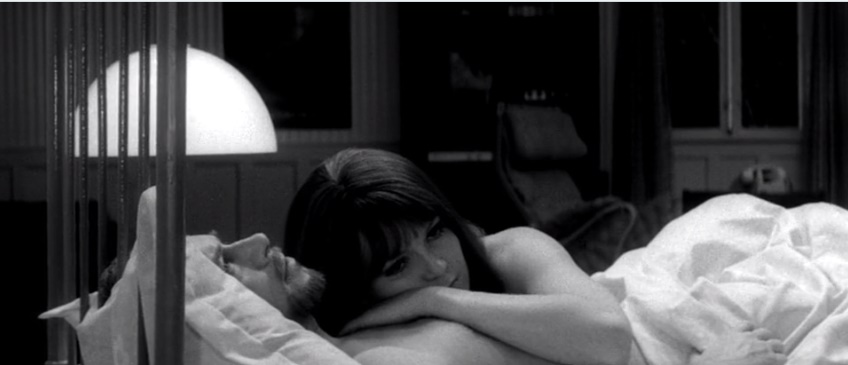
During the ride, Steinmetz reveals that he knows all about Max, including when he was born, that he's an orphan, that he was part of the Resistance during his youth, that he studied in America and that he's divorced from his first wife, has no children and is now dating young actress Susanne Plesner (Lotte Tarp). Steinmetz takes him to his home, where he finally shows him some of what he was blathering on about in the hospital. Max sees with his own eyes how Steinmetz is able to create a box of cigars simply by concentrating and willing it to happen. In other words he has created a tangible object using only his mind.

However, the rational, stubborn Max is a little difficult to convince. He initially assumes Steinmetz is a hypnotist who has somehow put him in a trance. Steinmetz promises to prove otherwise, but on two conditions: One, he's never to tell anyone else about any of this. Two, he's to perform brain surgery on him. He's even "willed" himself the most high tech operating room imaginable, which is tucked away in his home; hidden behind a secret door in the wall. Max's refusal to cooperate soon has Steinmetz tossing niceties out the window ("You'll do what I tell you to!") but things will get much worse than Max ever could have imagined.


Steinmetz has managed to unlock parts of his brain that the rest of us cannot access. However, his ultimate goal is to be able to use his mind to produce organic matter; life itself. His sights are especially set on creating a human being. He's already managed to create three mice, but each of them has dissolved into thin air after a short while because he can't maintain the level of concentration necessary to keep them. Hence his desire for the surgery. Max remains resistant, prompting Steinmetz to start stalking him and using his powers to mess with both his mind and his memory, which starts to have a detrimental effect on his career, studies and relationships.

Steinmetz's approach to coercion is so abstruse yet so potentially devastating, Max has to no choice but to keep dealing with him on a continual basis. He arranges for him to get a new apartment, which gets Max out of his tiny hospital apartment, gets Susanne away from her nosy, bitchy landlady and finally allows them to live together. However, word keeps getting back to Max about things he's said, things he's done and interactions he's had with various people that he has no memory whatsoever of. As it turns out, Steinmetz is mind-creating a doppelgänger of Max to cause chaos and confusion in his life... and the copy is actually much more agreeable than the real thing! His "better half" if you will.


The double cashes his paychecks, takes his identification and belongings, does his job better, gives more passionate, persuasive speeches, starts wearing suits, puts on a more "respectable" clean-shaven face for the world at large and even has a healthier relationship with his girlfriend! Soon enough, everyone thinks he's the impostor and the double is him, which gets him arrested for "stealing" his own car. Max breaks out in time to crash the wedding reception only to realize that no one, not even his former lover, believes he is who he says he is. They prefer the new and improved Max. Steinmetz also informs him that he no longer needs his assistance as he's managed to sustain the length of his creations long enough to just have the double do the surgery. Max now finds himself without a job, money, a home, friends, a girlfriend... Will there be any way for him to get his life back again?


This was a Palme d'Or nominee at Cannes in 1969 and then fell into obscurity almost immediately afterward. So how in the hell does something this good just get swept under the rug and then forgotten? Doesn't anyone care? If I had to venture a guess I'd say this all boils down to the sci-fi and horror elements both being very understated and the absence of marketing gimmicks. It's simply easier to sell an audience special effects, fantastical creatures and more overt horrors than it is to woo them with technical proficiency and subtle psychological mindfuckery. There's no violence, no monsters, no elaborate visual effects (the only effect is a split screen used so Max and his double can share a single shot) and no overt shocks in this one.

Instead, we get an intriguing story that hooks you right from the start, an understated creepiness and superb direction, production design, lighting and grainy black-and-white photography. The art direction is purposeful, amazingly uncluttered and quite striking in its restraint. The architectural designs are very eye-catching throughout. Parallel lines, various geometric shapes and symmetry are all used creatively within shots to arresting effect. There's tasteful use of zoom shots (often pulling back from mirrors, windows and doorways) and blurred images plus lots of pans, tracking shots and gliding back and forth between people and things. From a visual standpoint, this maintains total interest throughout but it's also very interesting content-wise. There's plenty of food for thought in the strong, thought-provoking script plus excellent acting from the two male leads.


The cast also includes Kristen Rolffes (The Kingdom) and Elith Pio (Häxan). This was based on a 1938 novel of the same name by Valdemar Holst. The English-language title ("The Man Who Thought Life") seems more than a little bit awkward at first but makes perfect sense once you watch the entire film. Translations of the other European release titles give us slightly altered versions of that like "The Man Who Thought Things," "The Man Who Thought Things Through" and "The Man Who Pondered Life." There was a digitally remastered DVD release through Palladium Film.

★★1/2
Related Posts Plugin for WordPress, Blogger...