

... aka: Le monde pétrifié (The Petrified World)
Directed by:
Jerry Warren
Like any other low budget 50s horror / sci-fi flick worth its grain in schlock, this opens with five minutes of narrated stock footage. We see the roaring ocean, an octopus and shark fighting and then a bunch of regular ole fish doing their thing. "We are now prepared to invade this black wilderness," says the monotone voice-over. Well, I was actually already prepared five minutes ago but thanks for your concern. After a few men at a private screening discuss the money and time sunk into ocean exploration, we're whisked off to somewhere in the Caribbean where Professor Millard Wyman (John Carradine) is preparing to test out his new diving bell, which should instead be renamed a "diving ball" because of its completely circular shape. Because both his peers and investors alike had no faith in what he was trying to accomplish, Wyman was forced to finance this project all on his own. Meaning, his reputation and pocketbook are both about to take a big hit.
Wyman's aluminum beach ball is slated to go "deeper than any man has ever gone before" so that a small group of explorers can see what exists "thousands of feet" below the surface. Since Wyman is already up there in age, he enlists four others to take the plunge in his place. There's ambitious, catty and cone-bra'd "lady reporter" Dale Marshall (Phyllis Coats), who's just received a Dear Joan letter from her estranged husband, oceanographers Paul Whitmore (Allen Windsor) and Lauri Talbott (Sheila Noonan), both former students of Wyman's, and scientist Craig Randall (Robert Clarke), the newest addition to their research team. Everyone is high in spirit and enthusiasm as the flimsy tin death trap is lowered into the water, but those good times won't be lasting much longer for our four-person crew.


Once they are 1700 feet below the surface, there's a glitch in the electricity, radio contact is lost and the cable lowering the contraption snaps, dropping the bell deep into the recesses of the unknown. Professor Wyman tries to stave off the obligatory bad press while fellow scientist J.R. Matheny (George Skaff), who's planning his own rival diving bell expedition with a different model designed by Professor Wyman's brother, Jim (Joe Maierhauser), keep tabs on what's going on and put their own planned underwater expedition on indefinite hiatus. Meanwhile, the crew, who passed out during the fall, finally awaken on what they first assume is the ocean floor. After a hysterical Dale has to be slapped back into reality, the group soon realize they're actually somewhere else entirely. They can see light through their porthole, which wouldn't be the case had they floated all the way down. And, well, they're still alive when they should be dead from the pressure increase.


The team throw on their diving gear and air tanks and head out to see where the light is coming from. They end up in an elaborate cave system, filled with countless tunnels illuminated by phosphorous. Pools of potable water are around and there's plenty of access to fresh seafood so at least their basic needs are met while they wait for help. Back on the main ship, Carradine and company have resigned themselves to the fate of their friends and are only hanging around nearby to potentially retrieve their corpses from the water. Radio operator Wilson (Lloyd Nelson) picks up what he believes to be the missing party on his sonar but his observations are all but ignored. Instead, Wyman discovers why his diving bell didn't work properly and goes to Matheny about possibly making adjustments to his diving bell so he can make a second attempt at underwater exploration.


By now, the four lost explorers have given up hope they'll be rescued. They use up most of their oxygen tanks making trips back to the diving bell to retrieve whatever may be useful for their long life living in the caves. They stumble across a big lizard, a human skeleton and, finally, a delirious, bug-eyed old man (Maurice Bernard) in a terrible wig and fake beard who claims to have been trapped down there for fourteen long years. As for why there's breathable air and clean water all the way down there, it's because they're situated somewhere underneath a movie volcano that only decides to become active when it's convenient for the plot. None of the new information raises morale or hope they'll ever make it back to the surface. With miles and miles of caves that are incredibly easy to get lost in, how will they ever be able to navigate themselves out of there?


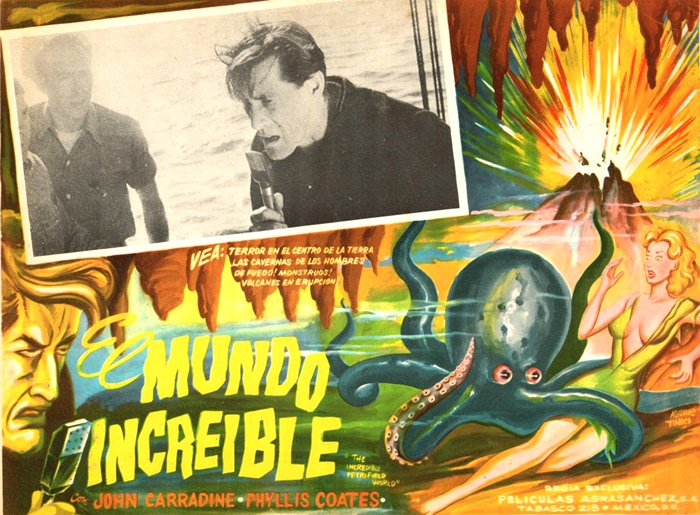
This is actually pretty good for a Jerry Warren film which means it's still pretty bad but could have been a whole lot worse. The poster writes a check ("Terror!" / "Monsters!") the film can't cash and the science elements are dated and ridiculous as is usually the case for this era, but the premise itself I quite liked. However, the budget isn't there to do much with it and there's not nearly enough plot to sustain things. In lieu of that, we get lots of talking and wandering around plus lots of cuts back to the surface where more people sit around talking. As far as drama and tension are concerned, the Dale character acts a bit bitchy at times, Craig and Lauri reveal their love for one another and the voyeuristic caveman falls for Dale and hopes she'll agree to his plan to kill off the others so they can have the cave all to themselves.

Despite the cheapness of the production, they filmed the underground scenes at Colossal Caves in Tucson, Arizona so at least those "sets" are convincing. There's also something unexpectedly lovely and (accidentally) poetic about the long diving scenes thanks to overbearing overhead lighting, bubbles and reflective surfaces mixed with ethereal stock music and the grainy black-and-white photography.

Brianne Murphy, Warren's wife at the time and co-owner of their company GBM Productions, was the production supervisor (as "G.B. Murphy") and dialogue director. She and Warren can also be spotted riding an airplane with Carradine. This was filmed in 1957 but not released until a few years later on a double with Warren's awful TEENAGE ZOMBIES. The budget is said to be a paltry 15,000 dollars (!), with 2K of that going to Carradine for two day's work and another chunk of it spent on making a rubber monster suit that they ended up not even using! The full running time is 66 minutes and the film is in the public domain so it's been released by a whole slew of labels on both VHS and DVD over the years.
★1/2


