.
.
.

Saturday, March 9, 2024

Banned (1989)

... aka: Banned: The Return of Teddy Homicide

Directed by:
Roberta Findlay

Findlay's stint in the dregs of New York exploitation was a pretty fascinating one. Not that the films were always that good, but what other woman at the time directed, wrote, produced, shot, lit, edited, did music and sound, operated the camera, composed scores, acted and had a hand in distributing their own films? I can't think of any. Findlay's career can basically be broken down into three distinct phases. The 60s saw lots of gritty soft-core / "roughie" films, often shot in black-and-white, sometimes quite interesting (at least by the low standards of that genre) and usually made in conjunction with her then-husband, Michael. That lasted until the two separated in the early 70s. Starting in 1974, Findlay began churning out dozens of hardcore sex films and racked up some unique credits there as well. When cheaply-shot porn videos began to dominate the adult market the following decade, she made the switch to R-rated horror and capped off her career with a string of low budget films that were well-distributed and profitable on home video. The last thing on anyone's mind was creating high art. It was all about making a quick buck by riding current trends. Once the money stopped rolling in, Roberta stopped making movies and settled into another line of work. It was just that simple.

Banned is the film that officially ended Findlay's two-and-a-half-decade long filmmaking career. She has referred to it as "garbage," "unreleasable" and "terrible" in various interviews and claims she was rushed into making it, had to settle for a subpar screenplay ("The script was awful!") and was uncomfortable with the subject matter. Not that being merely bad ever stopped something from making money in the past, but this was not only bad but also a difficult sell and distributors passed on it. Ads were run in Variety, but it was soon shelved and completely forgotten about. Findlay and her producing partner, Walter E. Sear, lost around 80K of their own money on the project, which prompted them both to throw in the towel and focus their energies elsewhere. It then sat unreleased for over 30 years (!) which automatically made the entire thing more enticing to cult movie aficionados, especially as people became more interested in Findlay's career.


Back in 1978, untalented, purple-haired Aussie (?) punk rocker Teddy Homicide (Neville Wells) went crazy, whipped out a machine gun, killed an entire studio full of engineers, musicians and groupies (plus a pizza delivery man) then ended it all by drowning himself in a toilet. Cut to present day, when a struggling, very confused-sounding NYC jazz / prog rock fusion band (!) called Banned is out performing for spare change on 42nd Street. Consisting of guitarist / Berkeley graduate Kent Travis (Dan Erickson), keyboardist / performance artist Chelsea Fontaine (Brent Trish Whitney), bassist and military vet Willie Jeffries (Roger Coleman) and former roadie turned drummer Serge (Fred Cabral), everyone involved is getting impatient waiting for their big break. After all, they've still got bills to pay, and their last attempt at a breakthrough album - "Stand and Deliver" - failed to do either and bombed.

Willie comes up with a possible solution to turn things around. His brother has recently purchased an old recording studio called Impulse. The band can work there to test out the soundproofing before the studio officially opens, and use the space to make another album plus gain some much needed publicity in the process. Publicity you say? Yes, Impulse was the site of the 1970s punk massacre, so this could boast of being the first album recorded there since.


Sid Biesenthal (Allen Lieb), executive from Banned's label Broken Records, thinks Kent is bringing the entire group down because of his insistence on being artsy and original over palatable and commercial. Willie's uncle, studio producer Rod Jeffries (Glen Mitchell), is assigned the difficult task of helping Banned come up with their first hit single and reigning in Kent's pretentious impulses. However, that plan goes out the window after Kent starts hearing voices coming from the toilet bowl and then finds himself possessed by the spirit of Teddy Homicide. Somehow that injects some much-needed appeal into the band despite them actually sounding even worse than they did before.

The new Kent acts in a kind of schizo manner where he's his usual mild-mannered pacifist self part of the time and the manic, screaming, giggling, hard-partying trouble-maker Teddy the rest of it. On stage, he goes into a fit, screaming profanities at the audience, which makes the place go wild and instantly turns on all of the ladies in the crowd. Though he's dating painter Rachel Fesperman (Amy Brentano), his newfound loss of inhibitions also means he feels free to make a move on Chelsea, who he's always had a crush on. When he takes her to lunch at an outdoor café, a group of Lebanese terrorists show up and start shooting everyone until Kent goes and gives them a pep talk, sending them over to Tavern on the Green instead (!)


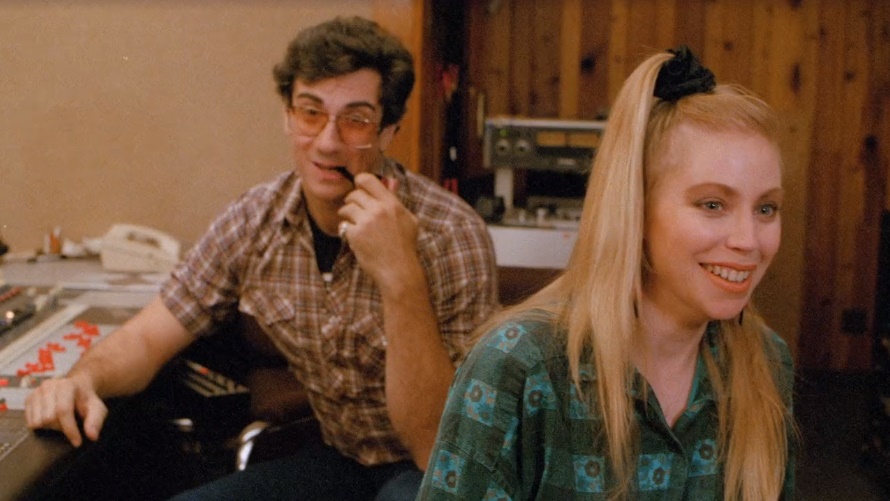


This is mostly an obnoxious collection of "quirky" pseudo-comic scenes; a couple mildly amusing, most excruciating. The worst bit is when Kent takes his girlfriend home to visit his parents and his drunken, psychotic dad goes on a screaming rant that feels like it lasts an hour. The old Jewish record exec snorts some white powder made from "beef tissue" (?!) and periodically transforms into a muscular black man (Cecil Howsen). Once the Teddy persona starts fully taking over, Kent starts "terrorizing" Rachel by trashing their apartment, huffing chemicals, insisting on exhausting sex marathons and forcing her to go dancing late at night after she's had a long work day. The short, balding drummer is somehow irresistible to women and manages to bed half the female cast, including studio assistant Debbie (Jacqueline Price) and even Kent's teenage sister, Eileen (Cheryl Hendricks).


Rachel's gay brother Percival (Adam Fried) is a seminary school dropout turned plumber turned flamboyant TV evangelist who shows up at the end armed with a toilet plunger and Drano for the incredibly lame "exorcism" finale. There are also a few recurring gags like our protagonist repeatedly falling into open manholes, cops showing up a decade late to investigate crimes and a seemingly endless chase scene through Central Park with machine guns and a rocket launcher (!) While a lot of this is obviously strange, it's almost never funny.


Watching this, I felt truly bad for lead actor Erickson, who was previously seen in Findlay's dull and near-bloodless (despite the title) slasher Blood Sisters (1987), along with Brentano. He puts a lot of energy and enthusiasm into his performance, and is likeable and appealing when he gets to act normal, but is consistently undermined by terrible dialogue. Whitney also displays some genuine charisma as the keyboard player but she disappears from most of the last third of the film after a dispute with her possessed band mate. The film's failures are certainly not for lack of trying from the cast, though nearly everyone comes off poorly because they're asked to constantly mug for the cameras and wildly overact as if that's automatically going to be amusing. It's not. It's simply annoying and borderline intolerable.

There are production issues, especially with the editing and the audio, and though this was marketed as a horror-comedy, and utilizes many horror film tropes, the horror is almost nonexistent here. However, belying the director's past work in sexploitation, there's plentiful topless nudity from nearly all of the female cast, including a young Debbie Rochon in a minor early role as one of the groupies. Another sleazy touch is the drummer's bedroom, which is decorated with posters for Findlay porn films like Private School Girls and Shauna: Every Man's Fantasy.


I've read several differing accounts about this film's belated release. To my knowledge, Findlay never publicly expressed anything but contempt for the project and claims to have never wanted to release it, but that seems a little bit suspect considering she personally held on to a print of it for nearly three decades. I suppose she finally just stopped caring about potential embarrassment and made what little she could from this disaster. I've also read that, supposedly, Media Blasters had purchased the film from Findlay herself way back in the early 2010s. That's also a bit odd considering they didn't bother officially releasing it to Blu-ray until 2022. I'm sure there's an interesting story or two to tell here that I'm unaware of. Definitely not worth the wait in any case.

★1/2

Wednesday, February 28, 2024

Dracula père et fils (1976)

... aka: Die Herren Dracula (The Dracula Gentlemen)
... aka: Dracula and Son
... aka: Dracula padre e figlio (Dracula, Father and Son)
... aka: Pure, vampyyri, pure! (Bite, Vampire, Bite!)

Directed by:
Édouard Molinaro

Despite being mostly associated with Hammer Films in the UK, and British horror in general, Christopher Lee has an impressive and quite varied slate of international productions on his resume as well. Even when he was at his peak with Hammer, he was still simultaneously taking up jobs elsewhere, namely in Italy, where he carved out a niche for himself in their Gothic horror cycle, and Germany, where he did other genre films and took part in their popular Edgar Wallace cycle. That turned out to be a wise career decision on his part. By the mid 70s, Hammer was running into problems and horror films were on the downturn in the UK. Since Lee already had cultivated an international following, he didn't have to look hard to find steady work elsewhere. The late 70s saw him appearing in American, British, Canadian, German and Spanish productions, and he was also shooting numerous films in the Middle East and Africa around this same time.

Dracula and Son, a vampire-themed horror comedy, was one of several French productions he turned up in during the later half of the 70s. He'd already spoofed his own image to good effect in another, earlier vampire comedy called UNCLE WAS A VAMPIRE (1959); a French / Italian co-production. Interestingly, his frequent Hammer co-star Peter Cushing also ended up headlining a French vampire comedy of his own called Tender Dracula (1974).


1784. A stagecoach rushing through a Transylvanian forest trying to reach their destination before nightfall breaks a wheel. Knowing it will take several hours to fix, a second stagecoach swings by and two of the ladies - noblewoman Marguerite (Claude Génia) and her nympho daughter Herminie (played by future director Catherine Breillat in a rare acting role and the same year she made the controversial and oft-banned A Real Young Girl) - decide to catch a ride with them. They don't even make it to the castle before the pale-faced stranger on board (Xavier Depraz) sinks his fangs into the mother's neck. Herminie becomes locked inside the castle grounds and is soon face to face with Dracula (Lee) himself. After he makes a grand entrance from behind a bronze statue of his likeness, Herminie passes out. Next thing we know she's moaning in ecstasy and having sex with a fully-clothed Lee (!) inside a coffin. After they finish, she hops out, runs over to the mirror and starts examining her neck. He assures her, "You will find no marks... I was extremely careful!

The girl's relief doesn't last long. "You are now the bride of the prince of the powers of darkness!," proclaims Lee. He'll now keep her prisoner in the castle until she can produce an offspring. Nine months later, she does just that, delivering him a son / heir he names Ferdinand, which finally makes her worthy of vampire bride status. Lee puts the bite to her, but the resultant creature is a weak, weepy, reluctant whiner of a bloodsucker. It then comes as no surprise that when he sends her out to claim her very first victim on her own, the whole thing backfires when she fails to make it back before sunrise and is reduced to a pile of ashes.


Five years pass and the vampire baby is now a spoiled little brat. He's fed blood in a baby bottle and rolls a skull across the floor to knock over the urn containing his mother's ashes while the sound of a bowling ball hitting pins is heard. He then has a laugh killing his old nanny by tricking her into going outside right before dawn and then locking the door. 116 years pass and the now grown Ferdinand (Bernard Menez) is a lazy, whiny, pale, mustachioed weakling who has thus far refused to claim a victim and is still using a baby bottle. 

Jump ahead to present day and not much has changed but the scenery. When some peasants and communist soldiers invade the castle to throw a party, Dracula and Ferdinand are forced to flee. They make their way into the nearest village, kill a couple of sailors and then try to stowaway in their coffins, hoping they'll be shipped back to France. Nope, they're instead dropped into the ocean.


Ferdinand's coffin ends up hitting shore in France, where he's immediately greeted by some violent xenophobes who get off on attacking "dirty immigrants." He befriends fellow immigrant Khaleb (Mustapha Dali) and the two hitch a ride in the back of a produce truck. They move into a derelict building with other immigrants and Ferdinand is eventually able to gain appropriate employment as a graveyard shift security guard. However, even there he's bullied and exploited by a personnel director using his illegal status to try to blackmail him out of his paycheck. Is this vampire comedy actually striving for a deeper sociopolitical meaning in between all the silly gags? It would appear so! No doubt that Ferdinand is facing the same hardships other Iron Curtain defectors possibly faced in other parts of Europe at around the same time and, sadly, some of this commentary is as timely today as it was back in 1976. Since he's still not worked up the courage to actually attack anyone, Ferdinand is reduced to raiding the local blood bank for nourishment.

Meanwhile, a disheveled-looking Dracula is caught in a fishing net and ends up in London, where his first victim is an inflatable sex doll. Weakened, he's having a hard time catching any prey until he's discovered by actress Anna Gaynor (Anna Gaël) and her movie director boyfriend, who immediately cast him as the Count in their vampire movie. He makes the mistake of vampirizing Anna and taking her home, where she proves to be a little too needy and codependent, so he promptly does away with her. Dracula becomes a huge movie star and starts making global news, which is how Ferdinand discovers he's still alive. He immediately travels to London for a reunion and the two are soon hitting the town doing heartwarming father-son things like casket shopping. 


As a celebrity, Dracula is now being courted by all types, including beautiful advertising executive Nicole (Marie-Hélène Breillat, Catherine's real-life sister and then-wife of the director), who wants him to be the new spokesperson for a brand of toothpaste (!) called Permadent. Nicole bears a striking resemblance to the count's first wife and he becomes romantically interested in her right away. Likewise, she's attracted due to his magnetism and commanding nature (plus, duh, he's Christopher Lee), which means her relationship with campaign designer Jean (Bernard Alane) gets pushed to the side for the time being. However, the lonely Ferdinand has also fallen in love with her, which is kind of weird seeing how she's a dead ringer for his mom, but what have you. This leads to jealousy, tension, sabotage and even murder attempts between parent and child that, thanks to the insanely childish and annoying behavior of the son, will probably have you cheering on Lee as he slaps the shit out of him multiple times and then booing during the conclusion.

The general consensus seems to be that this is bad, but I don't agree, at least when viewed in its original, uncut form. The story structure spanning centuries is pretty neat, with lots of little side characters filtering in and out of the vampires' lives over the years, some more interesting and / or amusing that others. The bits of social and political commentary were an unexpected surprise. The early period-set scenes have a lovely soft focus look to them and the art direction / sets and costumes are all good. Best of all, Lee gives a wonderful performance. There are actually more layers to his character here than he was given to play off of in most of his Hammer Dracula films. The multi-lingual genre icon's voice can be heard in both the French and English language versions.

There are definitely some problems here too, though. Things eventually deteriorating into a dull love triangle seems like a lazy cop out; as if the filmmakers didn't know quite where to go. While there are some clever and amusing moments sprinkled throughout, there really aren't many outright hilarious moments. I also found it almost impossible to care about Ferdinand, which is odd since I typically gravitate toward the black sheep / outcast characters. This guy is really that irritating. Furthermore, believing Nicole would be romantically interested in him is even less believable than when Caroline Munro agreed to go on a date with Joe Spinell in Maniac. To be fair, I did watch the English version and the congested-sounding voice actor for Ferdinand was damn near unbearable to listen to. I'm not sure if he's as bad in the French version, though even without the dubbing the character's actions are annoying enough as is.


Many prolific and well-known French actors appear in small cameos. Jean-Claude Dauphin plays student Christéa Polanski (obviously a reference to the director of The Fearless Vampire Killers), who's working on a graduate thesis entitled "The Existence of the Living Dead in Transylvania." Anna Prucnal (SWEET MOVIE) plays horror film actress Suzanna Podesti, whose cat gets eaten by Ferdinand, Raymond Bussières (THE CURSE OF BELPHEGOR) is a morgue cosmetologist, Robert Dalban (Dialolique) is a hotel receptionist, Gérard Jugnot (co-star of another French vampire comedy; The Crazy Boys vs. Dracula [1980]) is a blackmailing factory manager and Dominique Zardi (LITAN) is an agent.

Just two years after this, Molinaro would hit the big time with the comedy La cage aux follies (1978), an adaptation of the 1973 play by Jean Poiret. The film was a runaway financial success across Europe and even in the United States, where it quickly became the highest-grossing foreign language film up to that time (even over four decades later it's still in the Top 20). In addition, it earned Molinaro a pair of Oscar nominations, including for Best Director and Best Adapted Screenplay. Two sequels followed and it later became the basis for the 1996 comedy The Birdcage starring Robin Williams and Nathan Lane, which was also a huge hit.


This was based on a 1974 novel called Paris Vampire by Claude Klotz. The book was later reissued numerous times to tie into the film by re-titling it Dracula père et fils and either reusing the same poster art or showing images of Lee on the cover. A soundtrack album featuring music from Romanian composer Vladimir Cosma was also released in 1976 on the Vogue International label.


The English dubbed version that was released to U.S. theaters by Quartet Films in 1979 was cut down by 20 minutes and completely butchered in the process. (I'm also certain this version is a big part of the reason the film has such a bad reputation in the first place). This same cut was given at least two VHS releases in the 80s, from Columbia Pictures and GoodTimes. It wouldn't be until 2016 when an uncut version was released by Sinister Cinema, who offered an English-subbed, French-language widescreen version. In 2022, Severin finally released it on Blu-ray fully uncut and restored with all available audio options and subtitles one would need. It's available as part of their release "The Eurocrypt of Christopher Lee, Collection 2."

★★1/2
Related Posts Plugin for WordPress, Blogger...