... aka: Sob a Sombra do Mal (Under the Shadow of Evil)
... aka: Todfreunde (Death Friends)
Directed by:
Curtis Hanson
Most people of a certain age remember the whole Rob Lowe sex scandal. I was just a little kid and even I vaguely remember it being in the news. 1988, Atlanta, DNC convention, lots of alcohol, hotel, two guys, two girls, sex, video camera. Afterward, one of the girls took the tape and a bunch of copies started making the rounds. Controversy followed not just for the actual act itself being caught on camera but because one of the female participants was 16 years old at the time of filming. While that was above the age of consent in the state of Georgia, Lowe was still hit with a civil suit by the girl's mother and the case was settled out of court. This was one of the very first instances of a celebrity sex tape being mass distributed, except back then it wasn't quite the same as it is now. Over a decade later, we'd start seeing those of dubious talent like Paris Hilton and Kim Kardashian basically launch their careers on the backs of "accidentally" (uh huh) leaked sex tapes. But in the late 80s, this was uncommon and bad press for Lowe. Soon after, he went to rehab, got married, had kids and eventually overcame all of it by spoofing his image and the tape on shows like Saturday Night Live.
In June 1989, shortly after the sex tape started gaining traction in the mainstream press, Bad Influence began filming. It was released to theaters at the height of all the controversy in March of the following year. The timing was pretty much a producer's dream come true. Here they had a celebrity whose name was all over the news for doing something naughty playing another naughty boy in his first release since a much talked about sex tape came to light. However, none of that ended up making this film a big hit. Perhaps it made more than it otherwise would have but a middling 12 million on a theatrical wide release wasn't significant even back in 1990. Ironically, part of the main problem with the film is miscasting, particularly in the case of Lowe.

Michael ("Mick") Boll (James Spader) is an executive who seems to have it made. He's already in a high-ranking / paying position at work and poised to go even higher as a senior analyst... and he's not even 30 yet. He has a hot sports car and a luxurious, spacious apartment. And he's set to be married to the classy and wealthy Ruth Fielding (Marcia Cross); who comes from good stock being a millionaire doctor's daughter and all. The one thing he sorely lacks is a backbone.
Yes, Mick is somewhat of a push-over. He lets co-worker Patterson (Tony Maggio), who's competing for the same promotion, sabotage him by hiding a 60 million account he's been working on and doesn't put up much of a fight. He lets Ruth call the shots about setting the wedding date and even determining when they'll have children. In other words, he's letting her map out his future. Michael has become complacent in the cold, cutthroat corporate world in which he lives and his unhappiness is starting to wear him down physically, as well. Something important is missing. Something like excitement and unpredictability. But, as they say, be careful what you wish for.

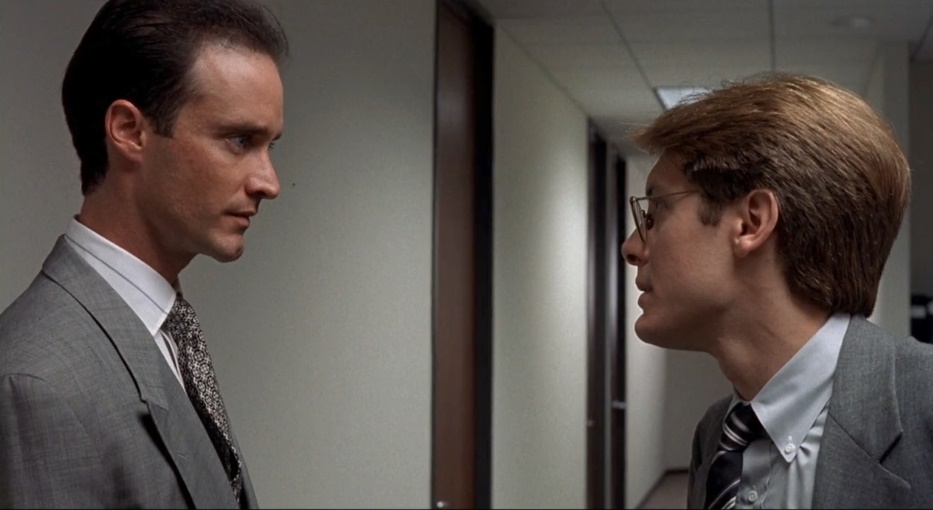


To escape his boredom, Mick starts going to seedy bars after work to drown his sorrows. At one of those, a man gets violent with him, but a knight in shining armor appears with a broken bottle to save the day. That guy turns out to be Alex (Lowe), who's suave, well put together, a hit with the ladies and seems to know all the right people in all the right places if one's interested in experiencing the exciting underbelly of the city. Despite the fact he likely also swiped his wallet when he "saved" him, Mick starts hanging out with him, anyway. Alex is a man of mystery. He doesn't appear to have a job, nor his own place, nor his own car, nor any other friends or relationships. People sometimes call him "Tony." People sometimes call him "Maxwell." And no one seems to know the first thing about him, his history, where he comes from or anything else. And neither will you by the time this film ends.


Hanging out with Alex gives Mick the courage and confidence to start standing up for himself and going after the things he really wants. He puts the conniving co-worker in his place and gets his missing files back. He also decides to start sleeping around on his fiance with a club girl named Claire (Lisa Zane). Alex wants to "help" Mick and asks him to tell him what he wants and what he's afraid of. When Mick has doubts about taking a big gamble at work that's unethical but not illegal, Alex encourages him to do it and it pays off. When he expresses fears about his upcoming marriage, Alex makes sure to take care of that problem, too. But then things take a criminal / violent turn.
Alex drags a drunken Mick along as he robs a diner and a liquor store, then makes a pit stop at the work rival's place to beat him within an inch of his life so he'll withdraw himself for consideration for the promotion. Once Mick finds out what they've done, he kicks Alex out of his apartment and tries to cut off all ties but Mick refuses to go away. He cleans out Mick's apartment, stalks him, taunts him, blackmails him, keeps hounding him at work and even tries to implicate him in a murder. Things eventually deteriorate into sub-Hitchcock suspense scenes of Mick and his pothead older brother Pismo (Christian Clemenson) attempting to dispose of a body in the La Brea Tar Pits, plus multiple potentially deadly run-ins with Alex.


Comparisons between this and the later Fight Club (1999) make perfect sense as both feature a timid, upper class white collar type getting involved with a charismatic, mysterious drifter who introduces a much-needed element of excitement (read: danger) into the uptight and predictably stuffy life of the protagonist. However, this has even more in common with Martin Donovan's APARTMENT ZERO (1988), an infinitely more interesting and insightful (and far better directed, written and acted) movie dealing with the same two male archetypes. Bad Influence, which is seemingly more focused on being late 80s / early 90s "hip" and glossy than substantive, just comes off as shallow and forgettable by comparison.


Monochromatic coloring, noir lighting, lots of promiscuous and "kinky" underground bit characters and "urban chic" types posturing around in nightclubs, art galleries and ultra fancy apartments don't make this any less empty nor does it make the characters any more interesting. This project also never feels remotely believable as it's too calculated and obvious. Of course this just had to throw some videotaped sex (which Alex sneaks into the VCR at a party being held at Mick's future in-laws home) into the works, which was clearly both a nod to Lowe's troubles and to recall the acclaimed (and, again, vastly superior) Sex, Lies & Videotape (1989) that Spader had just starred in.


The acting? Well, Lowe is pretty bad in this. The tone of his voice, the line delivery, the deer-in-headlights eyes, the facial expressions, the constant Cheshire Cat grin... just nothing seems to ring true about his portrayal of a psycho / sociopath. And just wait until you see him pretending to pass himself off as Francois the Frenchman! I guess playing the bland square was a change of pace for Spader at the time, though the character isn't at all sympathetic. Then again, generating sympathy for a protagonist in one of these yuppie nightmare / rich-person-problems flicks is next to impossible. Zane is used as nothing but window dressing, while a few good character actors like Kathleen Wilhoite (secretary) and John de Lancie (boss) show up only to be wasted. The cast also includes Rosalyn Landor (The Devil Rides Out), David Duchovny (who I don't even remember seeing), Lilyan Chauvin and Brendan Hughes (HOWLING VI) is small parts.

Hanson went on to make the financially successful The Hand That Rocks the Cradle in 1992 and finally made the critics happy after two decades in the business with L.A. Confidential in 1997, which garnered him an Oscar nomination for Best Director and an Oscar win for Best Adapted Screenplay (shared with Brian Helgeland). Outside of those and perhaps Wonder Boys (2000), he has a pretty unexceptional resume. His early exploitation psycho-killer flick Sweet Kill (1973; aka The Arousers) for producer Roger Corman is actually a lot more interesting than this more polished and far bigger budgeted one.
★★