.
.
.

Saturday, April 16, 2016

Stalls of Barchester, The (1971) (TV)

... aka: Ghost Story for Christmas: The Stalls of Barchester

Directed by:
Lawrence Gordon Clark

With this 45-minute offering began a series of “Ghost Story for Christmas” films that became a holiday tradition in the UK from 1971 until 1978. Each were shot on 16mm and in color, ran less than an hour (some were as short as 30 minutes) and played on BBC 1 either right before or right after Christmas. The first five of these productions, including this one, A WARNING TO THE CURIOUS (1972), LOST HEARTS (1973), The Treasure of Abbot Thomas (1974) and THE ASH TREE (1975) were adaptations of M.R. James ghost tales and were directed by Clark. The director followed those with THE SIGNALMAN (1976); an eerie adaptation of a Charles Dickens story, and then STIGMA (1977), an atypically bloody offering which was based on a new original script and not a classic short story. The initial series wrapped up with Derek Lister's THE ICE HOUSE (1978), which was the only one not directed by Clark and also based on an original script. In 2000, the Ghost Story for Christmas banner was revived for a four-part TV special starring Christopher Lee as James. BBC 4 would bring it back yet again in 2005, starting with Luke Watson's A View from a Hill. This one's an adaptation of the story The Stalls of Barchester Cathedral, which was contained in James' second collection of stories titled More Ghost Stories, published in 1911.

In 1932, Dr. Black (Clive Swift) is brought in to catalogue the dusty library at Barchester Cathedral. The books and papers there disappoint him... that is until the librarian (Will Leighton) digs up a locked box whose contents the now-deceased former college dean refused to look at. Naturally, this strikes Dr. Black's curiosity and he insists on checking out what's inside the box inscribed “Papers of the venerable Archdeacon Haynes. Bequeathed in 1894 by his sister Leticia Haynes.” Black (who narrates the story) cracks open the box, finds a series of letters and a black book and begins reading from the latter. We're then whisked away to 1872 where the bulk of our story takes place.


With ambitions of quickly moving up the ladder and taking control, Haynes (Robert Hardy) arrives in Barchester, takes up resident with his gossipy busybody spinster sister Letitia (Thelma Barlow) and begins work as a junior deacon under 84-year-old Archdeacon Pulteney (Harold Bennett). Haynes secretly wishes the old man would kick the bucket already but next thing he knows Pulteney is still 90 and going strong. Two years later, the old deacon takes a fatal plunge down a set of slippery oak stairs. A stair rod put in for protection was suspiciously missing from the scene of the “accident” and many blamed a maid for being careless. The actual culprit was Haynes himself, who was sick of waiting for his promotion. Haynes indeed gets the title of Archbishop but it's not without a price. Not only does the maid attempt to extort money out of him but, after his sister leaves town to go stay with a cousin, he's left all alone in their large home and starts feeling like someone or something is still around. He hears voices, whispering and laughter, the sounds of bells and footsteps and senses the presence of a cat even though they don't have one. Then bizarre things happen in church, particularly at his hand-carved wooden stall...


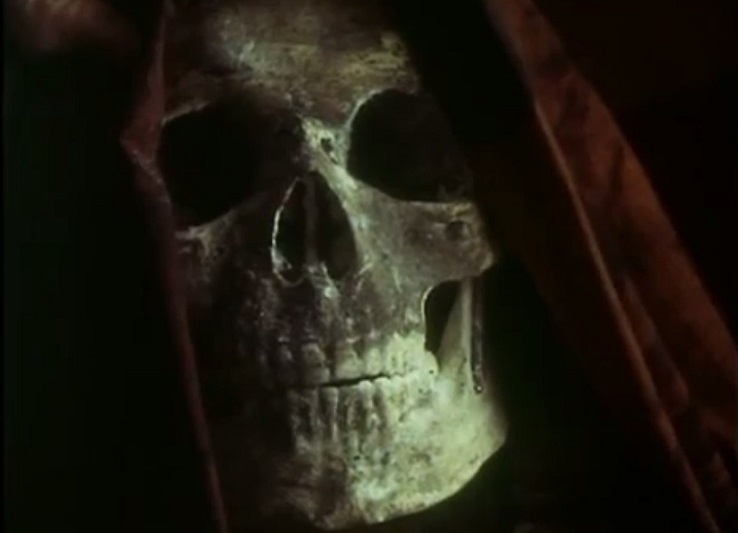


As Dr. Black and the librarian delve further into the journal, they begin to suspect that loneliness and fatigue from long hours of work are driving the man mad, but it may also be something more sinister. After all, the wood used to build Haynes' stall came from something called “The Hanging Oak;” which had been used hundreds of year earlier to execute witches. Human bones were even found between its roots when it was cut down. Despite being a man of the cloth, Haynes ironically refuses to believe in any “superstitious foolery” and is convinced it's some psychological malady and he must stay firm. In fact, “I must stay firm” is the last thing written in his journal before his untimely and mysterious passing. He was found with his neck broken and a deep gash on his face. Did he go mad? Was he killed by a vengeance-seeking ghost? Or was this all a completely coincidental yet karmic visit from the demonic cat and hooded figure depicted on his stall?


This lays down the groundwork for the tone and feel of most of the later entries in this series. It's not as unnerving, interesting and creepy as some of the better later entries (most notably Warning and Signalman), but it's still well-acted, well-made, classy, subtle, atmospheric and ambiguous. Worth watching.

★★1/2

Friday, April 15, 2016

Empire of the Ants (1977)

… aka: Angriff der Nuklearmonster (Attack of the Nuclear Monster)
… aka: H.G. Wells' Empire of the Ants
… aka: In der Gewalt der Riesenameisen (Violence of the Giant Ants)
… aka: Killer-Termiten (Killer Termites)

Directed by:
Bert I. Gordon

After THE FOOD OF THE GODS (1976) became A.I.P.'s highest-grossing film of its year, executive producer Samuel Z. Arkoff handed Gordon over some more money and proclaimed “More of the same, please!” And that's pretty much what we get here. Though this claims to be based on the 1905 H.G. Wells short story of the same name, it has almost nothing at all to do with the story. First published in 1905 in The Strand Magazine and later included in the collection The Short Stories of H.G. Wells (published in 1927), the source story takes place somewhere in South America and centers around a captain and an engineer sent to an Amazonian village to investigate reports of an ant plague and running across a new species of (slightly) larger than normal, super-intelligent, highly-evolved killer black ants. For this movie version, Gordon (who also wrote the screen story, produced and did the visual effect) kept the ant theme (though increased both the size and intelligence of them) but that was about it. This is basically a whole new tale and Wells' good name really shouldn't even be attached.


Heading this one up is none other than a slumming Joan Collins, whose career was on life support by 1977 and wouldn't be revived until her lack of warmth and likability could be correctly harnessed on TV's Dynasty in 1981. Going on record as calling this the worst experience she ever had filming a movie, Joan and the rest of the cast and crew endured filming locations swarming with fleas and mosquitoes as well as a director who was unable to get stunt people on location, which forced many of the actors to do their own stunts in bacteria-laden swamp waters. Doing such scenes ended up giving Collins a terrible infection in her legs. In later interviews, Collins stated that “Bert asked us to do things that actors usually don't do. We were hip deep in swamp water!” and concluded that she “... was never so delighted and relieved as when the last day of shooting arrived and it was finally my turn to be asphyxiated by the giant queen ant.” Regardless of all that, Collins' presence in this one is a plus if for no other reason than her bringing a glamorous and bitchy camp element (“I'm not running a charity organization!”) to a film desperately in need of it.


Marilyn Fryser (Collins), the no-nonsense president of “Dreamland Shores,” puts together a boat trip for potential buyers in hopes of wining, dining and attempting to sell off property in a future luxury resort community on a currently non-populated stretch of oceanfront swampland. It boasts a future 18 hole gold course, a future tennis club, a future beach house, a future marina, a future pool and current “fascinating wildlife,” which turns out to be more fascinating than the visitors probably imagined. With help from her assistant / lover Charlie Pearson (Edward Power), she charters a boat from unfriendly Captain Dan Stokely (Robert Lansing) and awaits her potential buyers. Most who show up, including two miserly and incredibly self-pitying elderly couples (“All we wanted was to enjoy what's left of our lives. Is that bad?”), aren't so much interested in buying property as they are a free trip, sight-seeing tour, booze and hors d'oeuvres. Actually just about all of this particular group is a bunch of duds.


Among the tag-a-longs ares are scrunchy-faced Joe Morrison (John David Carson), who's divorced, unemployed and pretty much just there to drink, friendly Margaret Ellis (Jacqueline Scott), a secretary fired from her job of 20 years who's on a limited income and outgoing Coreen Bradford (Pamela Susan Shoop), who's attempting to start a new life for herself after having been the mistress of a married doctor for years. Feeling emasculated because his father-in-law is a better provider for them than he is, scumbag Larry Graham (Robert Pine) enjoys being an ass and hitting on other women right in front of his clueless, simpering doormat of a wife Christine's (Brooke Palance, daughter of Jack) face. Actually he also seems to have no issue attempting to rape a woman about 20 feet away from not only his wife but the rest of the tour group.


As you've probably already guessed, giant ants end up spoiling everyone's picnic. Earlier, a ship's crew dumped a bunch of barrels of radioactive toxic waste into the ocean. Some of the barrels washed ashore, leaked some silver goo and the local ant population gobbled it all up, grew to enormous size and became MENSA eligible in the process. After they pick off the slower (i.e. all the old people) and dumber (i.e. the moron wife) among the group, the six survivors find a boat and decide to row two miles down river to the nearest town. Their trip is interrupted only by a few ant ambushes which leave Larry (who previously stood around and watched his wife get eaten) dead. Everyone else makes it to shore and find there way back to civilization only to realize many of the townsfolk acting somewhat strange. They soon discover some wacky slave “indoctrination” going down at the local sugar refinery.


Empire is dumb as hell, cheesy as hell and talky as hell... and yet it's slightly more enjoyable than Gordon's previous effort. While Food went pretty much right down the line as far as nature-runs-amok  / animal attack movies go and came off as bland and not even good for laughs in the process, this one at least boasts a little creativity in the final third. Of course the last 25 minutes or so are completely absurd but there's still no way you'll see it coming. This is also campier and funnier, even if all of that is completely unintentional. A few moments, like Collins' stud-for-hire trying to cheer a traumatized adult woman up by giving her a Babe Ruth bar like she's some 5-year-old, even made me laugh out loud. The attack scenes all feature shaky camera to distract from the immobility of the creatures and many also feature ant POV shots. The mock giant ants (which really don't look that bad) are combined with Gordon's usual rear project / superimposition effects of real ants, which are mostly awful but slightly better than what we saw in Food since a few border on being at least passable. Most of the characters in this one are also a bit more defined (and in a few cases, likable) than the ones in Food. I'm still going to rate the two films the same because they're both bad but not terrible. This just happens to bleep the SBIG radar more often.

None of the above really changes the fact that watching, or even re-watching, Them! (1954) or PHASE IV (1974) to get your killer ant kicks is time better spent, but sometimes we gotta take what we can get, right?


The cast also includes Albert Salmi, who manages to flub more lines than the entire rest of the cast combined in his short screen time, Jack Kosslyn (in his sixth film for the director) and Emmy-nominated TV actress Irene Tedrow. The Dana Kaproff score sounds an awful lot like John Williams' famous Jaws theme. This has received numerous VHS and DVD releases over the years and made its Blu-ray debut in 2015 courtesy of Scream Factory. It's rated PG.

★1/2

Thursday, April 14, 2016

La lama nel corpo (1966)

... aka: Blade in the Body, The
... aka: Das Monster auf Schloß Moorley (The Monster at Castle Moorley)
... aka: Les nuits de l'épouvante (The Nights of Terror)
... aka: Murder Clinic, The
... aka: Night of Terrors
... aka: Revenge of the Living Dead

Directed by:
"Michael Hamilton" (Elio Scardamaglia)

Set in late 19th Century England, this is an underwhelming, average but fairly well shot (in Technicolor and Techniscope) Gothic horror / mystery yarn set in an off-the-beaten-path nuthouse. Compassionate nurse Mary Stuart (Barbara Wilson) arrives at the secluded Morley Sanitarium. She'll be starting work there in the morning and only has time to meet the humorless main nurse Sheena (Harriet “White” / Medin) and one of the patients, the mute Janey (“Ann Sherman” / Anna Maria Polani), before heading off to bed. Later that night, someone wearing a black hooded robe and armed with a straight razor surprises Janey in her bedroom, chases her outside and slashes her to death by a fountain. The next day Mary finds no sign of Janey and the cover on a book she left in the room has been slashed. Head honcho Dr. Robert Vance (William Berger) shows up to put her mind at ease. The girl's parents came and picked her up at the crack of dawn, he says. Clearly, Dr. Vance is somehow involved in the murder but as is often the case, may not actually be the killer. This clinic is filled to the rafters with potential murderers.


For starters, there are a handful of loony patients. Elderly, senile Mrs. Hurley goes into fits any time someone touches her “only friend:” A stuffed cat. Schizo Fred (“Max Dean” / Massimo Righi) is convinced everyone is trying to kill him and usually has to be doped up and locked in a room with no furniture or else he may find something to hurt someone with during one of his paranoid, violent outbursts. Dr. Vance's shut-in of a wife Lizabeth (Mary Young) is insecure, jealous, bitter and has a weak heart. There's a strange bald servant (William Gold) lurking the grounds as well as handyman Ivan (“Grant Laramy” / Germano Longo), who's having a secret affair with one of the nurses and happens to own a straight razor identical to the one used in the murder. Loud, echoing footsteps can be heard coming from the third floor but the staff forbid Mary to go up there because the doctor is hiding something up there. That something is Laura (Delphine Maurin); his melted madwoman of a sister-in-law, whose disfigurement he may have been responsible for.


Many years earlier, Dr. Vance was fresh out of medical school, happily married and on the verge of opening a new state-of-the-art clinic in the area. Everything went to hell after an accident at the construction site found Laura falling into a vat of lime and melting off all her flesh. Though the doctor has always proclaimed his innocence, a witness claimed he saw him push her off the scaffolding. Vance was acquitted at the trial due to lack of evidence but the damage was already done. His reputation ruined, he had no other option than to take on dangerous patients no one else wanted and now spends much of his free time experimenting with skin grafts on guinea pigs in hopes of one day being able to restore Laura's beauty.


Meanwhile, Marc (Philippe Hersent) is traveling through the forest late at night headed to the coast where he hopes to unload his adulterous, scheming wife Gisele (Françoise Prévost). After she unsuccessfully tries to seduce him their rickety carriage breaks down and she uses the opportunity to club him over the head. The horses go crazy, trample him to death and run off. Gisele then walks to a cave and spots Dr. Vance burying Janey's corpse. She goes outside and pretends to be unconscious until he's done and can discover her. Vance takes her back to his clinic where she snoops around, tries to seduce him and finally attempts to blackmail him for 50 thousand pounds. Gisele's presence seems to kick the cloaked killer into high gear and he / she grabs the razor again and starts slashing up staff and patient alike before the big reveal.


While watchable, this is still disappointingly routine and predictable. As far as the 60s Italian Gothic horror cycle is concerned, Murder Clinic also came very late in the game. By 1966, there were already dozens of near-identical movies with near-identical plots, near-identical settings and near-identical characters and this one brings nothing of note to the party. Many of the previous films also happened to star more charismatic actors and were made by more creative and stylish filmmakers, which immediately knocks this one off of the priorities list and into the rainy day pile. It was scripted by Ernesto Gastaldi and Luciano Martino; two men who had their hands in writing dozens of Gothics and gialli apiece. Scardamaglia is best known as a producer and production manager on films like The Demon (1963) and Mario Bava's masterpiece The Whip and the Body (1963) and this was his only film as director. The credits have been Anglicized, so the identities of some of the actors (like “Barbara Wilson” and “Mary Young”) remain unknown to this day.


The initial U.S. release in 1967 by Europix Consolidated under the title The Murder Clinic came and went without much attention. Six years later, it was more famously re-titled Revenge of the Living Dead and reissued by the same company as part of their notorious “Orgy of the Living Dead” triple feature. The other two titles shown in the “triple avalanche of grisly horror” were Curse of the Living Dead (1966; aka Bava's Kill Baby Kill) and Fangs of the Living Dead (1969; aka Malenka, the Vampire's Niece). The hilarious ads featured a man in a straight jacket who was supposedly driven crazy from attending a showing!


The only way to see an English-language version of this one for many, many years was trying to track down an extremely rare VHS distributed by VCI. It's so rare I cannot even find a box for it. Code Red briefly included a cut, less-than-stellar print (with the title screen The Murder Clinic) in a six film, 2 disc set called “Six Pack: Volume 2.” Seeing how that set has been pulled from their website and is no longer available for purchase one can assume they ran into copyright issues. No need to worry about any of that anymore, though. In 2015 the film finally got a Blu-ray / DVD release from the German company Media Target Distribution. That release (title screen Die Mörderklinik) is the full, uncut version restored and in widescreen with an English language option. Too bad the film itself is hardly worth the trouble.

★★
Related Posts Plugin for WordPress, Blogger...