.
.
.

Sunday, March 12, 2023

Kaibyô ômagatsuji (1954)

... aka: 怪猫逢魔ケ辻
... aka: Ghost-Cat of Ouma Crossing
... aka: Mysterious Cat Exorcist

Directed by:
Bin Katô

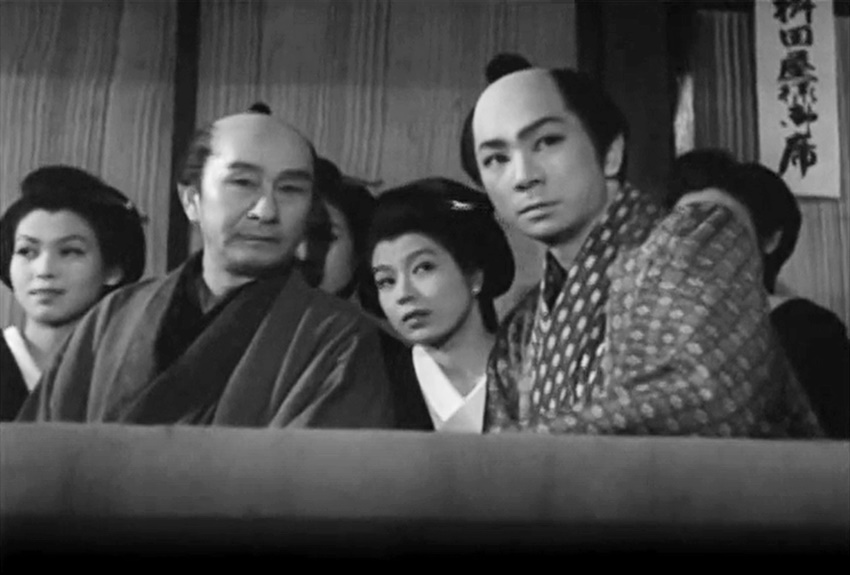
There are a lot of 50s / 60s era Japanese period-set ghost films with near-identical characters (who almost always fall into one of two categories: amazingly evil or uncommonly virtuous) and plots, but this one hopes to differentiate itself with its setting. Kaibyô ômagatsuji is focused around the world of acting troupes and busy kabuki theaters which are being dominated by the Masudaya troupe and their popular headliner, the demure and sweet Miss Ichikawa "Tayu" Senjo (Takako Irie). However, with great popularity comes great jealousy and there are forces conspiring against the star attraction. Mr. Okuba has high hopes for young actress Somewaka (Noboru Kiritachi), whom he'd love to see eclipse Tayu as the #1 kabuki actress. However, due to Tayu's talent and fame, there's almost zero opportunity to show Somewaka off and she seems destined to be stuck in small supporting roles so long as Tayu is still working. As for the few remaining ways to still get one's foot in door, well, some kind of freak accident could always occur and thus create an opening for another leading lady...

Mr. Ume, Somewaka, Somewaka's (very mean!) sister, Sunekichi (Chieko Murata), and a few others all get to work trying to make their dreams a reality, which means Tayu has got to go. They first sabotage a catwalk, which causes Tayu to step through the floor and injure her foot mid-performance. However, it's just a minor injury and she's determined to continue performing despite her scrape. After all, she says, a true artist should be willing to die on the stage if necessary. The suspicious incident also puts the theater staff as well as Tayu's entourage on high alert as they rightly suspect foul play is involved.



After suffering her way through yet another performance on her still-tender foot, Tayu is almost smashed backstage when a sandbag "accidentally" falls from the scaffolding. However, no one happens to be up there aside from a cat named Miya (or "Mi" for short), who belongs to one of Tayu's understudies. While the incident is written off as an accident, the troupe's manager still decides to postpone performances until Tayu has adequate time to heal. That opens the door for nasty Sunekichi to humiliate and bully her in front of her peers. She takes her seat at the head of the table, dumps a bowl full of sake over one of her apprentice's heads, shatters a cup in front of her which cuts her face and tries to force her to dance despite her injury. By the way, most of the female characters in this are hilariously melodramatic about every little thing and will wail, burst into tears and collapse at even the smallest of provocations!

Tayu will soon have a real reason to flip her shit though when her enemies increase their attacks against her and someone she loves and trusts stabs her in the back. That person is her lover, Tsubaki Genziro (Kôtarô Bandô). She wants to marry him but, unbeknownst to her, he's been secretly dating Sunekichi and is leading the plot to get her out of the picture. Due to the cut on her face, Tsubaki brings Tayu a special black ointment "medicine," which turns out to actually be some kind of poison. After applying it, Tayu's face becomes hideously disfigured on one side, thus potentially spelling the end of her acting career. She covers up the rotten half of her moneymaker and puts hope in another doctor to cure her.




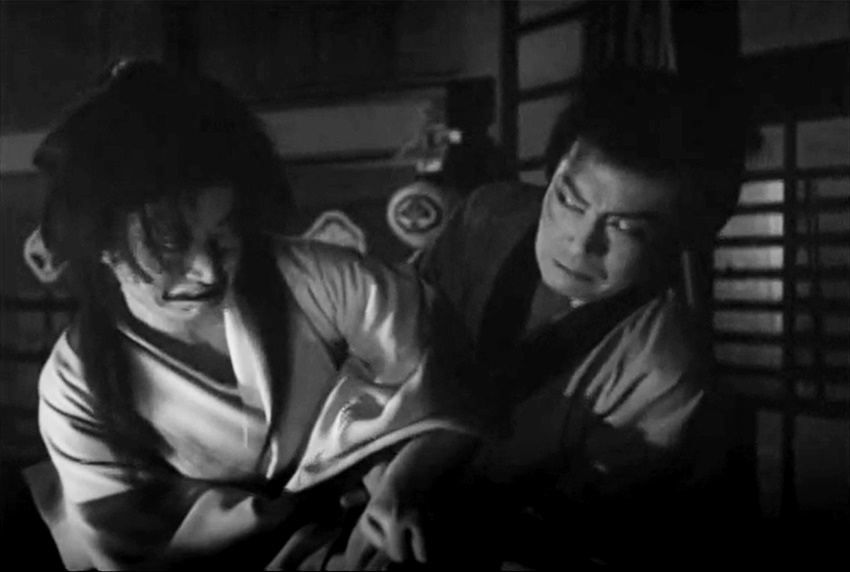
Things start spiraling out of control after Tayu's trusted confidant, Tomezi (Kimiko Tachibana), finds out about what's going on. After she threatens to spill the beans, Tsubaki strangles her to death and then stages her murder to look like a hanging suicide. He then takes Tayu out on a romantic moonlit boat ride, which quickly turns sour when he cruelly recounts everything they've been up to before slashing her to death with a sword and throwing her body into the lake. As the bad guys start rehearsals with Somewaka (who turns out to be quite untalented) as the new lead, Tayu's vengeful ghost returns to ensure that they don't even make it to see opening day.

While this isn't entirely useless, it's a very middling example of this type of film and suffers from very poor pacing and an unnecessarily large roster of characters. Good luck trying to keep tabs on the constant theater names, acting troupe names, troupe manager names, etc. that the cast are constantly talking about because I couldn't make heads or tails of it much of the time. Even worse, so much time is spent with the bad guys plotting and tormenting Tayu that an hour of this 82 minute movie is up before the ghost even makes her first appearance. Also disappointing is the promise of a ghost cat film and failing to make full use of it. There's no discussion about the mythology of the ghost cat or anything else that could have made this type of spirit interesting. They simply show a domestic feline hanging around the theater a few times and, almost at the very end of the film, the ghost finally turns up with slightly bushy eyebrows, crazy hair, crooked lipstick and occasionally does a pawing type motion with her hands. And that's really the extent of it. This ghost also appears to have vampire-like tendencies and goes straight for the jugular, though she mostly just moves her head in the general direction of the neck and then the victim falls over dead.


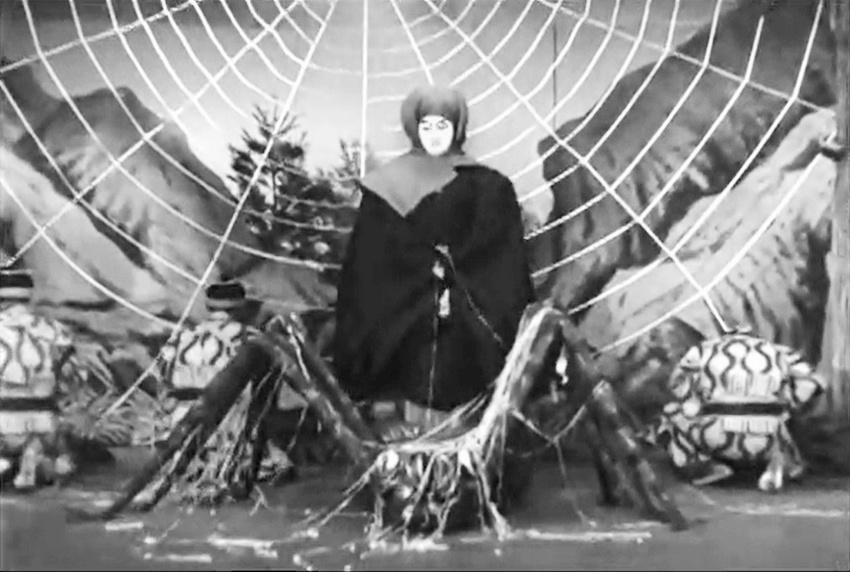
Not that this is all bad. A few elements work. Costumes and sets are fine. Some of the ghost scenes, especially the ones on the lake when the ghost keeps popping its head out of the water and one where it peeks around an umbrella, are fun. This also has some precise and surprisingly well-executed jump cuts that are effective. The most notable aspect here is the time set aside to show kabuki, which almost makes the ghost stuff feel like it's the padding. We get to see several performances, including a cool opening number that includes a webbed backdrop and a giant spider prop. One of the silly death scenes is even patterned in kabuki style with the victim flipping, floating, doing rolls across the stage, contortions, hanging upside down, etc. Aside from that, this is pretty forgettable.




Director Katô made a few other similar movies, including The Terrible Ghost-Cat of Okazaki (1954), Ghost-Cat of Gojusan-Tsugi (1957) and Ghost Story of Devil's Fire Swamp (1963), and this film may have been close to his heart as his brother (Asataro Ichikawa) was a notable kabuki actor in his day. Lead actress Irie, who was a major star for many years in Japan starting way back in the silent era, ended her long run making so many films in this category that she eventually earned the title "Queen of Ghost Cat Films," which is a pretty cool title really. The cast also includes Michiko Ai (who plays Tayu's understudy "Kocho"), a pre-Zatôichi Shintarô Katsu, Kôichi Katsuragi and Kôichi Mizuhara.

This has never been commercially released outside of its home country to my knowledge but there have been many VHS and DVD releases in Japan. While fan made subs are available and a watchable print is accessible (archive.org is one site that has it), there are probably several hundred other vintage Japanese ghost movies you'd be better off checking out first.

Saturday, March 11, 2023

Due occhi diabolici (1990)

... aka: Oczy szatana (Satan's Eyes)
... aka: Pahan silmät (Evil Eyes)
... aka: Two Evil Eyes

Directed by:
Dario Argento
George A. Romero

Originally conceived as an four-part anthology of Edgar Allan Poe adaptations with short segments to be directed by Argento, Romero, John Carpenter and Wes Craven (Stephen King was also considered), this instead ended up as a two-parter with segments from just Romero, who directed and co-wrote the first story, "The Facts in the Case of Mr. Valdemar", and Argento, who directed and co-wrote (with frequent collaborator Franco Ferrini) the second story, "The Black Cat." While it would have been interesting to see what Carpenter and Craven's contributions would have looked like (neither had done a Poe film before), it's also cool that whittling this down to just two segments that run nearly an hour apiece gives us essentially two features for the price of one. Not that the results here are flawless by any means, or anywhere near either director's best work, but there's still plenty of interest here for fans of both.

Revisiting this for the first time since my teen years, back when I much preferred Argento's segment, I've had a change of opinion now that I've looked at this again through adult eyes. Unsurprisingly, Argento's segment is much more bizarre, exploitative, flashy, attention-grabbing and visually creative and thus obviously would have appealed more to the instant gratification seeking teenager I used to be. However, it needs to be said that Romero is trying for something completely different with his take, something much more measured, moody and with reverence to both the tone and style of the source material. The brevity of most of Poe's classic stories didn't allow for much plot complication and most were structured as a steady atmospheric build toward a final shocking moment. That's similar to how Romero has approached this job, with respect for Poe's writing style, as opposed to Argento, who opted to stick to his signature directorial style. Both offer up imperfect visions with rewarding moments done in two completely different ways so it's impossible for me to say one is "better" than the other.


"The Facts in the Case..." opens with Jessica Valdemar (Adrienne Barbeau) paying a visit to family lawyer Steven Pike (E.G. Marshall) to liquidate a large portion of her dying husband's stocks. It would appear that the elderly husband, Ernest (Bingo O'Malley), who has just three to six weeks left to live, wants to make sure his much-younger wife is well taken care of in his absence. As for her feelings, she rather bluntly points out, "I was a flight attendant that Ernie brought home off the Red Eye to the shock and dismay of you and everyone else in this town. I married a rich old man. I let him use me for pleasure and for show. Now I'm going to let him pay me for my services." Jessica wants her payment for services rendered in the form of large sums of cash and doesn't want to wait the eighteen months to two years it would take to settle the estate. She not only has the signed paperwork to prove her husband's intent but she even puts her husband on the phone to have him personally ensure it's what he wants. Though suspicious, Pike prepares the paperwork as instructed.

Naturally, all is not what it appears to be. While Ernest is indeed on his deathbed, he's being kept in a state of hypnosis by Dr. Robert Hoffman (Ramy Zada). Using a pyramid-shaped electronic metronome and voice commands, he's able to control what his subject says and what he does, including making him sign important documents he'd otherwise not be signing. When out of the trance, Ernest is in such excruciating pain that all he can do is curse, scream and denigrate his wife, though apparently he wasn't a kind and decent man even in good health. Hoffman turns out to be Jessica's former lover who now wants to rekindle things. Though the two are conspiring to gain complete control over Ernest's estate, Jessica's still not completely sold on getting back together with Robert on a permanent basis. Both have their doubts about how trustworthy their partner in crime may, or may not, be.


A wrench is thrown into the scheming duo's master plan when Ernest dies before they're able to get his signature to receive the bulk of his money. Instead of reporting his death, Robert hatches a plan to hide his corpse in a freezer in the basement and pretend like he's still alive long enough to have Jessica forge the remaining documents herself. However, because Ernest was in a hypnotic state when he passed, he's become trapped in a limbo between our world and the next. While his corpse lies frozen solid, he's still able to continue communicating and, wherever he's now speaking from, it's dark, cold and "there are others..."

Albeit visually unimpressive and routine / predictable at points, this certainly isn't bad from a technical standpoint. Romero both works in some of his trademark social commentary ("Sick stuff always turns out to be rich people") and does a fair job of extending the short story by adding the conspiring-against-the-corpse angle to the works. Most of the highlights are quite subtle, so I'm not surprised many critics and viewers have completely overlooked them. Take the character Barbeau plays for instance. What probably would have been a one dimensional gold-digger role in another filmmaker's hands is more fleshed out than is the norm here thanks to both the script and Barbeau's performance. We're given enough information (working class background, abusive husband, upper class "polite society" never accepting someone with her background into their ranks...) to make both her motivations and her cold, hard exterior (used to mask her insecurities) all make sense.

Romero had originally wanted to update "The Masque of the Red Death" to comment upon the AIDS crisis and growing wealth disparity in Reagan-era America, which honestly sounds much more interesting than what we get here, but his concept was reportedly rejected by Argento (the executive producer of both segments) so he settled for this instead. Minor roles are played by Tom Atkins, who shows up near the end as a police inspector, Romero's then-wife Christine Forrest as a nurse and Antone Di Leo Jr. (Day of the Dead) as a taxi driver. The same story had previously been filmed, actually a fair sight better if I'm to be honest, by Roger Corman for his anthology TALES OF TERROR (1963), which starred Vincent Price and Basil Rathbone.


As we swing into Argento's take on "The Black Cat," we're immediately greeted with gore (body parts strewn about), full frontal nudity (a bisected nude female body), Poe references (the victim was killed with a razor-sharp pendulum), Argento's usual weird camera shots (from the POV of a swinging pendulum) and dreary narration talking about depravity and perversity. The near 180 degree change in approach from Romero's slow-moving, steady-handed, routinely filmed and comparatively classy segment to this is quite jarring! We open at a bloody crime scene where Detective Legrand (John Amos) and his men examine the carnage and photographer Rod Usher (Harvey Keitel) is busy snapping away at the grisly findings, completely unfazed by what surrounds him. Usher, who does not work for the police, actually makes his living publishing photographs of mangled and dismembered corpses taken at murder scenes. Is that even legal?

Usher's latest book, "Metropolitan Horrors," stirs up a lot of controversy, but his relationship with a pouty, much-younger violin teacher named Annabel (Madeleine Potter) is crumbling because of his alcoholism and cruel and controlling ways. When Annabel brings home a black cat that she refuses to divulge the name of, the animal is immediately and rightfully leery of Usher and hisses at his mere presence. Rod responds to that by murdering the cat and taking photos of him torturing and killing it, putting said photos into another of his morbid books. 

This all makes for quite an interesting contrast to how the central evildoer was handled in Romero's segment. While Jessica has reservations and moral qualms to work through, and a backstory to work off of, we know absolutely nothing about Rod aside from the fact he's an unpleasant degenerate with sociopathic tendencies. That doesn't enable Keitel to modulate his performance nor provide much nuance and, despite him garnering rave reviews from some fans, he seems completely lost here to me. What he does get to do is suck down about a quart of tequila shot-by-shot over the course of the film, scream and curse a lot and provide the occasional stilted and / or unintentionally funny line read. It's a memorable performance in a strange way, just how he's overwrought one minute and flat the next, but I wouldn't necessarily call it a good one.


Annabel strongly suspects Rod has killed her beloved pet, but he denies it ("It's a fuckin' cat! Meow! Meow! A cat!") and slaps her for accusing him. He then has a weird dream where he's swept back to Medieval times and gets executed (dropped on a sharpened spear that goes through his crotch and out his mouth to be precise!) for killing the feline. He runs into a black cat with the same exact distinct markings while at a bar, which the extremely strange-acting barmaid, Eleonora (Sally Kirkland), lets him take home. He attempts to kill it again, but Annabel interrupts and the two gets into a fight, which ends with him chopping her up with a cleaver. Instead of trying to dispose of the body elsewhere, he puts it in an upstairs closet, builds a wall in front of it and puts a bookshelf in front of that.

Paranoia soon sets in as the phone keeps ringing and Annabel's favorite student Christian (Holter Ford Graham), his elderly neighbors (Martin Balsam and Kim Hunter) and others show up looking for her. Not everyone is willing to buy his excuse that she went on a long concert tour either. As for the black cat that's already been killed a time or two, it shows up yet again in the home, only this time clawing its way through the wall from inside the hidden room housing Annabel's corpse. Though it's chopped in half with a saw, the cat leaves a secret behind that leads to Rod's undoing.


While Romero's segment has a more linear and coherent script, better characterizations and better performances, Argento's certainly has more visual flair, fluid camerawork and panache. Instead of going for a gloomy Poe-esque mood, he's content generally following the primary events of the covered short story and then scattering references to numerous other Poe works throughout the rest. There are not only nods to Cat, Pit and Usher but also The Premature Burial, Berenice, Annabel Lee and more. The best moment here is a protracted suspense scene near the end when Amos' detective and his partner (James MacDonald) show up at Rod's home and, through a series of minor incidents that prolong their visit, are around long enough to hear strange noises coming from upstairs.


Usually listed as a U.S. / Italian co-production, this was filmed entirely in and around Pittsburgh by a mostly American crew and features mostly American actors, though the two production companies who bankrolled it and all of the credited producers (including Claudio Argento) are Italian. Tom Savini was in charge of the typically solid make-up fx and appears in a brief cameo in Argento's segment. Pino Donaggio provided the scores for both segments, which are so different you'd never even guess that the same guy did both!


I can't say for sure how well Eyes did during its theatrical run in Italy, but it was a box office flop here in America when it was dumped into 150 theaters in 1991 and didn't even gross half a million dollars. However, the film likely made up for that with a strong global push on the home video market. I've found releases from nearly every corner of the globe.

After numerous DVD releases from Anchor Bay and other companies, Blue Underground finally gave it the Blu-ray treatment in 2009. Their 2 disc set comes with the 30-minute documentary Two Masters' Eyes (2003) which features interviews with Romero, Savini and a troika of Argento's; Dario, Claudio and Asia (who dubbed some of the characters in the Italian-language version). There are additional featurettes with Savini, as well as a brief separate interview with Barbeau that was originally intended for Roy Frumkes' 1989 Romero documentary Document of the Dead, which also touches on this production.

1/2
Related Posts Plugin for WordPress, Blogger...