.
.
.

Saturday, October 29, 2022

Marauders (1987)

Directed by:
Mark Savage

Did the world really need another “youthful 80s punks go on a rampage” exploitation flick? As far as I'm concerned, not really. Even the ones that are directed, produced and acted with some skill still tend to rub me the wrong way. What we typically get in this subgenre are films that are one-sided, reactionary, comically over-the-top (yet still want to be taken seriously) and dripping with conservative middle-aged bitterness and paranoia. The teenage thugs are seldom given proper characterization and are painted with a broad brush as unruly, obnoxious, physically and sexually violent, crude, murderous, drug-addled, foul-mouthed, cartoonish and ultimately unreachable. The only way to change them is to kill them. Meanwhile, the adults are typically shown to be the moral center and voice of reason, as if these teen “monsters” just emerged out of the Earth as some fully-formed evil monolith as opposed to being a byproduct of their environment or abuse inflicted upon them by adults. There's a good reason these movies usually turn out like this, I think: Most were made by middle-aged or even older adults with a subconscious fear of the younger generation and their differences. These films tend to try to discredit, undermine, stereotype and punish the youth, at least the ones who aren't obediently following in the footsteps of the “proper” adult characters.

What initially interested me most about Marauders was that this was one of the few "killer punks" efforts from this time not made by people three decades past their teen expiration date. This is not violent teens seen through the eyes of adults but violent teens seen through the eyes of their own peers. The director and most of the cast and crew were in their teens or early 20s when this was made. This was also done completely independently on a next to nothing budget. Now none of that means this is going to skirt right past the moralistic fear porn trap the other films in this category almost always fall into, or offer up much of note, but it does at least offer up the potential for a fresh take on the subject matter.


We're first introduced to two teen delinquents, both of whom fit the usual exaggerated criteria of other 80s violent punks and both of whom manage to make us thoroughly hate them after about 30 seconds of screen time. J.D. (Zero Montana), his kid brother and his mother are all involved in some kind of robbery-murder scam. J.D. lures victims to their home and his mother lets him get away with torturing and killing them so long as she's allowed to keep the money. When she threatens to go to the cops, J.D. hits her in the face with a shovel, ties her up and kills her. Punk #2, Emilio (Colin Savage), is sick of his crying baby and wife's nagging about how irresponsible he is. After punching his wife unconscious, Emilio then takes care of the nagging issue by shooting her in the head (in broad daylight and right on their front porch!) during an argument over car keys. Not surprisingly, these two nutjobs are best buds. Also not surprisingly, absurd story details like those just outlined make the film impossible to take seriously from the get-go.

Meanwhile, virginal schoolgirl Becky (Megan Napier) is dating a scrawny shitheel named David (Paul Harrington). She's young and naïve and thinks she's in love. He's banging any girl he can get his hands on. Unbeknownst to her, David has been bringing a new girl to a secluded family cabin once every week, where he coerces or forces them into sex before dumping them and moving on to the next target. His sights are now set on Becky. Before picking her up for their country getaway, David has a run-in with a drunken J.D., hits him with his car and then gives him the finger before driving off. That prompts J.D. and Emilio to hunt him down for revenge. They follow David and Becky to the country and commit one crime after another on their trip.


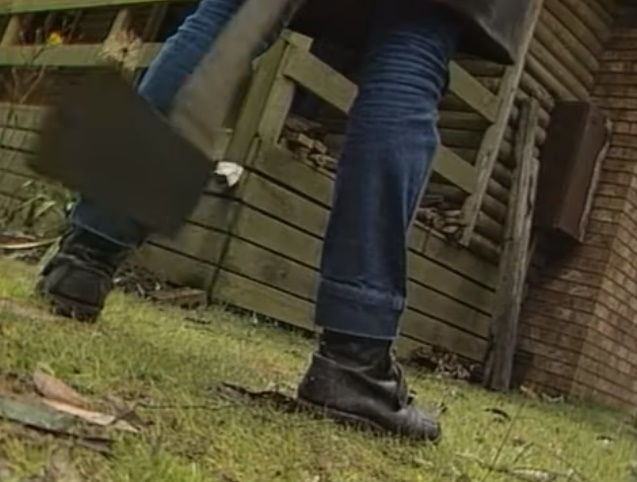

Broke and unable to pay for the gas, the thugs kidnap the female gas attendant at gunpoint and throw her from their moving vehicle. They steal booze from a liquor store, punch a kid in the face after asking for directions and destroy David's car with a sledgehammer. A female walking alongside the road is chased through the woods, thrown on the ground, punched, kicked, spit on, hit with a tree limb, raped and then has her corpse stuffed inside a wrecked car. As their victim count climbs, an ever-growing angry mob of people congregate and start looking for them. While that's all going on, David proves to be just as scummy as J.D. and Emilio; repeatedly calling his date stupid, trying to ply her with alcohol to loosen her up and, after she rejects his advances a few times, slapping her in the face, holding her at gunpoint, trying to force her to strip and threatening to rape her if she doesn't comply.


Seeing how none of this is believable for a second and the young filmmakers aren't striving for any kind of social commentary (their true intentions are made obvious when The Last House on the Left and I Spit on Your Grave get name dropped), this must be judged solely on how it works as an exploitation film. On those terms, the results are mixed. Though there are some nicely effective / gritty scenes in the first half of this barely 70 minute effort, once it settles at the cabin, we're left with a bunch of annoying, unlikable characters shrieking profanities at one another for an extended period in between frantically running around in the woods. It becomes pretty tedious.

I did appreciate the fact there's no attempt to legitimize any of this with moral grandstanding and the fact this isn't equating punk with criminality like so many other films of this stripe (at least balancing it out by making the preppy kid from well-to-do parents just as bad), but the best thing going on here, quite surprisingly, is the visual presentation. Though shot on video, this has some of the best cinematography and most creative camerawork you'll find on this particular medium from this particular era. The fluidity of the camera movements, well-done shot framing and dissolves and smoothness of scene transitions all far exceeded my expectations. Same cannot be said for the occasional sloppy use of freeze frames, which seem more a means of editing necessity than a conscious stylistic choice. Still, the overall direction certainly shows some promise.


Though usually listed as a 1986 release, the copyright date in the end credits is 1987. I could find no evidence of a theatrical or home video release anywhere in the world until the 2006 DVD from Subversive Cinema, which is no longer available. It came with an hour long documentary on the production as well as a commentary track. The now-defunct outfit also released other films from the same director. Much to my horror, I discovered that Subversive's former url (subversivecinema.com) has been taken over by "The Church of Peace" (!!), a Wisconsin-based congregation that won't let you in the door unless you're either wearing "your Sunday best" or "a clean pair of jeans and a sweater or polo shirt".

Sunday, October 23, 2022

La morte vivante (1982)

... aka: Lady Dracula
... aka: Living Dead, The
... aka: Living Dead Girl, The
... aka: Scare: Dead or Alive?

Directed by:
Jean Rollin

It's been a few years since I last logged a Jean Rollin movie here and I now remember why it's taken me so long to get back around to him again. My last Rollin ftv, FASCINATION (1979), which is widely considered one of his best films, left me completely bewildered as to how something so aimless, plot-less, blandly presented and poorly-made could be viewed by anyone as good let alone great. It did get me some hilarious hate mail from admirers of the director, though, informing me that I had terrible taste, was a moron and had no appreciation for art, so there's at least that. Admittedly, the movie wasn't without some merit. Yes, the house they shot it at was kind of cool. Unfortunately, this isn't HG-Fucking-TV here. I could also say a redeeming feature was the hot-bodied Brigitte Lahaie frequently naked, but there are a hundred other films providing the same exact thing and a lot of those feature much more of Lahaie with the added bonus of being generally better-made. So seeing how Rollin's supposed "masterpiece" did not do much for me, and the fact he's never been accused of being a "substance director" anyway (which actually made Fascination's minimalist visual merit feel almost depressing), I wasn't in a big hurry to see a generally-consensus'd "lesser" film of his.

However, I'm also aware by now that I'm simply not a fan of one type of Rollin film. His meandering and near plot-less vamp-erotic flicks do nothing for me. That said, I do enjoy some of his other work. He's proven he could deliver his usual exploitative and erotic elements while also making an otherwise decent genre film. Where I really conflict with a lot of others is that the films I prefer also happen to be the films the director's more hardcore fans usually slag off as being "too commercial." The Living Dead Girl is generally considered one of these "commercial" (i.e. coherent) efforts so I'm not one bit surprised that I enjoyed this a bit more than his usual. 


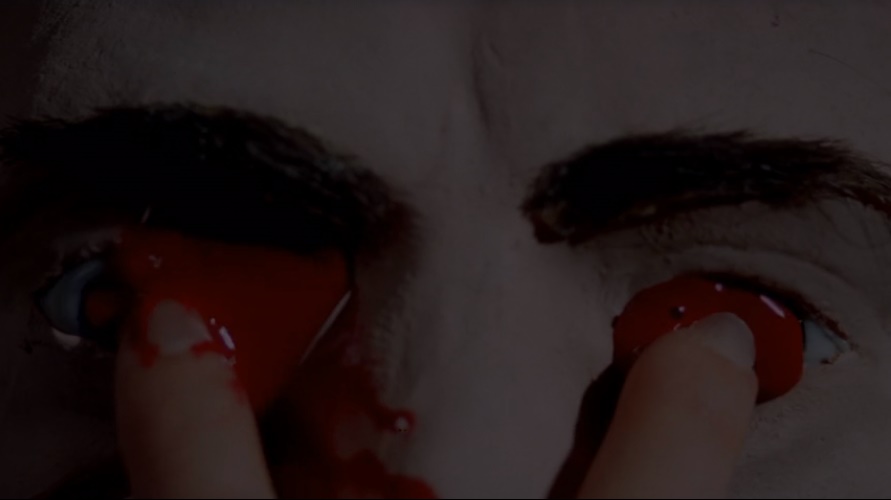
Three sleazy men are hired to find a place to dump some drums of chemical waste and choose a series of catacombs underneath an old home. Hey, it's dark, cold, forgotten and, while they're down there, they can do a little grave robbing. After cracking a couple of caskets and snatching a few pieces of jewelry off one corpse, a tremor and rock slide overturn one of the drums. Chemicals leak into the ground, fumes are released into the air and the amazing well preserved (consider she's been dead for two years!) corpse Catherine Valmont (Françoise Blanchard) is resurrected. After poking out the men's eyeballs and ripping out their throats, Catherine wanders above ground and makes her way to her former castle home, which is now in the process of being sold.


Even though she's a hot blonde, Catherine is basically a "creature" in the same spirit as the ghouls that usually populated 1930s creature features, believe it or not. She has a history and a tragedy about her and views her renewed life and bloodlust as a curse. In her teen years, Catherine was in love with her best friend Hélène. Whether that was platonic or romantic love and, if the latter, whether or not that was reciprocated love on both ends, is left unclear. The two close "friends" even made a blood pact that whomever of the two died first, the other would take their own life to join them. Of course, the now-grown Hélène (Marina Pierro), though heartbroken over her friend's passing several years earlier, did not hold down her end of the bargain and moved on with her life. Still, her heart has always remained with her late friend. That's why when she calls the castle to talk to Catherine's mother, unaware that she had recently passed away herself, and hears a familiar music box melody, she rushes to the castle.


Upon arriving, Hélène is greeted by the bloodied, nude corpses of both a Realtor (played by Patricia Besnard-Rousseau, who was also a hardcore porn actress under the name Patricia Bouvier) and the woman's lover. She then finds her bloody friend sitting nude playing the piano. You know, the same one who should be dead and buried. Inspecting the underground crypt, Hélène puts two and two together after discovering the corpses of the three slain grave robbers as well as Catherine's open casket. He beloved gal pal is actually a LiViNg DeAd GiRl! And like any good lover or friend, when you discover your amore has turned into a tormented vampire-zombie thingy with a thirst for blood, you're going to put them out of their misery as soon as possible, right? Right? Apparently not if you're Hélène, who cleans up the murder scene, hides the bodies and then offers up her own blood to Catherine.

Seeing how there's only so much blood in one human body, Hélène then tries to give her friend a dead bird to feast upon, but she refuses. Only human blood will suffice so the human half of the duo sets about procuring victims to satiate Catherine's blood hunger, starting with a motorist (Fanny Magier) who gets her guts ripped out after being lured into the crypt. Meanwhile, a couple consisting of American writer Greg (Mike Marshall) and his (English-speaking) French girlfriend Barbara (Carina Barone) are visiting the area. The dissatisfied Barbara wants to be an actress but has been roped into doing photography work by Greg, who - for some reason - is portrayed as being a complete douchebag. Barbara snaps a photo of Catherine wandering around in a field, becomes fascinated with her, discovers from locals that the girl in her photos died two years earlier and then sets about investigating the matter.


Can't say this film did anything to sell me on Rollin's rep as one of the genre's top visual artists. I've no clue why he even has that reputation in the first place to be perfectly honest! Like most of his other efforts I've seen, this is neither heavy on directorial flair nor visual imagination. Not that this looks bad or anything. It actually looks quite nice and is technically well-photographed (by Max Monteillet) and lit, plus benefits from good shooting locations and interior art direction. It's just that discernibly creative or artistic presentation of the material isn't something that just leaps out at you like it does with other notable horror stylists.


What is most surprising is that it takes the director almost 30 minutes before he gets around to squeezing in the first gratuitous nude scene. And, while there's ample nudity on display from there on out, it's incorporated into the film in a way where it never brings the story to a screeching halt like in many of his other films. While fairly amateurish (you can even see the tubes pumping out blood at one point!), the gore fx are adequately grisly and there are plenty of them. These were done by a 17-year-old Benoît Lestang, who'd move on to bigger films like The City of Lost Children (1995), Brotherhood of the Wolf (2001) and Martyrs (2008). Sadly, Lestang took his own life in 2008 at the age of just 43. Though the acting is highly variable, Blanchard (who starts out as a passive, aloof mute but eventually gains a more aggressive voice and presence) easily makes the strongest impression.


Though I've never even seen this pointed out before, LDG is actually a French / U.S. co-production produced by American Sam Selsky, who also appears in a cameo as a potential home buyer alongside another older lady who may have been his real-life wife. That probably explains why a number of the characters are American and also why a number of the actors also speak English. Supposedly, an entirely English-language version was simultaneously made by director Gregory Heller, who is only credited as a writer on the French version, but it was never released as is now presumed lost.


Despite the American connections and despite the fact his received a video release nearly everywhere else, the film completely bypassed the VHS era here and wasn't released until Image put it out on DVD in 1999. There has since been a number of other releases (including a Blu-ray) from companies like Redemption / Salvation and Kino Lorber.

1/2
Related Posts Plugin for WordPress, Blogger...