.
.
.
Showing posts with label Robert Bloch. Show all posts

Wednesday, March 6, 2019

Three Dangerous Ladies (1977)

... aka: Classics Dark and Dangerous

Directed by:
Robert Fuest
Alvin Rakoff
Don Thompson

This isn't a horror anthology in the traditional sense but instead three thematically-unrelated short subjects presented as a feature, most likely so it could fill vacant 2 hour slots on television. This same version was released on video by the obscure company S&B Marketing in 1988. It took some digging around on my part since IMDb currently has the info wrong, but all three of the shorts featured here were previously shown on Canadian TV as part of a series entitled Classics Dark and Dangerous in 1977 and were also aired on British television by ITV. In some Canadian schools, these were shown in classrooms and came with an accompanying book of the stories published by The Ontario Educational Communications Authority (see below).

The new opening credits, if you want to call them that, ineptly show snippets from all three shorts, introduce a few of the actors and then insert a new title screen while a deep-voiced narrator attempts to act like there's some kind of recurring theme here: "Three Dangerous Ladies. Lovely Simone, sweet Jenny Santander and the enigmatic Mrs. Amworth all seem so innocent, yet to know them..." After that, the full opening credits for our first story are run, and the full opening credits for the other two shorts are also run when their time comes; each time with silly new narration. It's quite sloppy.


Alvin Rakoff's "Mrs. Amworth" boasts a 1975 copyright date and is based on a story by E.F. Benson. After airing on the CDAD show and on British TV, it got its own separate VHS release through the company LCA in the UK and also became part of this anthology. Glynis Johns has the title role as an elderly eccentric who, claiming to be a descended from a family that lived there many years ago, moves to a tiny village populated primarily with older residents. Mrs. Amworth's presence, and frequent social gatherings at her mansion, seem to bring life to an otherwise boring little town, but she may be hiding a deep dark secret. Could she possibly have anything to do with a sudden outbreak in strange disorders resulting from a lack of hemoglobin in the blood? Prior to even finding out about this anthology, I'd already reviewed this one, so let me go ahead and re-direct you RIGHT HERE if you'd like to read more about it and see some pics.


Next up is Don Thompson's "The Mannikin." Singer / musician Simone Maglore (Ronee Blakley) arrives back at her childhood home just in time to see her elderly mother die... and she couldn't care less! Simone doesn't shed a single tear, claims she doesn't want any of her mother's belongings, tells the strange housekeeper Miss Smith (Pol Pelletier) she never wants to see her again and also announces that she won't even be attending the funeral. So why so bitter? Well, as a child, Simone was subjected to so much strange, scary and possibly Satanic activity - including being forced to participate in séances - that she was removed from the home and raised by someone else. Now as an adult, she'd just like to put her past behind her and concentrate on her budding music career.

Soon after leaving her mother's home, strange things begin happening to Simone. She hears her mother's voice calling her name, starts suffering from disorienting dizzy spells and comes down with an excruciating pain in her back. Family physician Dr. Paul Carstairs (Cec Linder) can't find a thing wrong with her, so he refers her to pickle-eating psychiatrist Dr. David Priestly (Keir Dullea). His diagnosis? Psychosomatic pain caused by guilt. Of course, that's not what's really wrong with her. Instead, she's been cursed by her mother and Miss Smith and must now give birth to a little demonic minion called a "mannikin;" which will be born out of huge growth that emerges on her back.


If you've ever read the 1975 Graham Masterson novel The Manitou or seen William Girdler's 1978 film version, you'll know just from the plot synopsis that these two stories are strikingly similar. However, this is actually based on a Robert Bloch story of the same name that was first published in Weird Tales magazine way back in 1937. For his novel, Masterson added a bunch of Native American mythology to the works to explain the growth but otherwise it's essentially the same basic idea. For this short, many changes were made from Bloch's source story, including changing the gender of the protagonist (who was a male outcast named "Simon Maglore"). The brief running time here ensures this whole thing is poorly under-developed. Simone's possession and demeanor change happen so abruptly we never have a chance to get immersed in the story. There are a couple of weird special effects eventually, including one of the creature crawling out of our heroine's back and then attacking Dullea in his car.

This was an oddball choice for Blakley; going from her Oscar-nominated turn in Nashville (1975) to something this low budget and schlocky, but once you see her awful acting it makes a bit more sense. She's also given the chance to promote her song "Need a New Sun Rising" here, which is heard no less than three different times, including being performed at the piano during a party scene. The same song ended up on the soundtrack for Bob Dylan's four-hour-long flop Renaldo and Clara (1978) the following year.


Finally, we have "The Island," based on a story by L.P. Hartley. Of the three shorts, this was the one I was most looking forward to because it features the strongest cast and was directed by Robert Fuest, who has several good genre films to his credit, including AND SOON THE DARKNESS (1970) and the Dr. Phibes films with Vincent Price. Unfortunately, this turned out to be every bit as predictable as the first story and even less entertaining that the silly second one.


While on leave from the war, Lt. George Simmonds (John Hurt) decides to go pay his lover Jenny Santander (Jenny Runacre) a visit. Her home is apparently the only one on a small island that none of the locals want to set foot on, including the ferryman who refuses to touch shore when he drops George off. On his walk there, the path is littered with dead seagulls. When he finally arrives at the house, things get even stranger. Jenny is nowhere to be found and the butler, Collins (Graham Crowden), behaves suspiciously and his story about Jenny's whereabouts changes. Even stranger, a man claiming to be an electrician (played by Charles Gray) is there and then promptly disappears even though he has no way to get off the island. All of this is supposed to build-up to a surprise revelation which, sadly, isn't the least bit surprising. The actors are fine, but this is just a waste of their talent.


Seeing what a poor job they did attempting to turn this into an anthology and how none of these shorts merits above 2 stars anyway, I wouldn't go too far out of my way to see this one. It's especially not worth it considering the version currently floating around is taken from the ancient VHS release and is blurry and too dark.

★1/2

Sunday, February 2, 2014

Cat Creature, The (1973)

Directed by:
Curtis Harrington

In a cheeky bit of casting, Kent Smith (star of the Val Lewton-produced classics Cat People [1942] and The Curse of the Cat People [1944], which this deliberately pays tribute to) shows up at a gloomy mansion late one night to do an appraisal of the late Hiram Drake's "secret collection" of Egyptian artifacts. He goes down to the cellar, cracks open a sarcophagus and finds a mummy with a large, solid gold medallion that has a cat's face on it and emeralds for eyes. Unbeknownst to the appraiser, thief Joe Sung (Keye Luke) is already hiding in the mansion. He swipes the medallion and takes off; awakening an ancient evil in the process. The appraiser  is promptly attacked and killed by what appears to be a domesticated cat. Joe immediately goes to "The Sorcerer's Shop;" an occult-themed antique store, to try to sell his new acquisition. The shop's owner, Hester Black (Gale Sondergaard), suspects it has been stolen and passes on a purchase. After Joe leaves, Hester's sales clerk Sherry Hastings (Renee Jarrett) heads out the door and begins to walk home when she runs across a black cat. She takes it home with her, where it passes on milk and then hypnotizes her and makes her jump off her balcony.


Lt. Marco (Stuart Whitman) is put in charge of investigating the appraiser's death and calls a local university for help. Instead of the Egyptologist he wanted, he gets archeology professor Roger Edmonds (David Hedison). Both the mummy and the amulet are missing from the crime scene, but claw marks are found on some of the artifacts and autopsy reports reveal that the victim died of a throat wound made by teeth and claws and that cat hair was found on the body. Roger notices that symbols on the coffin belong to a sect of ancient Egyptians who worshipped "Vaast, the great cat goddess." Rumor has it their priests even had the ability to turn into cats themselves. Meanwhile, at Hester's shop, shy loner Rena Carter (Meredith Baxter) shows up looking for work and is hired on as Hester's new sales girl. Roger becomes involved with her while more people mysteriously turn up dead... and curiously low on blood.


This seldom-viewed made-for-ABC-TV movie (which has never seen the light of day on VHS or DVD here in America) has some things going for it, including a reasonably good cast and a fairly interesting plot devised by writer Robert Bloch (of Psycho fame), which draws many parallels between mummies and vampires. Both must drink blood to sustain their lives and remain immortal, both can transform into animals (a bat for the vampire, a cat for the mummy) and the amulet around the neck functions much like a stake through the heart would a vampire; remove either and you resurrect it. Of course, a small domesticated cat attacking and killing people is a tough thing to pull off without causing chuckles from the audience, so the director decided to show most of that in shadow only, which turns out to be a wise decision.


In small roles are Milton Parsons as a cadaverous coroner, John Carradine (in just one brief scene alongside a dwarf prostitute!) as a hotel clerk, John Abbott as a librarian and Virgil Frye. Also turning up as a pawnbroker who gets stabbed is a guy who called himself "Peter Lorre Jr." Born in Germany as Eugene Weingand, Lorre Jr. emigrated to America at age 20 and was not in any way related to famous actor Peter Lorre. He went to court to try to change his name legally, but was denied his request. After Lorre died, Weingand began using the name professionally anyway and even went around claiming to be the late Lorre's son.

★★1/2

Monday, November 23, 2009

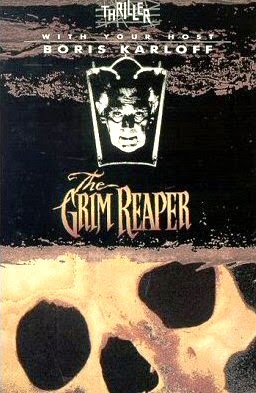
Grim Reaper, The (1961)

... aka: Thriller: The Grim Reaper

Directed by:
Herschel Daugherty

The popular Thriller series hosted by horror legend Boris Karloff ran from Fall 1960 to Spring 1962 on NBC and made an impact on lots of kids during its day, including a young Stephen King, who has called it "the best horror series ever put on TV." Unfortunately, of the 60+ episodes that were made, only six of them were officially released. This one, along with "The Incredible Doktor Markesan," "Masquerade" (also directed by Daugherty), "The Prediction," "The Premature Burial" and "The Terror in Teakwood" were all issued (separately) on VHS in 1996 by MCA/Universal. And sadly, that was it. Even though some (bootleg) sites offer the entire series on DVD-R, this has yet to see the legitimate box set release it so deserves. "The Grim Reaper" (which aired June 13, 1960 and was the 37th and final episode of the first season) was directed by prolific TV director Herschel Daugherty, who directed 16 episodes of the show and even more episodes of Alfred Hitchcock Presents. This one's also noteworthy for featuring William Shatner in an early starring role. Shatner and Daughtery would also work together on an episode of AHP that very same year, as well as several episodes of Star Trek in 1966.


"Someone is in mortal danger as sure as my name is Boris Karloff!"


In 1848 France, Pierre Radin (Henry Daniell) shows up at a boardinghouse looking for his reclusive artist son, only to find he's hung himself and left behind a painting of a skeletal Grim Reaper brandishing a scythe. Over a hundred years later, wealthy mystery writer Beatrice Graves (Natalie Schafer) is living up to her eccentric reputation by surrounding herself with offbeat things. She lives in a has a creepy old mansion, drives around town in a hearst and has just recently purchased the Grim Reaper painting at an auction to hang over her fireplace. Bea's not exactly the upbeat type; she's got a drinking problem and her latest husband, much-younger actor Gerald Keller (Scott Merrill) seems to have eyes for her secretary Dorothy (Elizabeth Allen) instead of her. In comes concerned nephew Paul (William Shatner), who wants to share some information about the painting, which is believed to be cursed. The past fifteen owners have all died unexpected, violent deaths and it's rumored that the painting bleeds whenever someone's about to die. When an inebriated Beatrice is found dead at the bottom of the stairs and it's revealed that Gerald has inherited everything, is it murder, is the story about the painting being cursed true or is it perhaps a combination of factors at work?

One of the most fondly remembered of all of the episodes in the series, and boasting one of the creepiest endings as well; solidly scripted by Robert Bloch (complete with some black comedy, a couple of decent twists and even an Addams Family reference) and nicely acted. Daniell and Karloff (the stars of the 1945 Val Lewton-produced classic The Body Snatcher) unfortunately do not appear in any scenes together here. Daniell appears for just for a few minutes during the opening scene and Karloff only has hosting duties in this one.

★★★
Related Posts Plugin for WordPress, Blogger...