.
.
.
Showing posts with label artist. Show all posts

Monday, June 3, 2024

Arrebato (1980)

... aka: Rapture

Directed by:
Iván Zulueta

As a regular consumer of low budget and, some would say "low grade," horror, and also someone who genuinely enjoys such films for a whole host of reasons that have nothing to do with making fun of them, I have a bone to pick with this general premise. Why is it that any time a director wants to make a movie about another (fictional) director and wants to show said director is a troubled individual, they always make that person a horror director? And by "troubled," I mean the entire gamut of fucked up here. It could be a delusional person of limited to no talent, or someone who's just coasting through their profession, or someone who's not passionate about what they're doing, or someone who feels like they're "trapped" making these kinds of movies as if it's a ball-and-chain around their ankle, or a pervert, or a drug addict, or someone who's going insane, depressed, repressed, mentally defective in some way or even a psychotic killer themselves. Yup, it's always gotta be a horror director; the go-to profession for all manner of in-the-business downward spirals! 

The only other genre-specific directors I've seen treated with such disdain on a regular basis are pornographers. I suppose it's because these two genres are (more specifically were; things have thankfully changed in recent years) considered to be the lowest rung of the filmmaking ladder, at least from the vantage point of pretentious artistes. In reality, I think they mostly frown upon the fact these films are often blunt, honest and straight-forward instead of burying content under 50 layers of impenetrable metaphor.


The director in question here is José Sirgado (Eusebio Poncella), who already has such Naschy-esque titles as "La maldición del hombre lobo" under his belt, and is currently in the process of putting the finishing touches on his latest vampire epic, which is strangely titled "Wolf Men." It's clear from the get-go this man is just not feeling it anymore. Maybe he never really did. He's so stubborn and desperate to do something different that he's willing, per his own editor's evaluation, to screw up the new film ("meaningless cinema" he dubs it) in post just to do something, anything, out of the ordinary. "Fuck the movies," he says. And yet that obsession for making films is still clearly there, even if written off with passivity ("It isn't me who loves cinema, but cinema that loves me"). Maybe going through the paces as a filmmaker isn't so much a passion as it is a crutch; a place to hide.

José leaves the editing room and then drives through Madrid as a parade of theater marquees are shown; mostly famous movie titles, mostly films more successful and respected than anything he's ever done or likely will ever do. The director's career ambitions certainly aren't helped any by the fact he's also a heroin junkie, and that's the main driving force behind the entire structure and style of the film. It's the nonsensical rationalized through an unreliable narrator. Since he's always in some kind of altered state, the events that follow are assumed to be some kind of altered reality. This compounds that confusion by adding another (actual) narrator to the works; a hoarse, husky, nagging voice that's ever-present. Regular dialogue will unspool between characters and any bit of silence is used to wedge in another comment or insight from this narrator. Not only that, but this also screws around with the chronological timeline on top of that.


José's in a miserable relationship with another junkie, an actress named Ana (Cecilia Roth). Sometimes she's there, sometimes she's not. He wants to end it, and even rehearses the break-up in the elevator on the way up, but just hasn't yet, likely out of guilt because it was he who got her addicted in the first place. Returning to his unkempt apartment after work, the everyday stresses of life start getting to him. He can't wake a stoned Ana up (and later will strip her and attempt to rape her while she's still unconscious), the bathtub overflows, the toilet won't work, everything's a mess... On a more intriguing note, he's received a package containing a film reel, an audio tape and a key. He starts the tape. It's from an amateur filmmaker named Pedro (Will More) and his is the voice of the pretentious narration we hear throughout. José has only met Pedro twice previously. Now he wants to see him again and claims it's "urgent."

José is actually better acquainted with Pedro's bubbly cousin, Marta (Marta Fernández Muro), whom he used to date and who's also a drug addict. She chauffeurs him to the remote home where Pedro lives in seclusion with his aunt, Carmen (Carmen Giralt). Pedro's obsession is making 8mm movies. These aren't real movies, as in scripted movies, or even documentaries with a set purpose, but instead random, mundane home movies that he curiously refuses to show anyone else after he shoots them. Marta sometimes hears Pedro "crying in desperation" from outside his bedroom as he watches them and claims his emotional development is stunted at around 12-years-old even though he's 27. She adds that her ex-husband is the only person who has ever seen one of the films. Whatever he saw was so strange and disturbing that he never spoke to Pedro ever again.


After dinner, everyone sits down to watch TV. Carmen goes on a never-ending rant about how much she adores Alan Ladd, how perplexing it is that men like "fat" Mae West, how she hates black-and-white movies despite being color-blind herself and how dubbing makes people sound like chickens. Pedro lurks in the background staring José down and clutching a clown doll. The doll's eyes start to glow as he proceeds to fast-forward through hours of TV in just minutes. It's like he's able to control time. Or maybe José is just high again.

Later that night, the weird man-child turns up in José's bedroom unannounced to share some lines and talk. He claims he hates drugs because they make him feel grown up, yet is unable to sleep without some "powder," and adds that he doesn't get to have much sex either, yet sometimes gets to "...fuck my cousin and her husband, too" (!?) He eventually shows José some of his home movies, which seem to merely document everyday, ordinary life, yet at an accelerated frame rate and lacking the proper "rhythm" he's looking for. As he watches, Pedro starts sobbing, curls into a fetal position and clutches a teddy bear. Why is he refusing to grow up? Why is he filming his life instead of living it? He, just like José with his drug addiction, doesn't seem to be able to handle unaltered reality, or perhaps the reality of aging, stress and mortality. The voice-over attempts to shed some light about his search for "understanding the meaning, the purpose, the role, the game that 'making movies' represented." Also, major homoerotic vibes going on here, along with numerous accompanying wang shots.

This entire trip to Pedro's turns out to be a flashback, as does the next sequence, which details a second trip to the home. This time, José brings along Ana, and there are immediate arguments over the drugs that are starting to take over everyone's lives. There's also discussion about those little things that bring on, or used to bring on, intense feelings of pleasure or joy; things as simple as green slime, Betty Boop dolls and King Solomon's Mines comic books; things most of us associate with childhood. It's no coincidence that much of the soundtrack is comprised of sounds that bring to mind carnivals, music boxes, squeaky toys and other things of childhood merriment. Drugs, sex and movies are perhaps just adult attempt at being as enraptured by something in the face of maturity, life experience and cynicism.


The rest of the film returns to present as José and Ana watch the film reels Pedro sent to them. He left home the day after their last visit to experience life, and found little about it to actually enjoy. He began documenting his travels. The drug use continued. And then he accidentally recorded himself sleeping one night. An anomaly, a split second red frame, showed up in the footage. Subsequent attempts to film himself sleeping resulted in the red "pause" increasing in length. Believing this signified that his days were numbered, he and his gal pal Gloria (Helena Fernán-Gómez, who's dubbed by Pedro Almodóvar!) hit the streets to indulge their base fantasies, which include seducing a biker with promises of a three-way and then trying to (I think?) drink his blood. However, Pedro's illness worsens as he finds out some interesting things (best not described by me) about his camera...

Arrebato is the exact type of art house / transgressive / surreal / experimental / whatever-you-wanna-call-it "cult" film that interests me in some ways yet doesn't really work for me in its entirety. It may for you. Who knows? Watch it and find out for yourself. Some people, including a lot of critics, seem to love this and lavish it with praise. I found it to be a film that reaps some rewards, yet I'm not sure the patience and forgiveness required on my end to make it down this rocky road was fully justified by the actual content found therein. I also found some aspects extremely silly and unintentionally comic.

The drug and film addiction parallels as a means of adult cope are pretty in your face, and there's no escaping the fact this could have said the exact same things with a linear narrative, less self-indulgent blabber and minus the hideously unlikable characters you'd rather see get hit by a bus than given another second of time to inflict their dreary worldview upon you. I think this would have been far more compelling if the characters were sympathetic, fleshed-out a bit better, or actually worth getting to know. They're not. What's even the point of using drugs as a means to escape existential crises and recapture the brain-not-fully-developed joys of youth if all that does is make you even more miserable than before? Maybe the director was trying to paint self-important, nihilistic addicts and artists (even himself, as he was both) as insufferable killjoys who suck every ounce of joy out of a room.


In film, we often get to see the ravages of addiction on the addicts themselves, but seldom get to see the toll taken on those left to deal with the fallout. Whether in film or in real life, dealing with addicts is tedious. Hell, just being around someone who's drunk or high in any capacity when you're sober can be pretty tedious. It's especially tedious when you're around someone chemically impaired who also fancies themselves a philosopher and spouts a bunch of gibberish they think is deep and profound when it's really just shallow and semi-coherent. This film often feels like that; like you're trapped in a room with Stoned Sartre lecturing you for two hours about how life is meaningless.

Yes, this is two hours long and it's a long two hours. At one point it was actually three hours long until a merciful producer stepped in and forced the director to edit it. Seeing how what's left is insanely dialogue-heavy (between the characters and voice-overs, it's a near-constant stream of talk from beginning to end), moments of pause and reflection may have been what ended up on the cutting room floor.


Though often listed as a 1979 release on various websites (perhaps due to the fact the opening credits brag that it won a "special prize by the Ministry of Culture in the year 1979"), this actually didn't have its official premiere until June 9, 1980 at the Azul Cinema in Madrid. Though it was not initially successful, it would become a popular midnight / cult film in Spain later on and reportedly played at one theater for an entire year.

Here in America, this played at the Chicago International Film Festival in 1980, had a very limited run in 1982 and then vanished for decades without ever making its way onto home video until it was 30 years old. There was a 4k restoration in 2021, followed by another limited run in select theaters. It was given a Blu-ray release by Altered Innocence in 2022 and finally earned the ultimate film snob seal of approval when it was streamed by The Criterion Channel that same year.

★★1/2

Friday, April 26, 2024

Un couple d'artistes (1970)

... aka: Artistic Couple, An
... aka: Artistique Couple, An

Directed by:
Bruno Gantillon

What are your least favorite job interview questions? The one I always dreaded the most, also, as luck would have it, the most commonly asked, is "Why don't you tell me / us a little about yourself?" It's just so broad and generic that I never know how to start or how to condense my entire being, life, essence, work experience, what have you into an appealing little blurb. Even though I know the question is coming, and coming right away, it almost always leaves me tongue tied. The last time I interviewed, which was thankfully many years ago now, I decided to make it as short as possible. Name. Where I'm from. Education. The last job I had. I probably sounded like a robot but I suppose that's preferable to sounding like a stuttering, rambling, incoherent mess. One thing I never bring up is my writing. I don't tell them about any books or magazines or websites I've written for, and I certainly never tell them about this place. Why? Well, because then they will ask "What's it called?" and I really don't want to have to say "The Bloody Pit of Horror!" How do you even spit something like that one out to positive response? The sad part is that I know know that response would be almost universally positive had I instead written about, say, Disney movies, Star Wars or comic book superhero movies.

Not that I'm at all embarrassed or ashamed of what I like. I love horror, love being a horror fan and talking to other fans, love the movies and love writing, it's just that I've experienced first hand what some folks think of all this. Yes, the stigma against horror is indeed real. Years ago, a past employer who was so extreme on the hardcore Christian scale that he considered mainstream rock "devil music" found out what I did in my spare time and never looked at me quite the same way again. In fact, he switched from friendly to complete asshole virtually overnight. To him, my tastes indicated that there had to be something wrong with me, or defective about me. Perhaps he thought I was evil. Or a Satanist. Or a serial killer. I'm not so sure, but finding myself essentially being forced out of a job that I was good at, and more than qualified for, was an eye-opening experience. It also made me wonder if potential employers are actually owed any honesty in the initial interview, outside of things directly involved with the job. Why are they even privy to details about your hobbies or interests, or how you choose to spend your free time, even though that's another FAQ?


The opening of this 13-minute short, featuring a job interview with awkward, inappropriate and invasive questions clearly meant more as a means to judge rather than determine qualifications, brought back some fun memories then. College student Catherine Berne (Martine Deriche) answers an ad and shows up at an elderly couple's home looking for work. While the husband (Paul Bonifas) serves tea, she's drilled by the wife, Mrs. Faroy (Thalie Frugès). Instead of asking your usual questions, she inquires more about the young woman's personal life. She wants to know her age (20), where she comes from (the country), about her family (both parents are dead and her only sibling is in Italy working as a painter), what she's doing in Paris (she's studying art history) and whether or not she has a boyfriend (nope). Naïve Catherine tells her too much. She's only been in Paris for a couple of weeks, so no boyfriend, no family, no friends... These answers seem to please the couple.

The job is for a live-in housekeeper and cook, so Catherine moves in right away. They share a nice dinner, Catherine complements their interesting Chinese artwork and then it's time for bed. After Catherine goes to sleep, Mrs. Faroy sneaks into another room, turns a knob and gases the girl. She's knocked unconscious and has creepy visions of the couple repeating their line of questioning from earlier. She's then taken to a room, has her head shaved and is injected with something. Whatever is happening will be ready by morning. And did I mention that the couple make money selling wax figures to a museum?


Despite being extremely predictable (granted you've seen Mystery of the Wax Museum, House of Wax, NIGHTMARE IN WAX or any number of other similar titles), this is otherwise a well-made, well-acted short with an especially impressive final shot. It's pretty much exactly what it feels like, too: A means for an aspiring filmmaker to show that he knows what he's doing and is thus worthy to advance to feature film projects, which is exactly what happened. The following year, Gantillon made Girl Slaves of Morgana Le Fay (1971).

This is available on Youtube or as an extra on Mondo Macabro's 2005 Girl Slaves DVD release. The director didn't do any other genre films that I know of, though he did direct seven episodes of the syndicated series The Hitchhiker from 1989 to 1991.

★★1/2

Thursday, October 5, 2023

Lao Shan gui lian (1984)

... aka: 嶗山鬼戀
... aka: Love with the Ghost in Lushan

Directed by:
Fong Pau

Liaozhai zhiyi (English title: Strange Tales from a Chinese Studio) is a collection of allegorical ghost / supernatural tales compiled by Songling Pu over a forty year period, starting in the 1670s up to the turn of the 18th century. The collection features around 491 stories in total, was first published in 1766 and is now seen as a classic, influential work of Chinese literature. There have been a number of films adapting some of these stories going all the way back to the mid 1920s. Included among those are the Shaw Brothers productions THE ENCHANTING SHADOW (1960), The Enchanted Chamber (1968) and The Ghost Story (1979), Taiwanese director Feng-Pan Yao's ALL IN THE DIM COLD NIGHT (1974), The Blue Lamp in the Winter Night (1974) and Ghost Under the Cold Moonlight (1975), and the acclaimed hit A Chinese Ghost Story (1987). That covers only about 1% of all of the films that are either direct adaptations or clearly took ideas and inspiration from the collection.

This one opens with a little biographical information about the author and his work and tells us the movie we are about to see is based on just one of the book's chapters. When I glanced back over at my review of the same director's THE PAINTED SKIN (1966), his only other genre effort, I realized he began that film the exact same way and it's also based on another of these stories.


Wanting to take advantage of the breathtaking scenery, artist Jiang Yu (Henry Fong) travels to a remote mountainous region of China to work on some drawings for wealthy client Mr. Wu (Ming Chiang). Upon arrival, he sees a female figure in white disappear behind some trees. He then hears a woman's cries for help. Following her voice, he sees a few brief flashes of the figure and then some smoke being sucked into cracks between rocks. Shrugging off the incident, a local foodstall owner (Kwai-Ping Wong) informs him of a free place to stay while he's in the area; a long-ago abandoned temple formerly used by Taoists, which is currently occupied by an old drunk (Jing Ping Wu). His first night there, he again sees the figure in white, only this time accompanied by footsteps forming on the ground all by themselves and then the same young woman being beaten by a woman before they all suddenly disappear.

The following day, Jiang once again spots the girl running around in the mountains, only this time she leaves behind a slipper a la Cinderella. (For the record, the origins of the Cinderella story predate Liaozhai zhiyi by 1500+ years). The girl - Shiu Sen (Fay Yu) - later returns to the temple to retrieve her shoe. Jiang inquires about her peculiar behavior and she tells him a sad story about how her abusive stepmother (there's that Cinderella nod again) had sold her into slavery. She pleads with him to take her away from there, even promising to become his servant for life if he does. However, he's just a poor artist, feels he doesn't have much to offer and sends her on her way.

As soon as the mysterious young woman vanishes, yet another mysterious young woman arrives. She - Hung Yu (Bing-Hsin Hsia) - claims to be Shiu Sen's stepsister, though she's much more heavily-made up and expensive in dress than Shiu Sen, who wears peasant's clothes. Hung Yu wants to commission him to draw a picture of her. However, she wants it done immediately and he must be finished before the sun rises to collect his gold. As soon as he begins, the woman strips off her dress and comes on to the outraged artist. When he attempts to kick her out, she suddenly transforms into a blue-faced vampire and attacks, though Jiang manages to escape shaken but unscathed.


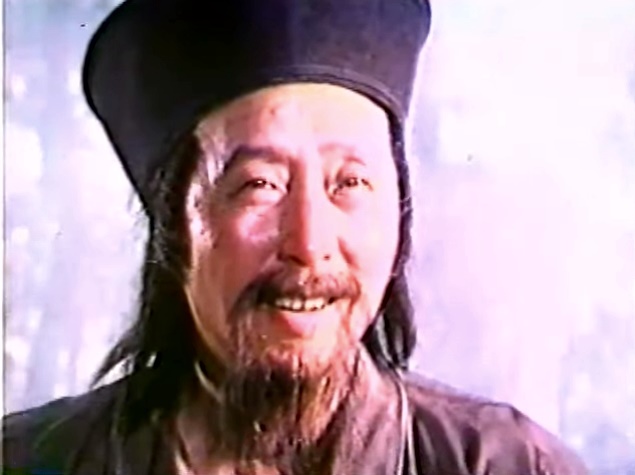
While fleeing down the mountainside, Jiang ducks into a cave, discovers Shiu Sen's grave hidden inside (revealing to him that she's actually a ghost) and is almost grabbed by zombie hands that emerge from the ground. It's then that he realizes that someone has stolen all of his drawings, so he's forced to return to the haunted village to retrieve them. In his absence, the seductress ghost has killed a wandering swordsman (Pei-Wen Hou). Luckily, he runs across Shiu Sen before he does her sister. A good ghost, Shiu Sen, further explains her predicament: She's trapped at the mercy of an old mistress who sends her and Hung Yu out to seduce men so she can drink their blood. His only hope may be convincing the old drunk, a former Taoist, to get sober long enough to help banish the evil spirits. After doing so, or so they think, Jiang retrieves Shiu Sen's bones and plans on giving them a proper burial so that she can finally be at rest.

Returning home to his grandmother (Ping Qiu) and kid brother, Jiang realizes he's now late on delivering Mr. Wu's artwork. He asks for a few more days, in which time Shiu Sen pays him another visit (he still has her remains so no rest just yet) and helps him with his artwork, which is a rousing success. She brings additional pieces to him during her late night visits and the two begin to fall in love. While it seems like a doomed relationship if there ever was one, hope is found through the possibility of revival if he can feed her enough of his own blood. Complications ensue thanks to Mr. Wu's daughter, Su Jin (Kong-Nam Ha), who has also fallen in love with Jiang, and a rival artist who is himself in love with Sun Jin and jealous of Jiang's sudden success. And even more complications ensue than that when those mountain ghosts find their way there looking for revenge.


Not every movie needs to reinvent the wheel. Some are just perfectly nice examples of what they are, and that's basically what we get here. The director deftly mixes horror, fantasy, drama and romance, and does just enough stuff differently, to land this firmly in hidden gem territory. And when I say hidden gem, this really is one, unlike any of the titles you'll find listed in books like Fangoria's laughable 101 Best Horror Movies You've Never Seen or highlighted on one of those awful countdown specials like 50 Best Horror Movies You've Never Seen. Good luck finding any information online for this one. Almost no one has even heard of it, or watched it, and it doesn't even have enough votes to register a score on any of the major movie websites.

Among the more novel touches here is how it handles its main characters. The artist is kind and a genuinely nice guy, but he's also a bit squeamish and has a bad habit of either running off or passing out whenever things get to be too much. In other words, he behaves like the vast majority of real people would in similar situations! With our nominal hero proving to not be much use in tackling the evil threats, this hands the reigns over to the drunken Taoist and the good ghost girl. We assume from the beginning that the former is going to be utterly useless, but he proves to still have some tricks up his sleeve, while the latter starts the film as your standard weepy / tragic figure but proves to be the most courageous character in the entire movie, not to mention the most talented artist!


In addition to a likable cast of characters, this offers up some really beautiful outdoor locations in the first half, fine art direction, nice camerawork with lots of tracking, crane and POV shots, some good, though sparsely used, make-ups and visual effects, and fine production values all the way around. There are also some interesting things plot-wise to spice things up, like a poisoning victim being resurrected to get revenge on their killer, a man emerging from a painting and a blessed bag that acts as a ghost vacuum to suck up spirits.

Currently, the only available print is a bad pan-and-scan VHS copy with some jagged editing, a large logo blur on the top right corner and cut-off English subtitles, meaning this also gets added to the list of films in desperate need of rescue. Sadly, in this case, that's not likely to happen. Since this was made by the Feng Huang Motion Picture Company, which was later dissolved into the Chinese-government-run Sil-Metropole, what we have now is likely the best we'll ever be getting. Feng Huang was known for making social issue films with a left wing political stance, meaning it wouldn't be one bit surprising to learn that China destroyed its entire catalogue of films upon acquisition.

★★★
Related Posts Plugin for WordPress, Blogger...