... aka: Dan Curtis' Dracula
... aka: Dracula et ses femmes vampires (Dracula and His Vampire Wives)
... aka: Drácula, el último romántico (Dracula, the Last Romantic)
... aka: Drácula, O Demônio das Trevas (Dracula, the Dark Demon)
... aka: Graf Dracula (Count Dracula)
... aka: Il demone nero (The Black Demon)
Directed by:
Dan Curtis
As most people reading this are probably already very well aware, Bram Stoker's novel Dracula is one of the most filmed literary works of all time, and the titular vampire count is one of the most filmed literary characters of all time. That horse has not only been beaten to death, it's been smothered in garlic, doused in holy water, had a crucifix shoved in its face, received a stake through the heart and been exposed to direct sunlight more times than anyone can count. There are so many versions out there, across all forms of popular entertainment (film, TV, stage, anime, video games...), and of varying degrees of faithfulness, that one wonders if there's really anything left to gain from watching yet another version. I personally cannot answer that except to say it depends on who you are. If you can't get enough of the book or this character, you'd be fine checking out this version as well. If you're just getting started, I recommend going all the way back to the earliest versions; the unsanctioned German silent classic Nosferatu - Eine Symphonie des Grauens (1922) and the 1931 original "legit" version from Universal starring Bela Lugosi, and working your way up from there. With some discernment.
The 1970s alone saw portrayals of the count from Frank Langella (on Broadway and on film), Louis Jourdan, Klaus Kinski, Narciso Ibáñez Menta, Udo Kier, Jamie Gillis, George Hamilton and many more. Hell, Christopher Lee alone played him in no less than five different films. This one gives us Jack Palance, who'd previously starred in Curtis' The Strange Case of Dr. Jekyll and Mr. Hyde (1968) to positive reception, in the role. Palance seems a very odd choice at first glance, bordering of miscasting. I mean, an American tough guy actor playing a Hungarian count? How about an American tough guy actor playing a Hungarian count who doesn't even bother with any kind of accent? Disaster? Well, not entirely. Though born in Pennsylvania, Palance (born Volodymyr Ivanovich Palahniuk) was at least of Eastern European (Ukrainian) descent and he kind of just does his own thing here for the most part. How you react to that is going to depend on expectations and how big of a stickler you are for literary faithfulness.


It's 1897 (the same year the novel was first published and presumably set) and British solicitor Jonathan Harker (Murray Brown - VAMPYRES) has just arrived in the Carpathian Mountain-set village of Bistritz, Hungary. He's there at the behest of the elusive and mysterious Dracula and immediately notices that everyone in the area shudders at the mere mention of him. He gets a ride from a coach but the driver refuses to get too close to the castle. Instead, Harker's met by a second coach sent by the count, which whisks him away into the night. They're chased by a pack of wolves that surround the premises, then he's dropped off and the coachman swiftly drives off without having uttered a single word to his passenger.
Harker is soon met by Dracula, who has dinner waiting for him. The count is shown some properties in England that he's hoping to purchase and soon move into and opts for the rustic Carfax Abbey estate. Instead of it being a done deal and the young solicitor being on his way, Dracula insists he stay at his castle for an entire month. He keeps Harker up all night long talking and drinking, and even locks him in his room when he goes so his guest can't leave even if he wanted to. During their conversations, the vampire is shown a photo of Harker's fiancée, Mina (Penelope Horner), Mina's best friend, Lucy Westenra (Fiona Lewis, whose haunting blue eyes are well-utilized here), and Lucy's fiancé Arthur Holmwood (Simon Ward). Dracula seems to take a special liking to Lucy.


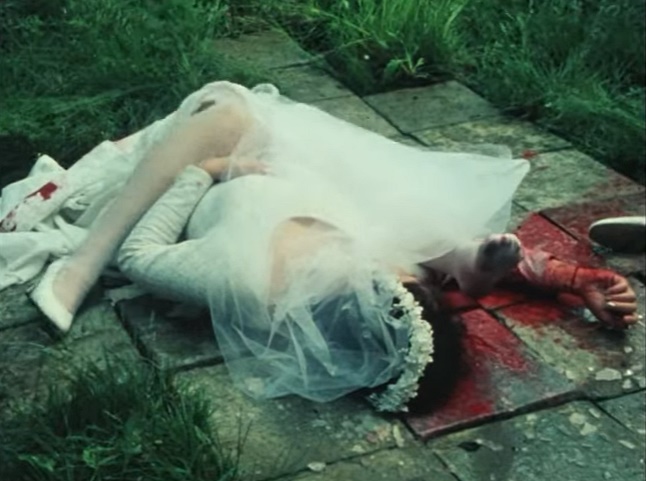
Getting locked up for the day yet again, a frustrated Harker discovers a doorway hidden behind a tapestry that leads to a separate wing of the castle. After walking down some hallways and ascending stairs, he finds a room with a casket reading "Vlad Tepes, Prince of Wallachia, 1475" and an old painting of Vlad that looks an awful lot like Dracula. Also in the painting is a young woman who's a dead ringer for Lucy. Before he even has a chance to put two and two together, Jonathan's forced to write a letter home and is then attacked by Dracula, a couple of his goons and three of Dracula's vampire brides, two of whom are played by Virginia Wetherell (THE CRIMSON CULT) and a young Sarah Douglas (who'd go on to play Ursa in Superman 1 & 2 plus a lot of roles in fantasy, sci-fi and horror films in the following decades).
With Harker now out of the way, Dracula arrives in Whitby, England via a Russian schooner five weeks later. Soon after, Lucy comes down with a bizarre illness punctuated by anemia, weakness, sleepwalking and terrible nightmares, accompanied by strange marks on her neck. Mina arrives at their estate to help out Mrs. Westenra (Pamela Brown), while Arthur brings in reinforcements in the form of Dr. Van Helsing (Nigel Davenport - PHASE IV). Naturally, Dracula has been luring Lucy out of the home late at night for necking sessions. Van Helsing, who's well-versed on all things supernatural, fears a Nosferatu may be responsible and takes the necessary precautions. However, garlic necklaces, blood transfusions and trying to guard the girl all end up for naught when Dracula uses a wolf to distract the family and is able to sink his fangs into Lucy yet again. She passes away and is entombed, returns as a vampire and has to be staked.


Now that the reincarnation of his lost love is gone, Dracula sets out for revenge. He kills a zookeeper (using an entranced wolf), a servant and some guys at a hotel (heaving one out of an upstairs window), plus sets his sights on Mina. Meanwhile, Van Helsing and Arthur try to find out more about him. They're able to tie his arrival in England to the Russian boat and a shipment of dirt (that the count needs to sleep in), which then leads them to Carfax. There, they destroy coffins containing the Earth, effectively forcing Dracula to return home. While that sounds good in theory, Mina is hypnotized and drinks the vampire's blood first, which forces them to go all the way to Transylvania to track Dracula down in order to prevent her from turning into one of the undead.


This is a very difficult movie to either praise or criticize, so I won't really do either. I mean, it's FINE. It's adequate. It's watchable, well-produced, well-acted, paced about right and competently directed and presented. There's nothing wrong with this at all... and yet there's also very little that stands out about it either. The art direction, sets, props, costumes and overall period detail are fine as an evocation of the late 1800s... yet not particularly imaginative. The photography is decent and there are some odd camera angles... just not very many of them. Same with landscape shots and shooting locations (mostly the UK but with bits shot in the former Yugoslavia). All nice. All fine. Richard Matheson's script, which adds a reincarnated love story angle and ties to Vlad the Impaler to the works, is also fine. I could continue to "fine" you to death right now describing everything else about this so I won't.


Palance's approach to the part combines a stiff gait, soft-speaking, a certain breathlessness at times... plus some animalistic hissing during the more intense moments. Everything about him seems a little bit off. He's awkward, sometimes anxious and doesn't seem comfortable in normal conversation; certainly not the suave, sophisticated, confident, gentlemanly Dracula we so often see in other films. Though he's aware of his power and strength, he's mostly quiet and brooding. His driving force is love and companionship and Palance attempts to play him more as a tragic outcast than outright evil. Though I could see this casting choice and the actor's approach to the role being problematic for purists, Palance ends up being the most interesting thing here because at least he offers up something different. As far as the rest of the cast is concerned, zero complaints there. Every single actor does their job well.


Originally scheduled to make its U.S. debut on CBS TV in October 1973, the premiere had to be bumped a full four months to February 1974 due to more pressing news coverage involving the resignation of corrupt president Richard Nixon's corrupt vice president Spiro Agnew. While Agnew got off easy like nearly all wealthy, well-connected people do (he had all charges dropped aside from one, paid a small fine and was given a few years probation), Dracula ended up getting screwed. It lost its prime time pre-Halloween time slot and was then unceremoniously dumped off later on to little attention. To make up for that somewhat, this was released to theaters in the UK, Italy, France, Brazil and in other countries. It was also later able to capitalize on the release of Francis Ford Coppola's (overrated) big budget Dracula adaptation in the early 90s with TV and VHS reissues.


This made its VHS debut here on the ThrillerVideo label in 1986, which came with Elvira commentary. MPI then handled later laserdisc, VHS, DVD and Blu-ray releases. The version that ran on TV was slightly cut to remove a bit of blood seen in the theatrical cut; changes that are outlined in one of the bonus features on the Blu-ray. It also has (very brief) interviews with both Curtis and Palance. The extras are slim on all of the releases.
★★1/2