.
.
.

Tuesday, November 24, 2009

Alien degli abissi (1989)

...aka: Alien: Creature from the Abyss
...aka: Alien: La creature des abysses
...aka: Alien from the Deep

Directed by:
Antonio Margheriti

Science professor/reporter Jane ("Julia McKay"/ Marina Guilia Cavalli) and her cameraman Lee (Robert Marius), both of whom work for Greenpeace, travel to a remote, barely-populated island to investigate claims of illegal toxic waste dumping. They sneak into E Chem; a large, heavily-guarded geothermal plant, catch them throwing barrels of waste into an active volcano and take video evidence. As they're leaving, security camera catch them snooping around. Gruff Colonel Kovacs (Charles Napier, doing that hard-ass, jaw-clenching bad guy routine we love him for), the guy who runs E Chem, sends out some guards to capture them. Lee is smart enough to hide the tape before being apprehended. Jane, on the other hand, stows away on a helicopter, manages to leap out into a lake and is then pursued by the guards through the jungle. Jane is lucky enough to bump into brainy-looking, tobacco-chewing "snake hunter" Bob (Daniel Bosch), who's there on the island to acquire snake venom to see to a pharmaceutical company. With his help, Jane manages to get to safety, at least temporarily. She still plans on sneaking back over to E Chem to rescue Lee and locate the hidden video. We are now over 50 minutes into this movie and only one question remains: "Where in the hell is that alien?"

Rest assured, it does finally show up. At first we get mere glimpses of the beast's giant claw as it reaches out and kills people. The monster burrows through the ground and also seems to have either acidic blood or toxic blood that's been effected by the dumped waste. In other words, getting the green blood-gunk on you is bad news as it melts away your flesh. Several characters refer to it as an alien here. What I don't get is why they even bothered having it be an alien in the first place. They've already spent so much time with the chemical dumping plot, so why not just make it a mutant creature spawned from toxic waste? Oh well, I guess "Mutant Metal Crustacion from the Deep" just doesn't have that special ring to it. Well actually, I like the ring of that better, but it probably wouldn't have the same ability to rope in fans of ALIEN (1979) and ALIENS (1986). Speaking of ALIENS, the finale here is almost an exact carbon copy of its finale. The James Cameron film featured a tank top clad Sigourney Weaver using one of those yellow loading dock contraptions to push the alien out of a time lock into space, while this one features a tank top clad heroine using a yellow bulldozer to push the alien into a volcano. So much for originality.

You will need some patience to make it through this one. It's slow moving, the dialogue is pretty cheesy ("Don't come on to me, you snake squeezer!") and many of actors are poorly dubbed, but patience is rewarded with one of the most bizarre-looking monsters ever created. The best way to describe it by calling it an upright scrap metal crab. It's black, oily, skinny and very tall... and its claws are bigger than its body! The fact that someone actually designed this huge thing full scale is also pretty great and makes me resent CG effects more than I already do. There's a decent amount of violence (including a face being ripped off) and jungle action (including a scene where three guys are killed by leaping cobras in a cave), quite a few explosions and some decent miniature model work of the plant being destroyed. Technically, it's a well-made, well-budgeted movie, but as a whole it's still a bit too predictable, derivative and routine to have much staying power. Prolific Euro horror regular "Alan Collins" / Luciano Pigozzi has a good-sized role as nuclear physicist Dr. Geoffrey.

There's no R1 DVD release. I don't think it was ever released here in the U.S. on video either. It was one of the last films from Margheriti (billed here under his usual "Anthony M. Dawson" alias), who worked steadily in Italian films from the late 50s until the early 90s (and passed away in 2002). His other genre work (as director) includes HORROR CASTLE (1963), CASTLE OF BLOOD (1964), THE LONG HAIR OF DEATH (1964), WILD WILD PLANET (1966), SNOW DEMONS (1967), SCHOOL GIRL KILLER (1968), SCREAMS IN THE NIGHT (1968), WEB OF THE SPIDER (1970), SEVEN DEATHS IN THE CAT'S EYE (1972), KILLER FISH (1978) and CANNIBAL APOCALYPSE (1980).

★★

Black Castle, The (1952)

Directed by:
Nathan Juran

Adapting the alias "Richard Beckett," Englishmen Sir Ronald Burton (Richard Greene) travels with his faithful servant Romley (Tudor Owen) to a small Austrian village to investigate the recent disappearances of two of his friends who were last seen in the area. He assumes Karl von Bruno (Stephen McNally), a sadistic count who seems to have a stranglehold over the entire village, has something to do with it because of an altercation that occured years earlier in Africa that cost him one of his eyes. Ronald has managed to snag an invitation to a hunting competition taking place on von Bruno's grounds (he's even imported a vicious black leopard in for the occasion) and decides to use the opportunity to search for either his friends (granted they're still alive) or evidence that will implicate the count in murder. What Ronald doesn't plan on is falling in love with his host's mistreated wife Elga (Rita Corday), who was forced into marrying a man who has no problem flaunting his infidelities in front of her. Various complications ensue, castle physician Dr. Meissen (Boris Karloff) becomes an unlikely ally and brutish, mute manservant Gargon (Lon Chaney, Jr.) lurks around in the hallways.

You certainly get your money's worth with this Universal production. Not only is it a well-made, extremely entertaining and nice-looking effort recalling the studio's classic era days, but it's also fast-paced, fairly well-plotted (Jerry Sackheim scripted) and offers up a pinch of just about every single genre under the sun. There's swashbuckling action, an exciting hunting adventure, romantic drama and excellent Gothic castle sets, secret passageways, a pit full of hungry alligators, a torture dungeon, a truly sadistic villain and Karloff and Chaney on hand for us horror fans. Both horror stars do what's asked of them here in their smaller supporting roles, but the film centers primarily around Greene and McNally. Thankfully, both actors are great in their roles. Greene is very charismatic and likable as our hero and McNally (in a role that will likely bring to mind the character of Count Zaroff in THE MOST DANGEROUS GAME) gives a terrific performance as the evil, eyepatch-wearing count. In addition, there are nice supporting turns from Michael Pate and John Hoyt as von Bruno's cronies and novel use is made of a fake death serum; an idea later recycled for the all-star Gothic horror THE BLACK SLEEP (1956).

Director Juran would go on to make the cult horror favorites 20 MILLION MILES TO EARTH (1957), THE BRAIN FROM PLANET AROUS (1957) and ATTACK OF THE 50 FOOT WOMAN (1958), but this is just as noteworthy - if not moreso - than his better-known films. The music score is all stock (including familiar snippets from THE WOLF MAN) and Bud Westmore (whose work adorns over 500 films) did the makeup.

Universal issued an excellent print of the film as part of their "Boris Karloff Collection" set, which also includes the films NIGHT KEY (1937), TOWER OF LONDON (1939), THE CLIMAX (1944) and THE STRANGE DOOR (1951; which was also written by Sackheim).

★★★

Sorcerers, The (1967)

Directed by:
Michael Reeves

Elderly, impoverished professor Dr. Marcus Monserrat (Boris Karloff) promises to painlessly cure stammering, self consciousness, anxiety and other psychological problems through "medical hypnosis." He and his wife/assistant Estelle (Catherine Lacey) run a small clinic out of their own home where they treat patients, but are actually looking for a guinea pig in their mind-control experiments as young antiquity store owner Michael (Ian Ogilvy) soon finds out. While hanging out in a cafe, Michael is approached by Marcus, who promises "an extraordinary evening" if he'll simply follow him home. Michael, who's looking for some excitement and getting a bit bored hanging out in swingin' London clubs with his mechanic best friend Alan (Victor Henry) and sort-of girlfriend Nicole (Elizabeth Ercy), takes him up on the offer, allows the professor to hook him up to a machine, some psychedelic swirls are projected onto his face and now the professor and his wife can control his every action. Not only that, they can also feel exactly what he feels.

Though Marcus wants to immediately share his discovery with the scientific community so it can be used for good, Estelle talks him out of it. She wants vindication for him having been laughed at and discredited by his peers 30 years earlier, which effectively ended his professional career and caused them financial hardship ever since. Estelle first uses their hold over Michael to make him break into a store and steal a fur coat. She then wants to feel the exhilaration of speeding across the country on a motorcycle and the adrenaline rush associated with physical violence. The more she experiences, the more power-mad she becomes. Estelle incapacitates her already frail husband, destroys his equipment and eventually forces Michael to stab his ex-girlfriend (Susan George) to death with a pair of scissors and strangle a pop singer (Dani Sheridan). Michael's chums begin to realize something's not quite right and the cops (led by Ivor Dean) start to close in on him.
.
I'm not quite sure what the "point" of this might be, but the storyline itself is full of subtext that helps to keep things interesting. We have an older couple controlling and living vicariously through a young host; experiencing the thrills and highs of a liberated, carefree youth that they likely never had a chance to experience in their own lifetime. As compromise, any time Michael experiences pain or injury, it's also felt by Marcus and Estelle. We also have the power play between husband and wife. From all indications, Estelle has been a supportive, subservient housewife for many years, always cooking her husband dinner and dilligently assisting him in his experiments. The very moment she gets a little control, she uses her newfound freedom to lash out, get the upper hand on her husband and enact out her own little violent scenarios.
.
Though the film certainly falls short of its true potential, often seems unfocused and spends too much time showcasing lame pop acts at the nightclub (likely to appeal to a younger audience), this still has its merits. Especially noteworthy are the two lead performances; Karloff does a fine job engaging our sympathies, and he's matched every step of the way by Lacey in the showier role as the increasingly unhinged wife.
.
Director Reeves had previously made THE SHE-BEAST (1965), went on to his greatest glory a year after this one with WITCHFINDER GENERAL (1968) and died of an "accidental barbituate overdose" in 1969 right before production was to begin on THE OBLONG BOX (1969), a project that was handed over to director Gordon Hessler. He was just twenty-five years old. Production company Tigon Film Distributors also released CASTLE OF THE LIVING DEAD (1964), which was co-written by Reeves, who also served as second unit director on the film.
.
Allied Artists handled theatrical distribution here in the U.S., though it's never been officially released here on DVD.

★★1/2

Monday, November 23, 2009

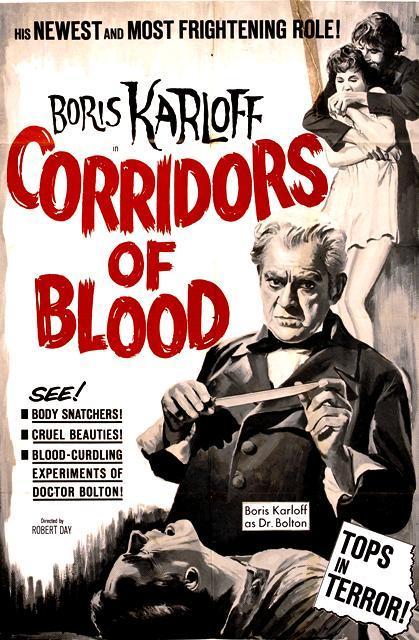
Corridors of Blood (1958)

...aka: Doctor from Seven Dials

Directed by:
Robert Day

In 1840's London, esteemed surgeon Dr. Thomas Bolton (Boris Karloff), who is renowned and respected by his peers for both his speed and his efficiency, is trying to find a way to perform painless surgeries. You see, in those days before anesthesia, anyone needing an operation or limb removed were simply strapped down to a table and forced to undergo the painful procedure completely conscious, which often led to some nasty psychological complications later on. At his home-lab, Dr. Bolton begins experimenting with nitrus oxide and other chemicals he thinks may alleviate pain, using himself as a guinea pig and keeping notes of all his findings in a small notebook. When he thinks he's made a breakthrough, he presents his findings to the medical board and is humiliated when things backfire and his patient freaks out. He returns to his lab and decides to begin experimenting with opium. Unfortunately, he's already created too much skepticism from his peers, who've put a block on his access to chemicals and refuse to let him do another demonstration on his findings. Even worse, after dozens of times inhaling the opium compound, he's become a pathetic drug addict who's quickly losing his surgical skills and suffers from blackouts and periods of amnesia.

Whilst on the chemical, Dr. Bolton stumbles into a rowdy tavern in the grotty Seven Dials district and gets hopelessly immersed in the schemes of several shady characters who have been selling suspiciously fresh corpses to the same medical college Bolton's son Jonathan (Francis Matthews) attends. Burly tavern owner Black Ben (Francis De Wolff), with help from his lover Rachel (Adrienne Corri) and a facially-scarred thug named Resurrection Joe (Christopher Lee) have been killing the drunken and destitute who wander into the establishment. They get their hands on Dr. Bolton's medical notes and blackmail him into signing the death certificates of their victims. Bolton eventually finds himself hiding out there in a back room, carrying on with his experiments and slowly succumbing to both his addiction and delirium, while the authorities (led by Nigel Green) start closing in.

Despite the fact this wasn't released until four years after it was made and often on a double bill with the fun if inferior Werewolf in a Girl's Dormitory (1961), this is a very well made period horror-drama with top notch sets, a strong screenplay and excellent performances. It's an especially good showcase for Karloff, whose well-intentioned character always manages to engage our sympathies even when he's hopelessly siding with evil. Watching the actor go from a driven and caring doctor to a weakened, drug-addled, mindless shadow of his former self is one of the major reasons to see the film, but there's also good work from De Wolff, Corri and much of the rest of the cast. In support, Lee; tall, lean, strikingly dressed in a tophat and all black attire and often standing silently in the background, makes the most of his role as a remorseless killer. The cast also includes Betta St. John as Karloff's daughter-in-law, Finlay Currie as a colleague, Basil Dignam as the hospital board chairman and a young Yvonne "Warren"/ Romain as an abused barmaid.

Day also made the Karloff vehicle The Haunted Strangler (1958) for the same company (Amalgamated Productions). Criterion picked the film up for distribution and have put out an excellent quality DVD with plenty of extras. They also released it as part of a "Monsters and Madmen" box set, which includes the two Karloff/Day collaborations as well as Day's First Man Into Space (1959) and the sci-fi / thriller The Atomic Submarine (1959).

★★★

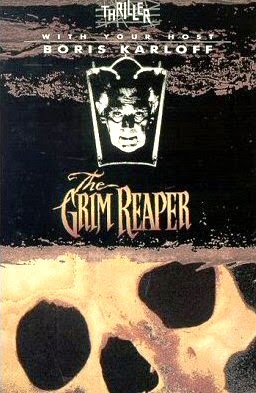
Grim Reaper, The (1961)

... aka: Thriller: The Grim Reaper

Directed by:
Herschel Daugherty

The popular Thriller series hosted by horror legend Boris Karloff ran from Fall 1960 to Spring 1962 on NBC and made an impact on lots of kids during its day, including a young Stephen King, who has called it "the best horror series ever put on TV." Unfortunately, of the 60+ episodes that were made, only six of them were officially released. This one, along with "The Incredible Doktor Markesan," "Masquerade" (also directed by Daugherty), "The Prediction," "The Premature Burial" and "The Terror in Teakwood" were all issued (separately) on VHS in 1996 by MCA/Universal. And sadly, that was it. Even though some (bootleg) sites offer the entire series on DVD-R, this has yet to see the legitimate box set release it so deserves. "The Grim Reaper" (which aired June 13, 1960 and was the 37th and final episode of the first season) was directed by prolific TV director Herschel Daugherty, who directed 16 episodes of the show and even more episodes of Alfred Hitchcock Presents. This one's also noteworthy for featuring William Shatner in an early starring role. Shatner and Daughtery would also work together on an episode of AHP that very same year, as well as several episodes of Star Trek in 1966.


"Someone is in mortal danger as sure as my name is Boris Karloff!"


In 1848 France, Pierre Radin (Henry Daniell) shows up at a boardinghouse looking for his reclusive artist son, only to find he's hung himself and left behind a painting of a skeletal Grim Reaper brandishing a scythe. Over a hundred years later, wealthy mystery writer Beatrice Graves (Natalie Schafer) is living up to her eccentric reputation by surrounding herself with offbeat things. She lives in a has a creepy old mansion, drives around town in a hearst and has just recently purchased the Grim Reaper painting at an auction to hang over her fireplace. Bea's not exactly the upbeat type; she's got a drinking problem and her latest husband, much-younger actor Gerald Keller (Scott Merrill) seems to have eyes for her secretary Dorothy (Elizabeth Allen) instead of her. In comes concerned nephew Paul (William Shatner), who wants to share some information about the painting, which is believed to be cursed. The past fifteen owners have all died unexpected, violent deaths and it's rumored that the painting bleeds whenever someone's about to die. When an inebriated Beatrice is found dead at the bottom of the stairs and it's revealed that Gerald has inherited everything, is it murder, is the story about the painting being cursed true or is it perhaps a combination of factors at work?

One of the most fondly remembered of all of the episodes in the series, and boasting one of the creepiest endings as well; solidly scripted by Robert Bloch (complete with some black comedy, a couple of decent twists and even an Addams Family reference) and nicely acted. Daniell and Karloff (the stars of the 1945 Val Lewton-produced classic The Body Snatcher) unfortunately do not appear in any scenes together here. Daniell appears for just for a few minutes during the opening scene and Karloff only has hosting duties in this one.

★★★

Boris Karloff Blogathon November 23-29

In celebration of Boris Karloff's 122nd birthday, a wonderful site named Frankensteinia: The Frankenstein Blog has decided to host a "Boris Karloff Blogathon" and are encouraging fellow film buffs, horror fans and/or admirers of the actor to participate in honoring the horror legend this week. If you have a movie blog, happen to stumble upon this and would like to contribute something, please make a trip to the link above, send them an email and sign up. Unfortunately, I probably won't be able to do a ton of reviews this particular week (got family coming in from out of town), and much of Karloff's work falls outside the years this particular blog covers (1950 to 1990), but I'm aiming to see at least three Karloff films I've yet to see. The blogathon ends November 29th, so the more Boris shout-outs, the better. I'm going to start my dedication with a brief bio and filmography and go from there.
.
Born William Henry Pratt on November 23, 1887 in Camberwell, London, England, Boris Karloff would go on to become one of the most respected, admired and acclaimed actors of all time; arguably the best to appear with regularity in horror films. Sadly, he himself never realized his importance or influence as a performer during his own lifetime, having a self-deprecating sense of humor about it all (he's been quoted as saying "My wife has good taste. She has seen very few of my movies!") After a spell at London University, Karloff emigrated to Canada in 1909, spent around ten years with a touring company and eventually settled in Hollywood, where he worked as a truck driver and sidelines player in silent features. He appeared in such films as THE BELLS (1926; his very first horror feature) and THE UNHOLY NIGHT (1929) before being offered a contract with Universal Studios. After the death of Lon Chaney and Bela Lugosi's refusal to play the role after his success in DRACULA, Karloff was offered the role of the monster creation in James Whale's timeless classic FRANKENSTEIN (1931) and delivered a multi-layered performance that shocked both critics and audiences; giving the hulking mass of strewn together body parts an unexpectedly disarming child-like quality. Whale used him again as a sinister butler in his great black comedy THE OLD DARK HOUSE (1932) and he was the first actor to portray THE MUMMY in a talkie that same year in Karl Freund's atmospheric film of the same name. Karloff would return to England to play another Mummy-like role as an Egyptologist back from the dead in THE GHOUL (1933) and make his first of many subsequent films with fellow horror star Lugosi in 1934's THE BLACK CAT, which allowed him the chance to play one of his most despicable characters; sadistic devil-worshipper Hjalmar Poelzig.

Karloff would go on to reprise the role that made him famous several more times, most notably in Whale's outstanding follow-up, BRIDE OF FRANKENSTEIN (1935), where he gave a brilliant, touching and relatable turn as an unloved, misunderstood and outcast member of a shallow and judgemental society. After the genre went into decline after Bride, he made spotty appearances in a few decent horror films and thrillers (most notably doing an outstanding job portraying good/bad twin brothers in 1935's underrated period horror-drama THE BLACK ROOM) and was in great form again playing a club-footed torturer to Basil Rathbone's Richard III in TOWER OF LONDON (1939). In THE MAN THEY COULD NOT HANG (1939), his wronged scientist avenged his death at the gallows by luring judge and jury to his home and then murdering them off one-by-one. The late 30s also saw him playing Chinese master-sleuth James Lee Wong in a series of five films, beginning with MR. WONG, DETECTIVE.

The 1940s saw a brief resurgence in horror (which died out again by 1946), but Boris managed to headline three excellent Val Lewton-produced chillers, where he gave notable villainous turns in ISLE OF THE DEAD (1945; playing a Greek general), THE BODY SNATCHER (1945; as a murderous grave-robber in one of his very best roles) and BEDLAM (1946; as Master Sims, sadistic asylum master). The 50s saw lots of TV work, two Abbott and Costello horror comedies and more turns as evil-doers, mass murderers and mad doctors. In THE STRANGE DOOR he was more or less wasted playing a manservant torn between doing the bidding of his evil master and helping out a young couple. In 1952's THE BLACK CASTLE he portrayed a similar conflicted supporting role as a murderous doctor. Other horror roles this decade include playing a skeptical scientist in VOODOO ISLAND (1957), a Jekyll and Hyde-like figure in THE HAUNTED STRANGLER (1958), the titular mad doctor in FRANKENSTEIN - 1970 (1958) and a well-intentioned but drug-addicted surgeon who makes an unholy pact with grave robbers in CORRIDORS OF BLOOD (1958).

In the 60s, Karloff was cast as a sorcerer in Roger Corman's horror spoof THE RAVEN (1963), appeared in Mario Bava's seminal horror anthology BLACK SABBATH (1963) in the chilling "The Wurdulak" segment (his only vampire role; he also hosted the American release version of the film), played Nahum Witley in DIE, MONSTER, DIE! (1965), one of the very first films based on an H.P. Lovecraft story and provided the voice of Boris von Frankenstein in the animated kiddy film MAD MONSTER PARTY in 1967. Toward the end of his career and in ill health, Boris gave an affecting and very knowing performance as aged horror star Byron Orlok, a character patterned more or less after himself and believes fictional horrors are no competition for real-life ones, in Peter Bogdanovich's impressive debut film, TARGETS (1968). Mr. Karloff wrapped up his long and distinguished career with four pretty awful U.S./Mexican genre films, where he shot his footage in California to be incorporated into footage shot south-of-the-border.

Having appeared in around 70 horror features, Karloff cemented his reputation by appearing on and/or hosting numerous horror/mystery television shows, including Boris Karloff Mystery Playhouse, Out of This World, Suspense, Tales of Tomorrow, Thriller and The Veil. In addition to his screen highlights, Karloff received acclaim for his stage performances in Arsenic and Old Lace and The Lark (receiving a Tony nomination the latter) and was one of the founding members of the Screen Actor's Guild.

Karloff Horrorography [1950-1968]

THE STRANGE DOOR (1951), THE BLACK CASTLE (1952), ABBOTT AND COSTELLO MEET DR. JEKYLL AND MR. HYDE (1953), THE MONSTER OF THE ISLAND (1954), SABAKA (1954), VOODOO ISLAND (1957), CORRIDORS OF BLOOD (1958), DESTINATION NIGHTMARE (1958), FRANKENSTEIN - 1970 (1958), THE HAUNTED STRANGLER (1958), JACK THE RIPPER (1958), THE VEIL (1958), THE PREDICTION (1960), THE GRIM REAPER (1961), MASQUERADE (1961), THE PREMATURE BURIAL (1961), TERROR IN TEAKWOOD (1961), THE INCREDIBLE DOKTOR MARKESAN (1962), THE COMEDY OF TERRORS (1963), THE RAVEN (1963), THE TERROR (1963), DIE, MONSTER, DIE! (1965), THE GHOST IN THE INVISIBLE BIKINI (1966), CAULDRON OF BLOOD (1967), MAD MONSTER PARTY? (1967), THE SORCERERS (1967), ALIEN TERROR (1968), THE CRIMSON CULT (1968), DANCE OF DEATH (1968), THE FEAR CHAMBER (1968), SNAKE PEOPLE (1968), TARGETS (1968)

I've seen Jack the Ripper, The Veil, Die, Monster Die! and Targets but haven't gotten around to doing the reviews for them just yet. Some of the titles listed are from the shows Thriller and The Veil, but were released in the U.S. as features on video so I'm including them here.

Sunday, November 22, 2009

Ashes of Doom (1970)

Directed by:
Don Arioli
Grant Munro


Made by the Department of National Health and Welfare (with financing from The National Film Board of Canada), this is an anti-smoking horror-short which may have been filmed as a commercial. Set sometime in the 17th Century, it opens with a neurotic, chain-smoking woman (Nadia Salnick) lighting her umpteenth ciggie with a candle. Surrounding her are loads of over-filled ashtrays. A gust of wind blows out the candles, a pale-faced Dracula (played by the director) floats in from the window, the woman passes out, the vampire bites her and then coughs up smoke and keels over himself. The end. The opening title is spelled out with ashes and it runs just two minutes (half of which are credits).
If you would like to view this (courtesy of YouTube), just click right HERE.

★★
Related Posts Plugin for WordPress, Blogger...