... aka:
Rapture
Directed by:
Iván Zulueta
As a regular consumer of low budget and, some would say "low grade," horror, and also someone who genuinely enjoys such films for a whole host of reasons that have nothing to do with making fun of them, I have a bone to pick with this general premise. Why is it that any time a director wants to make a movie about another (fictional) director and wants to show said director is a troubled individual, they always make that person a horror director? And by "troubled," I mean the entire gamut of fucked up here. It could be a delusional person of limited to no talent, or someone who's just coasting through their profession, or someone who's not passionate about what they're doing, or someone who feels like they're "trapped" making these kinds of movies as if it's a ball-and-chain around their ankle, or a pervert, or a drug addict, or someone who's going insane, depressed, repressed, mentally defective in some way or even a psychotic killer themselves. Yup, it's always gotta be a horror director; the go-to profession for all manner of in-the-business downward spirals!
The only other genre-specific directors I've seen treated with such disdain on a regular basis are pornographers. I suppose it's because these two genres are (more specifically were; things have thankfully changed in recent years) considered to be the lowest rung of the filmmaking ladder, at least from the vantage point of pretentious artistes. In reality, I think they mostly frown upon the fact these films are often blunt, honest and straight-forward instead of burying content under 50 layers of impenetrable metaphor.


The director in question here is José Sirgado (Eusebio Poncella), who already has such Naschy-esque titles as "La maldición del hombre lobo" under his belt, and is currently in the process of putting the finishing touches on his latest vampire epic, which is strangely titled "Wolf Men." It's clear from the get-go this man is just not feeling it anymore. Maybe he never really did. He's so stubborn and desperate to do something different that he's willing, per his own editor's evaluation, to screw up the new film ("meaningless cinema" he dubs it) in post just to do something, anything, out of the ordinary. "Fuck the movies," he says. And yet that obsession for making films is still clearly there, even if written off with passivity ("It isn't me who loves cinema, but cinema that loves me"). Maybe going through the paces as a filmmaker isn't so much a passion as it is a crutch; a place to hide.
José leaves the editing room and then drives through Madrid as a parade of theater marquees are shown; mostly famous movie titles, mostly films more successful and respected than anything he's ever done or likely will ever do. The director's career ambitions certainly aren't helped any by the fact he's also a heroin junkie, and that's the main driving force behind the entire structure and style of the film. It's the nonsensical rationalized through an unreliable narrator. Since he's always in some kind of altered state, the events that follow are assumed to be some kind of altered reality. This compounds that confusion by adding another (actual) narrator to the works; a hoarse, husky, nagging voice that's ever-present. Regular dialogue will unspool between characters and any bit of silence is used to wedge in another comment or insight from this narrator. Not only that, but this also screws around with the chronological timeline on top of that.


José's in a miserable relationship with another junkie, an actress named Ana (Cecilia Roth). Sometimes she's there, sometimes she's not. He wants to end it, and even rehearses the break-up in the elevator on the way up, but just hasn't yet, likely out of guilt because it was he who got her addicted in the first place. Returning to his unkempt apartment after work, the everyday stresses of life start getting to him. He can't wake a stoned Ana up (and later will strip her and attempt to rape her while she's still unconscious), the bathtub overflows, the toilet won't work, everything's a mess... On a more intriguing note, he's received a package containing a film reel, an audio tape and a key. He starts the tape. It's from an amateur filmmaker named Pedro (Will More) and his is the voice of the pretentious narration we hear throughout. José has only met Pedro twice previously. Now he wants to see him again and claims it's "urgent."
José is actually better acquainted with Pedro's bubbly cousin, Marta (Marta Fernández Muro), whom he used to date and who's also a drug addict. She chauffeurs him to the remote home where Pedro lives in seclusion with his aunt, Carmen (Carmen Giralt). Pedro's obsession is making 8mm movies. These aren't real movies, as in scripted movies, or even documentaries with a set purpose, but instead random, mundane home movies that he curiously refuses to show anyone else after he shoots them. Marta sometimes hears Pedro "crying in desperation" from outside his bedroom as he watches them and claims his emotional development is stunted at around 12-years-old even though he's 27. She adds that her ex-husband is the only person who has ever seen one of the films. Whatever he saw was so strange and disturbing that he never spoke to Pedro ever again.


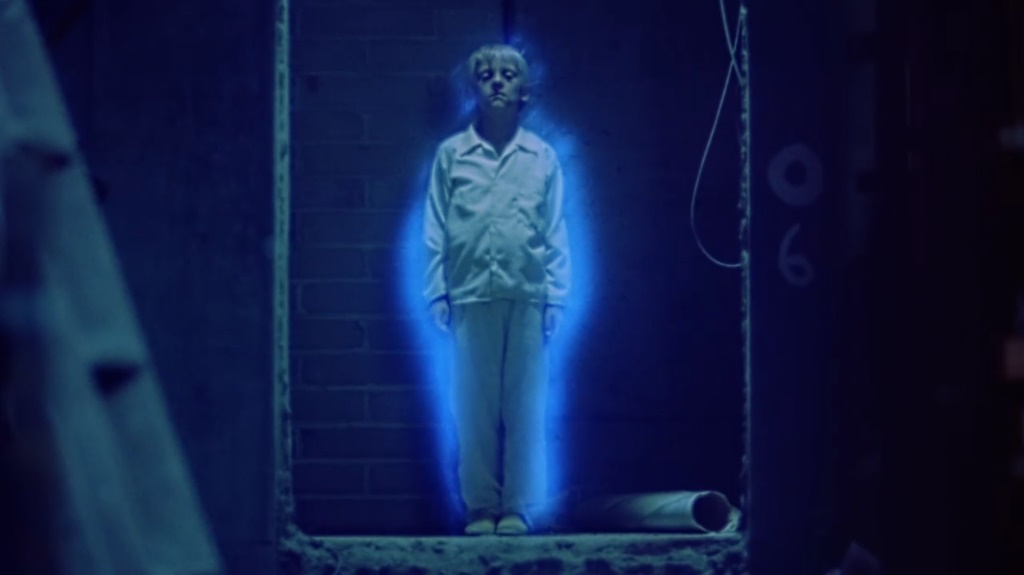
After dinner, everyone sits down to watch TV. Carmen goes on a never-ending rant about how much she adores Alan Ladd, how perplexing it is that men like "fat" Mae West, how she hates black-and-white movies despite being color-blind herself and how dubbing makes people sound like chickens. Pedro lurks in the background staring José down and clutching a clown doll. The doll's eyes start to glow as he proceeds to fast-forward through hours of TV in just minutes. It's like he's able to control time. Or maybe José is just high again.
Later that night, the weird man-child turns up in José's bedroom unannounced to share some lines and talk. He claims he hates drugs because they make him feel grown up, yet is unable to sleep without some "powder," and adds that he doesn't get to have much sex either, yet sometimes gets to "...fuck my cousin and her husband, too" (!?) He eventually shows José some of his home movies, which seem to merely document everyday, ordinary life, yet at an accelerated frame rate and lacking the proper "rhythm" he's looking for. As he watches, Pedro starts sobbing, curls into a fetal position and clutches a teddy bear. Why is he refusing to grow up? Why is he filming his life instead of living it? He, just like José with his drug addiction, doesn't seem to be able to handle unaltered reality, or perhaps the reality of aging, stress and mortality. The voice-over attempts to shed some light about his search for "understanding the meaning, the purpose, the role, the game that 'making movies' represented." Also, major homoerotic vibes going on here, along with numerous accompanying wang shots.
This entire trip to Pedro's turns out to be a flashback, as does the next sequence, which details a second trip to the home. This time, José brings along Ana, and there are immediate arguments over the drugs that are starting to take over everyone's lives. There's also discussion about those little things that bring on, or used to bring on, intense feelings of pleasure or joy; things as simple as green slime, Betty Boop dolls and King Solomon's Mines comic books; things most of us associate with childhood. It's no coincidence that much of the soundtrack is comprised of sounds that bring to mind carnivals, music boxes, squeaky toys and other things of childhood merriment. Drugs, sex and movies are perhaps just adult attempt at being as enraptured by something in the face of maturity, life experience and cynicism.


The rest of the film returns to present as José and Ana watch the film reels Pedro sent to them. He left home the day after their last visit to experience life, and found little about it to actually enjoy. He began documenting his travels. The drug use continued. And then he accidentally recorded himself sleeping one night. An anomaly, a split second red frame, showed up in the footage. Subsequent attempts to film himself sleeping resulted in the red "pause" increasing in length. Believing this signified that his days were numbered, he and his gal pal Gloria (Helena Fernán-Gómez, who's dubbed by Pedro Almodóvar!) hit the streets to indulge their base fantasies, which include seducing a biker with promises of a three-way and then trying to (I think?) drink his blood. However, Pedro's illness worsens as he finds out some interesting things (best not described by me) about his camera...
Arrebato is the exact type of art house / transgressive / surreal / experimental / whatever-you-wanna-call-it "cult" film that interests me in some ways yet doesn't really work for me in its entirety. It may for you. Who knows? Watch it and find out for yourself. Some people, including a lot of critics, seem to love this and lavish it with praise. I found it to be a film that reaps some rewards, yet I'm not sure the patience and forgiveness required on my end to make it down this rocky road was fully justified by the actual content found therein. I also found some aspects extremely silly and unintentionally comic.
The drug and film addiction parallels as a means of adult cope are pretty in your face, and there's no escaping the fact this could have said the exact same things with a linear narrative, less self-indulgent blabber and minus the hideously unlikable characters you'd rather see get hit by a bus than given another second of time to inflict their dreary worldview upon you. I think this would have been far more compelling if the characters were sympathetic, fleshed-out a bit better, or actually worth getting to know. They're not. What's even the point of using drugs as a means to escape existential crises and recapture the brain-not-fully-developed joys of youth if all that does is make you even more miserable than before? Maybe the director was trying to paint self-important, nihilistic addicts and artists (even himself, as he was both) as insufferable killjoys who suck every ounce of joy out of a room.


In film, we often get to see the ravages of addiction on the addicts themselves, but seldom get to see the toll taken on those left to deal with the fallout. Whether in film or in real life, dealing with addicts is tedious. Hell, just being around someone who's drunk or high in any capacity when you're sober can be pretty tedious. It's especially tedious when you're around someone chemically impaired who also fancies themselves a philosopher and spouts a bunch of gibberish they think is deep and profound when it's really just shallow and semi-coherent. This film often feels like that; like you're trapped in a room with Stoned Sartre lecturing you for two hours about how life is meaningless.
Yes, this is two hours long and it's a long two hours. At one point it was actually three hours long until a merciful producer stepped in and forced the director to edit it. Seeing how what's left is insanely dialogue-heavy (between the characters and voice-overs, it's a near-constant stream of talk from beginning to end), moments of pause and reflection may have been what ended up on the cutting room floor.
Though often listed as a 1979 release on various websites (perhaps due to the fact the opening credits brag that it won a "special prize by the Ministry of Culture in the year 1979"), this actually didn't have its official premiere until June 9, 1980 at the Azul Cinema in Madrid. Though it was not initially successful, it would become a popular midnight / cult film in Spain later on and reportedly played at one theater for an entire year.
Here in America, this played at the Chicago International Film Festival in 1980, had a very limited run in 1982 and then vanished for decades without ever making its way onto home video until it was 30 years old. There was a 4k restoration in 2021, followed by another limited run in select theaters. It was given a Blu-ray release by Altered Innocence in 2022 and finally earned the ultimate film snob seal of approval when it was streamed by The Criterion Channel that same year.
★★1/2