... aka: Gli occhi verdi della morte (The Green Eyes of Death)
... aka: Morbid Habits of the Governess, The
... aka: Vicios Morbosos de una Institutriz
Directed by:
"Peter Rush" (Filippo Walter Ratti)
Often times you get some pretty clear warning signs that a film is going to suck before you even watch it. This particular film has many of those. For starters, the director was nearing 60 when he made this and doesn't appear to have worked on anything of note despite being in the industry since the mid 1930s. Of his seventeen credits as director, only a few (this one included) have made it to DVD, most have no reviews anywhere and some appear to no longer even exist. I would also throw in the fact he has opted to use a pseudonym ("Peter Rush") as a warning sign except for the fact that was common practice for European filmmakers in order to try to sell their films internationally. The second cause for alarm is that this was shot in the heyday of Italian giallo (around 1972) but didn't receive a release until five years later when the genre had already cooled down considerably in popularity. Pretty much any mediocre genre film with the requisite blood and nudity was being released in the early 70s, so why not this one? In addition to that, this doesn't appear to have been theatrically released outside of Italy.
Finally, it took forever for someone to release this onto home video. I'm actually not aware of a single VHS release anywhere in the world until this made its English-friendly debut in 1996 courtesy of UK outlet Redemption. No one seemed to really care much back then (according to one source, this was one of the lowest-selling tapes in Redemption's entire catalogue), nor did they seem to care when DVDs were hitting their peak in popularity and films in this genre were being spit out left and right in fast succession. So why wasn't this one?

Some of the above questions can certainly be explained in other ways. A director can sometimes have a string of awful films yet eventually hit one out of the park... or start out with a great one and then deteriorate from there on out. And, of course, just because something's obscure or had distribution issues doesn't necessarily mean the film is bad. Often times it's because of copyright / ownership problems, or that the film cannot be pigeonholed into one genre (making it difficult to market), or that the original film elements are missing. There are all kinds of reasons really. Still, for this one to take around 45 years (!) to finally receive something resembling a decent home video release isn't exactly reassuring.


Platinum blonde Ileana (Isabelle Marchall) takes a break from her world travels to go home and visit her elderly father, Baron de Chablais; one of the world's leading experts on "Oriental art." Against her father's objections (not that it matters since he seems to suffer from either Alzheimer's or dementia and can't remember anything), Ileana insists on inviting some of her friends over to their castle home for the weekend. Coming along on the trip are her best friends and traveling companions, Elsa Leiter (Patrizia Gori) and Gretel Schanz (Adler Gray), as well as three male friends. Frank Hoffmann (Giuseppe Colombo) is the doctor son of one of the Baron's (late) good friends and has bad blood with the household maid Berta (Annie Carol Edel). Two years earlier, the two had an affair and he wiped out her savings account in the form of a "loan" that he has yet to pay back. Needless to say, she's still a bit salty about that.


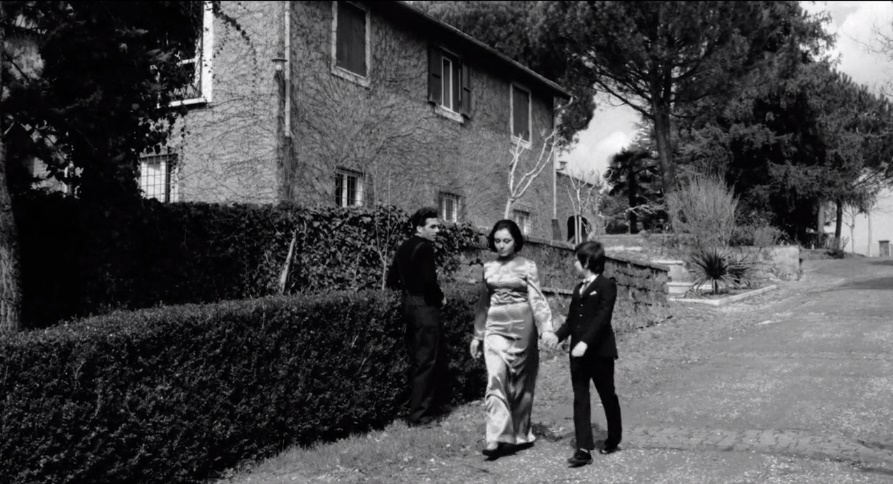
The two new additions to the clique are Pierluigi La Rocca (Roberto Zattin) and Bobby Jelson (Gaetano Russo), a pair of sleazy "two-bit playboys" who've somehow managed to pull the wool over the ladies eyes. Both men are involved in drug smuggling and hid drugs inside Ileana's vases (gifts for her father) while she was visiting Hong Kong. They now have 48 hours to get said drugs into the hands of some goons or else. While getting the drugs back proves to be no issue, the duo get wind of another money-making opportunity if they're willing to indulge in a little grave robbing. And at least one of them is. Apparently the elderly baron took a second wife, a teenage Thai princess (?), as a bride, but she died when she was just 30-years-old. Her crypt is located on the castle grounds and it's said she has been buried wearing a valuable emerald necklace worth 150 million lira. Hmmm.
There are two other permanent fixtures in the home; butler Hans and the baron's teenage son, Leandro. Leandro, supposedly driven mad after witnessing his mother kill the gardener during an attempted rape, is secretly being housed in the castle's labyrinthine cellar / catacomb system. The family have been lying and telling everyone he's actually a patient at a mental home in Beirut, but the "family shame" is actually hiding out there indulging in favorite pastime: killing, dismembering and stuffing animals. Sounds just like another famous Psycho we all know and love. Still, his bloody little hobby doesn't seem to bother the maid all that much, as she likes to have drug-fueled sex with him!


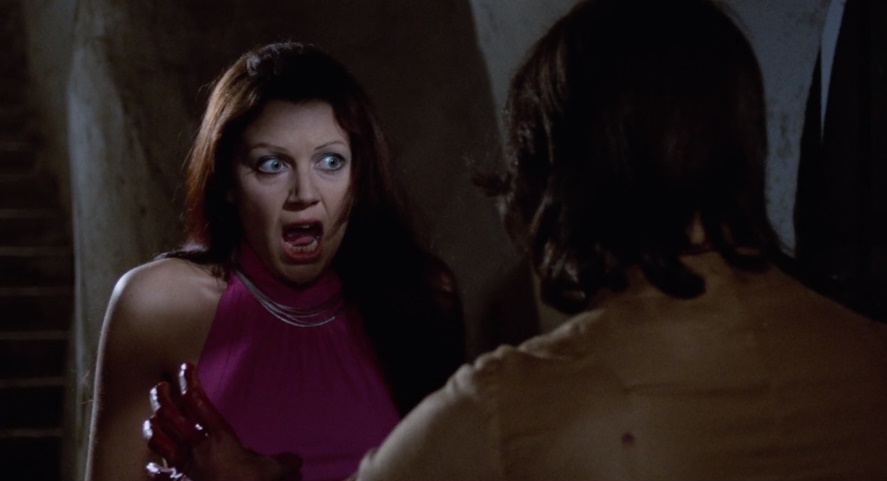


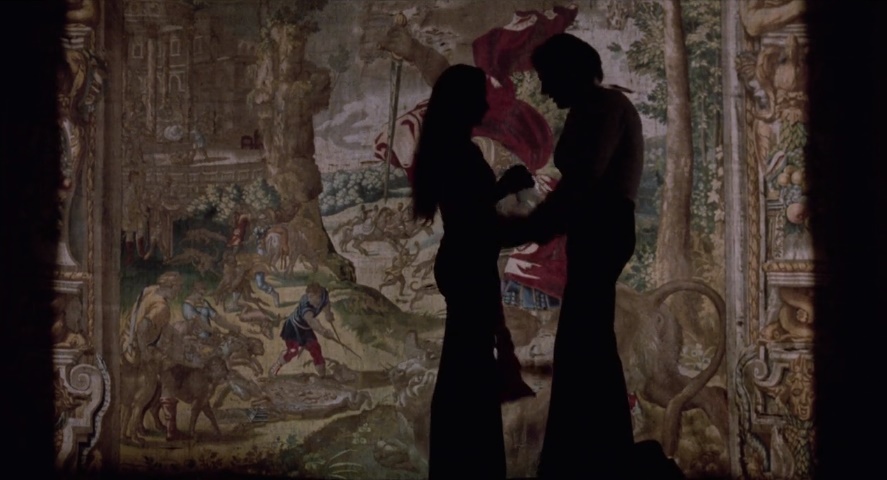
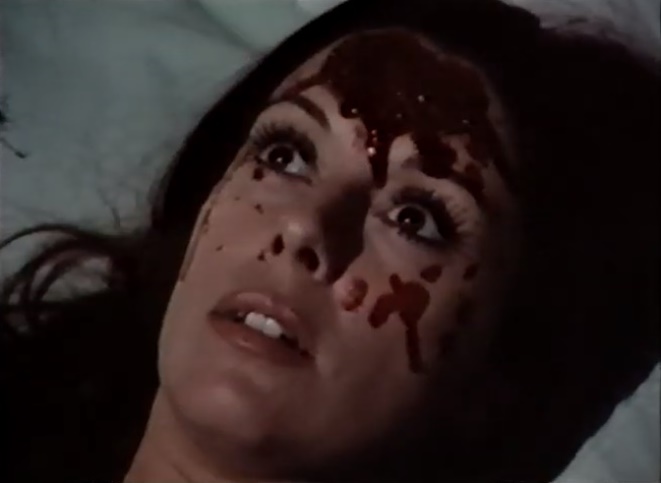
The "friends" get drunk on champagne, have a disco dance party and play charades, which somehow manages to include a lesbian make-out session in front of a fireplace. Bobby slips drugs into Ileana's drink so he can have his way with her, while Pierluigi finds a willing partner in the kinky Elsa, who isn't much for after-sex cuddling but is always up for having a lit candle shoved up her ass (!?) Everyone's fun is soon spoiled when a mystery killer offs Elsa, who's stabbed through the heart and then has her eyeballs popped out with a knife in the film's lone gruesome scene. Her nips are also removed from her corpse. The chaos gives the old baron (who sees the killer walking away with a bag o' eyeballs) his third heart attack, which then puts Ileana into a temporary "state of shock."


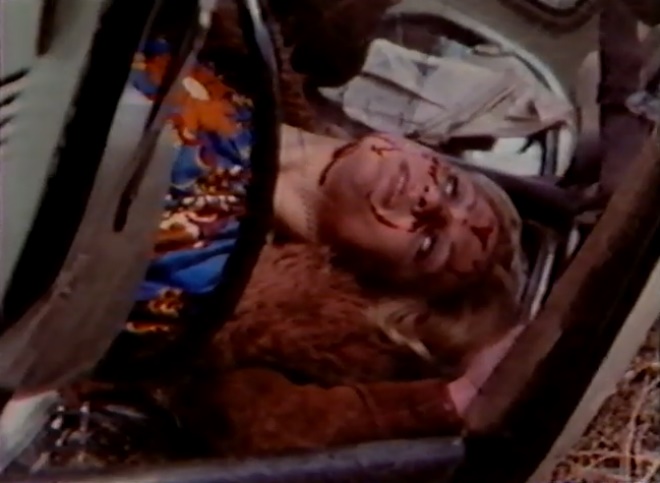
Police inspector Corrado Gaipa (who had a role in The Godfather at around the same time!) shows up to interrogate the household and spends his time hobbling around with his cane asking stupid questions. Meanwhile, the smuggled drugs turn up missing so Pierluigi decides to instead raid the tomb for the emerald necklace. He goes and kills two of the thugs who've been harassing him, puts their bodies into a car and sends it over a cliff.
This starts out tolerably and has fantastic early 70s fashions to feast your eyes upon, but becomes progressively duller until the first gory kill scene and a bit of sex finally wakes you back up at around the midway point. After that, this has little else to offer and deteriorates into a convoluted, plodding mess focusing most of its attention on its dull and unlikable roster of characters. Even the rapid-fire kills (stabbings, a neck slashing, a body thrown over a cliff, another [off-screen] eye removal...) in the last few minutes don't help any as these scenes are all poorly-staged and completely devoid of suspense.


The restored version under review (in its original Italian language with English subtitles) was released by Vinegar Syndrome in 2021. It's included in the box set "Forgotten Gialli: Volume 3," which also includes the pretty good Italian / Spanish Gothic film MURDER MANSION (1973), which is not even really a giallo, and Autopsy (1973). Interestingly, even the most complete version of this film appears to be missing a lot of footage, especially in regards to the sexual content. In the Cinesex Mese photo novel for this title (released back in 1973, a good FOUR YEARS before the actual film), there are photos of full frontal female nudity and more graphic sex scenes; none of which are in the film. (Scans from the photo novel can be seen on the Euro-Fever Blog [which hasn't been updated since 2015] if you're interested.)
★1/2