.
.
.

Friday, October 14, 2011

Twisted Nerve (1968)

Directed by:
Roy Boulting

Entertaining, well-acted, well-made psycho-thriller; this didn't make much of an impact at the box office back during its day and would be the only genre release from the fledgling Charter Film Productions (who cranked out a couple of comedies after this and then folded). The film was actually somewhat controversial upon release for what some felt was an irresponsible attempt to link mongolism (a condition we now refer to as Down's Syndrome) with psychopathic and criminal behavior. To counteract that, the film had a disclaimer ("Ladies and gentlemen, in view of the controversy already aroused, the producers of this film wish to reemphasize what is already stated in the film; that there is no established scientific connection between mongolism and psychotic or ciminal behavior.") spoken by a stuffy-sounding man tacked to the beginning. Aside from the scientific nonsense; which really only comes into play briefly at the end, doesn't amount to much of anything anyway and can easily just be overlooked, plus the fact the film isn't particularly well-known and underperformed at the box office, it would go on to become an influential effort in some rather surprising ways.


Twenty-two-year-old Martin Durnley (Hywel Bennett) lives at home with his overly nurturing mother (Phyllis Calvert) and his stern, wealthy stepfather (Frank Finlay). Since all of his siblings suffered from "mongolism" and Martin was born "normal," his mother has been a bit smothering over the years and managed to seriously spoil her son in the process. However, Martin's stepfather wants him to get out and begin his life independently of them; especially seeing how Martin doesn't do much but sit upstairs listening to records and is frequently getting in trouble with the law. While out shoplifting, Martin is caught by the police. He gives them a false name ("Georgie Clifford") and pretends to be mentally retarded. Pretty, sweet Susan (Hayley Mills), a student who works as a librarian, sympathizes with "Georgie" and helps get him off the hook, but when Martin returns home and his stepfather gets wind of what took place, he gives Martin some money and tells him he has to move out.


Martin then decides to adapt the "Georgie" persona and wedge himself into Susan's life. Susan is temporarily staying with her lonely mother Joan (Billie Whitelaw) while she completes her studies. Joan owns a boarding house and has already rented out rooms to Gerry (Barry Foster), an abrasive alcoholic struggling to get by in the film industry (who's also Joan's lover), and Shashie (Salmaan Peerzada), an Indian medical student. One evening, "Georgie" shows up with a forged letter from his father asking them to take him in while he's out of town on business. They're reluctant at first, but since he seems relatively harmless and soon proves to be a big help doing various chores around the home, Joan soon takes a liking to him. It isn't long before "Georgie" sneaks off to murder his stepfather and his true intentions for Susan begin to surface. Sensing there's more to their new boarder than meets the eye (and finding a handwriting book with the name Martin Durnley written over and over again inside), Susan investigates.


Despite running nearly two hours, this has no problem maintaining interest. It's helped along by very good performances, an interesting screenplay (written by the director and PEEPING TOM scripter Leo Marks) and solid production values. Bennett does an effective job as the psycho (a showy, edgy role allowing him to take on two different personas), Mills (a former child actress just starting to move into more adult roles here; she'd marry the director right after filming was complete) is likable as our heoine and there are nice supporting performances from Whitelaw (whose character finds herself sexually attracted to "Georgie" in one of the ickier subplots), Finlay, Calvert and most of the rest of the cast. There are also a number of D.H. Lawrence references throw in (obviously because of the author's own Freudian mother fixation), including a direct visual allusion to Lawrence's masturbation parable "The Rocking Horse Winner."


Someone must have liked the chemistry between Mills and Bennett because the two were re-teamed in the Agatha Christie adaptation ENDLESS NIGHT just a few years later. And apparently Alfred Hitchcock liked what he saw of Whitelaw (who won a BAFTA Award for her performance here) and Foster, because after viewing this film he decided to cast both in his hit FRENZY (1972). Bernard Herrmann's eerie, memorable whistling theme later turned up in rip-off artist Quentin Tarantino's KILL BILL: VOL 1 and other films. I also just noticed checking out the debut episode of the new series American Horror Story, that it not only recycles the same theme music, but also has a neighbor character (played by Jessica Lange) with a Down's Syndrome daughter (whom she refers to as a "mongoloid").


It's well-photographed by Harry Waxman, and also features Hammer film regular Thorley Walters and an uncredited Marianne Stone in small roles. The DVD is from Optium Releasing.

★★★

Sunday, October 9, 2011

Mosquito der Schänder (1977)

... aka: Bloodlust
... aka: Bloodlust: The Black Forest Vampire
... aka: Bloodlust: The Vampire of Nuremberg
... aka: Mosquito
... aka: Mosquito the Rapist

Directed by:
Marijan David Vajda


A very bleak, disturbing film about a troubled, lonely, reclusive deaf-mute outcast (Werner Pochath) who has endured much abuse in his life and, mistreated and / or shunned by the living since childhood, ends up seeking companionship with the dead. Living in a block apartment house, the man (who is never actually named) spends his evenings alone caring for his pet mouse and haunted by memories of childhood abuse. When he was a young boy, his alcoholic father beat him so severely that he lost his ability to hear or speak. His father also sexually molested his little sister right in front of him. At school he was constantly bullied by his peers. Things aren't any better as an adult. Though he does well at his job, his co-workers have labeled him a "queer" and "pervert" because of his interest in collecting dolls. Because he is unable to have a healthy adult relationship, he seeks the company of prostitutes, who mock him because of his inability to perform. The only person who even really acknowledges in a positive way is an aloof teenage neighbor (Birgit Zamulo), who doesn't seem quite right in head herself and sits outside in the courtyard all day dancing and listening to music. The girl's mother (Ellen Umlauf) warns her to stay away from the man. Though he's polite and well-mannered, she just doesn't trust him.


As the man descends further into madness, he begins sneaking into local morgues and graveyards to visit with perhaps the only people who aren't going to harm him or outright reject him. On his first visit, he simply slices up a body, but his defilement of corpses become more ghastly on each subsequent visit. He decapitates one and removes the eyeballs from another and takes them home to put in a mason jar. He also purchases a glass straw and begins drinking blood from the bodies of the recently deceased. During some of his visits, he defiles the walls with "M.Q." or "Mosquito;" a calling card that has the press equating him to a modern day vampire. When his young female neighbor dies after falling from the rooftop (it's unclear whether by accident or suicide), the man digs up her corpse and interestingly tries to feed her his own blood. By the end of the film, his crimes upon the dead will escalate into crimes upon the living.


Boasting some graphically gory special effects (which are generally effective and probably would have earned this an X certificate at the time of its release), a very haunting organ music score and a compelling wordless central performance from its lead actor, this is an effectively grim and actually quite sad character study that deserves to be seen by a wider audience. The director employs some stylish techniques in presenting the material; shooting the flashbacks with a red tint and the fantasy sequences (where the man temporarily tries to escape from the reality of his own actions) with blurred edges. There are lots of creepy shots of dolls, which are used metaphorically by both the director and the 'Mosquito' character.


Lead actor Pochath (who passed away in 1993) was a regular presence in Euro horror of the 70s and 80s, having already appeared in a small role in Argento's THE CAT O' NINE TAILS (1971) before graduating to lead roles sleazier films, such as the rapist-killers-hijack-a-train trash fest TERROR EXPRESS (1979) and Jess Franco's awful cannibal / zombie movie DEVIL HUNTER (1980). At one point he also came to America to act in the silly cannibal comedy AUNTIE LEE'S MEAT PIES (1991) and a few action movies. Bloodlust would turn out to be the best showcase for his talents within the genre. Regardless of how sick the character is, he and the director ensure he's not just some faceless, one-dimensional psycho, but a tragic figure driven to do unthinkable things because of lifelong abuse and isolation.


Viewers wanting action and excitement may find the film a bit on the slow side, and sticklers for realism might cry foul on scenes with the corpses; were they really not embalmed back in the 70s? The film isn't perfect, but if you're in the mood for a very dark character study, then this is certainly worth a look. It's based on real-life killer / necrophile Kuno Hofmann. The German-born Hofmann was deaf, mute and severely beaten as a child (just as in this film) and spent almost a decade in prison for theft, emerging from his sentence with an interest in Satanism and vampirism. He exhumed dozens of corpses, indulging in cannibalism and necrophilia, and shot and killed three people (so he'd have fresh blood) before being apprehended in 1972. He was sentenced to life in prison.


The Customflix DVD (under the title BLOODLUST: THE BLACK FOREST VAMPIRE) is an OK, English-dubbed print of the film.

★★★1/2

R.I.P. David Hess (1942-2011)

Best known to cinema buffs as the sadistic rapist / murderer Krug Stillo in Wes Craven's landmark horror film THE LAST HOUSE ON THE LEFT (1972), David Hess has passed away in his home just outside of Los Angeles at the age of 69. Under the name David Hill, Hess (then just fifteen years old) began his show business career as a singer (he had two songs just barely make it to the Hot 100), but ended up finding more success as a songwriter and composer for Shalimar Music. There, he penned hit records for the likes of Elvis Presley ("All Shook Up;" which ended up being erroneously credited to Presley, "Come Together" and "Frankie and Johnny" amongst them), Pat Boone (the eight-times-platinum chart-topper "Speedy Gonzales"), Andy Williams ("Your Hand, Your Heart, Your Love") and Conway Twitty ("Make Me Know You're Mine"). After a solid decade-plus working behind the scenes in the music industry, Hess became head of A&R at Mercury Records in New York City. In 1970, in conjuction with western composer John Corigliano, he helped create the rock opera "The Naked Carmen;" which ended up winning a Grammy Award.

Just two years later, Hess accepted the lead role in, and composed the score for, Last House, which would forever change the dynamic of his career. The film sparked much controversy for its graphic depictions of sadism and violence and nihilistic tone, and became an international hit. Hess moved to Munich soon after to work for PolyGram Records' German division. There, he worked as a film dubber and a script translator. Because of the increasing notoriety of Last House and its huge success in Europe, film offers started rolling in. Amongst those were HITCH-HIKE (1977), a psycho-thriller featuring Hess' character Adam terrorizing an unhappily married couple on the road, and the tasteless, sexed-up shocker THE HOUSE ON THE EDGE OF THE PARK (1979). In both films, Hess was typecast as a slimy, aggressive rapist and killer; unsavory roles almost identical to what he'd played in Last House.

In 1980, Hess made his directorial debut with the slasher flick TO ALL A GOODNIGHT (1980), which predated the much-more-famous SILENT NIGHT, DEADLY NIGHT by four years in its depiction of Santa Claus as a killer. In 1982, he reuinted with Craven to play a bad guy supporting role in the popular SWAMP THING (1982), and four years after that would reteam with Park director Ruggero Deodato to play a sheriff with a few skeletons in his closet in the slasher BODY COUNT. Hess also put in appearances in the Italian giallo HOMICIDE IN BLUE LIGHT (1991), NUTCRACKER: AN AMERICAN NIGHTMARE (2000), the very low-budget THE ABSENCE OF LIGHT (2003; though not released until 2006), several films for the much-derided Ulli Lommel (2004's ZOMBIE NATION - which currently sits at #11 on IMDb's 100 Worst list and ZODIAC KILLER, which clocks in at #27) and the recent gore flick homage SMASH CUT (2009), which also featured Herschell Gordon Lewis. Throughout his film career, Hess' love for music never wained. He continued to produce music, including several albums ("Caught Up In The Moment" and "Live & Unplugged in Hollywood, 2002."). Some of his music can also be heard on film soundtracks, such as CABIN FEVER (2002) and MANHUNT (2008).

Hess (whose cult celebrity has increased significantly in recent years) was slated to appear in at least four more horror films (including a follow-up to Park) before his untimely passing. He left behind a wife and three children.

R.I.P. David, and condolences go out to friends and family.

Saturday, October 8, 2011

Ling huan xian sheng (1987)

... aka: Ling wan sin sang
... aka: Mr. Vampire III... aka: Mr. Vampire Part 3

Directed by:
Ricky Lau


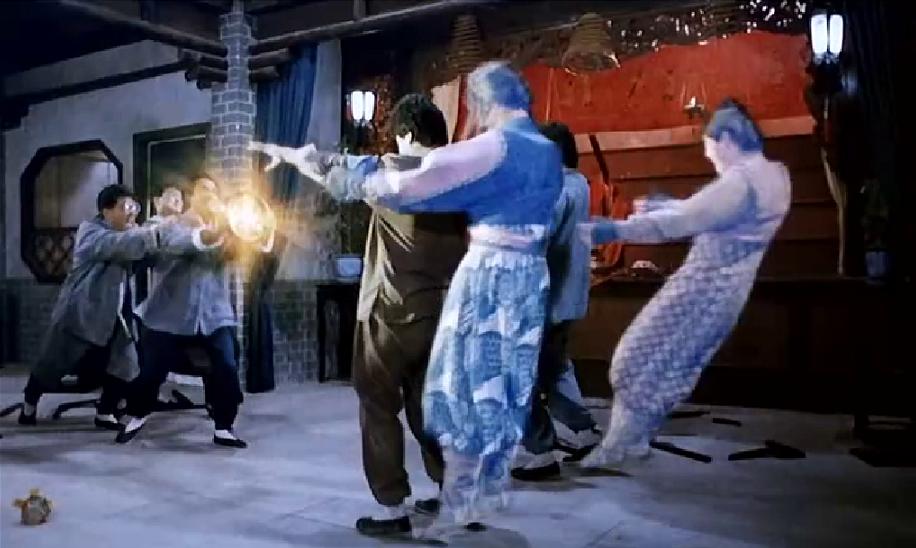
Uncle Ming (Richard Ng), a bogus priest, shows up at a reputedly haunted home and brings along a couple of his ghostly friends; the adult Ta Pao (Fong Liu) and little boy Hsi Pao, to help him make some extra money. His scam involves staging hauntings using his docile otherworldly friends and then accepting a fee for exorcising them (an idea later pinched for Peter Jackson's THE FRIGHTENERS). After discovering that his latest assignment really is haunted by an entire family of angry ghosts, he sucks his ghosts up into his wax umbrella and flees. Upon arriving in the town, the villagers are preparing to ward off some horse thieves headed to the area. As they begin fighting them off, they realize these aren't no ordinary horse thieves, but powerful, blood-drinking magicians who are impervious to steel weapons (unless you doctor up your weapon with your own blood) and travel around raping and plundering. After a long, elaborate fight scene, the villagers manage to capture two of them.


A wise and composed Taoist priest known only as Master (Ching-Ying Lam, returning from the first two films), his very dumb and obnoxious underling Captain Chiang (Billy Lau), the aforementioned con artist, his good ghost pals and a bunch of others at a nearby monastery then have their hands full dealing with the various monsters, ghosts and zombies that pop up along the way. The primary baddie this time out is a flying female demon / sorceress (Pauline Wang) who can become invisible, cures her minions by spitting up maggots and can create storms of cockroaches and bats by waving her cape. In one scene, she pops the head off a lizard and drinks its venom. She also possesses Ta Pao; making him see people dressed as priests are giant eagles (!) Two of her henchmen return as zombies and many people get possessed.


Many unusual ghost-busting techniques are employed here. Aside from the chicken blood, magic mirrors, hopping white rice and yellow spell papers used in many other Hong Kong horror flicks, plus the aforementioned wax umbrella, this has some clever ways to dispatch of or incapacitate ghosts. A medallion tempered during the "Five Elements Ceremony" can be placed on the bottom of a clay pot to suck ghosts inside and trap them there. To kill ghosts, they must be fried (yes, fried) in hot oil. During one sequence, a ghost gets half-cooked and emerges from the oil as a drippy white mess. Other tactics in the ghost fighting arsenal include spreading tar all over your body so ghosts can't see you and using a sword made of coins to hold demons at bay.


After the hokey, pseudo-family-friendly MR. VAMPIRE II (1986), this entry puts the series back on the right track again with its entertaining mixture of action, horror and laughs (though less successful at the latter than the original MR. VAMPIRE). It's well-made, well-edited, brisky-paced and very colorfully photographed. It's also packed with wild special effects, nicely-choreographed action scenes and impressive wire and stunt work. Yes, it can be a bit much at times (and the over-the-top idiocy of the Chiang character is more aggravating than humorous), but there's genuine imagination at work here, a little bit of unexpected heart and, since there's always something going on, you don't even have time to get bored.

★★★

Friday, October 7, 2011

Deadline (1980)

Directed by:
Mario Azzopardi


While not entirely successful, this is one of the more interesting non-Cronenberg Canuck horrors from the 1980s. Horror novelist and screenwriter Steven Lessey (Stephen Young) became rich and famous when his first novel "The Executioners" was turned into a controversial film. It was followed up by more of the same - successful book to film adaptations - including "Anatomy of a Horror," which features a scene where a demon sheep uses supernatural powers to dismember a man with a piece of farm machinery. All of Steven's movies seem to do well at the box office and he's built up a "name" in the industry. While speaking at a college, he has to defend both himself and his art to a group of pretentious students. He's called a "degenerate" and accused of propigating sickness because he sells sickness and being socially irresponsible. His films are brushed off as nothing more than "horseshit horror." Steven informs them that he tries to represent what he sees around him and uses genre conventions metaphorically. But regardless of the front he uses when it front of the firing squad, deep down inside, he's unhappy both at home and with his career.


Though he lives a lavish lifestyle in a beautiful mansion with a wife and three children, Steven is feeling the sting of having neglected his family in favor of his career over the years. His miserable wife Elizabeth (Sharon Masters) more or less hates his guts. She's unfaithful and has a serious cocaine habit. The children typically just get brushed off by both parents as they deal with work and play. They're so busy that while they're off hobnobing with film folk at a party, they forget all about hiring a babysitter to watch them. If that's not bad enough, Steven's work - both the quality and the quantity - is declining. Steven feels his films are getting shlocky and his slimy agent, film producer Burt Horowitz (Marvin Goldhar), is breathing down his neck, demanding a finished screenplay in two weeks on else he'll face a lawsuit. Can Steven deal with all of this, or will he crack under the pressure?


The film cleverly integrates scenes from Steven's completed films, with ideas he's contemplating using on his newest script and what's going on in his real life. As the film progresses and his sanity starts to slip, his ideas become more and more absurd and desperate. He toys with ideas of nuns killing a priest and passing his heart around at communion, suicidal fetuses that implode inside the womb and a Nazi enlisting the aid of a punk band (Carole Pope and Rough Trade) to infuse their music with sound frequencies that'll make those who listen to it literally shit themselves to death. Other macabre footage involves a woman trapped in a blood shower and two little kids tying their grandmother to a bed, covering her with gasoline and setting her on fire.


Deadline also calls into question the effects horror films may have on children. After viewing one of their dad's movies, his two sons decide to play a game with his daughter Sharon (The Brood's Cindy Hinds), which results in her accidentally being hung (and naturally speeds along the writer's decline). Though this may seem to suggest horror films have a detrimental effect on the mind's of young children, it should be pointed out that the tragedy is only allowed to occur because of the absense of both parents in the home. Thus, it could be seen as a cautionary message for parents to be more involved in what their children are doing and seeing.


Though the film contains some humor (Burt at one point suggests Steven relocate to Los Angeles because he claims they don't make good films in Canada!), it's overall pretty downbeat and leads up to a pretty dreary and depressing finale. None of the characters (aside from the children) are the least bit likable. The writer is incredibly self-absorbed, arrogant, neglectful of his children and physically absusive to his wife. The wife forsakes her children in favor of wallowing in her own self-pity and addictions. The film producer is a money-grubbing, prostitute-hiring sleazebag with a bully complex. The only other character with a significant amount of screen time is an actress (Jeannie Elias) and she's a demanding bitch with a diva complex who thinks she's above what she's doing.


Director Azzopardi was born in Malta, but relocated to Canada in the late 70s, where he's found steady work ever since, primarily in television (including directing over 20 episodes of the newer Outer Limits series). He also made the feature Bone Daddy (1998), which again centered around a tormeted writer; a pathologist and true crime novelist played by Rutger Hauer, who's terrorized by the subject of one of his books.


It was filmed in late 1979 and the copyright date in the end credits is 1980, though this doesn't appear to have been released in the U.S. until 1984 (Paragon Video handled the American VHS release). As of this writing, there's been no DVD release.

★★★
Related Posts Plugin for WordPress, Blogger...