.
.
.
Showing posts with label boarding house. Show all posts

Thursday, April 28, 2022

Museo del horror (1964)

... aka: Museum of Horror

Directed by:
Rafael Baledón

A young woman walking home alone late at night is stalked and then ambushed by a caped, behatted, skull-faced fiend. After she passes out, he carries her into a cemetery and opens the lid on an above ground sarcophagus. Inside is a secret passageway. He takes her down below, carries her through a hallway with mummy-filled caskets lining the walls and then into a room that's hidden behind one of those caskets. There, he lies her down on a table, pulls a boiling cauldron over and then dumps molten wax all over the screaming woman's face. This extremely atmospheric opening credits sequence proves that there are few greater combinations in the horror world than high contrast black-and-white photography, proper night lighting and a little bit of swirling fog. Gorgeous. This latest victim turns out to be the third of such disappearances in the area in the past few months. The police are baffled as there are no witnesses and no clues thus far. However, there is something of a pattern: Each disappearance has been of an attractive young lady in her early 20s and each girl disappeared at around the same time of the evening near the same location.


We next meet numerous characters staying at a boarding house run by the gossipy Doña Leonor (Emma Roldán). There's Luis (Joaquín Cordero), who was once a promising actor until a crippling injury put an end to that career. He now manages a theater and gives tours at a wax museum. Reading about the disappearances in the paper, Luis comments that the missing girls, being young and all, probably either ran off with a guy or split town to go on a little adventure. Not interested at all in the conversation is the grouchy and misogynistic Professor Abramov (Carlos López Moctezuma), who goes on an angry rant about how he despises the "chronic chatter of women" and how "God made a mistake putting tongues in women's mouths!" And then there's Raúl (Julio Alemán), a nice, upstanding young doctor (or so that's what everybody thinks), and Leonor's daughter, Marta (Patricia Conde), a nice young nurse. Raúl, who's known Marta since childhood, is interested in pursuing a relationship with her but she's not quite sold on him.


All three male boarding house residents are set up as the prime suspects. Luis is hoping to secure a grant with his new exhibit on the heroines of art and theater. He has painstakingly molded each of the lifelike wax figures and his museum only features female characters because, in his own words, he holds women in such high esteem. Or does her? Raúl is up to some sketchy things himself. In a Burke and Hare-influenced twist, he pays a pair of drunk lowlifes (José Dupeyrón and Vicente Lara) to rob graves and bring him fresh "specimens" to conduct his secret experiments on. He also has a collection of human heads he keeps in vats of liquid hidden in the hospital morgue. As for the professor, who is seldom seen without a scowl on his face, we've already established what he thinks about women, but he also has a thing for taxidermy and is developing "a new technique for embalming" on top of that.

After getting dropped off at a nightclub (where all of the principle characters happen to be in attendance) by her "papi," prostitute Sonia (Sonia Infante) becomes victim #4 during her late night stroll. Only in this instance, there's a witness: One of Raúl's patients. When he goes to the boarding house to tell the doctor what he's just seen, someone shoots him in the back with a poison dart. That finally brings the police, headed by David Reynoso as the Commissioner, to the home. It's discovered that the poison used to kill the witness was curare and the only person to have a bottle of it on hand is the good professor. Still, that's not enough to pin blame on him. Despite the murder, bosomy blonde nightclub chanteuse Norma Ramos (Olivia Michel), who's sick of the cheap hotel she's been staying in, decides to rent a room there.


In an interesting twist, Marta rejects a marriage proposal from straight-laced Raúl and instead finds herself falling for Luis. While he's older, crippled, less financially secure and more emotionally complicated, there's just something about him she's drawn to. Of course, this infuriates Raúl, who accuses Marta of mistaking pity for him and his disability with love. He also informs her that everything he's done in life thus far he's done to set up a good life for the two of them as a couple (awfully presumptuous, ain't he?) and he's not going to give her up without a fight. However, both Raúl and the professor seem to be fighting off their desires for the attractive singer who's just moved in.

A seldom-viewed film, this was an unexpected surprise. It boasts good performances and a competently-structured (though ultimately predictable) mystery with well-drawn characters courtesy of writer José María Fernández Unsáin, who pinches ideas from a number of other films, namely The Lodger, The Body Snatcher and House of Wax. However, where this really shines is in the atmosphere and visuals, with Raúl Martínez Solares' great cinematography aiding the mood immensely.


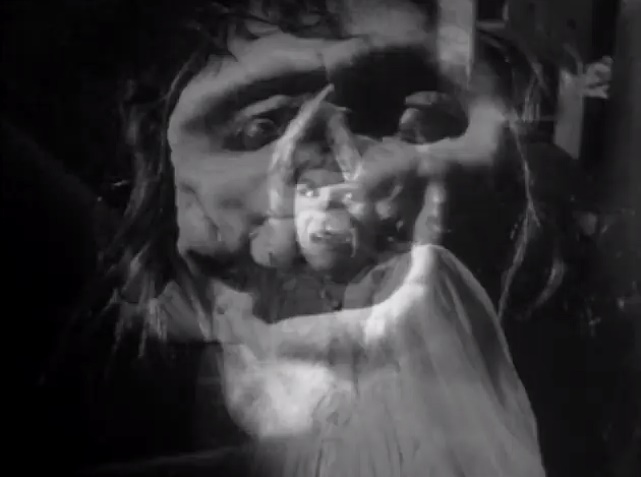


While obviously a low budget production, director Baledón also adds just the right amount of visual embellishments. One standout sequence features one of the proposed victims losing it after venturing out into the underground catacombs as a flurry of images of decaying corpses flash on the screen. There's also a very interesting bit where the grave robbers hit a patrolman over the head with a shovel and then bury him alive, which then segues into a nightmare scene of cobweb-covered zombies rising from their tombs. The shots used for the latter are extremely creepy and look like they come from another film (or films), which makes me wonder just what film exactly. One source claims stock footage from Bava's HERCULES IN THE HAUNTED WORLD (1961) was used.


To my knowledge, this has never been officially released in America. 5th Dimension Films, Creature Feature Videos and DVD Party are just three of the websites that carry this with English subtitles, though I don't believe any of these releases has been sanctioned.

★★★

Tuesday, January 13, 2015

Man in the Attic (1953)

... aka: Jack l'éventreur (Jack the Ripper)
... aka: L'étrange Mr. Slade (The Strange Mr. Slade)

Directed by:
Hugo Fregonese

Marie Belloc Lowndes' 1913 novel "The Lodger," which centered around the unsolved Jack the Ripper killings in 19th Century London (and hypothesized about the identity of the killer), was a very popular book in its day and went on to be adapted for radio, stage, TV and screen numerous times. To date, there have been five credited film adaptations. The first was The Lodger: A Story of the London Fog (1927), a silent version directed by none other than Alfred Hitchcock. It starred Ivor Novello in the title role and is still frequently-viewed and discussed all these years later, due in no small part to it being the first actual suspense film from the "Master of Suspense" himself. Hitchcock and Novello were both offered the chance to make a sound version five years later but only Novello was interested in the project. Maurice Elvey stepped into the director's chair and the resulting film was 1932's The Lodger (which became better known later by its U.S. title, The Phantom Fiend). Twentieth Century Fox produced a new and quite lavish version in 1944 that was directed by John Brahm, starred the wonderful Laird Cregar and was such a big critical and commercial hit it prompted a loose "remake" (Hangover Square) from the same team the following year. I guess someone took note that there were versions of the book made in the 20s, 30s and 40s, and then figured the 50s needed one as well.


While Attic wasn't made by someone with the filmmaking clout of Hitchcock (Fregonese had previously made some forgotten westerns and crime-dramas), it does have something the other versions do not: a major, internationally recognizable star in the lead role. Jack Palance was reaching a high point in his early career by 1953. The year prior he'd received an Oscar nomination for the excellent film noir / thriller Sudden Fear (1952), playing Joan Crawford's shady, unfaithful husband. He struck gold again playing a supporting role in the western Shane (1953) and received his second Academy Award nomination. One wonders then what the appeal of this medium-budget production would be. Considering the fact Palance's back-to-back Oscar nods were for supporting parts, it was probably something as simple as jumping at the chance to play a top-billed lead role.


As the film opens we're already in the midst of Jack the Ripper's reign of terror. The foggy night streets of London are being heavily patrolled by hundreds of constables and nearly everyone's been warned not to go out at night. Belligerent drunk Katy (Isabel Jewell) doesn't heed those warnings and becomes the newest victim. Later that same evening at a boarding house run by Helen Harley (Frances Bavier, aka Aunt Bea of "The Andy Griffith Show" fame) and her hubby William (Rhys Williams), a knock sounds at the door and a silken-voiced stranger stands on the other side. He announces himself as Mr. Slade and claims to be a pathologist looking to rent one of their rooms. Seeing how the Harley's have fallen on hard financial times and really need the money, Helen accepts the friendly, yet odd, stranger's offer of renting two rooms. Slade wants both the downstairs bedroom to sleep in and the upstairs attic space as a place for him to conduct his "experiments." He warns of having "irregular habits," like sometimes needing to be out until very late at night, and seems to have a strange distaste for actresses.


Helen and William's attractive niece Lily (Constance Smith) is also staying in the boarding house while she tries to make it big as an (uh oh!) actress. She's part of a bawdy Moulin Rouge-inspired cabaret number that includes (corny) singing with a fake French accent, dancing, skimpy costumes, gratuitous underwear exposure and getting into a bubble bath on stage. When she meets the shy, lonely Slade she finds him unlike the other men constantly drooling over her and thus intriguing enough to get to know a little better. Through their talks she discovers that his mother was a callous harlot who drove his father to suicide with her infidelities and becomes empathetic enough toward the awkward boarder that she doesn't want to believe anything bad about him even when all available evidence points to the contrary. Her aunt isn't quite as convinced and begins snooping through Slade's room and personal belongings. A detective (bland Byron Palmer) investigating the crimes becomes romantically interested in Lily himself and begins frequenting the residence.


Man in the Attic is, in a word, adequate. The direction, photography, sets, costumes, production values and the majority of the acting is fine. However, I can't really give this too high of a rating because the same exact film had already been done, and done better, eight years earlier. Instead of exploring the book further or putting a new spin on the theme, this instead opts to lazily recycle the screenplay from the 1944 film. In fact it's so close to that version that the previous film's screenwriter, Barré Lyndon, was also credited for co-writing this one. I'm not even sure what exactly the other credited writer, Robert Presnell Jr., did since there are next to no real changes in the plot or the dialogue. The best thing going on here is Palance himself. He gives an effectively subdued performance and just looks really cool (and creepy) photographed in black-and-white because of how his large cheekbones, protruding forehead and sunken in cheeks manage to capture all of the shadows. He never looked quite as interesting or enticing photographed in color.


Distributed theatrically by Twentieth Century Fox, this has since fallen into the public domain so it's extremely easy to find these days. There are too many DVD releases to even mention and every film archive site seems to have it. Also in small roles are Lilian Bond as one of the victims and Lester Matthews as a police chief.

★★1/2
Related Posts Plugin for WordPress, Blogger...